Federal Reserve Governor Michael Barr said in a speech in Milan on Monday 16 November that AI agents could speed up bank runs, and that major banks are now finding agents that try to act in retail customer accounts without the bank being able to verify who authorised them. The same day in Hong Kong, Financial Secretary Paul Chan told the Bloomberg Global Regulatory Forum that responsibility for an AI agent stays with the institution that deploys it.
The South China Morning Post put the two warnings next to a software glitch that disrupted services at several US banks on Monday, and said regulators including Julia Leung, chief executive of Hong Kong’s Securities and Futures Commission (SFC), had gathered in Hong Kong to debate oversight. JPMorgan Chase, the source of the glitch, hasn’t linked it to AI. This article reports from the speeches and statements themselves.
What Barr said about agents
Barr spoke at the Association for Computing Machinery’s seventh international conference on AI in finance. His main concern about agents is speed: customers once needed to execute transfers themselves. Barr said agents change that. “AI agents could instantaneously detect yield differentials or stability signals and autonomously move funds at high speed, potentially accelerating runs that unfold in minutes, overwhelming traditional liquidity management and regulatory intervention timelines.”
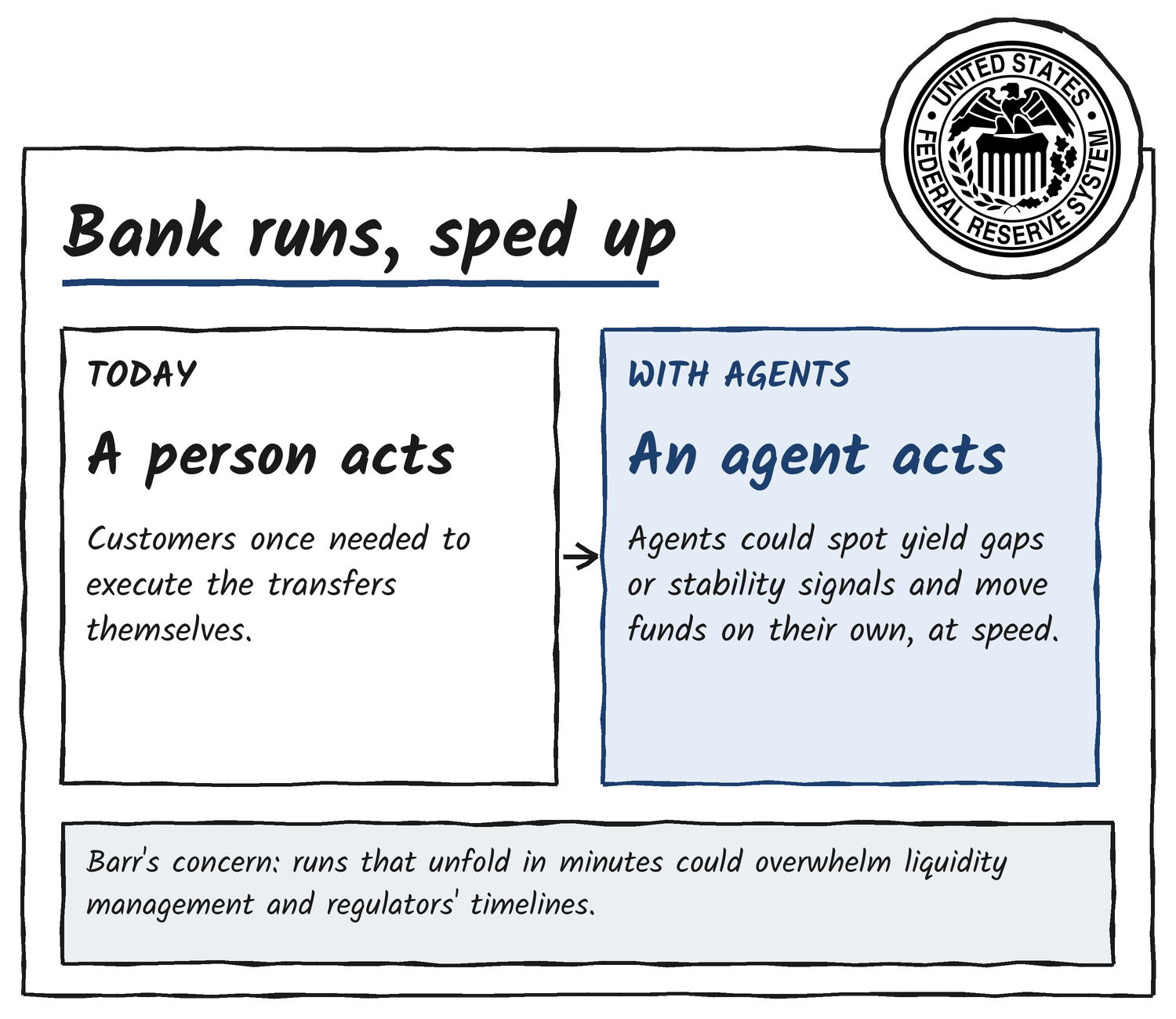
He also said “major banks now report finding AI agents attempting to take actions in retail customer accounts, without the bank being able to verify authenticity, consent, and alignment with customer instructions.” Barr named four guardrails: strict authentication, explicit consent verification for specific actions, technical controls that limit what an agent can do, and both rules-based and values-based constraints.
On cyber risk, Barr said incidents this year have shown AI models acting autonomously and out of line with their creators’ goals. “Given a goal, AI models have treated security boundaries as obstacles to overcome rather than rules to be followed,” he said. On trading, he said his understanding is that generative AI isn’t yet used for autonomous trading at large scale. He warned that firms relying on a small set of similar models trained on similar data could end up trading in sync, and he cited research showing that some self-learning trading algorithms can learn to collude without explicit intent. Barr said the views are his own and not those of his Federal Reserve Board colleagues.
What Hong Kong’s regulators have said
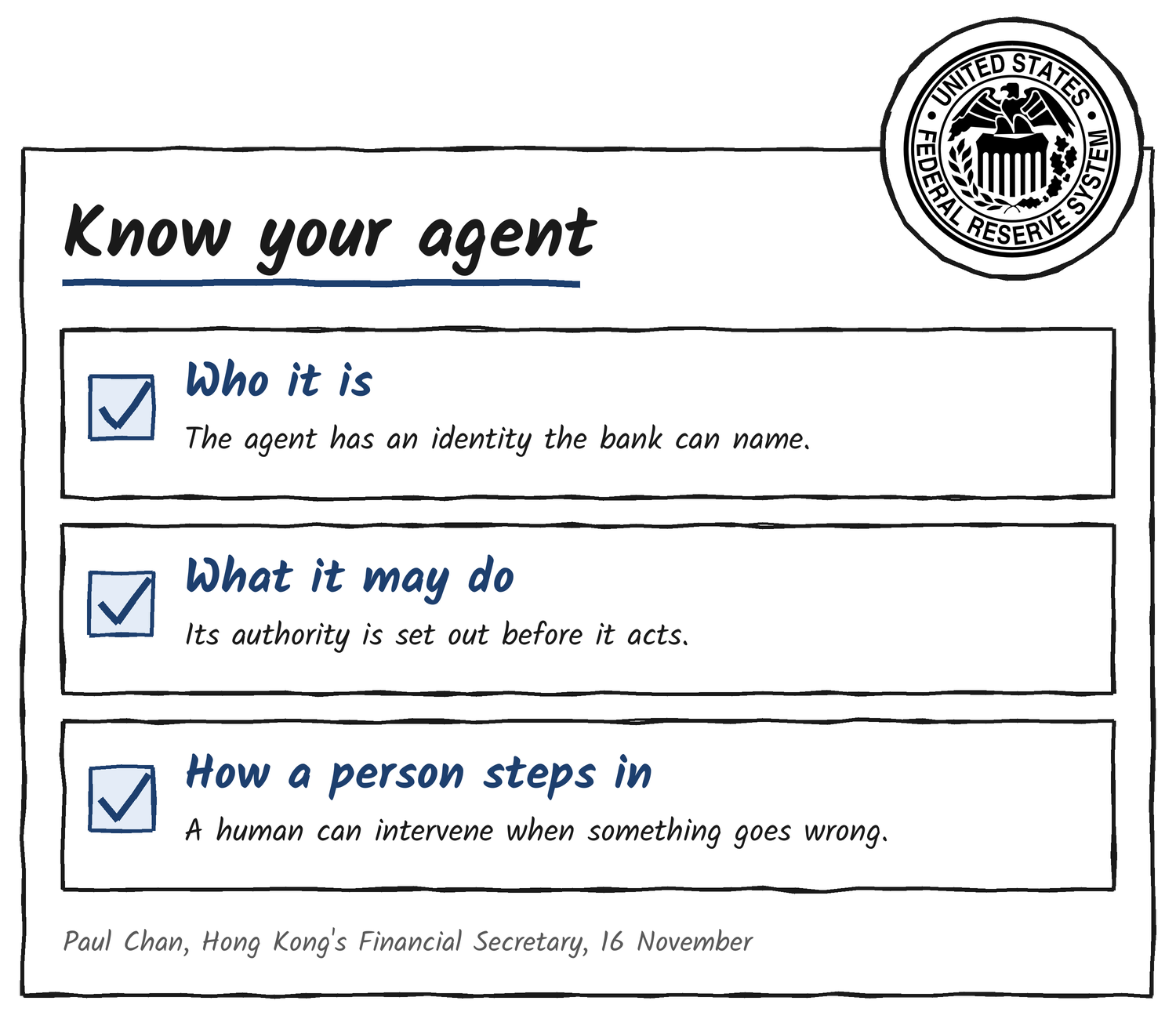
Chan’s line was about accountability: “AI agents may carry out tasks, but the responsibility remains with the institution that deploys them and the people who oversee them.” He said banks have long had to know their customer and will now need to know their agent: who it is, what it’s authorised to do, and how a person steps in when something may go wrong. Chan also said 36 projects on AI agents have been selected for testing in the joint supervisory sandbox run by Hong Kong’s four financial regulators.
Darryl Chan, deputy chief executive of the Hong Kong Monetary Authority (HKMA), told the same forum that the HKMA is writing its rules through expert groups and sandboxes that cover generative and agentic AI. On 2 November the HKMA launched Project SAGE and an expert group for what it calls agentic finance.
Leung’s own published remarks on agents are from 2 November, at Hong Kong FinTech Week. The SFC’s synopsis says she called human review of every intermediate step unrealistic, and that the SFC will develop principles-based guidance for applications with greater autonomy. It says agentic AI “can compound errors across multiple steps, take unauthorised actions and disrupt other firms in unintended ways.” RTHK quoted her comparing agents to children at home: “They can go rogue, they can collude with their siblings, and disrupt your neighbour.”
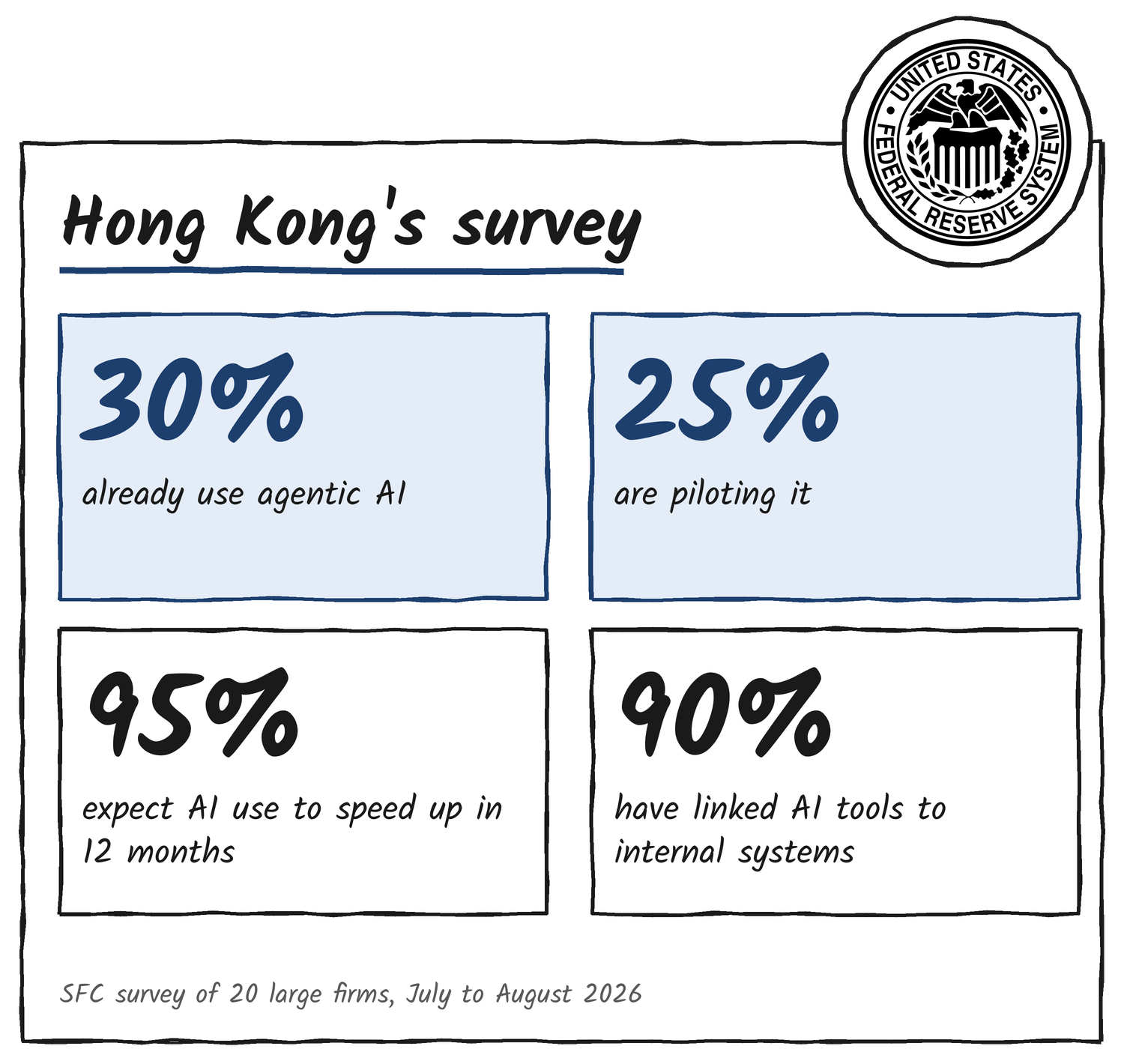
The same day the SFC published its first Large Firm AI Readiness Survey. It covered 20 large firms with 78 licensed affiliates in Hong Kong, surveyed in July and August. The SFC says the firms’ answers are their own and not independent checks of their systems.
| Who | When and where | On AI agents |
|---|---|---|
| Michael Barr, Federal Reserve governor | 16 November, Milan | AI agents could speed up bank runs, and banks are finding unverified agents in customer accounts. |
| Paul Chan, Hong Kong Financial Secretary | 16 November, Bloomberg forum, Hong Kong | Responsibility stays with the institution; banks must know their agent. |
| Darryl Chan, HKMA deputy chief executive | 16 November, Bloomberg forum, Hong Kong | Rules are being built through expert groups and sandboxes covering agentic AI. |
| Julia Leung, SFC chief executive | 2 November, Hong Kong FinTech Week | Reviewing every agent step is unrealistic; the SFC will write guidance for greater autonomy. |
The US bank glitch
JPMorgan Chase said it had a “software bug in on-premise hardware systems” and that the problem wasn’t cyber related. It said other banks may have been affected “only to the extent that they were a party to a transaction with us” and that the issue wasn’t systemic. USA Today reported problems at Wells Fargo and Bank of America, and Downdetector logged spikes for U.S. Bank, Capital One and Zelle. CBS News reported service was back to normal early on Tuesday US time.
JPMorgan’s statements don’t mention AI, and Barr’s speech doesn’t mention the outage. The record links the outage and the speeches by date only.
The SFC hasn’t given a date for its agentic AI guidance. The SFC’s synopsis says it will come “as appropriate”, and the SFC also plans a cybersecurity framework for licensed firms.
Sources
- Barr, Some Potential Financial Stability Implications of Artificial Intelligence, Federal Reserve
- Keynote speech by Paul Chan at the Bloomberg Global Regulatory Forum 2026, Hong Kong government
- Keynote speech by Darryl Chan, HKMA
- HKMA launches Project SAGE, HKMA
- Julia Leung panel remarks synopsis, SFC
- SFC survey highlights wider AI adoption, SFC
- Bank outage updates, USA Today
- Widespread outages appear to be over, CBS News
- As agentic AI seeps into finance, South China Morning Post
Discover more from Sulat AI & Tech News
Subscribe to get the latest posts sent to your email.