
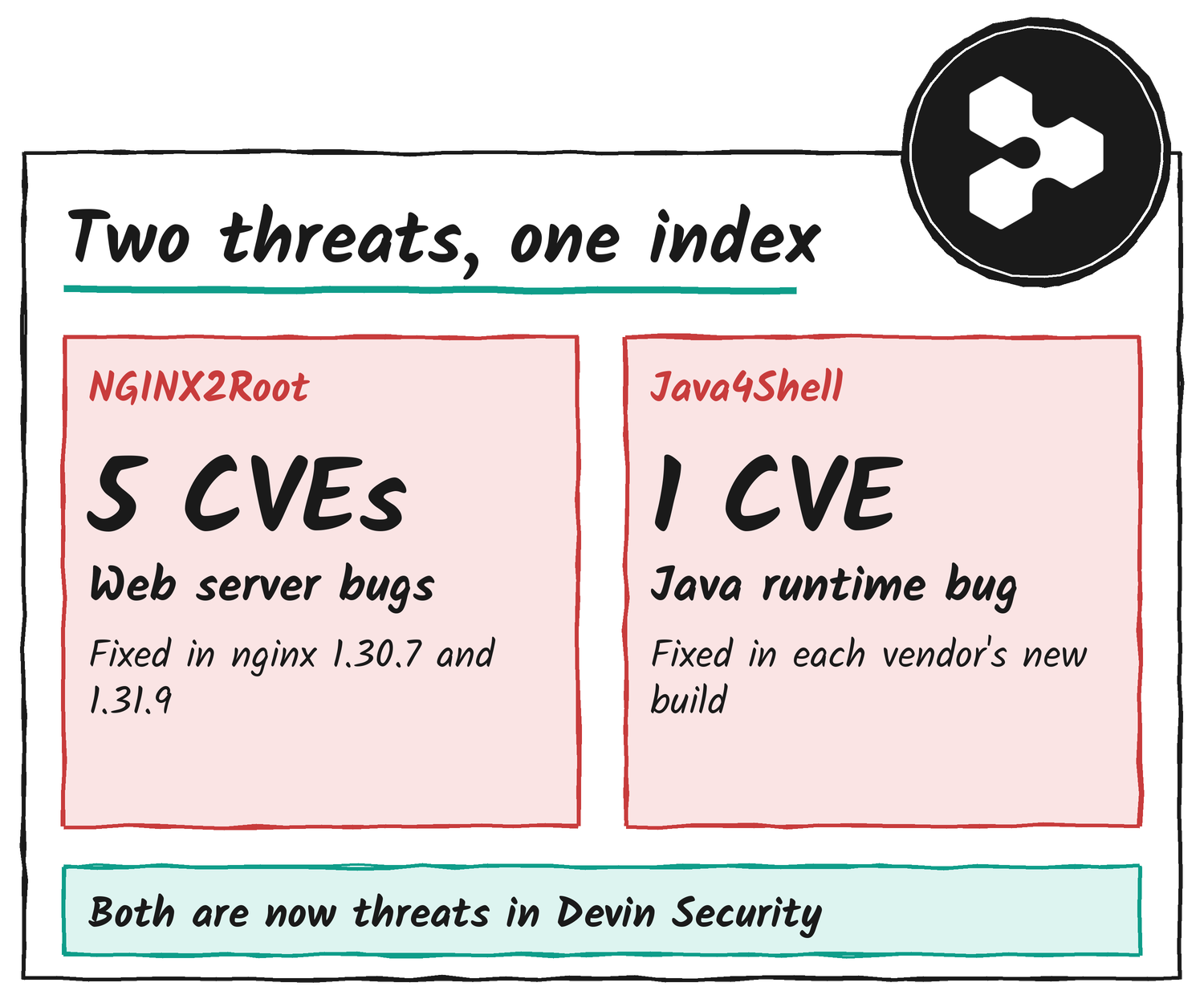
Cognition has added NGINX2Root and Java4Shell to Devin Security Threats, a managed index of newly disclosed vulnerabilities that Devin can scan your repositories for and then fix. The blog post is dated 18 November, and Cognition’s X post says: “There’s been a growing volume of threats such as Java4Shell and NGINX2Root, just this week.”
Both disclosures are serious and both have fixes. NGINX2Root is five memory-corruption bugs in nginx, fixed in 1.30.7 and 1.31.9. Java4Shell is one memory-corruption bug in the Java runtime’s Base64 decoder, fixed in each vendor’s November builds. The Linux kernel bug that turns nginx code execution into root on the host has no patch yet.
What Devin Security Threats does
Cognition defines a threat as “a description of something that could go wrong in your systems: what is affected, how an attacker would use it, and what fixes it.” Cognition publishes threats for major disclosures, and your team can add its own, for example from a bug bounty report, a vendor notice or an incident review. Both new threats are live at app.devin.ai/security.
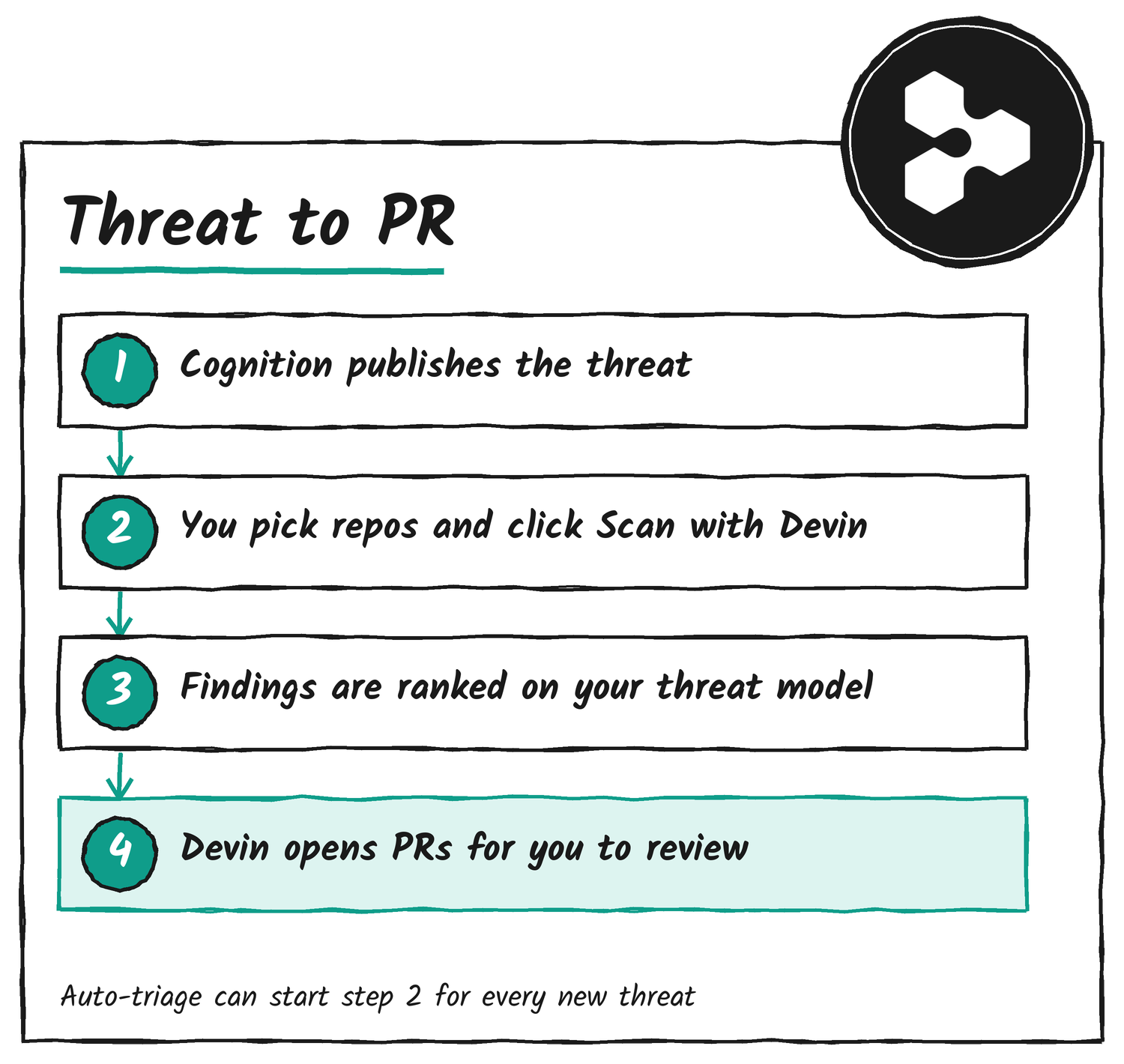
The Scan with Devin button opens a new scan with the threat already selected under Focus on threats. You choose the repositories, and Devin scans them with the same Agentic MapReduce process as any Devin Security scan. Findings are ranked against your threat model, and you can assign them to Devin, which opens pull requests for your team to review.
Auto-triage skips the clicking. You pick repositories and a minimum severity, and Devin scans them for each new threat as Cognition publishes it. A threat whose scan finds nothing can be dismissed automatically.
Two skills if you’d rather run a session
Cognition’s open-source Vulnerability Fixes plugin now has a skill for each disclosure: fix-nginx-vuln for the five nginx bugs and fix-java-vuln for Java4Shell. Install it from the Devin Marketplace or the Devin CLI:
devin plugins install CognitionAI/devin-marketplace#plugins/devin-vuln-fixesThe skills are plain Markdown, so you can also read them as a checklist or hand them to another coding agent. Both follow the same order. Devin inventories every connected repository without changing anything, shows you a table and stops. After you approve repositories, it starts one child session for each, with at most five running at once. Each child picks the smallest fixed target, runs the tests before and after, and opens one pull request with a risk label and a rollout plan.
The skills set hard limits. Neither edits before you approve a repository, guesses image tags or digests, or sends input meant to trigger the bug. The nginx skill adds that Devin won’t turn off HTTP/2 or HTTP/3 without approval and won’t present an nginx upgrade as a fix for the kernel bug. The Java skill treats a service as vulnerable when it can’t tell the CPU, and it counts outbound-only workloads such as build agents and batch jobs, because a Java program that opens a TLS connection to a malicious server can be compromised.
NGINX2Root: five bugs, five triggers
Xint found CVE-2026-123007 while preparing for ZeroDay Cloud 2026, reported it to F5 through HackerOne on 16 October, and says a fully automated scan found the other four a few days later. Each bug lets an unauthenticated attacker run code as the nginx worker, and each needs a different configuration. The table uses the trigger column from Cognition’s fix skill and the affected ranges from nginx.org.
| CVE | Bug and trigger | Affected |
|---|---|---|
| CVE-2026-123007 | HTTP/2 flow-control out-of-bounds write; HTTP/2 on | 1.9.5 to 1.31.8 |
| CVE-2026-123633 | HTTP/2 use-after-free; HTTP/2 plus proxying to a backend | 1.19.7 to 1.31.8 |
| CVE-2026-121810 | HTTP/3 use-after-free; HTTP/3 plus proxying to a backend | 1.25.0 to 1.31.8 |
| CVE-2026-123634 | Resolver use-after-free; resolver, a variable proxy_pass and a mirror or SSI subrequest | 0.6.18 to 1.31.8 |
| CVE-2026-113425 | Mail proxy use-after-free; proxy on with auth_http | 0.5.33 to 1.31.8 |
F5’s advisory scores CVE-2026-123007 at 8.1 on CVSS 3.1 and 9.2 on CVSS 4.0. It has sat in nginx’s HTTP/2 code since 1.9.5. Rapid7 reported it to F5 independently and published a proof of concept that gets unauthenticated code execution against nginx 1.31.8 in a Docker lab, with HTTP/2 over TLS on. The attack needs a very large volume of traffic on one connection, so a CDN or proxy that terminates HTTP/2 in front of nginx can blunt it.
Xint chained a bug in the Linux kernel’s SCTP code with these to take root on the host, including from inside a Docker container. The kernel bug is a use-after-free that has been in Linux since 4.15 in 2018. As of 19 November it has no CVE and no patch, according to SOCRadar. I covered the nginx side in more detail in nginx2root: five critical nginx flaws let attackers run code.
Java4Shell: one Base64 bug under many products
CVE-2026-114938 sits in the HotSpot JVM’s x86-64 Base64 intrinsic, the hand-written fast path that uses AVX-512 VBMI instructions. Calif, which found it, says the routine miscalculates the store mask for a padded tail, so malformed input writes 64 bytes where the output array holds fewer and overwrites neighbouring heap memory. Oracle scores it 8.1 on CVSS 3.1 and Calif scores it 9.2 on CVSS 4.0.
It affects OpenJDK 17.0.6 and later, plus 21, 25 and 27, from every vendor that builds from that code, and Oracle’s Java 8 Enterprise Performance Pack. Standard Java 8 and 11 don’t contain it, and ARM64 CPUs don’t run the vulnerable code. On the x86-64 side, Intel Xeon from Ice Lake and AMD Zen 4 or newer qualify.
Calif says Quang Luong found the bug in about an hour and had a first working exploit two hours later, for under $200 in AI token costs, and that Codex surfaced the finding after roughly 20 minutes of prompting. Calif demonstrated unauthenticated code execution against Keycloak, Atlassian Jira and Confluence, JFrog Artifactory, Jenkins and PingFederate, and authenticated execution against Kafka, Solr, Elasticsearch, Gerrit and Spinnaker. There’s no universal exploit, because each application needs its own chain, and Calif is holding back the product-specific exploits. I covered the first 24 hours in CISA tells organisations to patch Java4Shell now.
Where the fixes stand
| Software | Fixed in | Status |
|---|---|---|
| nginx Open Source | 1.30.7 stable, 1.31.9 mainline | Released 18 November |
| NGINX Plus | 37.0.8.1, 37.3.0.1 | R34 to R36 have no fix; move to 37.x |
| Oracle Java SE | 17.0.21.1, 21.0.13.1, 25.0.5.1, 27.0.1.1, 8u513-perf | Released 17 November |
| Amazon Corretto | 17.0.21.1.2, 21.0.13.1.2, 25.0.5.1.2, 27.0.1.1.4 | Released |
| Eclipse Temurin | 17.0.21.1+2, 21.0.13.1+2, 25.0.5.1+2, 27.0.1.1+4 | Adoptium is publishing binaries as testing finishes; Docker said on 19 November its Temurin images weren’t out yet |
| Red Hat OpenJDK | None | No fix as of 18 November, per The Hacker News |
| Distro nginx packages | Backported, version unchanged | Ubuntu, Amazon Linux, Alpine and AlmaLinux had packages on 19 November; Debian, RHEL and SUSE didn’t, per PatchMon |
Java’s non-LTS lines, 18 to 20, 22 to 24 and 26, carry the same code and have no fix. Amazon lists Corretto 22, 23, 24 and 26 as no fix planned.
Is anyone exploiting them?
For nginx, no attacks have been reported as of 19 November, and none of the five CVEs is in CISA’s Known Exploited Vulnerabilities catalogue. A lab proof of concept for CVE-2026-123007 is public, and PatchMon warns that fake exploit repositories carrying malware have already appeared on GitHub.
For Java4Shell, GreyNoise reported exploitation attempts as of 18 November but hadn’t confirmed a successful one against its sensors, and VulnCheck says a working exploit is available to its customers. It isn’t in the catalogue either. CISA’s alert on 17 November urged organisations to patch immediately.
What to do today
- Find every nginx and every JVM you run, including the ones inside products. Keycloak, Jira, Confluence, Artifactory, Jenkins, PingFederate, Kafka, Solr and Elasticsearch each bundle a runtime.
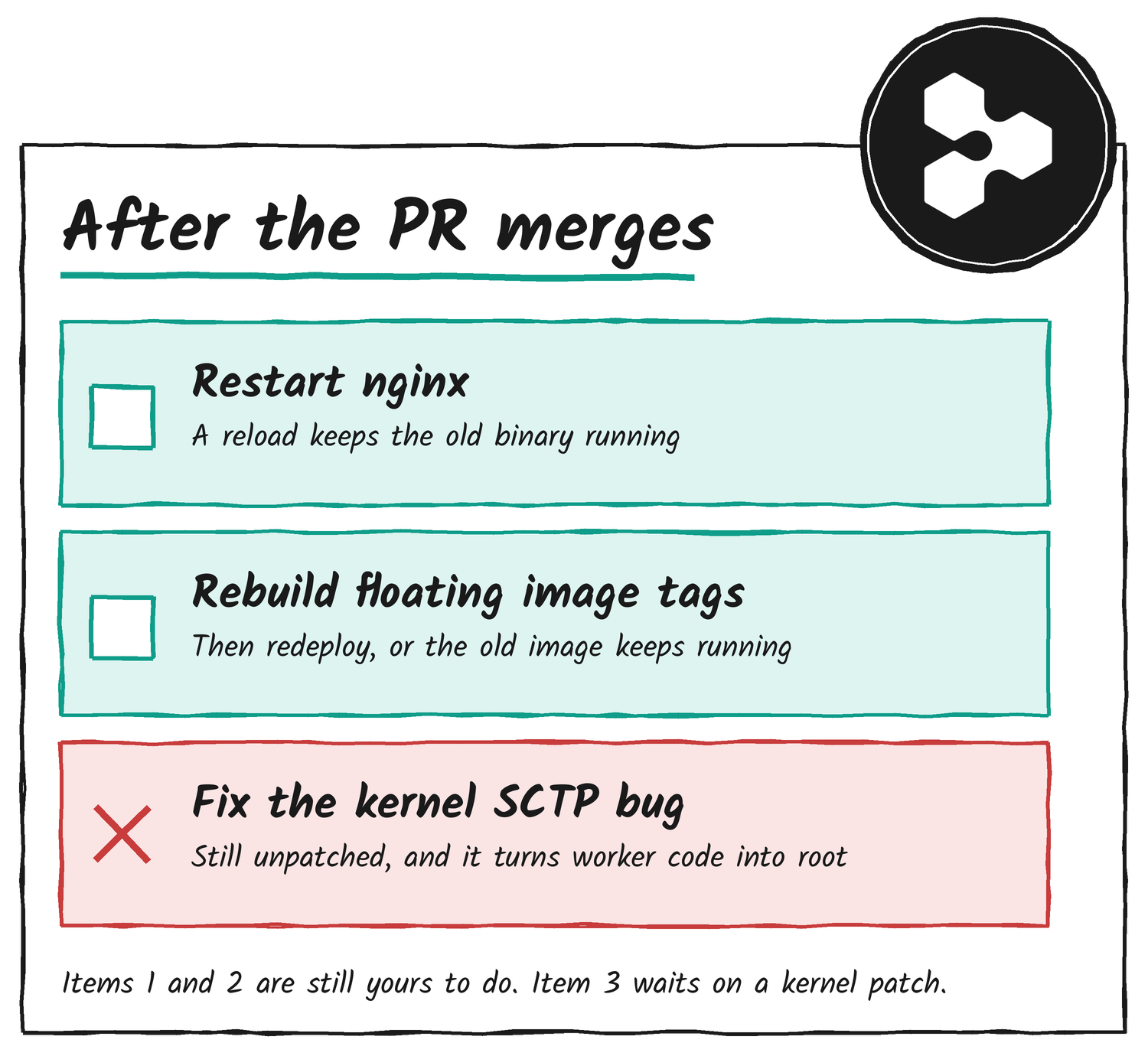
- Update nginx to 1.30.7 or 1.31.9, then restart it. A reload keeps the old binary running. For distro packages, compare the full package version with your distribution’s advisory, because
nginx -vwon’t change. - Update Java to your vendor’s fixed build and confirm it with
java -versionagainst that vendor’s advisory. Don’t compare one vendor’s version string with another’s. - If you can’t patch yet, turn off HTTP/2 for the first two nginx bugs, remove QUIC listeners for CVE-2026-121810, and start Java with
-XX:-UseBASE64Intrinsics. The other option,-XX:UseAVX=2, fails to start on ARM JVMs unless-XX:+IgnoreUnrecognizedVMOptionsis also set, so use it on x86-64 hosts only. - Rebuild floating image tags such as
eclipse-temurin:21and redeploy them. A merged pull request doesn’t replace what’s already running. - On hosts that don’t use SCTP, add
install sctp /bin/falseto a file under/etc/modprobe.d/. That doesn’t unload a module that’s already loaded, and it does nothing where SCTP is built into the kernel.
Disclosure: I’m an OpenAI, Firecrawl and Devin ambassador.
Discover more from Sulat AI & Tech News
Subscribe to get the latest posts sent to your email.