CISA has told organisations to patch CVE-2026-114938 immediately. The flaw, an Oracle Java bug nicknamed Java4Shell, sits in the Base64 decoder of the x86-64 HotSpot Java virtual machine. CISA’s alert, published on 17 November, says specially crafted Base64 input can crash the JVM or give an attacker unauthenticated remote code execution, and it calls the flaw critical.
Oracle released fixed builds on 17 November US time (10am on 18 November in New Zealand) in its November Critical Security Patch Update, and Calif, the firm that found the flaw, put out its technical write-up at the same moment. NCSC NZ followed with its own alert at midnight NZ time. CISA also pointed to its alert on X.
🚨We urge orgs to immediately patch the recently disclosed Oracle Java vuln CVE-2026-114938. This critical memory-corruption vulnerability, known as “Java4Shell,” affects the Base64 decoder of the x86-64 HotSpot JVM, part of the Java Development Kit. 🔗 https://t.co/SwrhdPFlZF
— CISA Cyber (@CISACyber) November 17, 2026
Java4Shell isn’t on CISA’s Known Exploited Vulnerabilities list, and the alert doesn’t claim anyone is using it. Calif has already shown it working against a string of popular products, and the method is public.
What the bug does
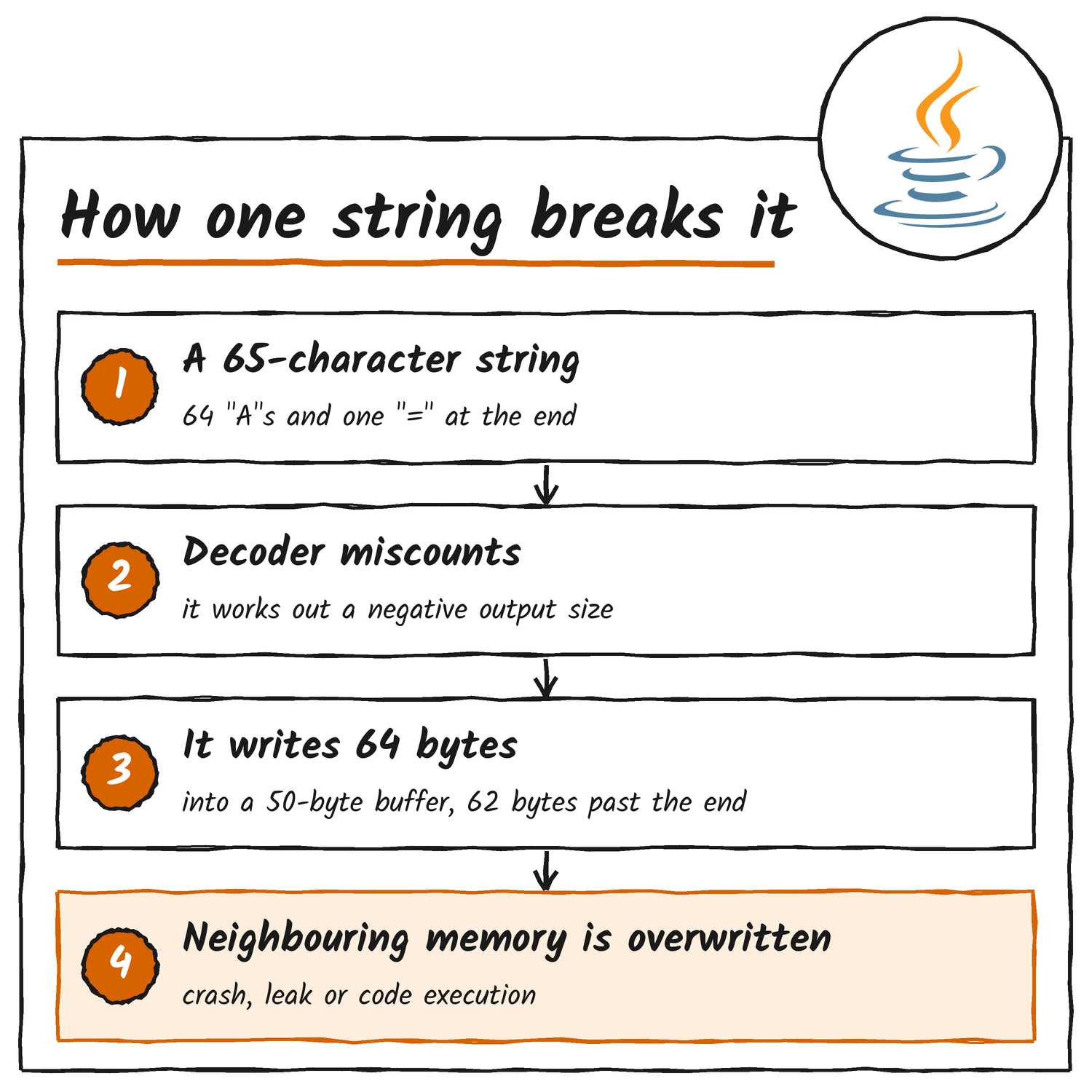
Java uses Base64, a way of writing binary data as text, for login headers, tokens and file uploads. To speed up decoding, HotSpot uses hand-written code on chips with AVX-512 VBMI, a set of vector instructions. That code goes wrong at the end of a string, Calif says: when the input finishes with “=” padding, it works out a negative output length. Feed it 64 “A”s and a single “=” and the output array is 50 bytes, yet the decoder writes 64 starting near the end, which leaves 62 bytes past the array. Java throws the input out afterwards, by which point neighbouring objects are already overwritten. Older OpenJDK 17 builds need 128 “A”s.
Calif says Quang Luong, one of its researchers, found the flaw in about an hour using an AI coding agent. A first working exploit followed two hours later, and the total AI bill was under US$200. Most of the later exploit chains, the firm says, were built almost autonomously by AI agents.
Who is affected
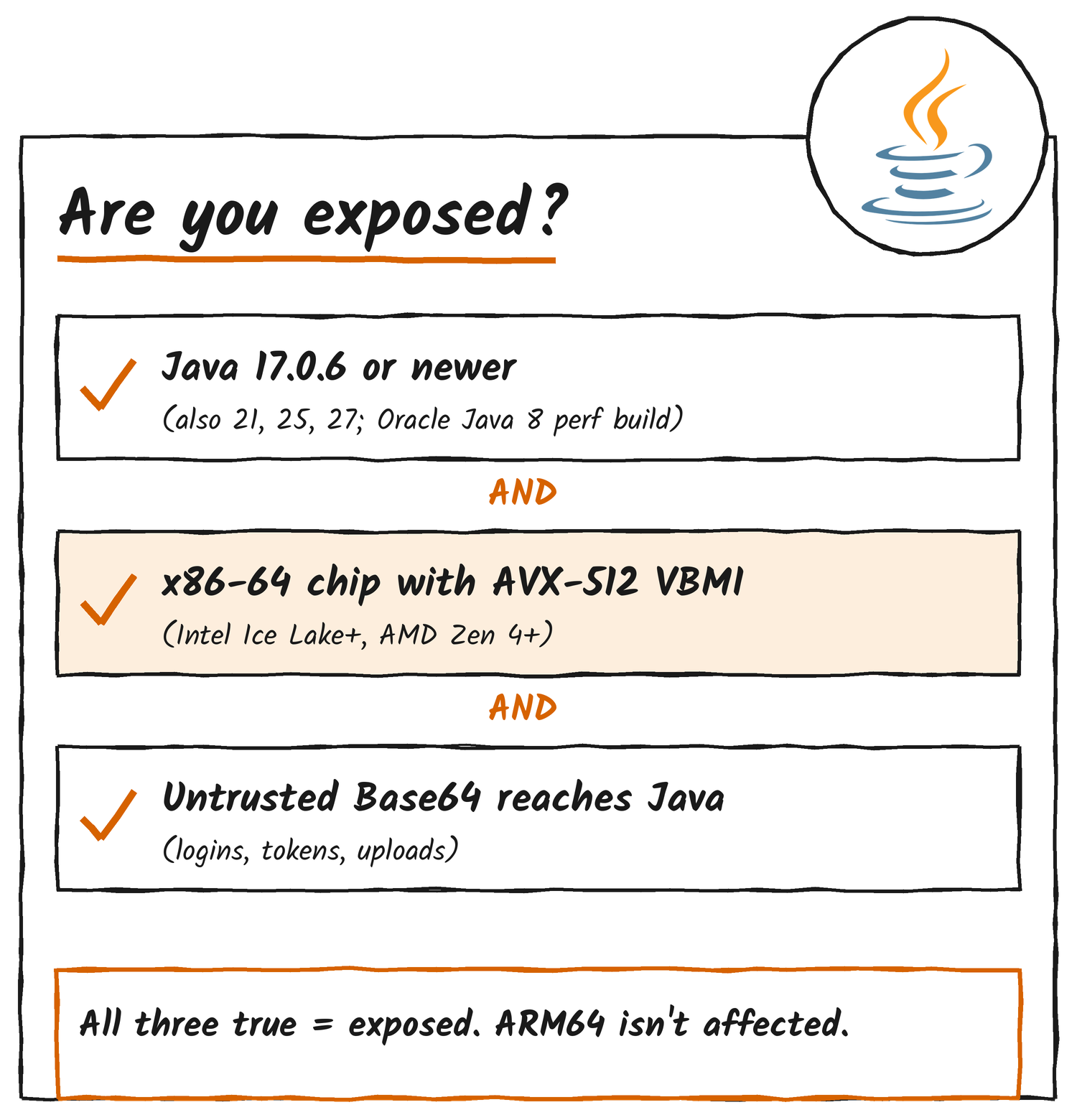
Every OpenJDK build from 17.0.6 onward has the bug, Calif says, so Oracle Java SE, Oracle GraalVM for JDK, Amazon Corretto, Eclipse Temurin, the Microsoft Build of OpenJDK, Azul Zulu, BellSoft Liberica, SAP SapMachine and Red Hat’s OpenJDK are all in scope. OpenJDK’s advisory marks Java 17, 21, 25 and 27. Oracle’s list adds its Java 8 Enterprise Performance Pack build 8u511b33-perf and two GraalVM lines, with 17.0.21.0.3, 21.0.13.0.3, 25.0.5.0.3 and 27.0.1.0.3 as the affected Java SE builds.
Only x86-64 chips with AVX-512 VBMI run the vulnerable code: Intel Xeon from Ice Lake, Sapphire Rapids, Emerald Rapids and Granite Rapids, and AMD EPYC and Ryzen from Zen 4. ARM64 isn’t affected. Upwind notes that one container image can therefore be exposed on one node and safe on the next. Attacker data has to reach the decoder too. Logins and file uploads can feed it, Calif says, and a Java program that connects over TLS to a malicious server can be compromised, using an exploit supplied by the researcher samczsun.
Java 8 and 11 need a closer look. OpenJDK’s risk matrix lists only 17, 21, 25 and 27 for this CVE, but NCSC NZ’s alert names 11.0.33 and 8u512 as affected. Those are the version numbers for the whole advisory, which fixes nine other Java CVEs. Five of those are marked for Java 8 and 11, so both need the November update anyway. Thai Duong of Calif, the firm that found the bug, told us OpenJDK is the authoritative source. Duong pointed to Oracle’s own list of vulnerable Oracle Java SE versions: 8u511b33-perf, 17.0.21.0.3, 21.0.13.0.3, 25.0.5.0.3 and 27.0.1.0.3. Duong isn’t sure whether Oracle Java SE is identical to OpenJDK and put it plainly: “the Java world is a bit confusing.”
How severe it is
The CVE-2026-114938 record shows Oracle scoring the flaw 8.1 under CVSS 3.1, with high attack complexity. Calif scores it 9.2 under CVSS 4.0, which is the critical band. The Hacker News reports Red Hat’s preliminary score as 9.8 and Amazon’s as 8.8. Different scoring versions and different assessors explain the spread, and CISA’s alert calls the flaw critical.
Is it being exploited?
On 18 November The Hacker News checked CISA’s catalog and Java4Shell wasn’t listed. Tenable found no reports of exploitation as of 17 November. Canada’s Cyber Centre says it knows of none either, and adds that this can change quickly.
Calif demonstrated code execution before login in the default configurations of Keycloak, Atlassian Jira, Atlassian Confluence, JFrog Artifactory, Jenkins and PingFederate. It demonstrated execution after login in Apache Kafka, Apache Solr, Elasticsearch, Gerrit and Spinnaker, and in sample Apache Struts and Spring Boot applications. Calif says the lists aren’t exhaustive and that no universal exploit exists, because each application needs its own chain. It has published only a reproducer that triggers the memory overwrite, and Duong said the product-specific exploit chains will probably follow in one to two weeks. The pre-patch leak doesn’t change that plan, because Calif wants to give everyone enough time to upgrade. Duong also said Calif hasn’t seen any exploitation in the wild.
Details of the bug were out before the patch. HeroDevs reports that Calif wrote on X before Oracle’s release that the vulnerability had leaked. Kevin Breen of Immersive wrote on X on 17 November that he has a working exploit for specific applications, according to Tenable, and that Tomcat’s Basic authentication and the java-jwt library give a way in before login.
Deadlines
CISA’s alert sets no deadline. Federal due dates come with KEV listings under Binding Operational Directive 26-04, which binds US civilian agencies, and Java4Shell isn’t listed, so none applies. CISA still tells every organisation to patch immediately and to start with internet-facing systems.
Fixes and workarounds
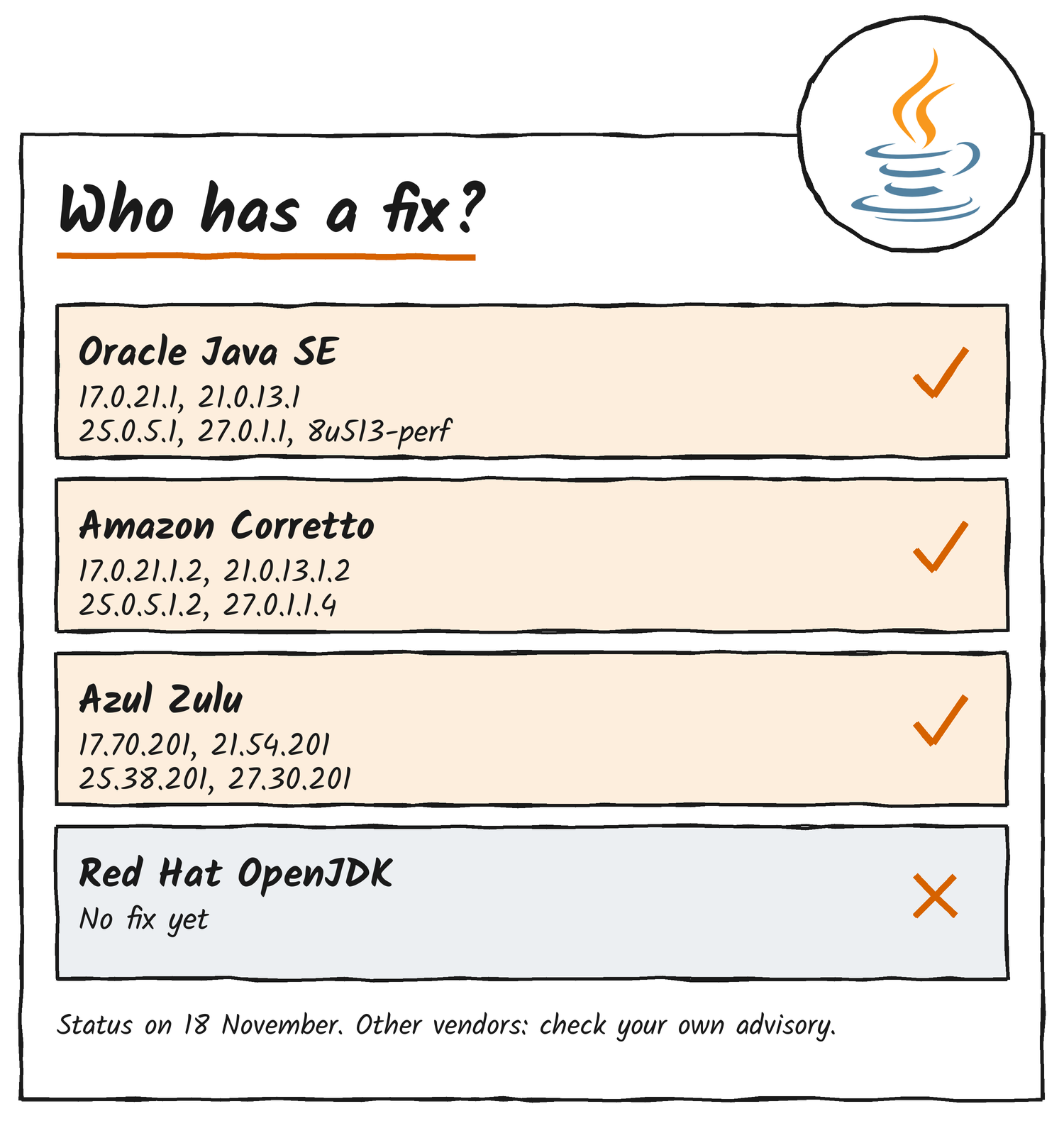
Oracle’s fixed builds are 17.0.21.1, 21.0.13.1, 25.0.5.1 and 27.0.1.1, plus 8u513-perf for the Java 8 Enterprise Performance Pack. The Hacker News reports that Amazon has fixed Corretto in 17.0.21.1.2, 21.0.13.1.2, 25.0.5.1.2 and 27.0.1.1.4, and Azul has fixed Zulu in its November update. Red Hat hadn’t released fixes for Red Hat Enterprise Linux or its OpenJDK builds. SAP released SapMachine builds this week, but their release pages don’t say what they fix, and Eclipse Temurin, the Microsoft Build of OpenJDK and BellSoft Liberica hadn’t listed fixed builds.
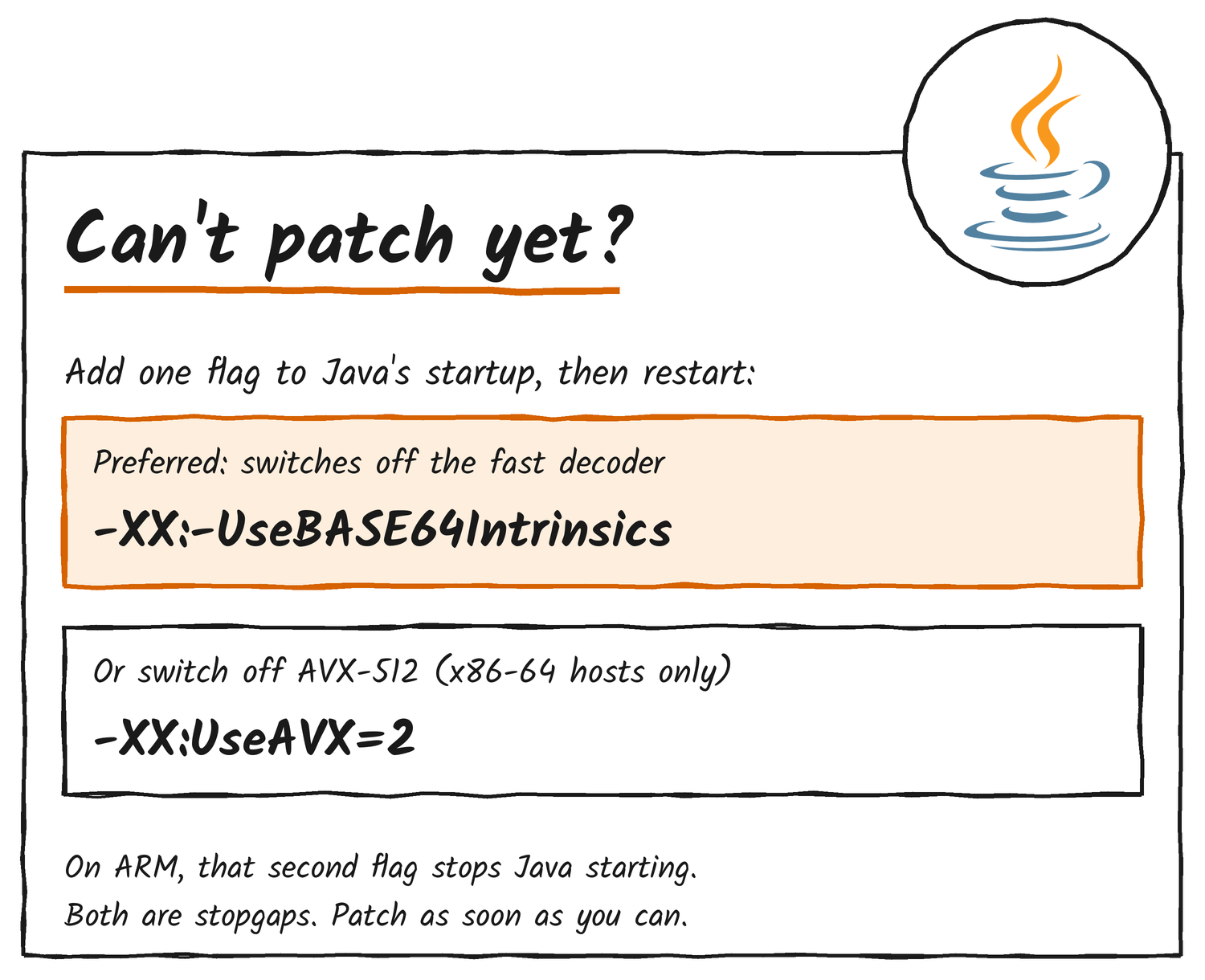
Calif gives two startup options for anyone who can’t patch yet. The preferred one switches off the accelerated Base64 code, and the other switches off AVX-512 on x86-64 hosts. Both take effect after a restart.
-XX:-UseBASE64Intrinsics
-XX:UseAVX=2
Don’t add the second flag on ARM, because Java there fails to start with it. CISA’s own stopgaps are to restrict and validate Base64 input at the application boundary, enforce input-size limits and limit unauthenticated access. Canada’s Cyber Centre adds that isolating internet-facing applications from public networks is an option where patching isn’t possible. Calif says a reverse proxy that buffers request bodies, as nginx does by default, breaks some of its exploit chains but isn’t a general defence.
What to do now
- List every Java runtime you run. CISA says JDKs and runtimes may not appear as separate entries in software inventories, and they can sit inside third-party applications, container images and appliances.
- Check which hosts have the chip. On Linux, a processor is exposed only if the avx512f, avx512bw, avx512vbmi and bmi2 flags all appear in
/proc/cpuinfo, according to Calif. The command under this list prints each flag the host has, so four lines of output means it has the instructions. - Patch internet-facing services first, then restart them. Rebuild and redeploy container images so the running process uses the new build, and check the running JVM’s version with
jcmd <pid> VM.version. - Where a product bundles its own Java runtime, wait for that vendor’s update. NCSC NZ says to follow the vendor’s advice for those.
- Watch for rogue runtimes, unexpected JVM crashes and suspicious Java processes, which CISA lists as signs to look for. In its lab tests, Hadrian saw Spring Security and Tomcat services exit with code 134 and write a fatal error log when sent crafted HTTP Basic credentials.
grep -o -w -E 'avx512f|avx512bw|avx512vbmi|bmi2' /proc/cpuinfo | sort -uThe New Zealand angle
NCSC NZ’s alert says the flaw allows pre-authenticated remote code execution and that most Java applications on affected hardware are expected to be hit. It names Keycloak, Atlassian Jira, Confluence, JFrog Artifactory, Jenkins and PingFederate as examples. The centre tells organisations to update affected runtimes, rebuild and redeploy them, and restart the applications. Incidents can be reported through the NCSC NZ reporting page.
Red Hat, Eclipse Temurin, the Microsoft Build of OpenJDK and BellSoft Liberica hadn’t listed fixes for CVE-2026-114938 at the time of writing, and Calif’s product exploits are expected within one to two weeks, according to Duong.
Discover more from Sulat AI & Tech News
Subscribe to get the latest posts sent to your email.