Together AI says you can now post-train DeepSeek V4.1 Flash 1017 on its platform. The announcement went up on X early on 18 November UTC, and it’s short: SFT or RL, your own data, your own rewards and environments, and a training loop that stays in your Python.
deepseek v4.1 flash 1017 is now available for post-training on together ai
— Together AI (@togethercompute) November 18, 2026
run sft or rl with your own data, rewards + environments, and keep the training loop in your own python code
take v4.1 flash and shape it for your own coding and agentic work https://t.co/0WHnc47hCY pic.twitter.com/0WHnc47hCY
The picture in the post is a screenshot of Together’s console. It shows the Create model resource dialog with deepseek-ai/DeepSeek-V4.1-Flash-1017 highlighted in the base model list.
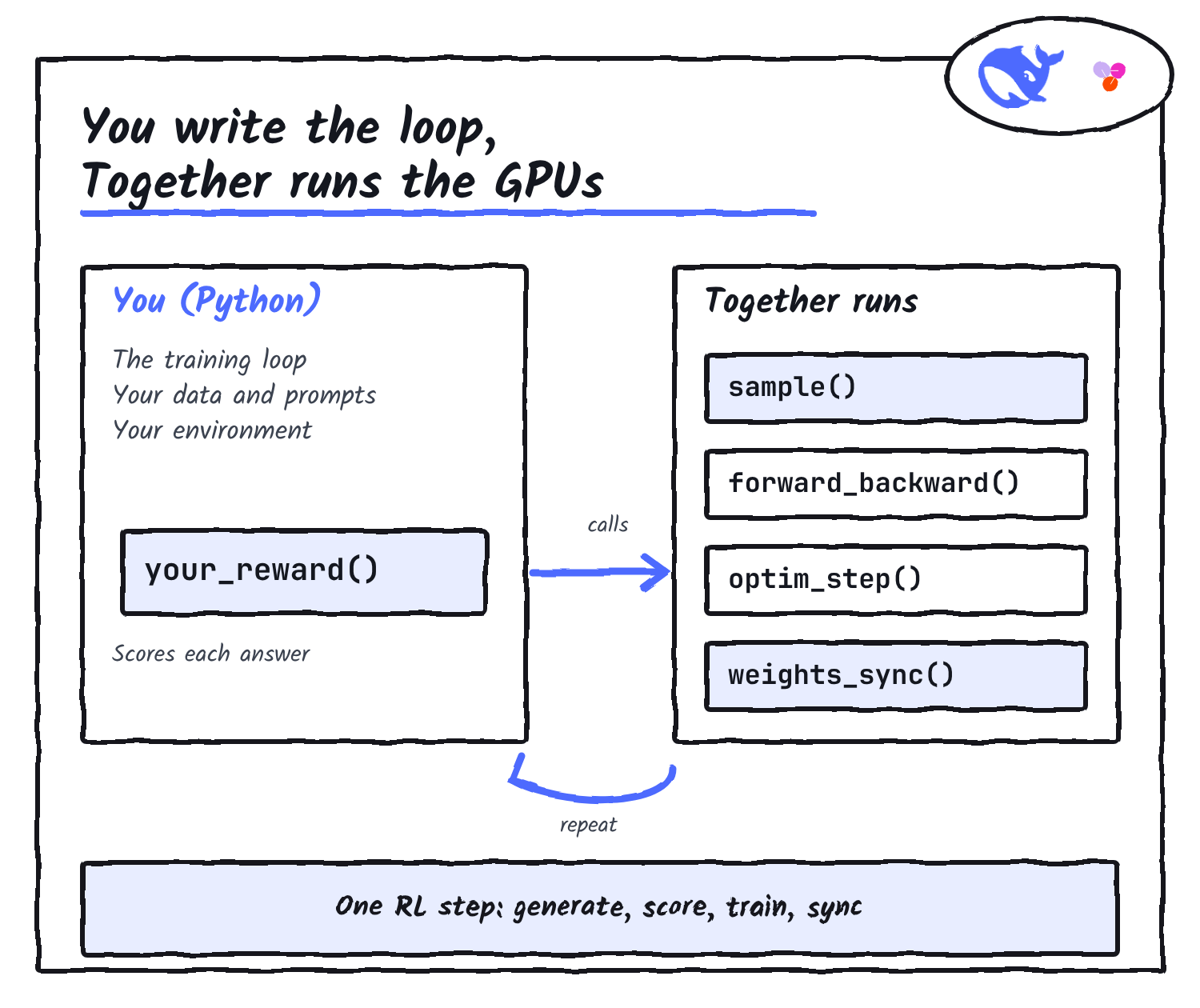
You write the loop, Together runs the GPUs
What does Together actually do here? Less than you might guess, and that’s the point. On its post-training page, you write the recipe: data, rewards, environments, the loss, the loop. Together handles the trainer and, when you’re doing RL, the rollout engine and the weight sync between the two. Pick GRPO, PPO or a loss you’ve written yourself. Train a LoRA adapter, or full weights if the model allows it.
One RL step is five calls: sample(), your_reward(), forward_backward(), optim_step() and weights_sync(). SFT skips sample() and weights_sync(). Your reward is plain code, so it’ll work with whatever sandbox you already run, and for multi-turn agents your script drives the episode while Together generates each turn.
The model underneath
DeepSeek shipped the model itself on 17 October. It called 1017 a minor update to V4.1 Flash, put the weights out under the MIT licence and kept the 1M-token context. The model can read images. Together’s docs, though, say post-training only trains and samples on text, even for models that can.
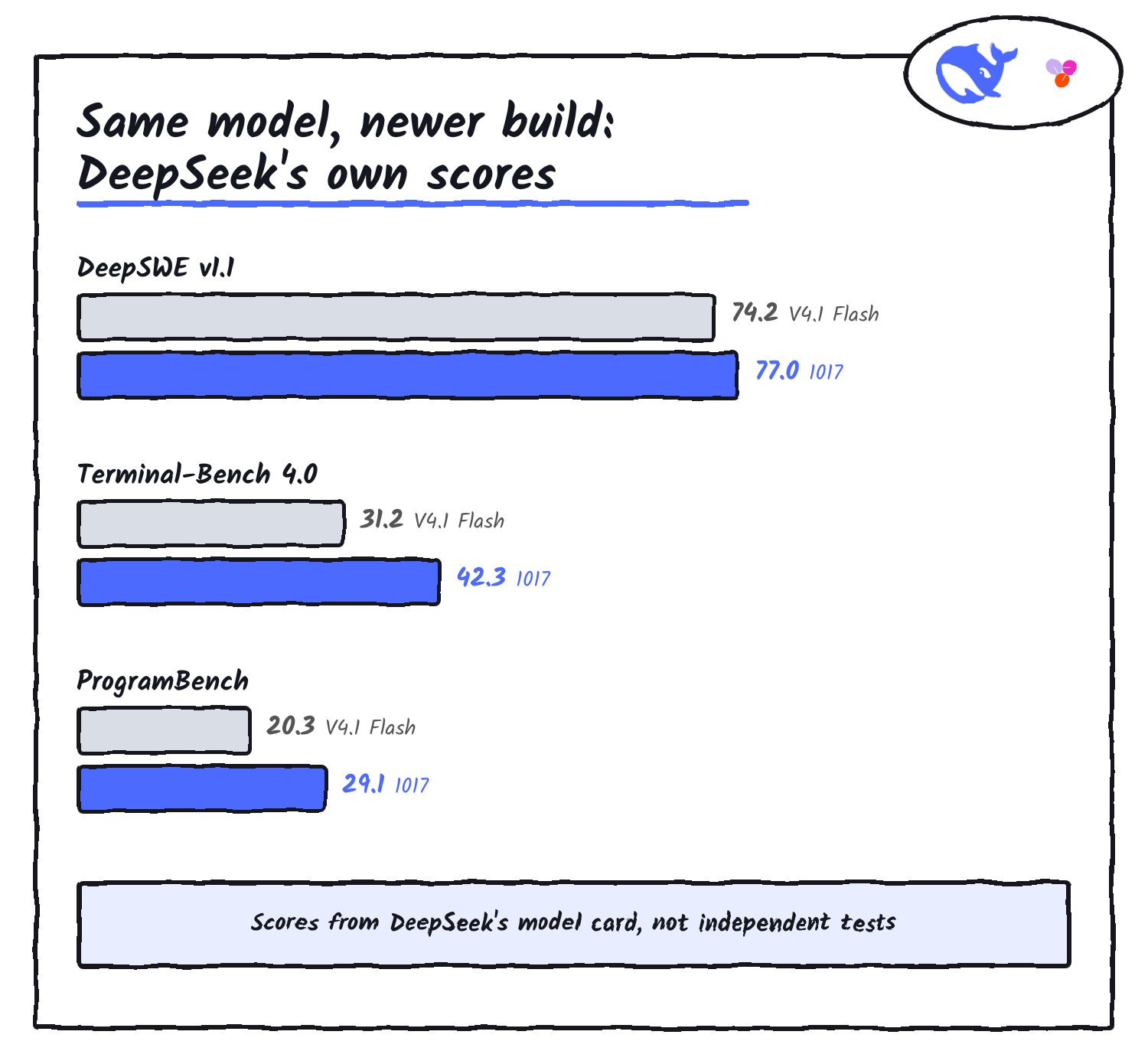
DeepSeek’s own table makes the update look big for agentic coding. DeepSWE v1.1 climbs from 74.2 to 77.0. Terminal-Bench 4.0 jumps from 31.2 to 42.3. Claude Opus 5 is still ahead on Terminal-Bench 4.0 (51.8) and on ProgramBench (37.0 against 29.1). These are all DeepSeek’s numbers, run on the Claude Code harness for Terminal-Bench and Mini-SWE-V2 for DeepSWE.
What Together hasn’t published yet
Together’s own pages don’t list the model yet. The post-training page shows GLM-5.3, Kimi K3, Qwen3.8 27B and Qwen3.6 35B A3B, plus a “coming soon” tile. The supported models catalog has nine entries, none of them DeepSeek. So there’s no word yet on whether 1017 trains as LoRA only or with full weights, how long a sequence the trainer takes, or what an hour costs. The docs add that everything runs on B200 GPUs for now.
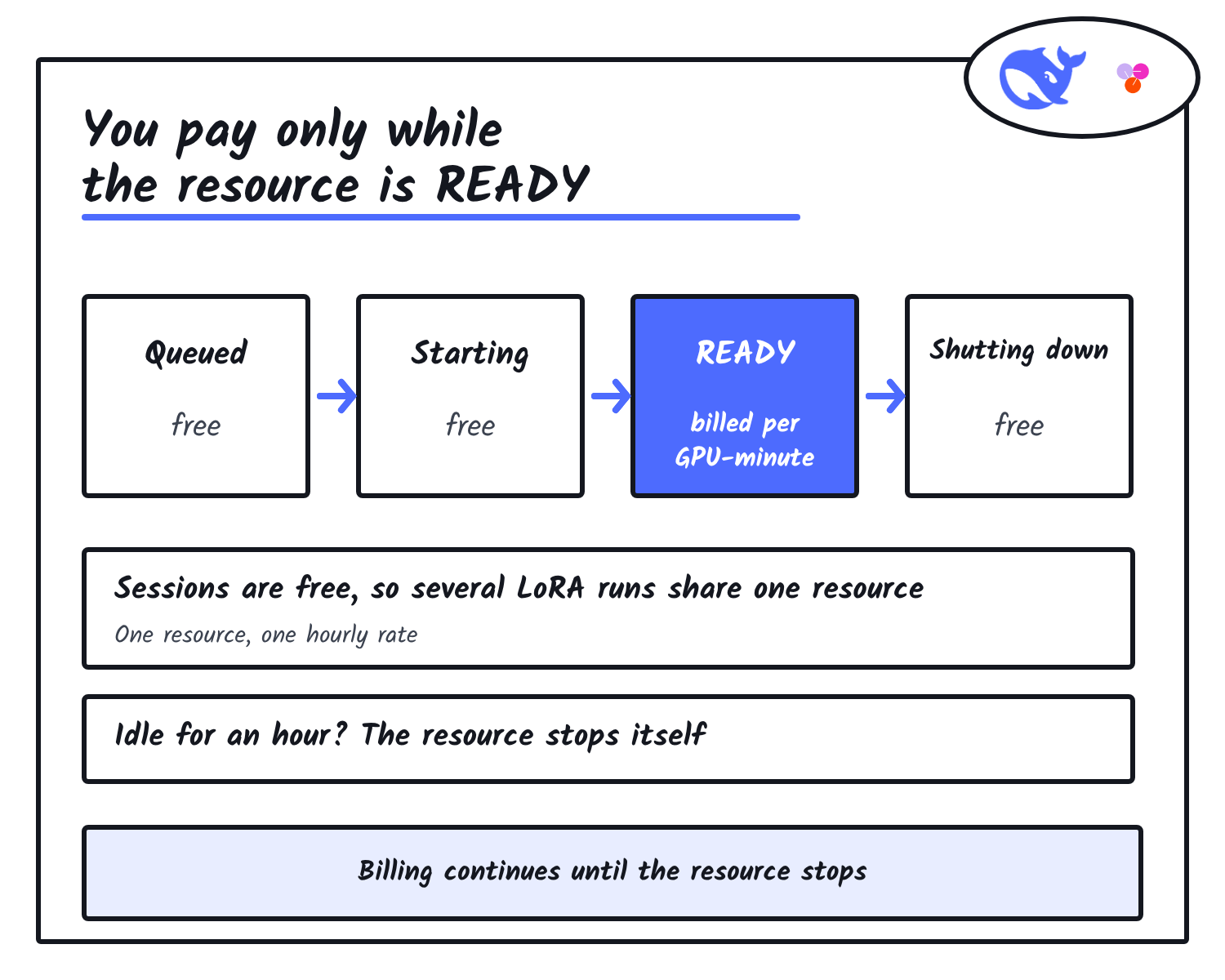
The billing is simple. You pay per GPU-minute, and only while a resource is READY. Queueing, starting up and shutting down are free, and so are sessions, which means several LoRA experiments on one resource cost the same per minute as a single one. You can ask for an hourly estimate with estimate_cost before creating anything. In the pricing docs‘ worked example, Qwen3.8 27B with LoRA and one generator replica comes to US$88 an hour at US$11 per GPU-hour, and a new resource needs credit for four hours of it.
Watch for one trap. A resource keeps billing after your script exits unless something stops it. The cookbook recipes clean up after themselves, and an idle resource stops on its own after an hour.
Sources
- Together Post-Training, Together AI
- Post announcing DeepSeek V4.1 Flash 1017 support, Together AI on X
- Supported models, Together AI docs
- Pricing, Together AI docs
- DeepSeek-V4.1-Flash-1017 model card, Hugging Face
- DeepSeek-V4.1-Flash-1017 release note, DeepSeek API docs
Discover more from Sulat AI & Tech News
Subscribe to get the latest posts sent to your email.