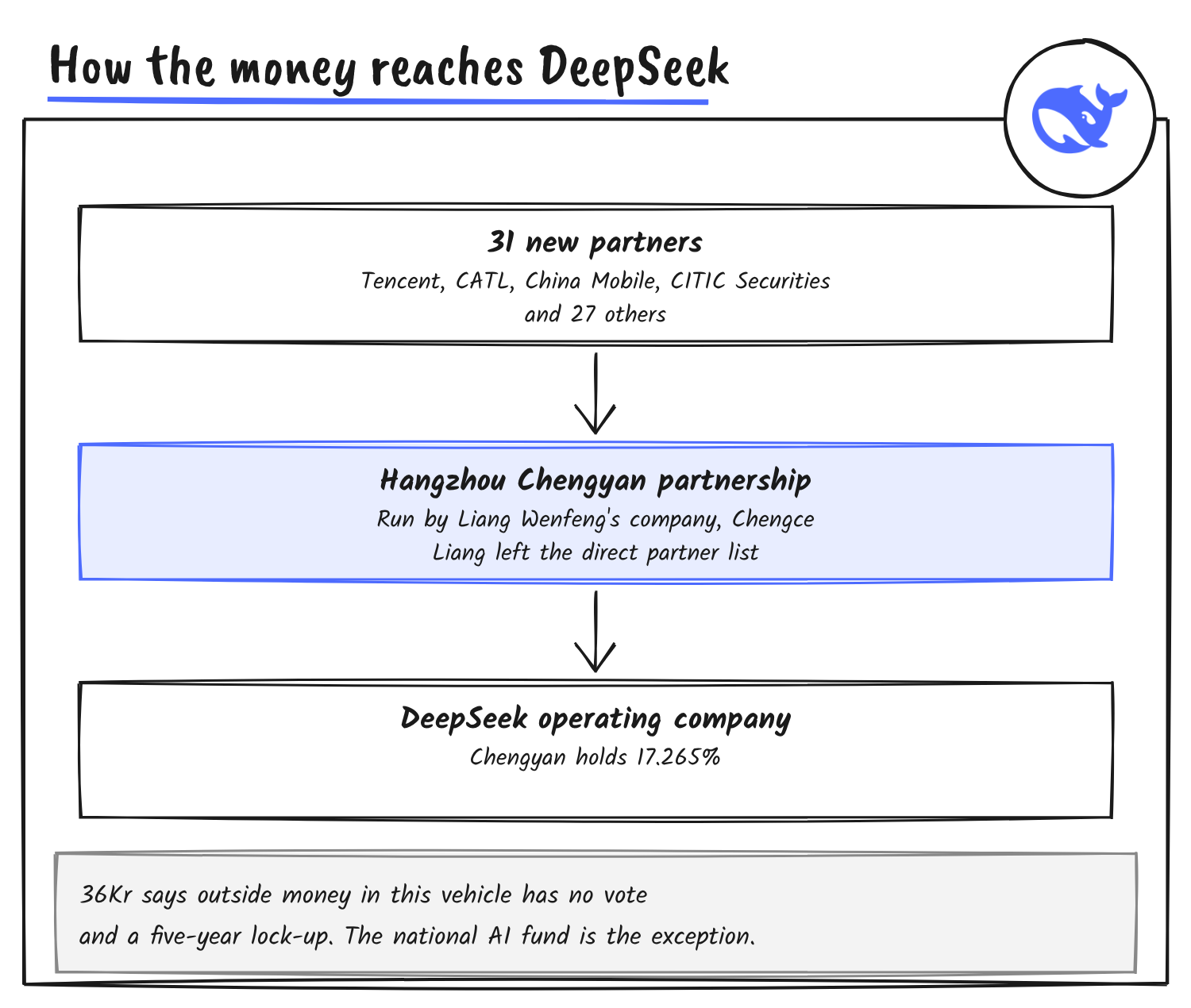
DeepSeek’s second funding round has reached the company register. Qichacha shows a new holding partnership, Hangzhou Chengyan, owns 17.265% of DeepSeek’s operating company, and that 31 new partners joined it. Tencent and CATL are tied as the biggest. DeepSeek hasn’t responded on the investment vehicle or on how much each partner put in, 36Kr’s Zhidongxi reports.
I couldn’t open Qichacha or Tianyancha, which both want a login. The registry details below come from 36Kr’s reports of Qichacha, and BigGo Finance carries the same share figures.
What the register shows
Chengyan’s registered capital went from 6,000 yuan to about 3.439 billion yuan. It holds 17.265% of Hangzhou DeepSeek Artificial Intelligence Basic Technology Research, the operating company, with subscribed capital of 3.439 million yuan. BigGo Finance adds that the operating company’s own registered capital rose about 21.1% to 19.92 million yuan in the same change. Entertainment Capital Theory dates the change to 17 November, while Zhidongxi reported it on 19 November, China time.
Founder Liang Wenfeng is no longer a direct partner in Chengyan. His company, Hangzhou Chengce Business Consulting, fell from an 83.33% share to 0.0001% and stays on as executive partner. Chengce also runs Hangzhou Chengli, the platform from DeepSeek’s first round. With the 31 new partners that makes 32 in total.
Who’s in
| Partner | Share of Chengyan | Implied amount (billion yuan) |
|---|---|---|
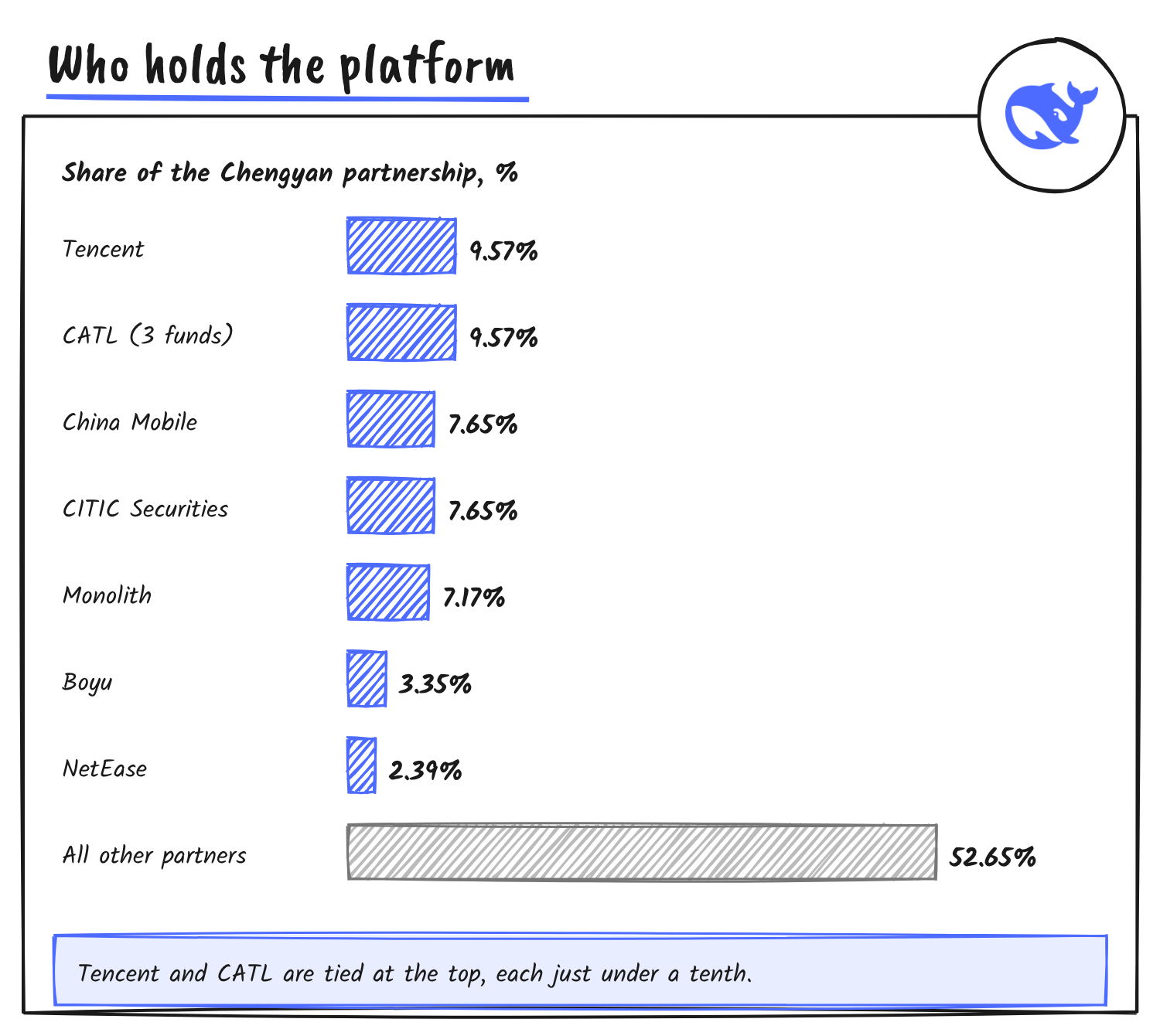
| Tencent (Shanghai Hengxiu) | 9.5653% | 10.1 |
| CATL (three funds combined) | 9.5653% | 10.1 |
| China Mobile (China Mobile Investment) | 7.6522% | 8.1 |
| CITIC Securities (CITIC Securities Investment) | 7.6522% | 8.1 |
| Monolith Capital (Tianjin Monolith Xingshen) | 7.1740% | 7.6 |
| Boyu | 3.3479% | 3.5 |
| NetEase (Hangzhou Leihuo Wanxiang) | 2.3913% | 2.5 |
The shares are shares of the Chengyan partnership, not of DeepSeek. The amounts are my arithmetic: each share times the 105.5 billion yuan figure, the same method Entertainment Capital Theory used. If the round was nearer 100 billion yuan, each amount drops by about 5%. Tencent’s 10.1 billion yuan lines up with The Information’s report that Tencent put 10 billion yuan into each round. Tencent’s 9.5653% of Chengyan works out to about 1.65% of DeepSeek, also my arithmetic.
Other names on the partner list include China Telecom, vivo, Midea, Xiaohongshu and GigaDevice, plus Hengdian, Bilibili and Perfect World, according to 36Kr.
The size of the round depends on who you ask
| Source | Date | Size | Valuation |
|---|---|---|---|
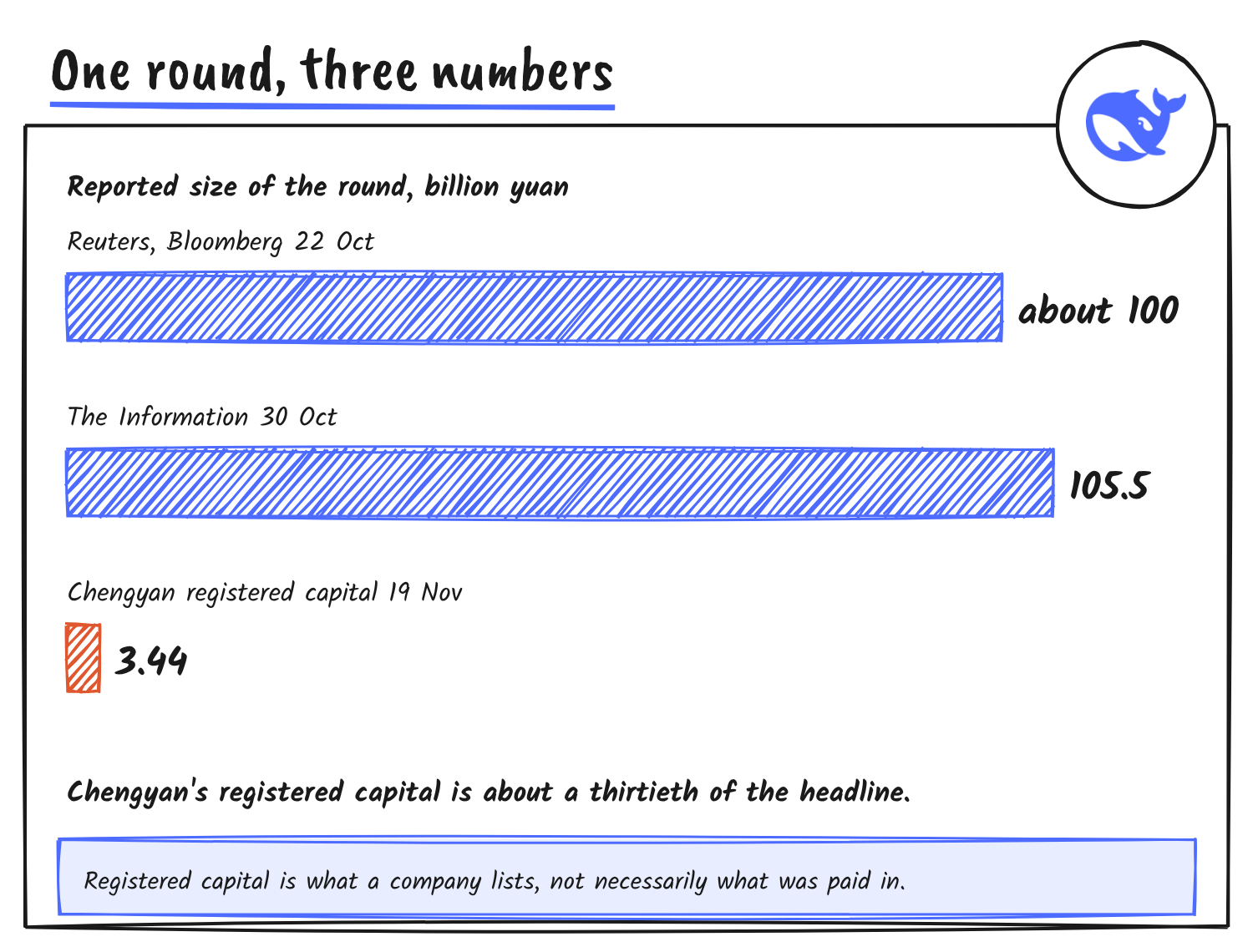
| Reuters | 22 Oct | About 100 billion yuan (US$14.98 billion) | 500 billion yuan before new money |
| Bloomberg | 22 Oct | About 100 billion yuan (US$15 billion) | Not given |
| The Information, via PANews | 30 Oct | 105.5 billion yuan (about US$15.8 billion), nearly 30 investors | 615.5 billion yuan after the round |
| 36Kr, from Qichacha | 19 Nov | 3.439 billion yuan registered capital in Chengyan, 31 new partners | Not given |
Reuters and Bloomberg put the round at about 100 billion yuan on 22 October. The Information’s 105.5 billion yuan figure came eight days later, and it’s the one 36Kr’s outlets use. The 31 and 32 aren’t a conflict either: 31 is the new partners and 32 is the total.
The register shows neither size. It shows 3.439 billion yuan of registered capital in Chengyan, about a thirtieth of the 105.5 billion yuan headline, and I haven’t found a report that explains the gap.
At the 6.68 yuan to the dollar that Reuters’ 22 October conversion implies, 105.5 billion yuan is about US$15.8 billion and 615.5 billion yuan is about US$92 billion. 36Kr gives US$86 billion for the valuation, which implies about 7.16 yuan to the dollar and doesn’t match its own US$15.8 billion for the round. Subtracting the round from the 615.5 billion yuan valuation leaves 510 billion yuan before the new money, against the 500 billion yuan Reuters reported.
How the money is set up
36Kr puts the first round at 51 billion yuan, four months ago. The Information says CATL and its chairman, Zeng Yuqun, put in 5 billion yuan in the first round and 10 billion yuan in this one. It also says DeepSeek doubled the round from a 50 billion yuan target as Nvidia’s high-end chip prices kept rising and fears of an AI bubble grew.
Entertainment Capital Theory says the structure carries over from the first round. Apart from the national AI industry investment fund, outside investors’ money goes into the partnership Liang controls rather than straight into DeepSeek, with no voting rights and a five-year lock-up. Bloomberg reported on 6 October that DeepSeek was raising ahead of an IPO in early 2027.
Discover more from Sulat AI & Tech News
Subscribe to get the latest posts sent to your email.