Palo Alto Networks has agreed to buy Applied Compute, a San Francisco startup that helps companies train and run open-weight AI models. The all-stock deal is valued at $4.5 billion, subject to adjustments. Palo Alto announced it on 18 November in the US, alongside its fiscal first-quarter results, after The Wall Street Journal broke the news in an exclusive.
What Palo Alto is buying
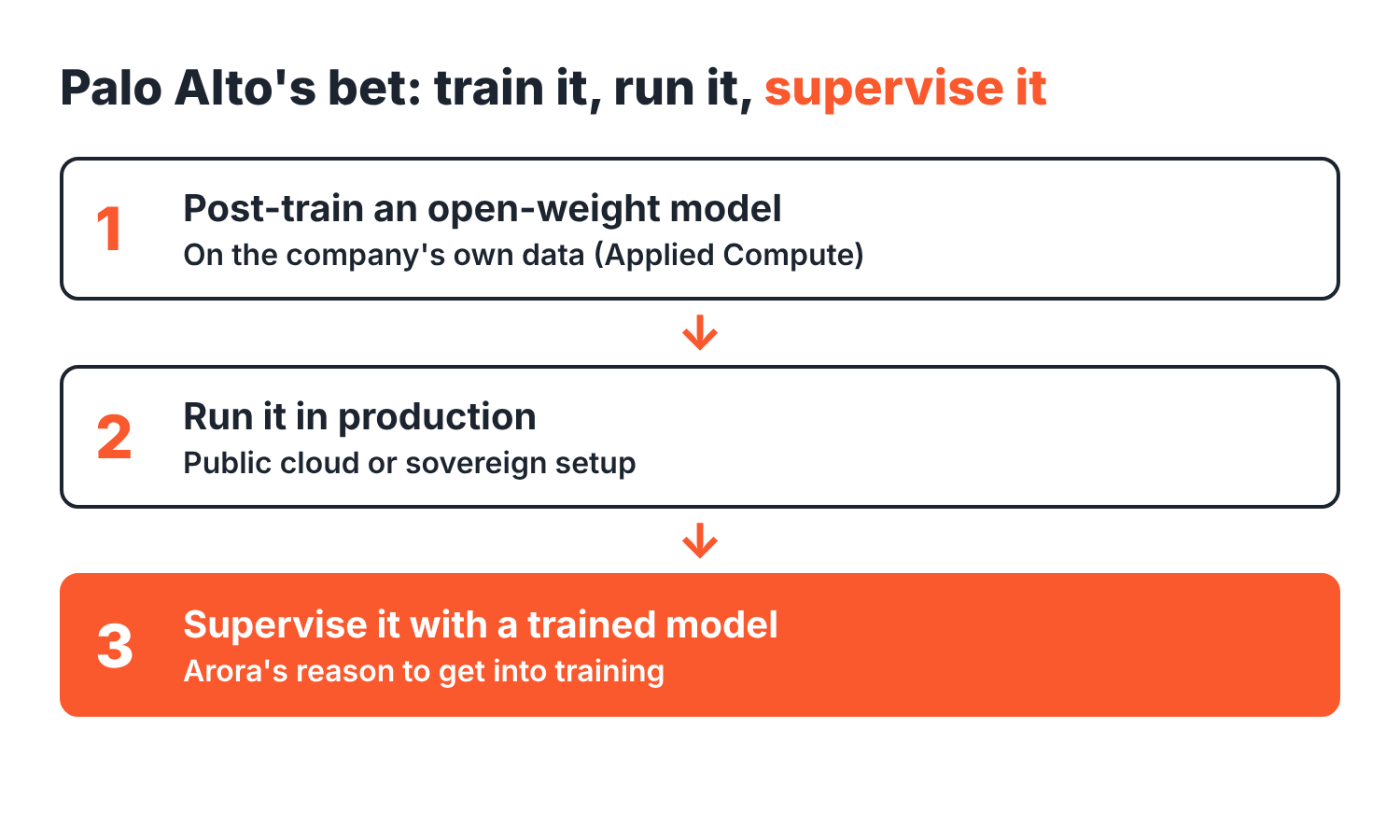
Applied Compute’s platform covers two jobs. Post-training is where a company tunes an open-weight model on its own data, and inference is running that model once it’s live. Palo Alto’s release says enterprises will be able to train, adapt and deploy those models with security built in, in the public cloud or in sovereign environments. Applied Compute keeps serving AI-native companies, digital natives and large enterprises, and Palo Alto will sell the platform to its own customers. SiliconANGLE lists Microsoft and DoorDash among its customers.
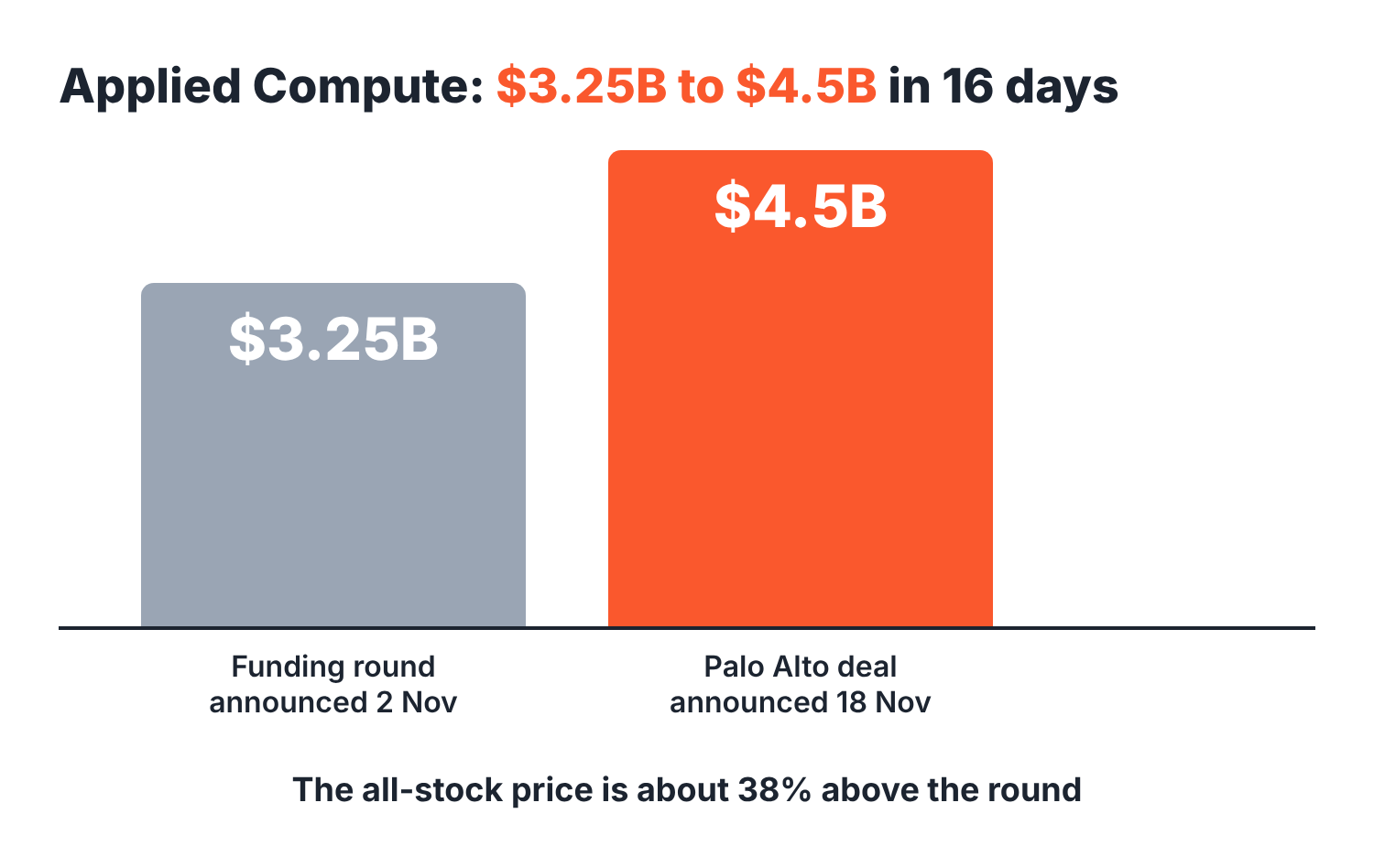
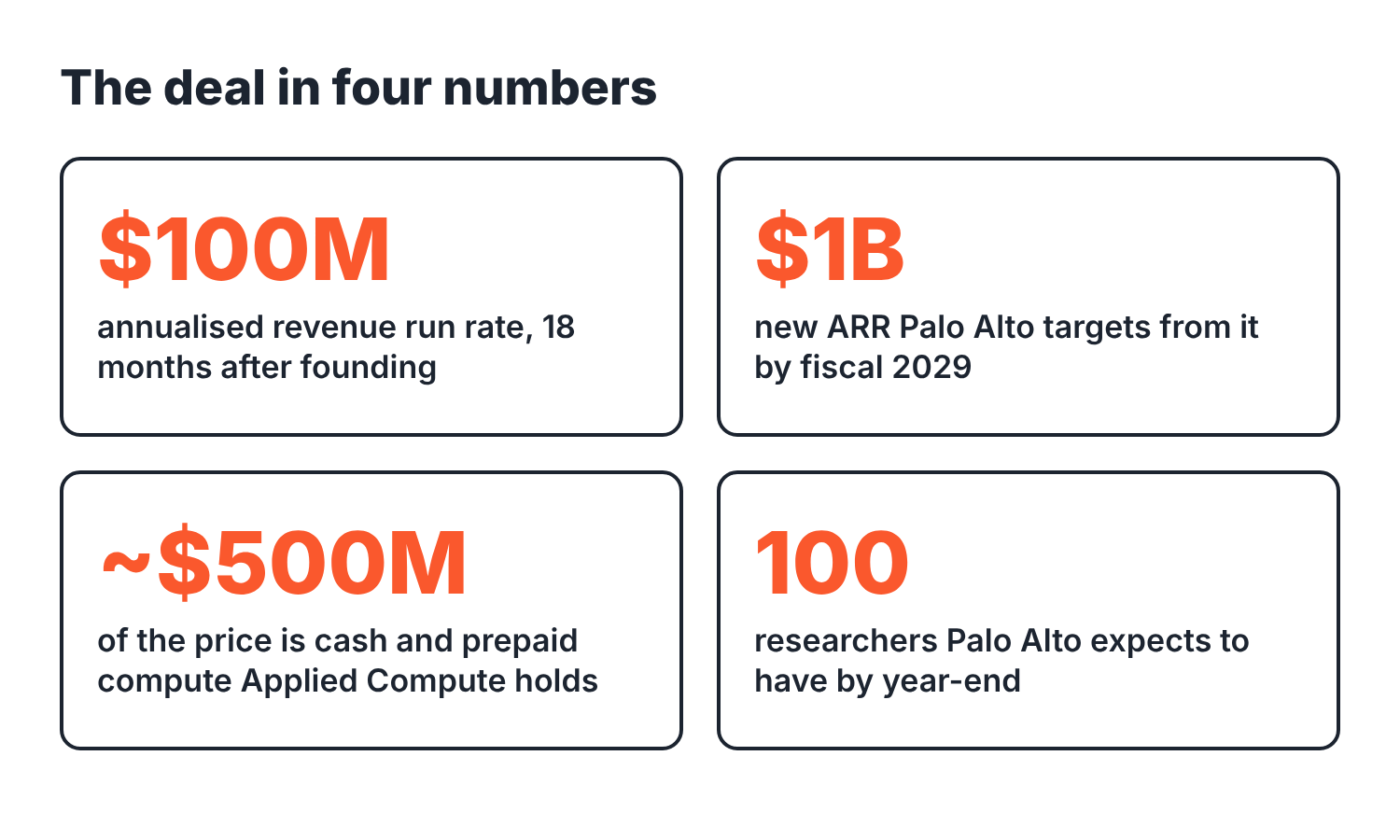
Former OpenAI researchers Yash Patil, Rhythm Garg and Linden Li founded the company in 2025. On 2 November it announced $350 million at a $3.25 billion valuation, in a round led by Elad Gil with Nvidia, Shopify Ventures and HubSpot Ventures taking part. Patil wrote on X that a few dozen people in just over 18 months “grew this company from zero revenue to over $100M in annualized revenue run-rate.” The $4.5 billion price is about 38% above that valuation, which was set 16 days earlier.
The terms
On its earnings call, Palo Alto said the $4.5 billion is paid entirely in stock and includes about $500 million in cash and prepaid compute commitments that Applied Compute owns. The deal needs regulatory clearance. Palo Alto expects it to close in its fiscal third quarter of 2027, which runs from February to April 2027.
At close, Patil becomes Palo Alto’s Co-Chief AI Officer and the Applied Compute team joins the company. Palo Alto expects to have 100 researchers by the end of the year. It expects the business to add $1 billion of next-generation security ARR by fiscal 2029, and it called the deal top-line growth accretive from day one. Its guidance for the year leaves the pending deal out.
Compute is the big spend. Palo Alto said it expects a commitment of less than $3 billion through fiscal 2030, which it put at about half a year of free cash flow. It plans to buy that compute from cloud partners. Arora said Palo Alto aspires to 100 to 150 megawatts, a size he said a neocloud or a cloud provider can supply.
Why a security company wants it
Nikesh Arora said in the release that Palo Alto saw Applied Compute’s work firsthand as a prospective customer, and that its Unit 42 Frontier AI Assessment confirmed the startup’s security foundations. On the call he said Palo Alto went looking for a partner to train its own models and picked Applied Compute because “no other team matched their technical pedigree in post-training open-weight models.”
The Hugging Face incident pushed the decision, Arora said. It showed Palo Alto that deterministic controls can’t anticipate everything an agent might try, so it needs a trained model that can interpret AI behaviour and stop it misbehaving. His summary: “we have to get in the training business to be able to build a good supervision business.”
Arora also put the stakes high. “Hopefully, this is the right bet for us, and if it works, I think this will dwarf the abilities that we have in cybersecurity,” he said. “This could be bigger than what we do today.” CNBC reported the comment.
The quarter around it
Palo Alto’s first-quarter results put revenue at $3.44 billion, up 39% on a year earlier. SiliconANGLE reports next-generation security ARR of $9.73 billion, up 66%. Palo Alto raised its full-year revenue forecast to $14.52 billion to $14.57 billion, from $14.10 billion to $14.20 billion. SiliconANGLE says the shares rose almost 10% in regular trading, and CNBC says they’re up 85% this year.
Disclosure: I’m an OpenAI, Firecrawl and Devin ambassador.
Discover more from Sulat AI & Tech News
Subscribe to get the latest posts sent to your email.