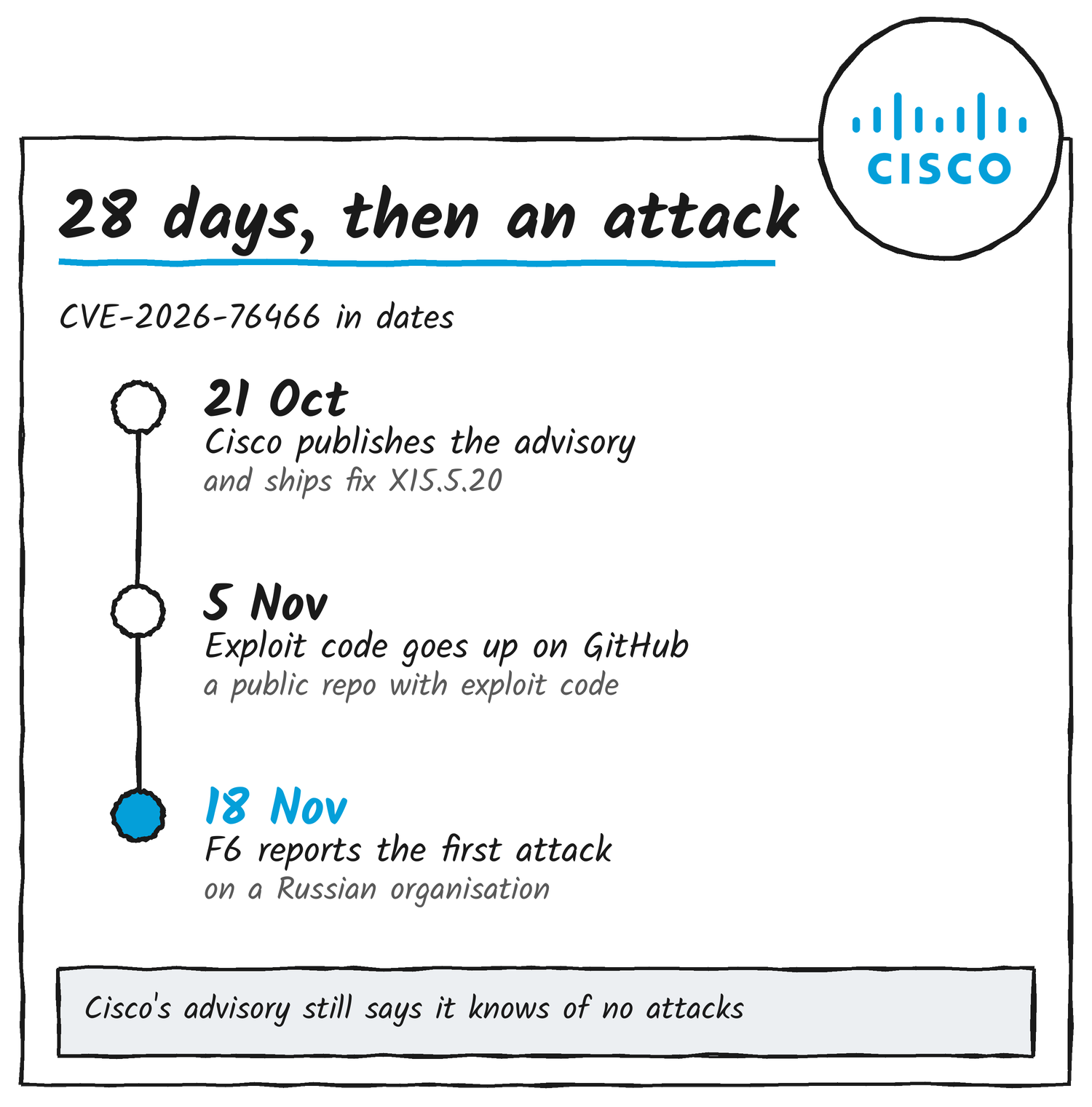
F6, a Russian cybersecurity firm, says attackers broke into a Russian organisation through clustered Cisco Expressway devices using CVE-2026-76466, a root-level flaw rated 9.8 out of 10. The attack came shortly after exploit code for the flaw was published on GitHub, and SecurityWeek reported F6’s findings on 19 November.
F6’s press release, dated 18 November, calls it the first exploitation of the flaw it has investigated. Cisco’s advisory is dated 21 October and hasn’t been revised since. It still says Cisco’s Product Security Incident Response Team isn’t aware of public announcements or malicious use. SecurityWeek says it has asked Cisco to comment on F6’s findings.
What the flaw is
Expressway is Cisco’s gateway for letting remote staff, partners and outside users reach an organisation’s internal video, voice and messaging services. The flaw sits in the Expressway database service, which clustered devices use to talk to each other. Cisco says an unauthenticated attacker with network access to a device can run operating system commands as root. It puts the cause down to persistent cookies, and adds that client certificates aren’t validated when TLS Verify Mode is enabled for clustering.
Cisco says the flaw affects Expressway Core and Edge, virtual and appliance, only when the devices are clustered. Releases X15.5.3 and earlier are affected, and X15.5.20 fixes it. Customers on X14 or earlier need to migrate to a fixed release. Cisco lists no workarounds, and credits Stefan Aleksic of Jane Street with reporting the flaw.
The exploit code
A GitHub repository called dinosn/cve-2026-76466 was created on 5 November, 15 days after Cisco’s advisory. Its README says the cluster-manager module contains a hard-coded maintenance identity and a matching hard-coded cookie, so any client that knows both can join the cluster’s Erlang service on TCP port 4372 and call functions on the device as root. The author says they validated the exploit against one Expressway-C running X15.3.2 in a two-node cluster, in TLS Permissive mode, which the README calls the factory default. TLS Enforcing mode, Expressway-E and X14 releases are listed as untested.
What F6 found
According to F6, the attackers first broke into two internet-facing Expressway devices running X15.5.3. They then used one of them to reach two other cluster nodes on the organisation’s internal network. With root access, they prepared tools for moving further through the network: custom Python scripts that scan the network, look for SMB file shares, talk to SQL Server and WinRM, and search GitLab repositories. F6 says the aim was to pull out credentials and other sensitive data.
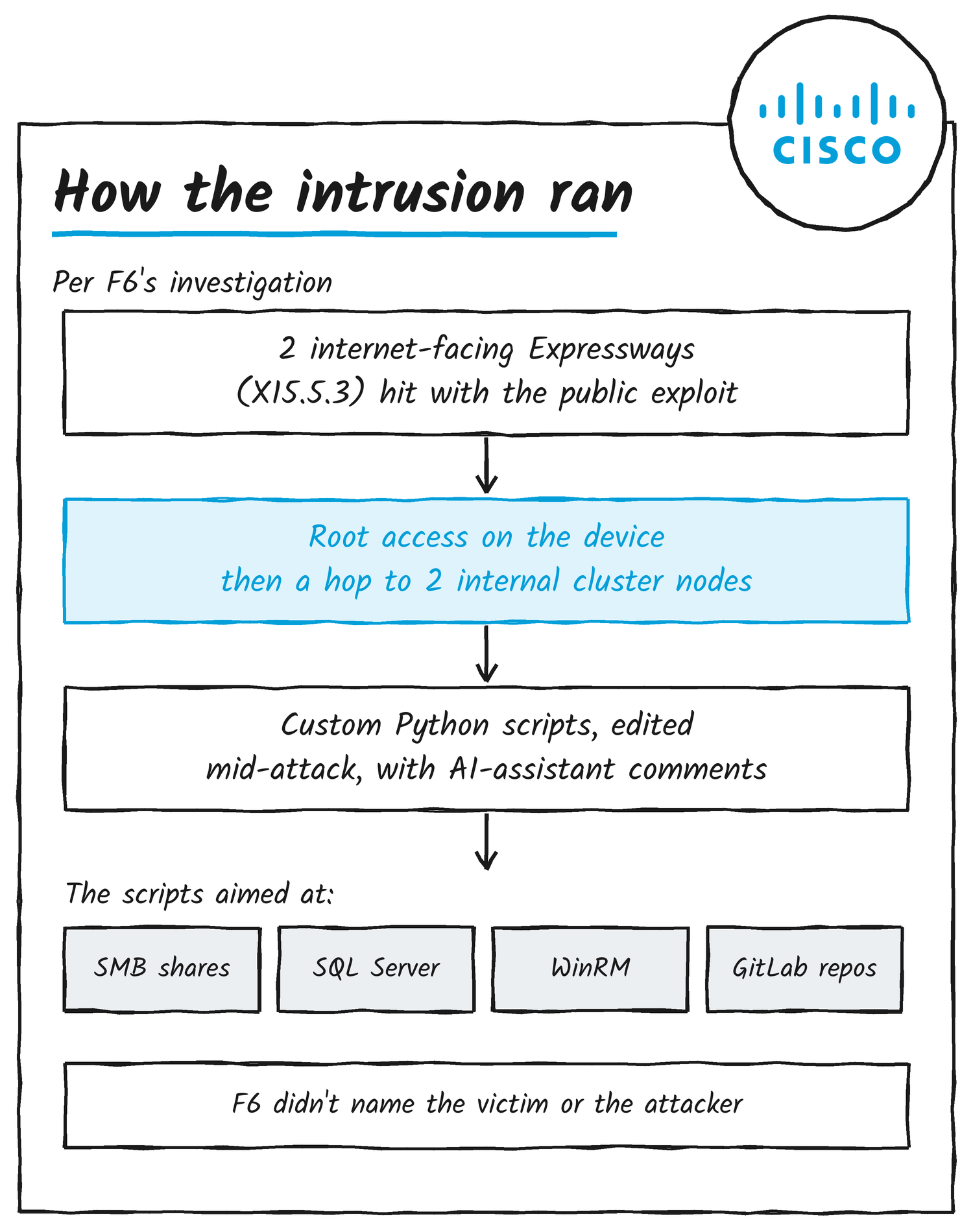
The attackers edited the scripts during the attack, F6 says, and the source code held comments and descriptions of fixes that are characteristic of an AI assistant. F6 didn’t name the victim, attribute the attack to a known group or say which assistant. Its release doesn’t date the intrusion; it says only that the attack came soon after the exploit code appeared.
Checking your own devices
F6 points to one clear sign of exploitation: a nodeup,'[email protected]' entry in the Erlang system log, erlang.log, on the device. It records a connection from an Erlang node whose name matches the known exploit, and F6 says other logs and artefacts should be checked to confirm a compromise. Its other indicators are the IP addresses 66.179.31[.]32 and 18.130.47[.]116, and Python files in /mnt/harddisk/ subfolders matching i{0-9}{4}[a-zA-Z]?.
F6 recommends upgrading to a fixed Expressway release. Where that can’t happen straight away, it says to block TCP ports 4371 to 4372 at the firewall for everything except the IP addresses of trusted cluster nodes. The exploit’s README gives the same advice, and Cisco still lists no workarounds.

CISA hasn’t added CVE-2026-76466 to its Known Exploited Vulnerabilities catalog; the catalog’s 18 November release doesn’t list it. Cisco’s advisory is still at version 1.0.
Discover more from Sulat AI & Tech News
Subscribe to get the latest posts sent to your email.