PHP released 8.5.13, 8.4.28, 8.3.37 and 8.2.36 on 19 November 2026, along with PHP 8.6.0. Together they fix 17 security advisories: seven critical (all CVSS v4 9.2), four high and six medium.
If you run Laravel in production, the short version is simple. Upgrade PHP, restart PHP-FPM, and check three settings. Laravel itself needs no update, because these are bugs in PHP, not in the framework.
I’ve covered the full release, CVE by CVE, in my full PHP deep dive. This guide is the Laravel version: what touches a typical Laravel app, what doesn’t, and what to do on Forge, Sail, Herd, Docker and the managed platforms. Laravel News covered the October PHP release in the same spirit, so this picks up where that left off.
The one-minute version
- Move to PHP 8.2.36, 8.3.37, 8.4.28, 8.5.13 or 8.6.0.
- Restart PHP-FPM (or rebuild your container image) so every worker loads the new binary.
- Check
session.upload_progress.enabled, FastCGI connection reuse, and, on PHP 8.5,zend.exception_ignore_args. - PHP 8.1 and older get no upstream fix. Plan an upgrade.
Which Laravel and PHP versions are in play
| Laravel | PHP range | Security fixes until |
|---|---|---|
| 13 | 8.3 to 8.5 | 17 March 2028 |
| 12 | 8.2 to 8.5 | 24 February 2027 |
| 11 | 8.2 to 8.4 | 12 March 2026 (ended) |
| 10 | 8.1 to 8.3 | 4 February 2025 (ended) |
Source: Laravel’s support policy.
Every PHP 8.2 to 8.5 install is covered by the new releases. A Laravel 11 app on PHP 8.3 gets fixed by upgrading PHP, even though Laravel 11 is out of security support. A Laravel 10 app on PHP 8.1 has no upstream fix. A composer update changes nothing here, because the bugs sit in the runtime.
What applies to a typical Laravel app
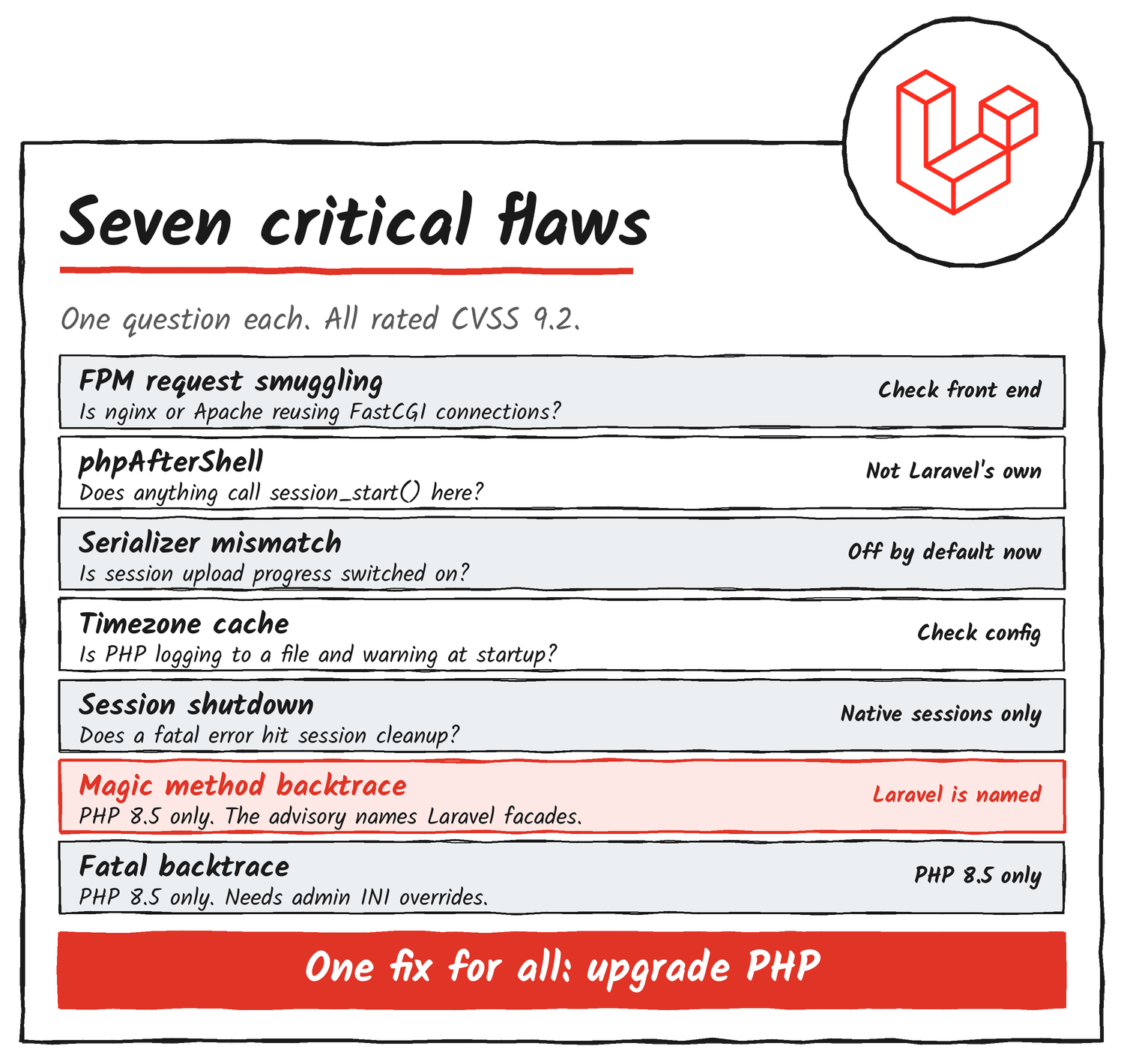
Each critical flaw needs something extra before it works. For most Laravel apps, that extra thing is a server setting, not your code. Here are the ones worth a closer look.
CVE-2026-129289: PHP-FPM request smuggling
An unauthenticated attacker can smuggle a second FastCGI request into PHP-FPM and run PHP code as the worker. PHP’s advisory says it needs two things at once:
- A front end that reuses FastCGI connections, such as nginx with
fastcgi_keep_conn on, Apachemod_proxy_fcgiwithenablereuse=on, or HAProxy. - An application path that opens
php://inputwithout reading it to the end.
Standard nginx and Apache setups that close the connection after each request aren’t affected by the demonstrated attack. In laravel/framework 13.x and Symfony’s Request, the body is read through getContent(), which reads it all. One framework route, the signed PUT endpoint for local-disk temporary uploads, opens the stream with getContent(true). The advisory says reading the body to the end isn’t a reliable control by itself, so check the front-end setting:
sudo nginx -T 2>/dev/null | grep -n fastcgi_keep_connNo output means nginx is on its default, which is off.
CVE-2026-129474: the one that names Laravel
This is a PHP 8.5 bug. The advisory describes a use-after-free when PHP builds a backtrace for a fatal error that happens as a __call() or __callStatic() method is entered. Its example attack sends crafted JSON to an import endpoint that then logs the data through a magic static method, sized so the work crosses memory_limit.
It lists Laravel facades as a path that reaches magic method calls. It also says exploitation of a complete Laravel installation hasn’t been demonstrated, and that a framework, a magic method or a large request body alone doesn’t prove an app is exploitable.
The demonstrated remote attack needs two settings together:
fatal_error_backtraces=1, which is the default on PHP 8.5.zend.exception_ignore_args=0, which is PHP’s built-in default.php.ini-productionsets it to1, and that blocks the attack path.
Distribution packages usually ship a production-style php.ini. The official Docker images ship both templates but don’t apply either, so unless your Dockerfile moves php.ini-production into place you’re on the built-in defaults. Check the FPM configuration, not only the CLI:
php-fpm8.5 -i | grep -E 'zend.exception_ignore_args|fatal_error_backtraces'The workaround is zend.exception_ignore_args=1 or fatal_error_backtraces=0 in the config your web workers use, then a restart. display_errors=0 doesn’t help, because PHP still builds the backtrace.
CVE-2026-129496: the timezone cache bug
This one has nothing to do with your code. On non-thread-safe builds, a warning during PHP’s startup, such as an invalid date.timezone or a session setting deprecation, can leave a stale pointer behind. If PHP logs to a file through its own error_log, an early warning in a fresh worker, such as the one for exceeding max_input_vars, can then touch freed memory. An unauthenticated request can crash a worker, and PHP says code execution was demonstrated locally in FPM and Apache mod_php with known memory addresses.
FPM’s own error log doesn’t meet the condition by itself. Check whether error_log points at a file, and whether PHP logs warnings at startup:
php-fpm8.5 -i | grep -E '^error_log|date.timezone'
sudo grep -h "PHP Startup" /var/log/php8.5-fpm.log
Log paths vary by distribution. Until you upgrade, fix whatever produces the warnings, or send PHP errors to syslog, then restart.
The session bugs, and why Laravel sidesteps most of them
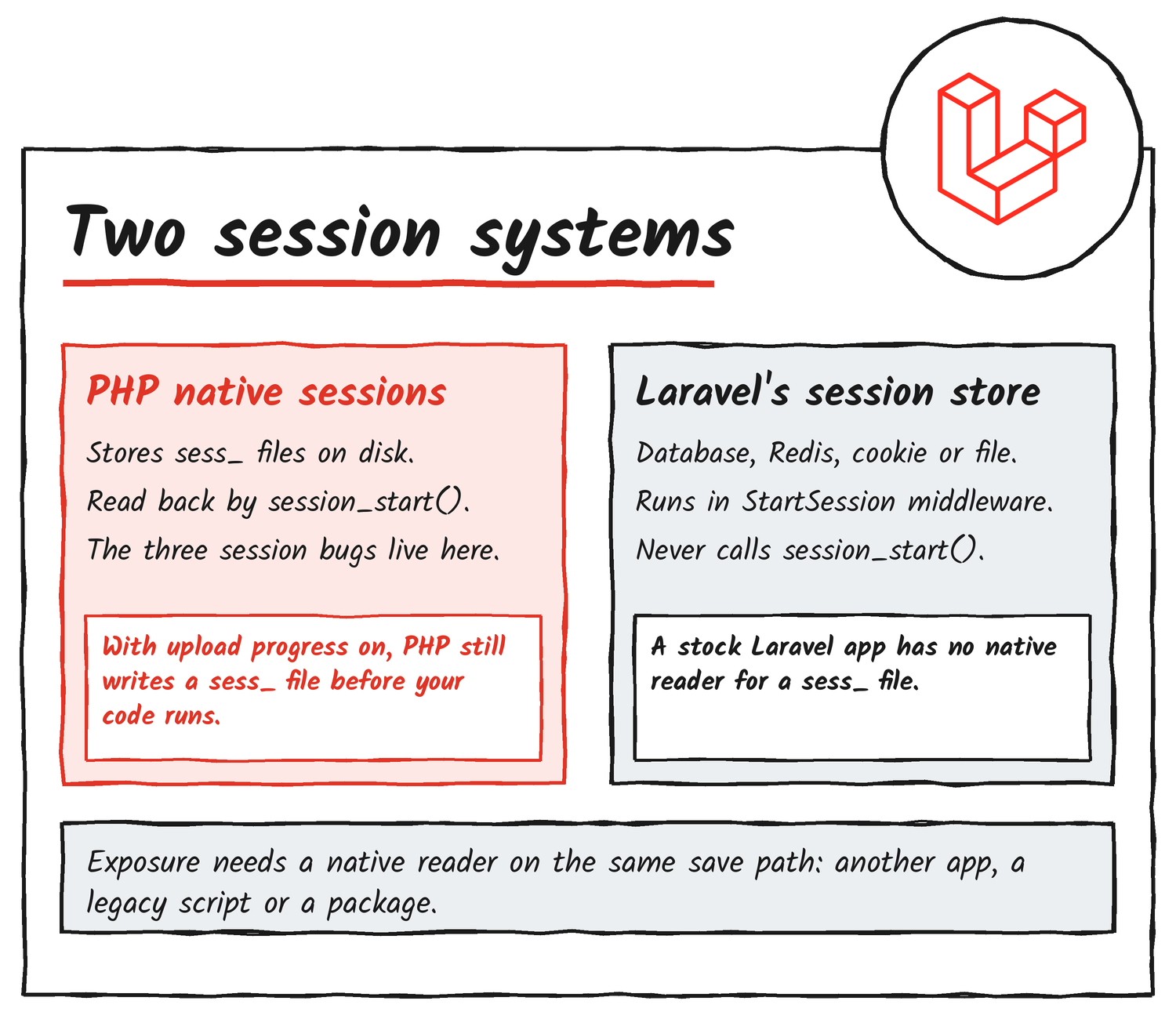
Three of the seven critical flaws live in PHP’s built-in sessions: CVE-2026-126714 (phpAfterShell, the name depthfirst gave it in its write-up), CVE-2026-115560 and CVE-2026-129481.
Laravel doesn’t use PHP’s native sessions. A code comment in StartSession says so directly, and a GitHub code search of laravel/framework finds no session_start() call. Laravel’s drivers (database by default in the current docs, plus Redis, cookie, file and the rest) are its own code.
There’s a catch, and it’s the reason these bugs still matter on a Laravel box. laravel/framework requires ext-session in its composer.json, so the session extension is loaded. With session.upload_progress.enabled on, PHP writes a native sess_ file during multipart parsing, before any application code runs. A local test shows it on PHP 8.3.6 with the built-in server and an app that never starts a session:
# www/index.php is any script that never calls session_start()
php -S 127.0.0.1:8099 -t www \
  -d session.save_path=/tmp/sess -d session.upload_progress.enabled=1

head -c 200000 /dev/zero | tr '\0' 'A' > big.bin
curl -b "PHPSESSID=probe1234" -F "PHP_SESSION_UPLOAD_PROGRESS=tok" \
  -F "[email protected]" http://127.0.0.1:8099/index.php
ls /tmp/sess    # sess_probe1234 appears; with the flag set to 0, nothing does
Writing the file isn’t the exploit. The attack needs something to read it back with session_start(). A stock Laravel app has no such reader. Something else on the same server could: another PHP app, a legacy script, or a package. Separate FPM pools don’t get separate session storage by default, so a neighbour sharing session.save_path is the realistic path. This command finds native session calls in your own tree:
grep -rn "session_start(" app bootstrap routes vendor --include=*.phpYou’ll see Symfony’s NativeSessionStorage in the results. Laravel doesn’t use it.
Two facts make the details worth knowing:
- PHP’s advisory for phpAfterShell says code execution also needs a deserialization gadget chain in the application. depthfirst’s write-up says it reached code execution without one, by chaining a second memory-corruption bug it hasn’t published. The two sources disagree on that point.
- For CVE-2026-115560, the proof of concept used a Guzzle gadget on PHP 8.2.35, 8.3.36, 8.4.27 and 8.5.12, and a Monolog 2.11.1 gadget. Those are libraries a typical Laravel project already has in
vendor/. A “gadget” is just an existing class an attacker can abuse once they can inject objects.
The fix is in the update. PHP now turns session upload progress off by default, and rejects runtime changes to session settings while it’s on. An explicit session.upload_progress.enabled=1 in your config still overrides the new default, so look for one. Laravel Forge has disabled upload progress for new PHP installs since 31 October, but servers provisioned earlier keep whatever they had.
A bug that skipped anyone using a real HTTP client
One of the high-severity fixes, CVE-2026-128064, shows the framework angle better than any of the critical ones. PHP’s http:// and https:// stream wrappers checked for a lowercase s to switch TLS on. A URL written as HTTPS:// went out over plain HTTP, and so did a redirect target.
Mattias Geniar’s follow-up on X put the blast radius plainly:
And to clarify: Guzzle, Symfony HttpClient and curl were all fine!
This was only affecting PHP’s stream wrappers: getimagesize, exif_read_data, simplexml_load_file, DOMDocument::load, md5_file, SOAP WSDLs, …
If your Laravel app talks to the outside world through the Http facade, which wraps Guzzle, or through the Symfony HttpClient behind the API mail transports, this bug passed it by. Code that hands a URL straight to file_get_contents(), getimagesize() or simplexml_load_file() is where it lands. Search your own code for those calls with a variable URL, and upgrade PHP.
So, are frameworks the safer choice?
This release gives a fair argument for yes, with limits.
What Laravel’s conventions bought you this week:
- Sessions run through Laravel’s own store, so the three native-session bugs have no reader in a stock app.
- Outbound HTTP runs through Guzzle, so the stream wrapper bug never saw your requests.
- Request bodies come in through
getContent(), which reads the whole body, not an unreadphp://inputstream.
Each of these is a case of the framework standing between your code and one of PHP’s raw edges.
What it didn’t buy you:
- PHP’s own advisory names Laravel facades as a path to CVE-2026-129474.
- Your
vendor/directory carries the Guzzle and Monolog classes that the CVE-2026-115560 proof of concept used. - No framework patches the runtime underneath it. The Laravel apps exposed this week are the ones on old PHP, with unusual FPM settings, or in containers running on built-in defaults.
My read: a framework shrinks the number of places your code touches PHP’s rough edges, and that’s a real security benefit. It doesn’t remove the runtime. Use the framework for the narrowing, and patch PHP anyway.
Where your PHP comes from decides who patches it
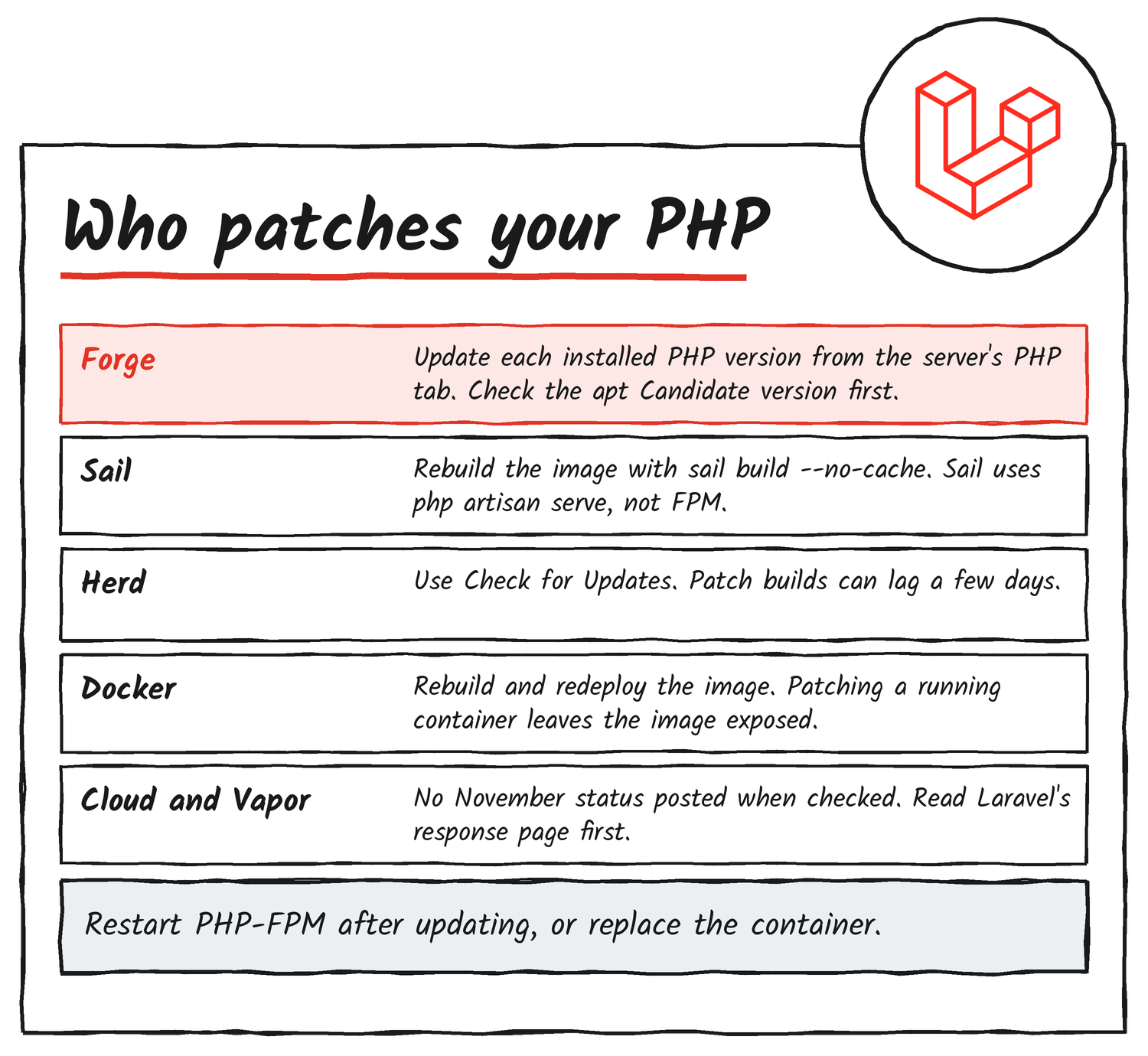
Forge. Per Forge’s October advisory, automatic security updates don’t patch PHP. Open the server’s PHP tab, update each installed version, and expect a few seconds of FPM downtime. Check what you’re about to install first. At about 18:30 UTC on 19 November, packages.sury.org for Ubuntu 24.04 listed php8.5-fpm 8.5.13-2, 8.4.28-2, 8.3.37-2 and 8.2.36-2, while the ondrej/php Launchpad PPA still listed 8.5.12, 8.4.27, 8.3.36 and 8.2.35. Forge’s own guidance is to compare the Candidate version from apt-cache policy php8.4-fpm with the fixed version, and wait if they differ.
Sail. The Sail runtime image installs PHP from packages.sury.org. Rebuild it with sail build --no-cache as the docs describe. Sail serves requests with php artisan serve, not FPM, so the FPM-specific bugs don’t apply there.
Herd. Use Check for Updates or the PHP tab. Herd’s docs say patch builds can lag a few days behind the official release while they’re tested.
Docker. The official php:8.5.13, php:8.4.28-fpm and sibling tags are on Docker Hub. Rebuild and redeploy, because patching a running container leaves the image exposed. Octane servers don’t run PHP-FPM, so the two FPM bugs skip them, but the engine-level fixes still apply, so rebuild those images too.
Laravel Cloud and Vapor. Laravel posts status for each platform on its PHP vulnerability response page. For October’s release, Cloud was patched in place and Vapor apps needed a redeploy. That page carried no update for the November release when I checked. Read it before you assume either way.
If you can’t upgrade today
These reduce exposure. PHP says the update is the fix.
| Setting | Covers | Notes |
|---|---|---|
session.upload_progress.enabled=0 |
126714, 115560 | Put it in php.ini or the pool config. ini_set() is too late. |
fastcgi_keep_conn off, enablereuse=off |
129289 | nginx’s default is off. |
zend.exception_ignore_args=1 or fatal_error_backtraces=0 |
129474, 129182 | PHP 8.5. Set it for FPM, not only the CLI. |
| Fix startup warnings, or log to syslog | 129496 | Restart the master and all workers. |
catch_workers_output=no |
129291 | High severity, local privilege escalation. The official FPM Docker images enable it. |
Pitfalls
- CLI and FPM differ.
php -vin your SSH session reports the CLI. Checkphp-fpm8.x -v, and a temporaryphpinfo()page for the web config. - Restart, don’t reload. Existing workers keep old state. In containers, replace the container.
- Distributions backport. The version string can stay the same while the fix is in. Check your distribution’s advisory for the CVE IDs.
- Queue workers. CLI workers aren’t hit by the web-facing bugs, but keep them on the same patched binary, and run
php artisan queue:restartafter upgrading.
Checklist
- PHP 8.2.36, 8.3.37, 8.4.28, 8.5.13 or 8.6.0 on every web server, queue box and container image
- FPM restarted, and the version it serves confirmed
session.upload_progress.enabledis 0 in every config that can write sessionsfastcgi_keep_connis off, unless you’ve decided otherwise- On PHP 8.5,
zend.exception_ignore_args=1in the FPM config - No PHP errors logged to a file at startup
- Nothing on the server calls
session_start()against a shared save path - No PHP 8.1 or older left in production
Sources
- PHP 8 ChangeLog and php-src security advisories
- CVE-2026-129289, CVE-2026-126714, CVE-2026-115560, CVE-2026-129496, CVE-2026-129481, CVE-2026-129474, CVE-2026-129182, CVE-2026-129291
- depthfirst: phpAfterShell
- Laravel support policy, Laravel PHP vulnerability response, Forge PHP advisory, Forge changelog
- My full PHP deep dive
Discover more from Sulat AI & Tech News
Subscribe to get the latest posts sent to your email.