Daniel San, who posts as @dani_avila7, wrote on X on 19 November (UTC) that Anthropic “just opened” its Claude Forward Deployed Engineer learning path and that he has finished most of it. The path exists, it’s free and it takes about 9.5 hours. Only members of the Claude Partner Network can register, and it has been listed longer than “just” implies.
Anthropic just opened its Claude Forward Deployed Engineer learning path!
— Daniel San (@dani_avila7) November 19, 2026
I’ve already completed most of it, and it gives you a clear picture of how to deploy AI in enterprise environments, from initial pilots to production, with the necessary security and compliance safeguards pic.twitter.com/4hDQUokGWd
The post is two sentences, so this piece goes to the source. It covers what’s on Anthropic’s path page and the course pages behind it, who can take it, and where it leads.
What the path is for
The path lives on Anthropic’s Partner Academy, hosted on Skilljar. Its tagline is “Take a customer from a first use case to a working pilot, on site.” A forward deployed engineer, or FDE, is an engineer who works inside a customer’s organisation. Demand for the title is growing: Lenny Rachitsky’s late-2026 hiring report put FDE openings at about 1,500, up 4.6 times in a year.
By the end, the page says, you can write a pilot plan for a customer use case. That plan has four parts: the baseline you’ll measure against, the success measures you agree before building, the slice of the use case you ship first, and how you bring on the first wave of users. The only prerequisite is that you build software and have worked directly with client teams.
The 11 courses
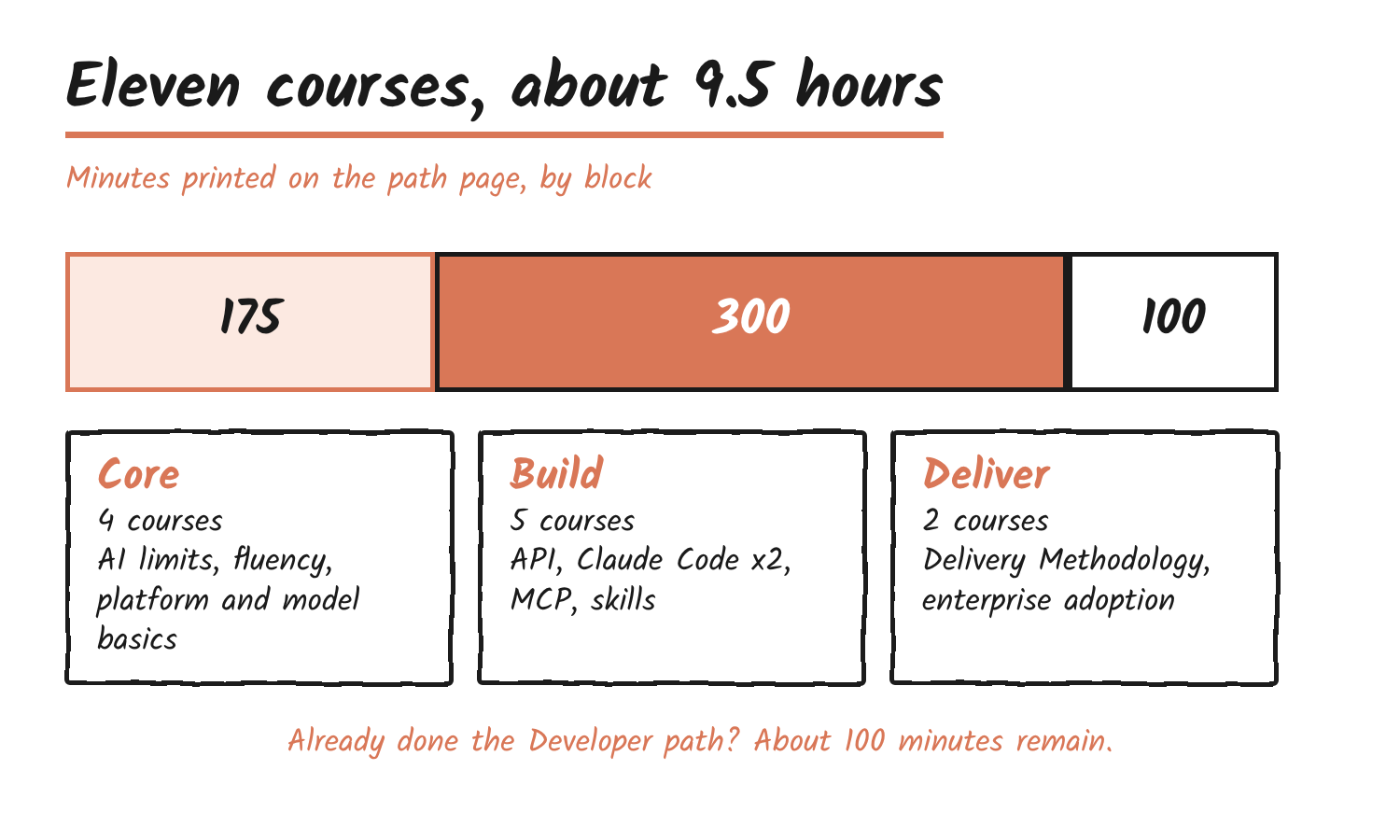
Anthropic sorts the courses into three blocks and prints a length beside each. Added up, they come to 575 minutes, the “about 9.5 hours” in the heading. Two of them, courses 1 and 4, link out to Claude Academy. The page also says the path shares nine courses with Anthropic’s Claude Developer path, so anyone who has finished that path has two courses left, about 100 minutes.
| # | Course | Minutes | What it covers |
|---|---|---|---|
| 1 | AI Capabilities and Limitations | 60 | Next-token prediction, knowledge, working memory and steerability, so you can say why a model behaved as it did |
| 2 | AI Fluency for Builders | 45 | The 4D Framework: delegation, description, discernment, diligence |
| 3 | Claude Platform and Model Foundations | 60 | Four decisions before a prompt: entry point, capability features, model and context |
| 4 | Choosing the right Claude model | 10 | Which model fits which task, and how each draws on your rate limit |
| 5 | Claude Platform 101 | 90 | First API call through the agent loop, tools, extended thinking, skills, MCP, context management and managed agents |
| 6 | Claude Code 101 | 60 | Install, the explore, plan, code, commit workflow, CLAUDE.md, subagents, skills, MCP and hooks |
| 7 | Claude Code in action | 60 | Long hands-off sessions: plan mode, permission modes, hooks, routines, headless runs and verification |
| 8 | Introduction to Model Context Protocol | 60 | Building MCP servers and clients in Python with tools, resources and prompts |
| 9 | Introduction to agent skills | 30 | Writing, sharing and troubleshooting skills |
| 10 | Delivery Methodology | 40 | Qualifying a use case, pilot design, baselines, adoption and risk |
| 11 | Driving enterprise adoption of Claude | 60 | Activation, acceleration and expansion, from the success team to the next workload |
What you need to do the build courses
The build courses are hands-on. Claude Platform 101 runs its demos in the TypeScript SDK with Node and npm, and asks for an Anthropic Console account, an API key and a small amount of prepaid credit. Claude Code 101 asks for a Claude Pro, Max or Enterprise account, or an API key. The MCP course needs working Python and a basic grasp of JSON and HTTP.
Claude Code in action is the course aimed at the customer’s repository. It teaches you to scope long sessions with plan mode, enforce non-negotiable rules with hooks, schedule routines on Anthropic’s infrastructure, and verify what an unattended run produced in proportion to how little you watched it.
The two courses that make it an FDE path
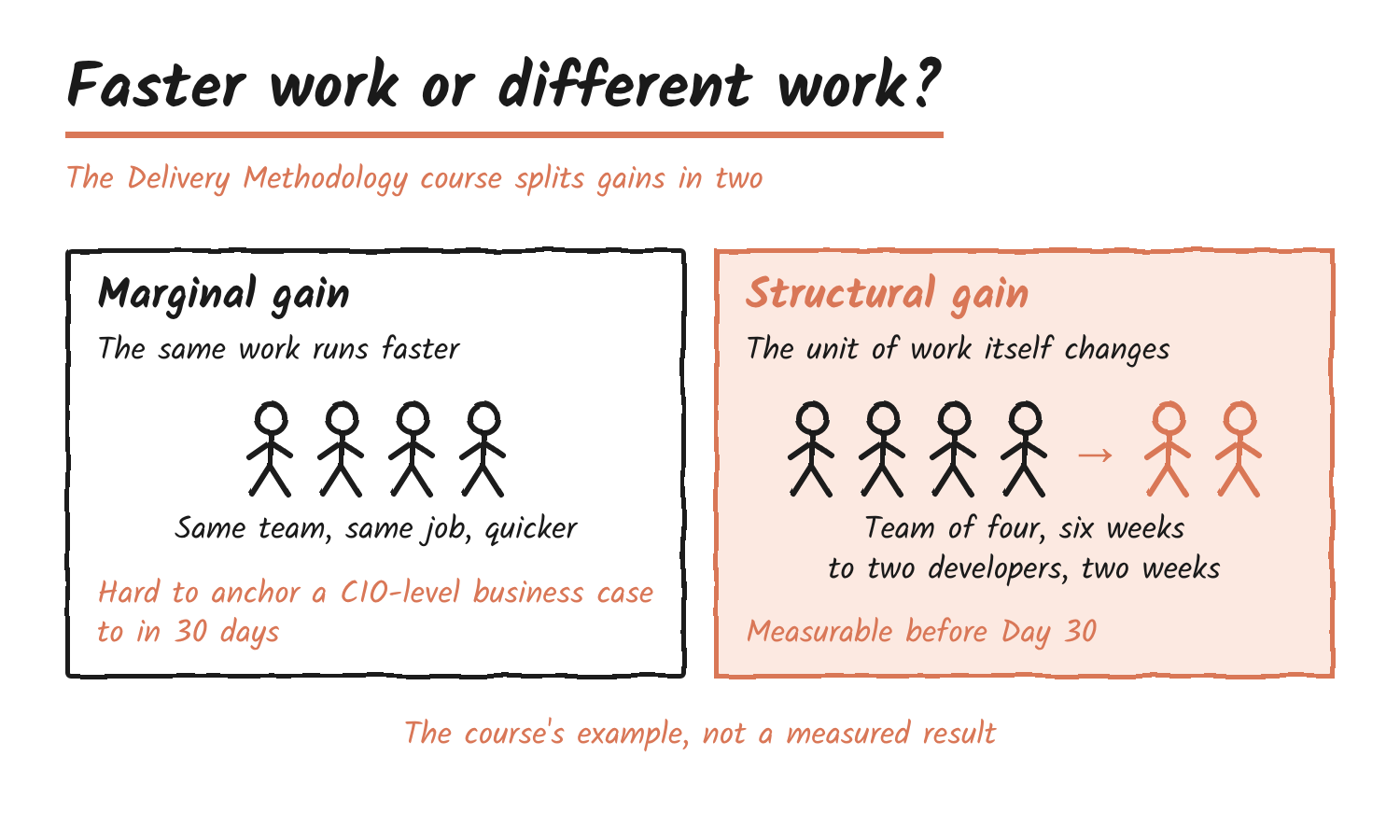
Delivery Methodology is the course that turns the rest into a customer engagement. Its page says the technical deployment is the easier part. It gives four criteria for a pilot-worthy use case: volume, complexity, measurability and developer readiness. It says to capture a baseline before day one, because without pre-pilot data there’s no denominator for the ROI calculation. It also covers cohort selection, champions, CLAUDE.md as deployment infrastructure, and a walkthrough of a 30-day Claude Code activation. The artifact you build is a Delivery Plan Pack: use case qualification, pilot design, ROI scorecard and champion plan, completed for a sample client brief.
The course’s central distinction is between marginal and structural gain. A marginal gain means the same work runs faster, which the page calls real but hard to anchor a CIO-level business case to in 30 days. A structural gain means the unit of work changes. Its example is a task that took a team of four six weeks and now takes two developers two weeks.
Driving enterprise adoption of Claude takes over once the pilot works. It follows a three-phase framework. Activation sets up the technical foundations and the success team. Acceleration scales through governance and a Centre of Excellence, and Expansion goes after the next workload. The course tells learners to expect a productivity J-curve, a dip before the gain, and ships with configuration checklists, communication templates and measurement surveys.
Who can take it
The path page says “Register | FREE” at the top and, further down, “Open to Claude Partner Network members.” Anthropic’s separate eligibility page says the certification exams work the same way: they’re open to people at organisations in the network, who sign in with a company email on a domain in the organisation’s partner record. An organisation that delivers Claude for clients can apply at claude.com/partners.
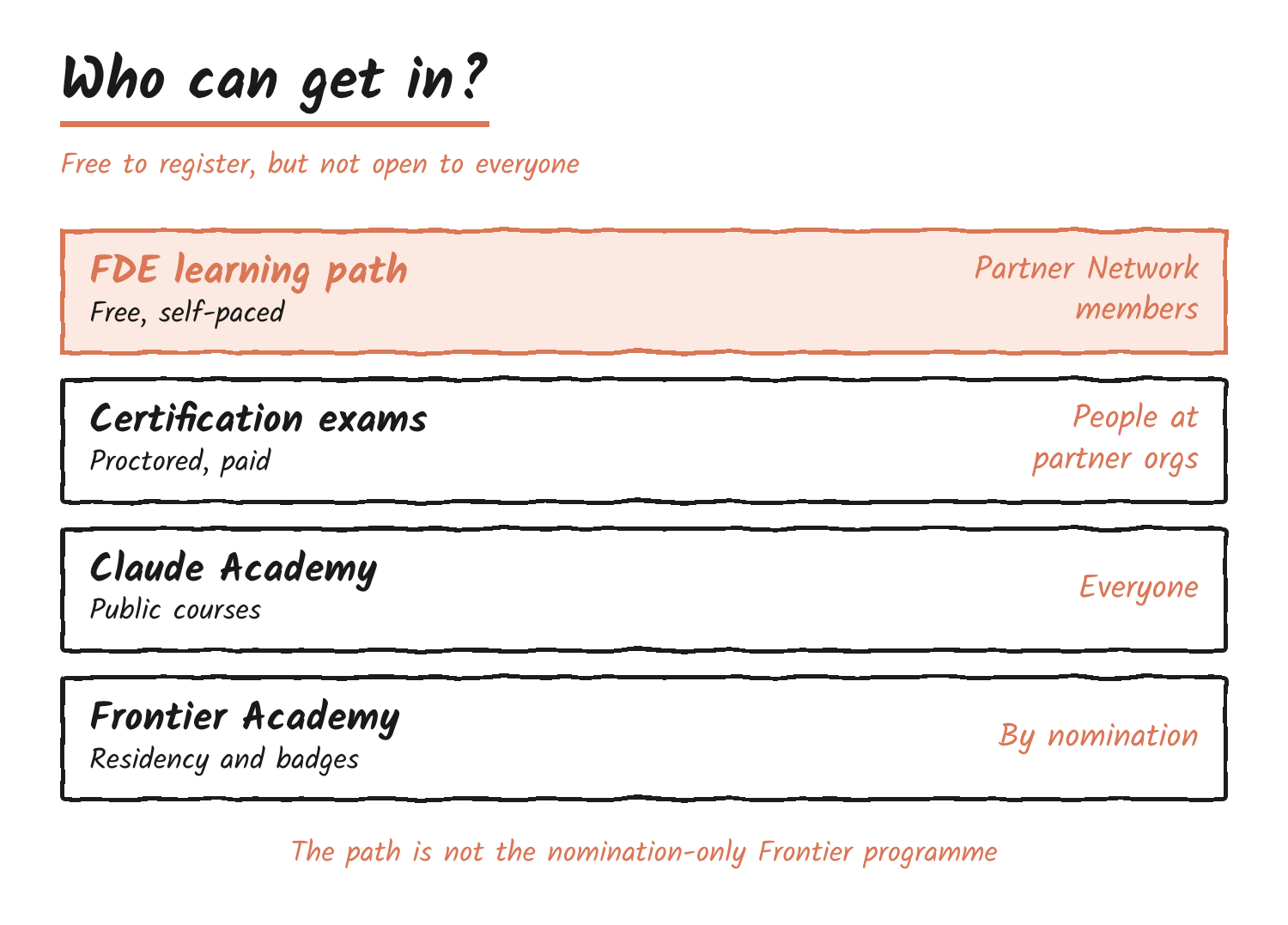
Everyone else has Claude Academy, which is public and ends each course with a quiz and a certificate of completion. Two of the path’s own courses, 1 and 4, already sit on Claude Academy.
It’s not the Frontier Academy, and it’s not new this week
Anthropic launched Claude Frontier Academy on 2 October with US$100 million and a target of 10,000 Frontier Deployed Engineers by the end of 2027. That programme is by nomination: a simulated enterprise deployment, a Claude Resident Engineer badge, a 12-week residency, and the first Frontier Deployed Engineer badges in early 2027. The Partner Academy path page doesn’t mention it, and the path page names no badge of its own.
On timing, the path page prints no date. Cred Farmer, an independent study site with no tie to Anthropic, recorded the path on Partner Academy on 6 and 10 November. The Delivery Methodology page also prints more time than the path does: 1 hour 13 minutes measured plus an estimated 1 hour 10 minutes of practice, against 40 minutes on the path page. For that course, 9.5 hours is a floor.
Where it leads
The path has no exam of its own. Its “Where next” section recommends preparing for Claude Certified Developer – Foundations, and says the exam “counts toward partner tier in the Claude Partner Network.” It puts the prep courses at about 13 hours, and names Claude Certified Developer – Professional as the next level. For engagements heading to production it points to Architect – Professional prep, and for Claude Code deployments to the free Claude Code partner badge, whose courses take about 12 hours.
The exams are proctored through Pearson VUE and scored from 100 to 1,000, with 720 to pass. Passing earns a Credly badge and a credential valid for 12 months. Sitting one means being 18 or older with a government-issued ID, and the exam fee is separate from the free path.
Discover more from Sulat AI & Tech News
Subscribe to get the latest posts sent to your email.