Imbue has open sourced Sculptor, a desktop app that runs several coding agents in parallel, under the MIT licence. The company announced it on X on 18 November, saying it spent two years building “a better version of Claude Code” and linking a post on what it learned along the way. The code and downloads are on Imbue’s GitHub repo.
We spent two years building a better version of Claude Code. Today we’re open sourcing it. Here’s what we wish we knew before we started. https://t.co/Epm9ph5BO9
— Imbue (@imbue_ai) November 18, 2026
The linked post is dated 16 November and was written by Bryden Fogelman, the Sculptor team’s directly responsible individual, and Jean Juang, who handles developer relations. It says Imbue launched Sculptor in 2025 and open-sourced it in mid-2026. Version 0.50.0, released on 16 November, added Fable 5.2, Sonnet 5.5 and Haiku 5.5 to the model list.
What Sculptor does
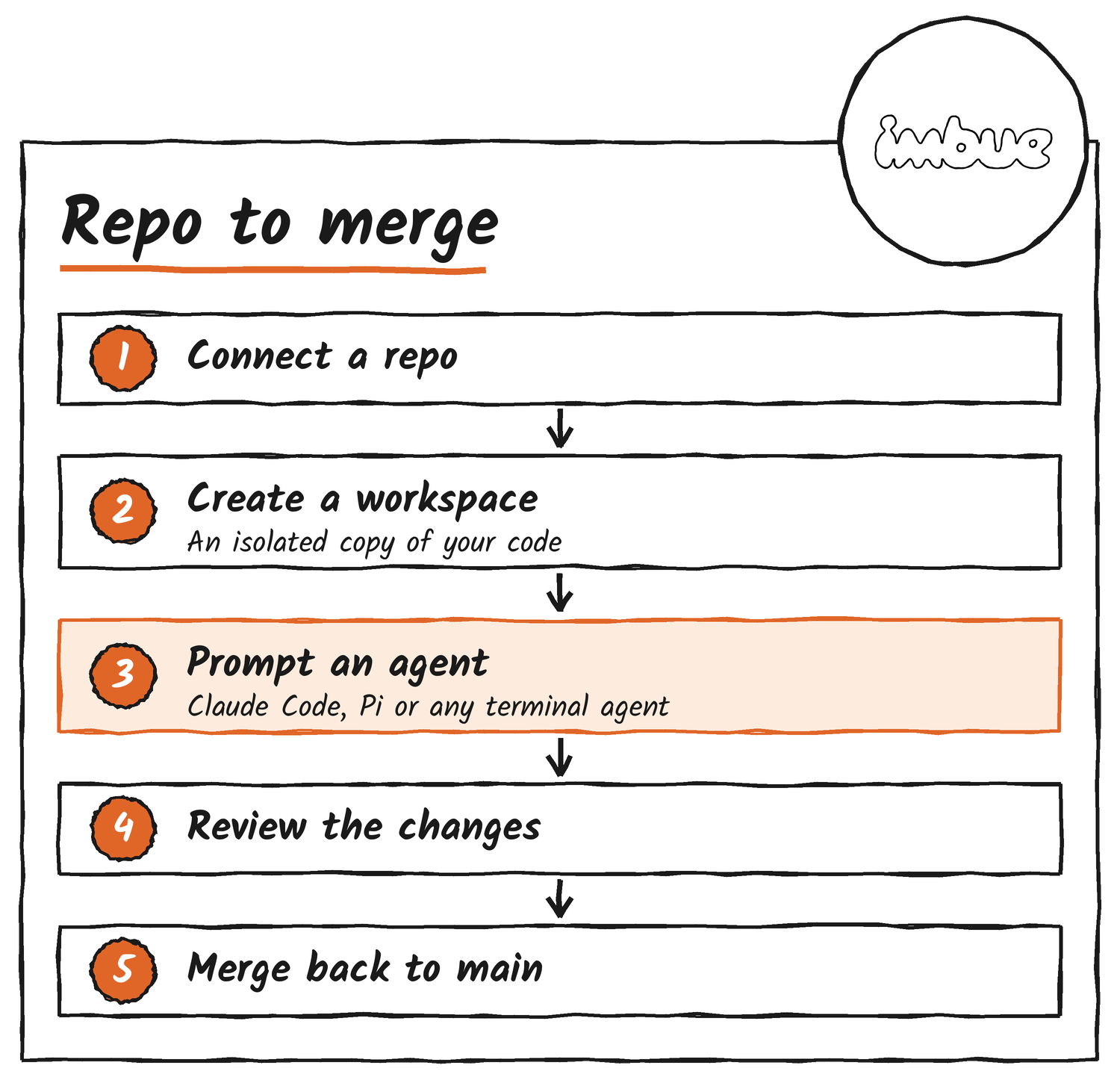
Imbue’s README gives the loop in four steps. Connect a repo, create a workspace (an isolated copy of your code), prompt an agent, then review the changes and merge back to main. You can open another workspace for a different project, or add a second agent to the one you have. Fogelman says the agents keep working while you do something else, so you don’t have to manage Git worktrees by hand.
Sculptor runs Claude Code and the Pi harness, an open, community-supported agent harness, and it can manage any terminal-based agent. Imbue’s harness docs say Claude Code runs as a streaming JSON process with its control protocol switched on, so Sculptor can read Claude’s events and ask it questions mid-session. Pi runs in RPC mode, and Sculptor pins the extensions Pi loads. For Pi, the docs list two gaps: there’s no fast mode, and the turn footer has no context-usage percentage.
The default window has panels for code, a terminal, the agent list and agent chat, plus a plugin library that includes a web browser, notes and a Linear board. Imbue’s product page says plugins are written in JavaScript or TypeScript. Pairing mode syncs an agent’s work into your IDE. The app also ships workflow skills, and the fix-bug skill runs a short reproduction interview, writes failing tests, then makes them pass.
Imbue describes isolation two ways. Fogelman’s post says each agent runs in its own container, so it can’t wreck your local setup. The product page says each workspace is an isolated Git worktree with its own branch, terminal and diff view.
The two builds Imbue threw away
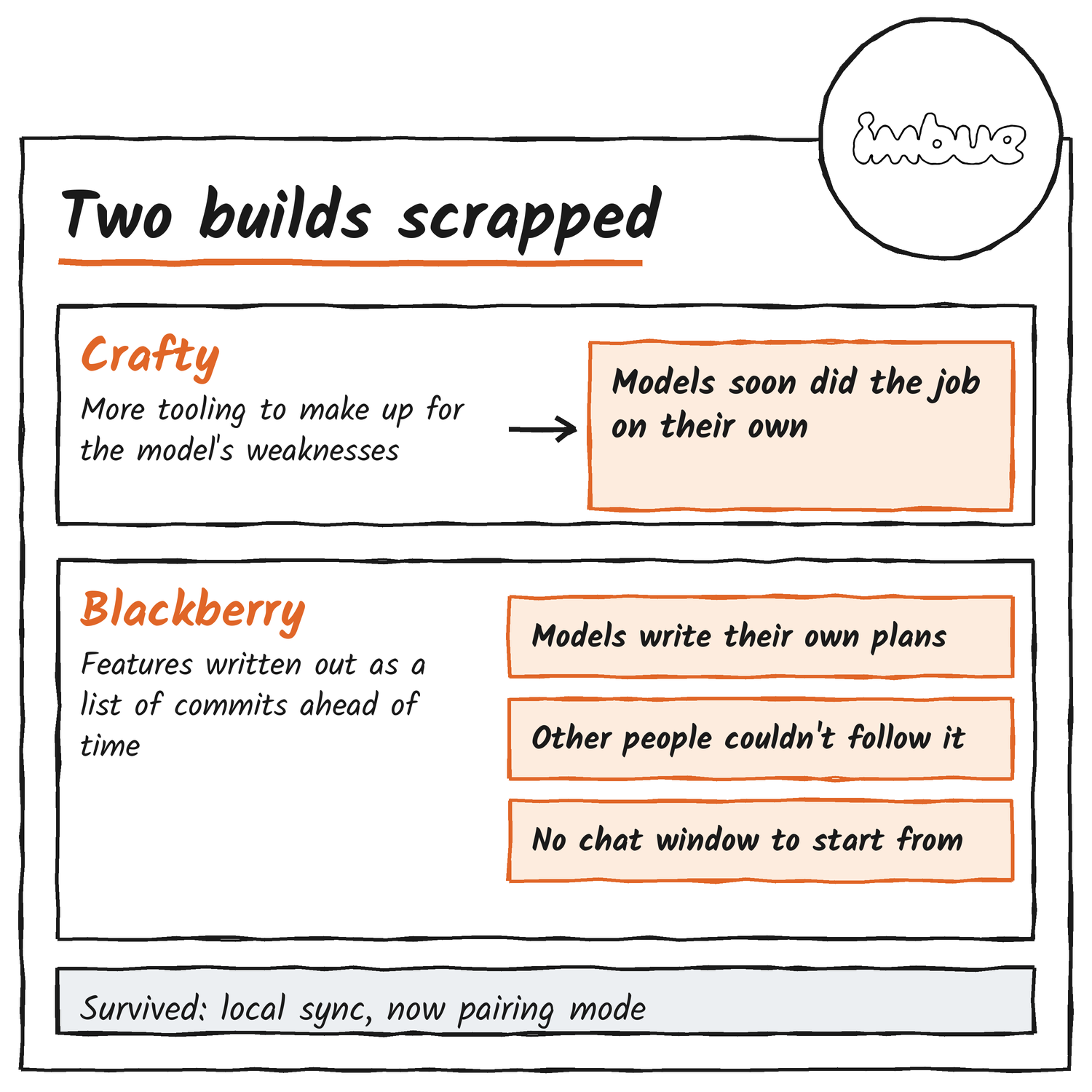
Fogelman says the first attempt, Crafty, generated code in parallel from GPT API calls that returned diffs. Imbue kept adding tooling to cover the model’s weaknesses, such as fixing the bugs a linter flags, until the model could do those jobs itself. He calls that the bitter lesson of AI, where any investment built around a model tends to lose to improvements in the model.
The second, Blackberry, had you write a feature as a nested list of commit descriptions ahead of time, and the tool built it. Imbue scrapped it for three reasons Fogelman gives. Models got good at writing and iterating on their own plans, other people couldn’t understand how it worked, and it had no chat interface, which users had come to expect. One idea survived. Local sync, which let you pull an agent’s work into your local checkout, became pairing mode.
Fogelman says the lesson he keeps returning to is that Imbue should have asked other people how it feels to build software this way, because he had built Blackberry around his own workflow. For Sculptor, the idea he cares about most comes from Pi: a tiny, simple core that you extend however you want. He says people at Imbue have each customised the interface heavily, and that saving and restoring panel layouts is in the works. Sculptor is model-agnostic on purpose, so you can run Pi and Claude side by side.
Why Imbue open sourced it
The post gives three reasons. Fogelman says Sculptor should be a public good, because the closer agents and LLMs get to open and publicly available, the better he thinks it is for society. He says a tool that abstracts over model providers is an off-ramp from any one lab’s platform as open-weight models improve at coding. And he says Imbue maintains it but doesn’t own it, inviting people to fork it, cut out the parts they don’t use and inspect the code for security and privacy.
Fogelman also lists four projects he’d like to see built, which he describes as bounties. They are an agent that uses a Claude Max plan until it hits its limit and then switches to an open model on Pi with no new context, a nightshift mode that nudges enabled tasks along overnight, event-driven work that spawns workspaces from GitHub issues, Slack, Sentry and Telegram, and a mobile version. None of them are shipped features.
What it costs and where it runs
Sculptor is free. Imbue’s product page says it runs on your computer, needs no subscription beyond your model provider, and that Imbue doesn’t store your repositories or train on your code. You bring your own Claude plan or a supported open model.
Downloads cover Mac (Apple Silicon), Linux and Linux ARM64. The product page says there’s no Windows or mobile support.
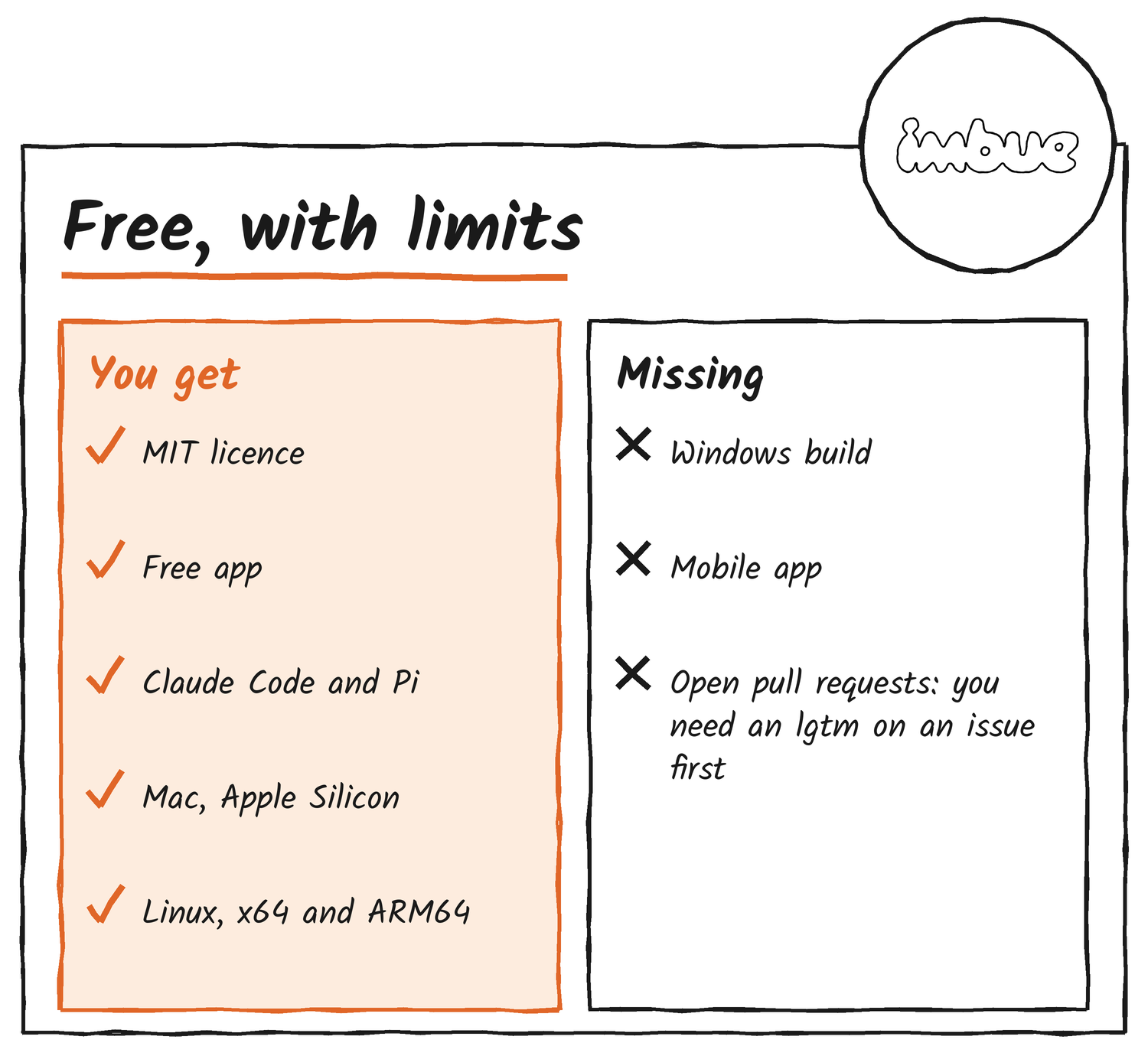
The README labels Sculptor an experimental research preview and says to expect bugs and fast changes. It also says Imbue doesn’t have the bandwidth for a large volume of outside contributions. Issues are open to everyone, but pull requests aren’t. Imbue’s contributing guide says it accepts them only from contributors a maintainer has cleared by replying lgtm on an issue, and it closes the rest automatically.
Bug reports and ideas go in the repo’s GitHub issues, and release notes are on its releases page.
Discover more from Sulat AI & Tech News
Subscribe to get the latest posts sent to your email.