The European Commission has confirmed that an AI-generated cyber campaign hit some of its systems, hours after Politico reported the attack on the morning of 19 November. Spokesperson Thomas Regnier told a Brussels press briefing that the Commission detected the campaign on 22 October and has seen no evidence of a data breach affecting its staff as a whole, Reuters reports.
Politico’s Brussels Playbook broke the story, citing an EU official who said CERT-EU, the cybersecurity service for the EU institutions, detected hackers using ARTEX, a publicly available AI tool built to find weaknesses in IT systems. The official put the detection earlier in November, while the Commission’s own date is 22 October. Regnier didn’t name the tool at the briefing, Xinhua reports, and said he isn’t aware of any ransom demand.
EXCLUSIVE: A huge cyberattack has hit the European Commission.
— POLITICOEurope (@POLITICOEurope) November 19, 2026
The incident has potentially compromised swaths of personal data and prompted the most senior officials to discuss the crisis at their weekly meeting.
More in Brussels Playbook 👇https://t.co/9WURHuiJLZ
What went offline
Politico reports the disruption ran for more than 10 days and hit Sysper, the HR platform staff use for payslips, leave requests and timesheets, and MyPMO, the medical reimbursement system. Both were restored earlier this week, though Sysper crashed again on Wednesday 18 November, and translation services were also hit on Tuesday. Salaries landed as usual, Politico found, but some officials couldn’t submit timesheets or request leave.
Euronews, citing an official, adds that the Joint Sickness Insurance Scheme, the staff health cover known as JSIS, was still unavailable on Thursday. It reports that the HR systems hold names, pay grades, home addresses and contact details, but wouldn’t normally open the way into the Commission’s internal documents, which sit on a separate system.
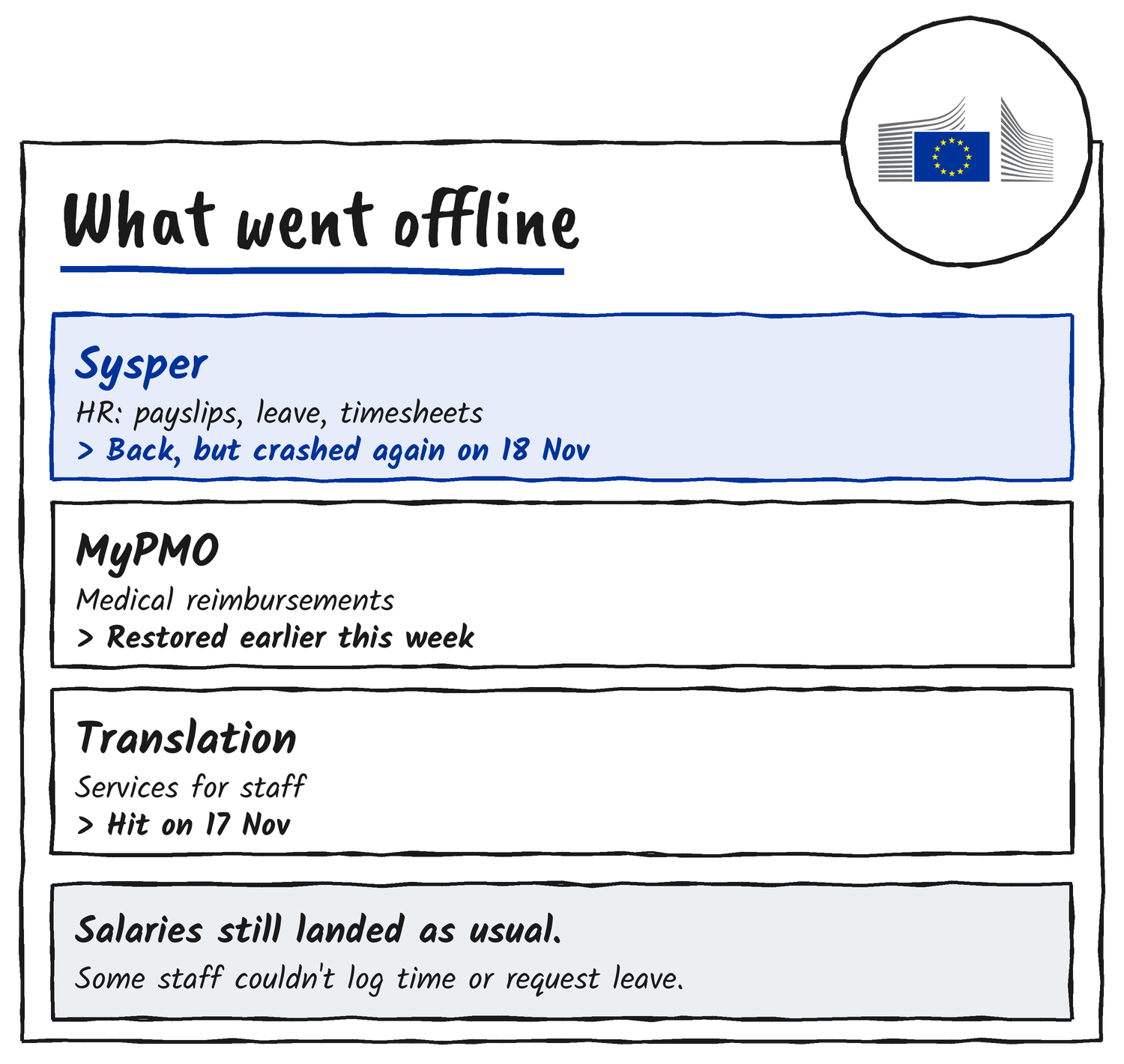
Staff heard little. Three officials told Politico the Commission hadn’t communicated well, and one IT reply about a Sysper problem, seen by Politico, blamed a general issue without mentioning a cyberattack. The EU official said the silence reflects the Commission not yet knowing whether, or how much, personal information was taken.
What the Commission says
Regnier said the Commission took several applications offline as a protective and preventive measure and that most are back. “The investigation is still ongoing,” he said, adding that the Commission is taking any necessary steps as findings come in. He declined to say who is behind the campaign. In a written reply to Sulat, a Commission spokesperson said the Commission is also preventively checking other systems, and pointed to its Action Plan on Cybersecurity and Artificial Intelligence, which identifies the risk of AI being misused for cyber operations. The European Data Protection Supervisor’s press office told Sulat that the Commission has informed and notified it, but that it doesn’t yet have the full information because the Commission’s analysis is still developing, and it referred questions about the state of play to the Commission. The Commission has told the departments concerned, and Xinhua reports it remains in close contact with CERT-EU and the European Data Protection Supervisor.
Inside the building, the Commission convened its Corporate Management Board, its top crisis-management body, over what a leaked internal email called “ongoing cyber incidents”, according to Politico. The digital services department ordered stepped-up security checks, and the tech commissioner, Henna Virkkunen, briefed the College of Commissioners on Wednesday, two officials told Politico.
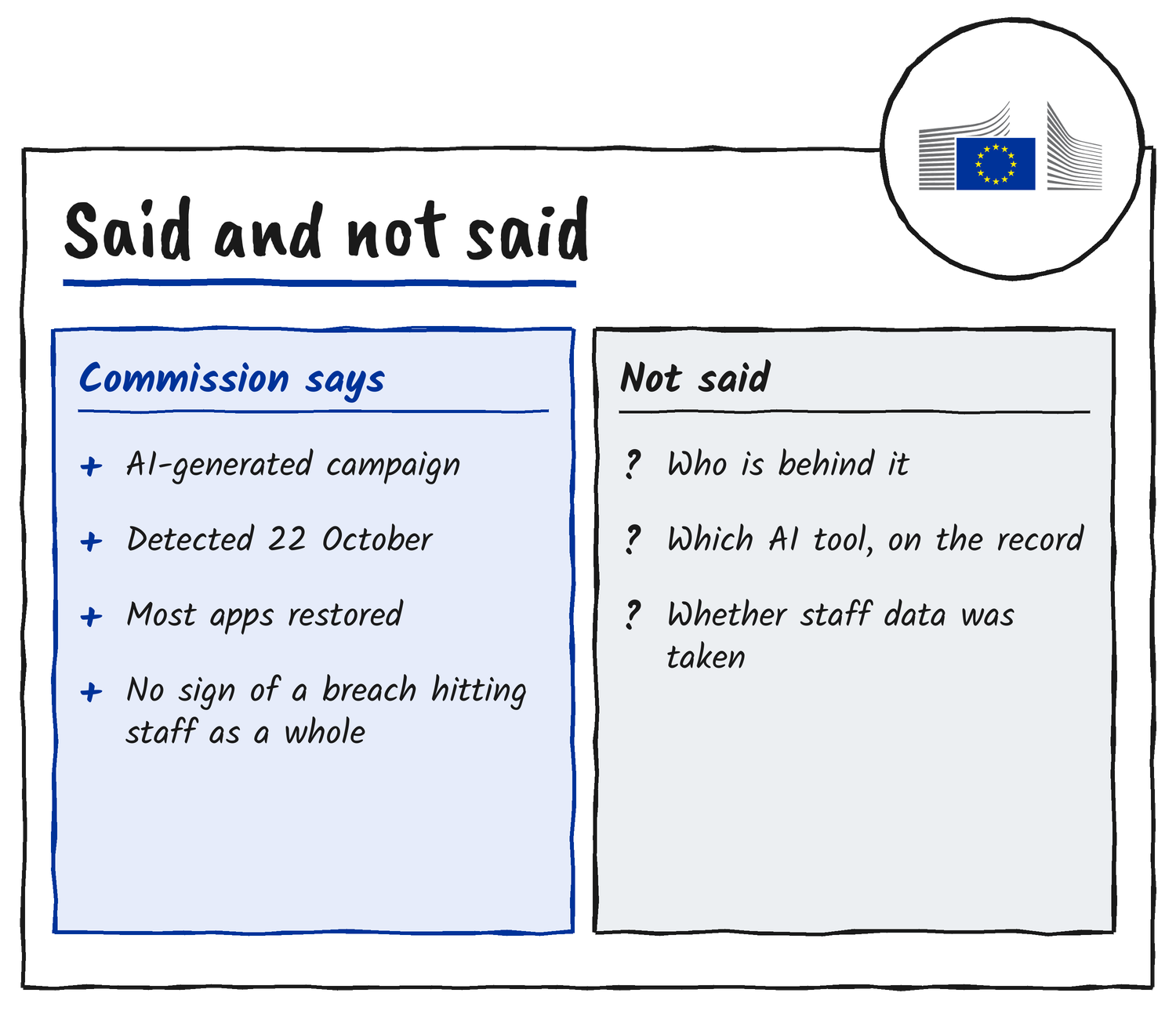
The Commission’s statement says “individual systems were targeted” and that those concerned were told. Neither the statement nor Politico’s report gives a number for how many people that covers.
Where ARTEX fits
CERT-EU’s 5 November advisory describes ARTEX as an open-source platform that takes a goal in plain language, splits it into tasks and has AI agent workers run reconnaissance and testing with real tools. A human operator steers it from a dashboard, but CERT-EU says nothing technical enforces its scope. ARTEX has no model of its own, so operators plug in an outside LLM, and its original author pulled the repository in October after reports of misuse, which leaves only independent forks.
CERT-EU said it had seen AI-driven activity against its own constituency that “highly likely” involved ARTEX, and it assessed that the tool’s public availability will likely speed up adoption by attackers. The FBI issued its own warning on 13 November, saying some ARTEX intrusions reached privileged access in under three hours.
Earlier this year, attackers used a stolen API key to get into the Amazon Web Services account behind the Europa.eu website, and CERT-EU later said about 92GB of compressed data was stolen, according to The Next Web. Politico’s report doesn’t say how the attackers got into the HR systems this time, or whether ARTEX did the breaking in or only the scanning.
Hero illustration features the European Commission logo, which remains the trademark of its owner.
Discover more from Sulat AI & Tech News
Subscribe to get the latest posts sent to your email.