Cloudflare CEO Matthew Prince said on the company’s third-quarter earnings call that OpenAI pays Cloudflare for hints about when web pages change, and that an AI company signed a one-year, $11 million contract for the Workers developer platform. The call ran on 5 November in the US, which was 6 November in New Zealand, and Cloudflare has posted the corrected transcript on its investor site.
Cloudflare’s results release puts third-quarter revenue at $782.5 million, up 39% on a year earlier. Prince said that took the company past $3 billion in annualised revenue. Cloudflare guided to $845 million to $846 million for the fourth quarter.
What OpenAI is paying for
A Goldman Sachs analyst asked Prince when Cloudflare’s products for the agent economy would bring in real money. He answered that Cloudflare is already recognising significant revenue from making crawling more efficient, and he named OpenAI. Instead of fetching every page over and over, OpenAI’s crawler gets a hint from Cloudflare when a page has changed, say when a restaurant updates a menu price, and fetches only that page. “OpenAI is paying for that,” Prince said. He said the hints save OpenAI money, and they get the freshest version of a customer’s page to OpenAI without wasting the customer’s resources. The arrangement first came up on the previous quarter’s call.
The two companies announced the research pilot on 8 July. In a 15 October blog post, Cloudflare said signals from a cohort of about 1% of its network had helped OpenAI discover and index hundreds of millions of new pages.
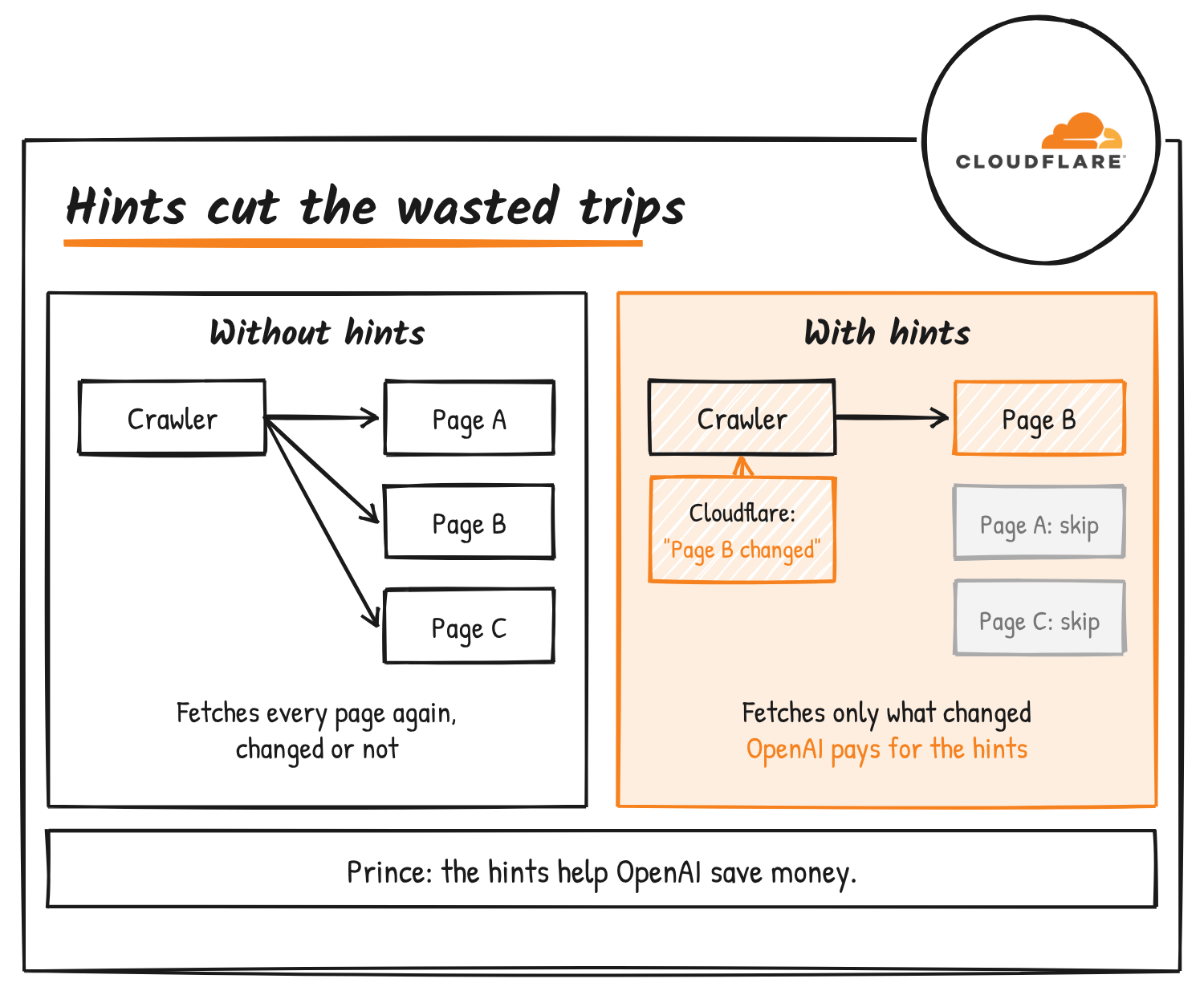
Prince expects other companies to follow OpenAI. He also expects small payments to flow from agents to websites, and said a site might charge an agent less the more it says about why it’s visiting. Cloudflare recorded its first revenue from what it calls Act 4 products, the ones built around a new business model for the internet. Looking ten years out, Prince said he’d imagine they become the largest part of the company. For sites that want more agent traffic, he said Cloudflare is helping with what he likened to a new version of SEO.
The $11 million Workers deal
Prince described the buyer only as a rapidly growing AI company, and Cloudflare didn’t name it. The contract is a pool-of-funds deal, a prepaid commitment the customer draws down as it uses Cloudflare’s services, and it runs for one year. Prince said tens of millions of AI-generated applications have been created on the customer’s platform. With Cloudflare’s dynamic Workers those apps start in milliseconds, and the customer pays only for the compute it uses. One of its lead engineers told Cloudflare that without dynamic Workers “we wouldn’t be able to build what we want to build.”
It was one of six large contracts Prince listed.
| Customer | Contract | Products |
|---|---|---|
| Fortune 100 cloud infrastructure provider | $15.5 million, 13 months | Magic Transit |
| Rapidly growing AI company | $11 million, one year | Workers developer platform |
| US federal department | $10.3 million, five years | SASE |
| Fast-growing technology company | $9.5 million, 39 months | Application services, Workers |
| European media company | $8.1 million, five years | Application services, Workers |
| Global consulting firm | More than $7 million, three years | Zero Trust, application services, Workers |
Developers, isolates and agents
Prince said Cloudflare now has more than 10 million active developers, up from 7 million a quarter earlier. It added more than 158,000 paying customers in the quarter, nearly double its previous record of more than 80,000 in the second quarter.
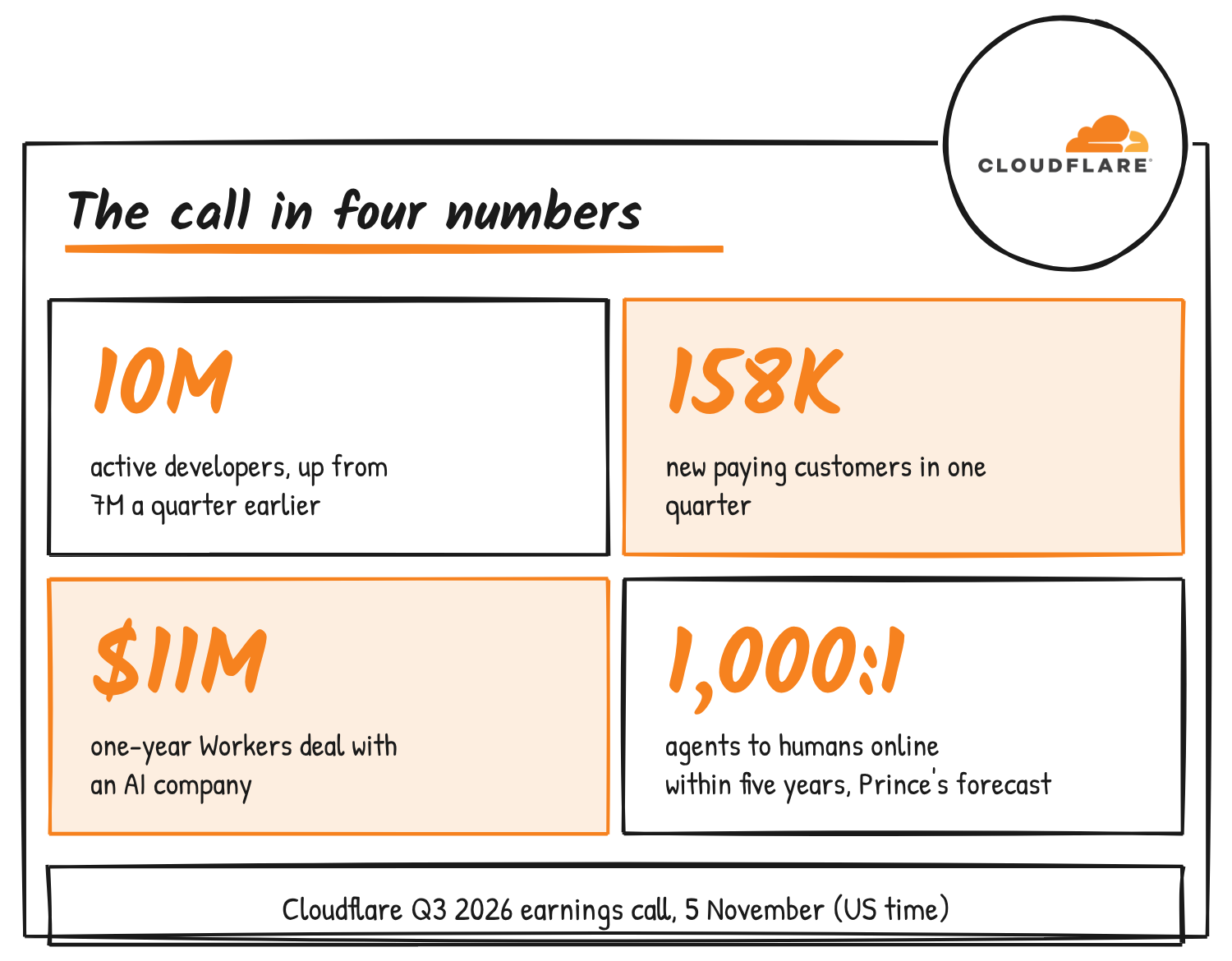
Prince put the growth down to Workers. He said it runs on isolates, not the containers that hyperscalers and the newer neocloud providers are built on, and that containers can’t keep up with agent workloads at a sensible cost. He called Cloudflare the first agentic cloud. On agents, he repeated last quarter’s forecast that they’ll outnumber humans online 1,000 to 1 within five years, then said he’d now take the under on the timing.
Asked how customers feel about the rise in agent traffic, Prince said some want as many agents as they can get and others want them kept out, and Cloudflare serves both. He added that Cloudflare has never been a CDN business in the usual sense. It caches pages because it worried its security services would slow them down, and charging for CDN traffic has never been a big part of its revenue.
For the full year, Cloudflare expects revenue of $2.963 billion to $2.964 billion. Chief financial officer Thomas Seifert said the company expects to reach GAAP profitability in the fourth quarter.
Disclosure: I’m an OpenAI, Firecrawl and Devin ambassador.
Discover more from Sulat AI & Tech News
Subscribe to get the latest posts sent to your email.