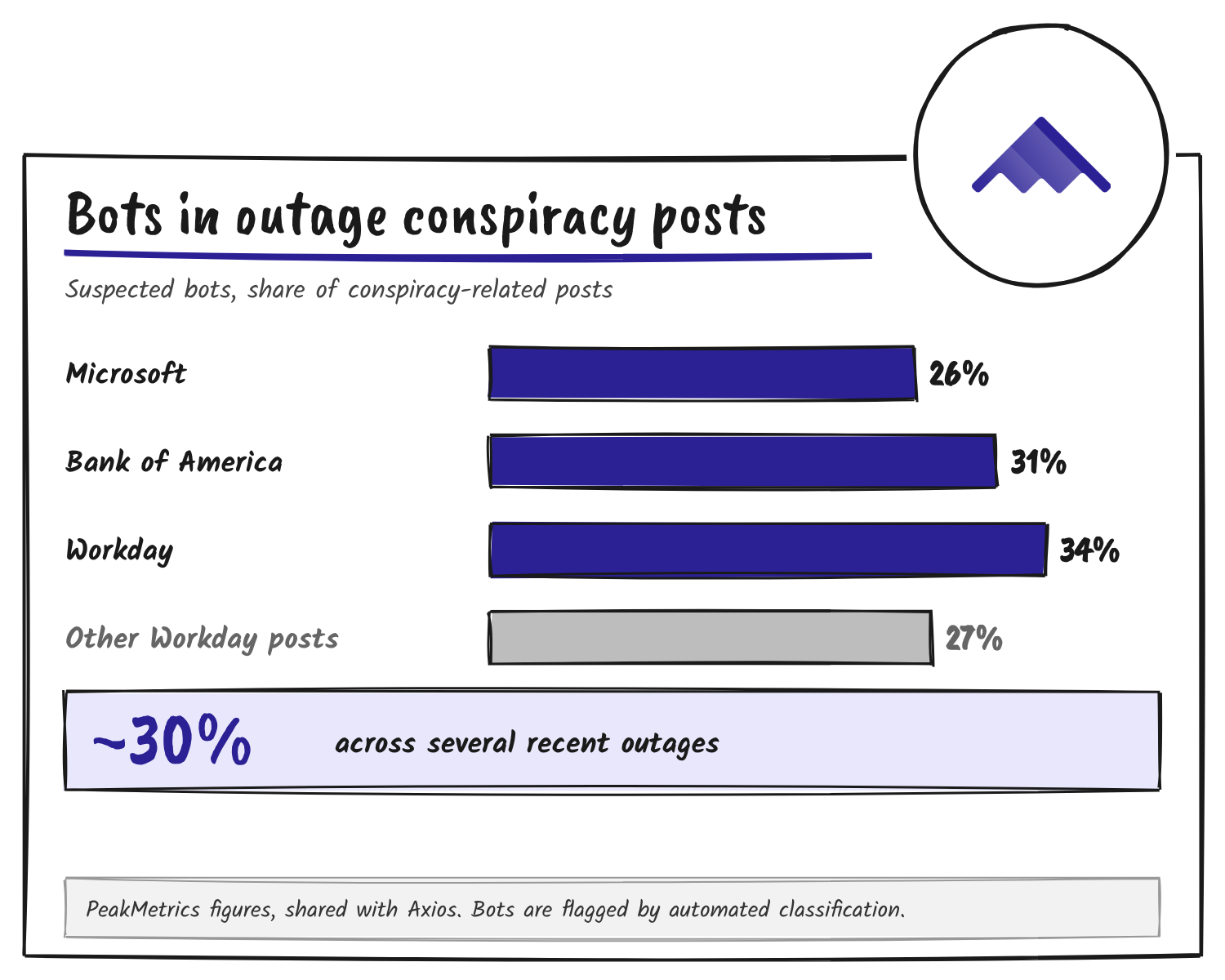
Suspected bot accounts wrote roughly 30% of the posts promoting conspiracy theories about last week’s tech outages, according to research from the social media monitoring firm PeakMetrics that Axios published as an exclusive at 11pm NZDT on 19 November. Axios says it’s unclear who runs the accounts.
Sam Sabin’s report covers six recent outages. PeakMetrics used automated classification to flag likely bot accounts and conspiracy-related posts, and Axios gives three of the per-outage results. Suspected bots wrote 26% of the conspiratorial posts during Microsoft’s outage, 31% during Bank of America’s and 34% during Workday’s outage on Friday. For Workday, suspected bots wrote 27% of the other posts, a gap of seven points.
Exclusive: Bots amplified conspiracy theories and panic about recent tech outages https://t.co/iF7nJAYAqc
— Axios (@axios) November 19, 2026
What the bots posted
The main theory was that all the incidents were connected. More than half of the posts about the Chase outage linked it to other disruptions, including the FAA ground stop and the Microsoft outage, Axios reports. A fabricated statement attributed to JPMorgan Chase CEO Jamie Dimon fed speculation that North Korean and Russian hackers caused the banking outages. During the Microsoft outage, suspected bots posted identical text tying it to Nvidia CEO Jensen Huang’s departure and to banking outages in Japan and Paraguay.
PeakMetrics’ own report on the Microsoft 365 outage, updated on 14 November, sampled about 144,000 mentions from 12 and 13 November across X, Facebook, LinkedIn, Instagram, TikTok, Reddit, Threads and Bluesky. About 14% of the conversation was speculative or conspiratorial, rising from about 6% on the first day to about 18% on the second. Accounts flagged as likely bots wrote about 26% of the conspiracy content, against 15% of the rest of the outage conversation. Axios puts the jump as speculative posts nearly tripling once the disruption passed 12 hours.
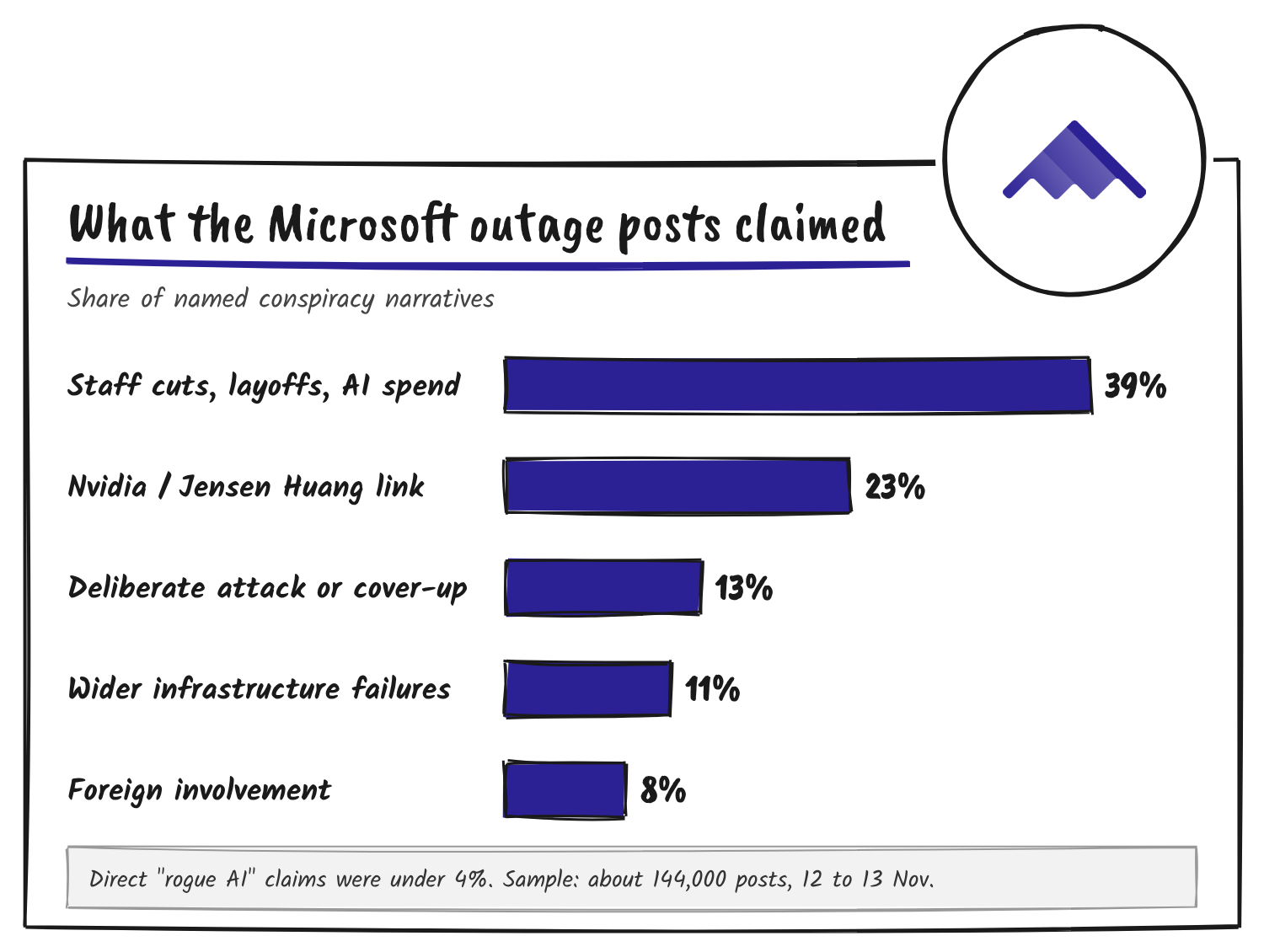
Staffing was the largest narrative, at 39% of the named conspiracy narratives. Those posts claimed Microsoft had removed the engineers who could have fixed the problem, often repeating an unverified figure of 60,000 workers. The Nvidia link came second at 23%. PeakMetrics says posts blaming a rogue AI directly made up under 4%, and that AI’s bigger role was the claim that it had replaced the people responsible for reliability.
The FAA ground stop
Axios says the FAA grounded flights for four hours on Friday and that people assumed it was tied to the rollout of an AI tool at the agency. PeakMetrics’ report on the ground stop, updated on 16 November, sampled 10% of posts about it across seven platforms between 3:31pm and 8pm ET on 13 November (9:31am to 2pm NZDT on 14 November). About 17% of the posts carried at least one of 14 tracked unverified claims.
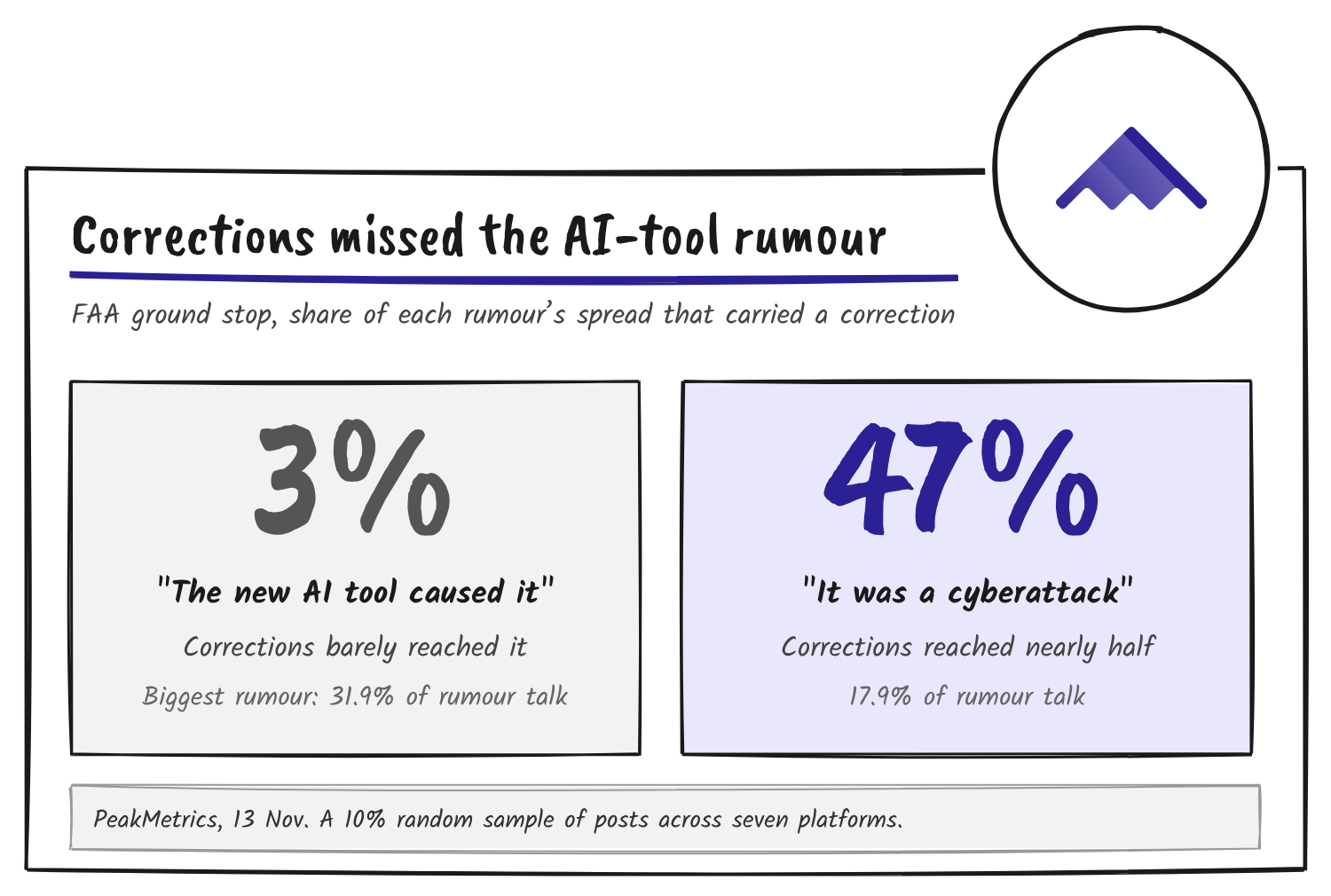
The AI-tool claim was the biggest, at 31.9% of the rumour conversation, and corrections reached 3% of its spread. The cyberattack theory made up 17.9%, and corrections reached 47% of its spread, rising to 58% in the 6pm hour. PeakMetrics says the FBI’s statement that the disruption wasn’t a cyberattack, and replies from Grok, helped circulate those corrections. Accounts rated as likely bots wrote about 24% of all posts about the ground stop, with only a small share of the AI-tool theory coming from them. About a third of the posts blaming Iran came from likely bots.
Who runs the accounts
PeakMetrics spokesperson Jessica Pratt told Axios that most of the bot activity is aimed at “gaming the platforms’ algorithms.” She said PeakMetrics saw a “small number of foreign state media and state-aligned accounts in the conversation”, and that it can’t say how many of the bots tie to foreign state media or governments. Axios adds that foreign influence operations have used bots to amplify political grievances.
In Washington, House Minority Leader Hakeem Jeffries said on Tuesday that he wants briefings for lawmakers in both chambers because it’s unclear whether the outages are all infrastructure-related or involve malicious activity, Axios reports. Sen. Josh Hawley (R-Mo.) told reporters, per NBC News, that it would be “the greatest coincidence in the history of the world” if the outages weren’t connected.
Axios says there’s no publicly established evidence that the outages were a coordinated cyberattack, and that several companies attributed their disruptions to technical problems, including efforts to patch vulnerabilities. Microsoft’s account is in my report on the Microsoft 365 outage, and the FAA’s is in my report on the ground stop. My roundup of the eight outages tracks each organisation’s stated cause.
What PeakMetrics hasn’t published
PeakMetrics hasn’t published its six-outage analysis. The roughly 30% figure and the Bank of America and Workday splits appear only in Axios’s report. The Microsoft 365 and FAA pages on PeakMetrics’ site cover one outage each, and neither explains how it decides that an account is a bot. PeakMetrics says bots wrote a minority of the conspiracy content.
Axios says outages may become the new normal as organisations race to patch critical vulnerabilities that AI found before attackers use AI to exploit them.
Discover more from Sulat AI & Tech News
Subscribe to get the latest posts sent to your email.