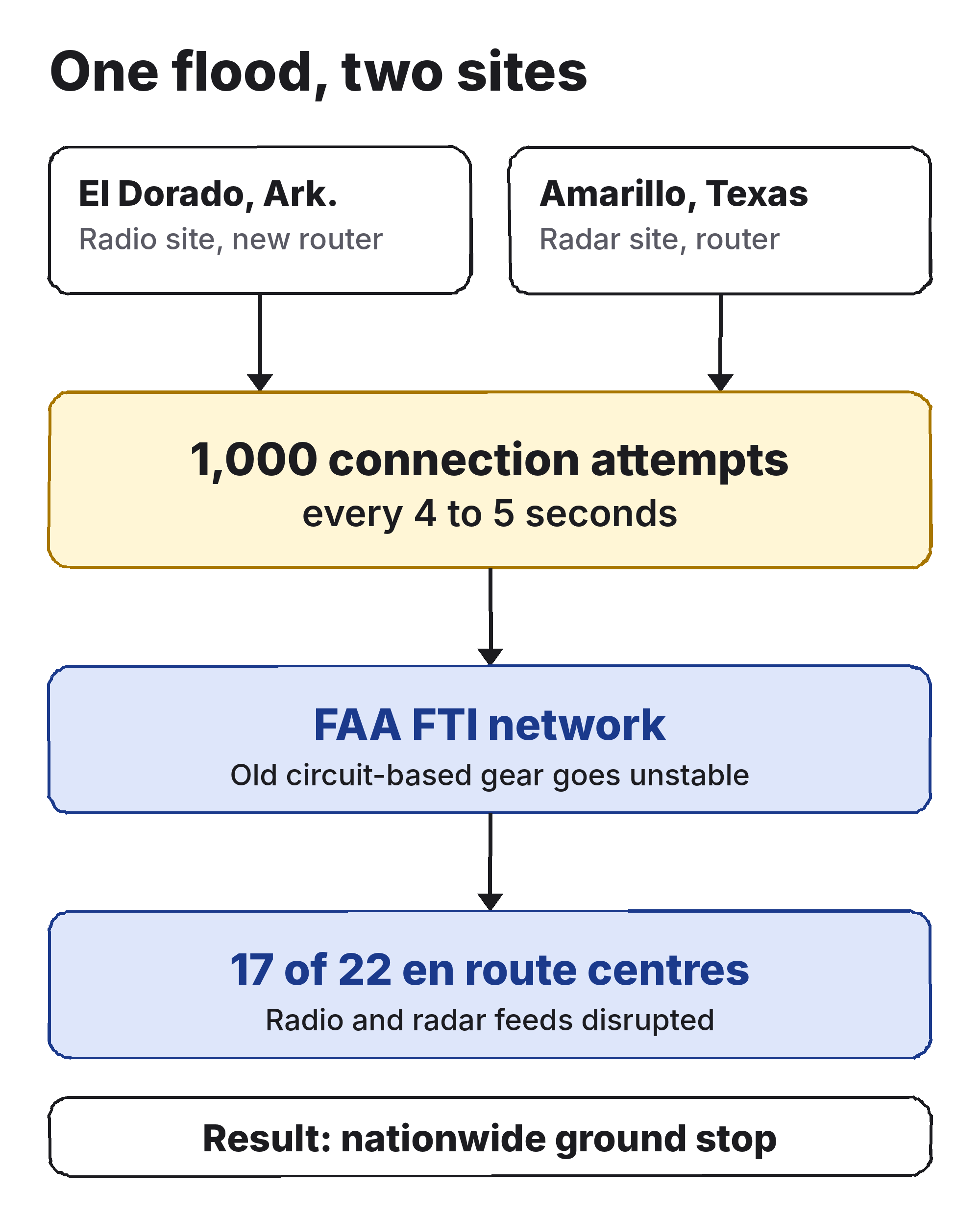
The FAA has traced Friday’s nationwide ground stop to a flood of network traffic from two remote sites, a radio communications site in El Dorado, Arkansas, and a radar site in Amarillo, Texas. The Wall Street Journal framed it as the single router in southern Arkansas that ground air travel to a halt. The FAA’s own Q&A, published on Sunday, names both sites.
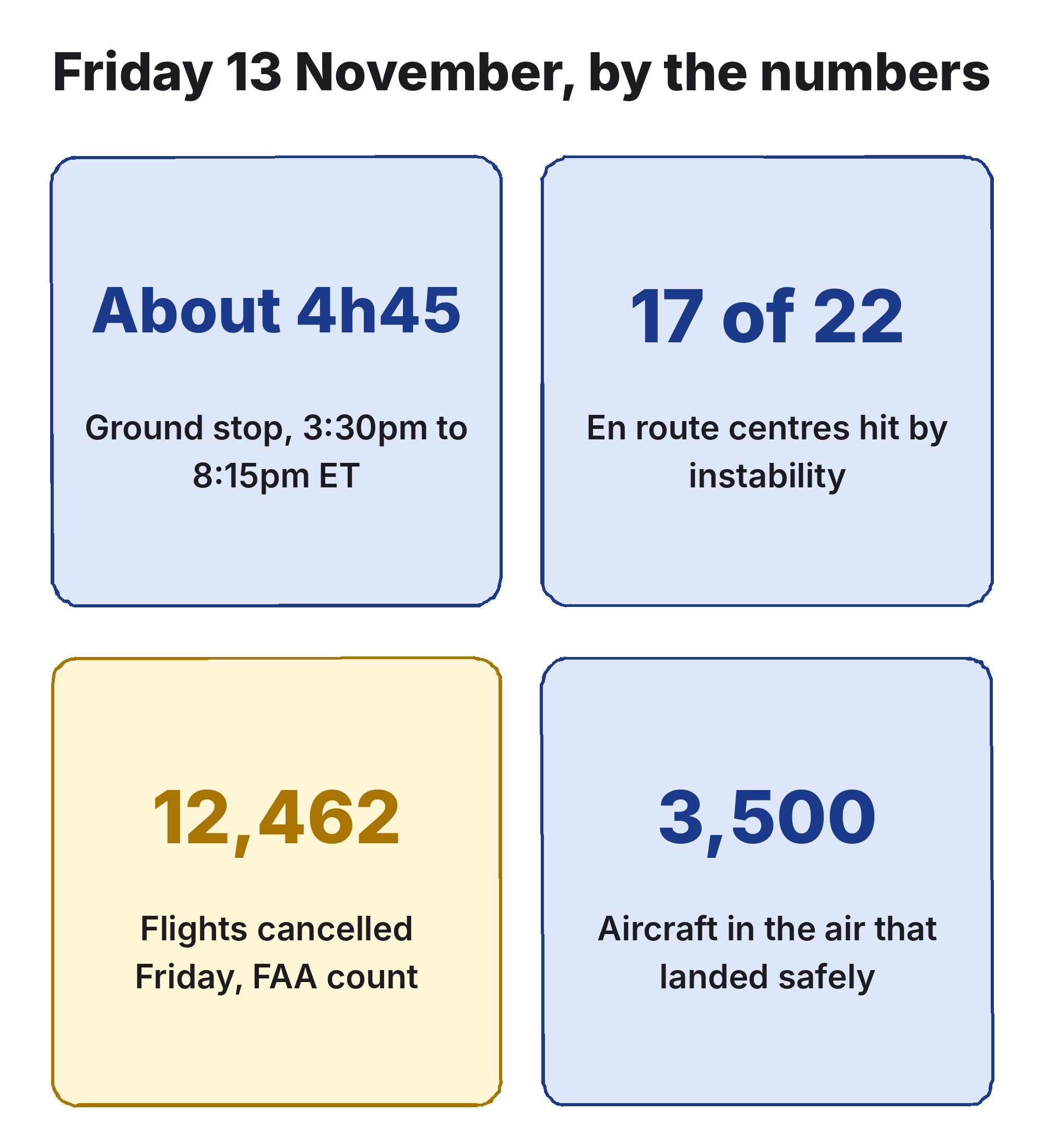
The agency issued the ground stop at about 3:30pm ET on 13 November and let traffic resume at 8:15pm. Reuters calls it the longest nationwide halt since the 11 September 2001 attacks. The FAA counts about 12,462 flight cancellations that day, 9,082 of them by major airlines, and says every aircraft landed safely, including about 3,500 that were in the air when the stop began. I covered the first hours in my earlier report.
What the FAA says happened
The FAA says its legacy equipment became unstable when data began flooding its FTI network at a rate of 1,000 connection attempts every four to five seconds. That disrupted aircraft communications and radar feeds at 17 of its 22 air route traffic control centres and spread into several terminal radar approach controls. Some radio frequencies and radar feeds stayed reliable throughout, the FAA says, and it describes the event as instability rather than a full outage.
The FAA says its network provider, L3Harris, was working at the El Dorado site that day and was installing a new router there. Once the data inconsistencies showed up, the FAA says, L3Harris cut off both locations and the network stabilised. The Journal reports that the router was made by Juniper Networks, which HPE owns, and that it started sending out a high volume of data on Friday afternoon, not long after the installation. Rebecca Guy, the FAA’s technology chief, told Saturday’s press conference: “We disabled both of those right away and were able to stabilize our network.”
The feature behind the flood
The Journal, citing government and industry officials, reports that FAA officials identified a broadcasting feature on the router that sent data more broadly than necessary. The FAA says it disabled that function on the originating routers and, as a precaution, on about 60 similar routers in the network.
Who’s blaming what
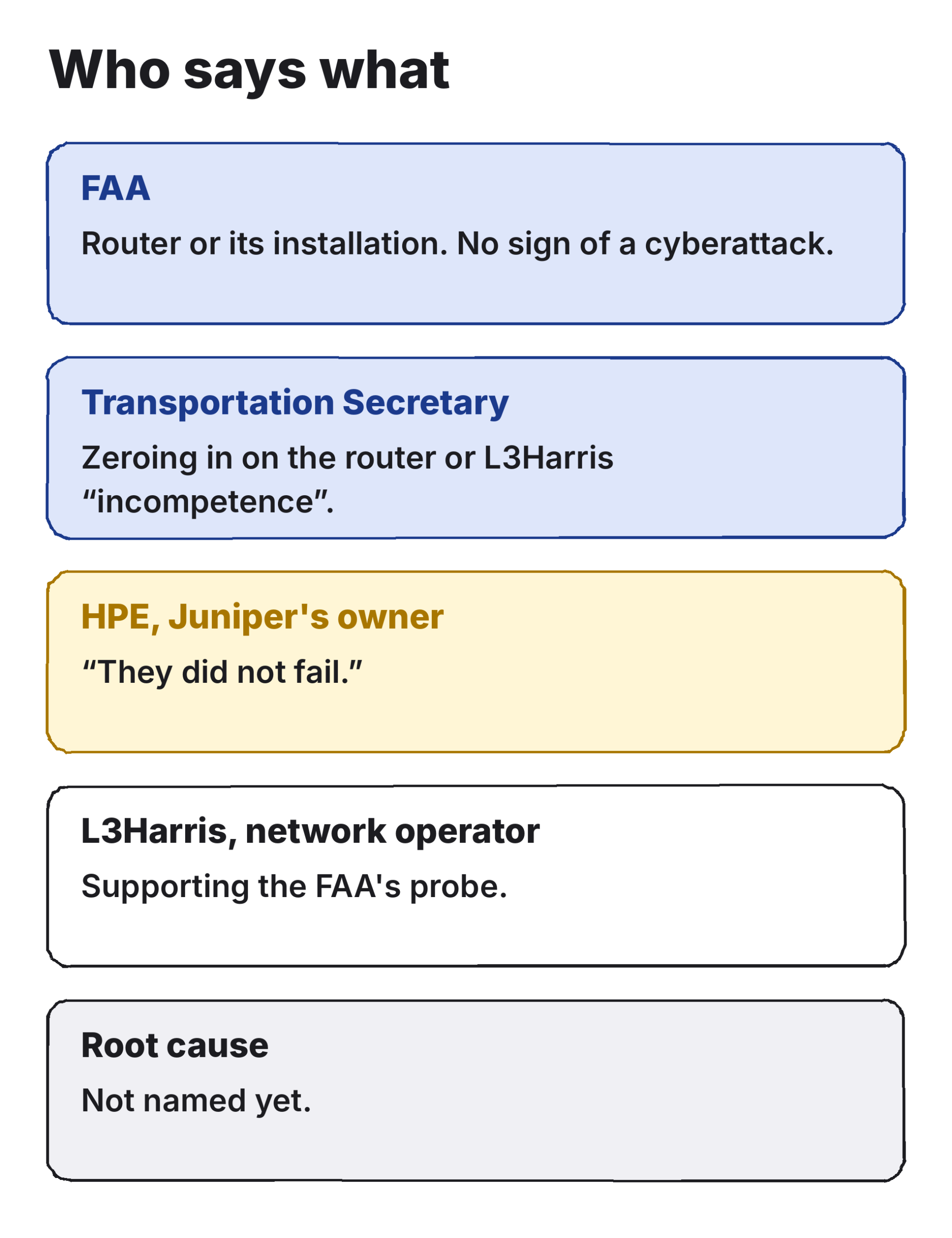
Transportation Secretary Sean Duffy has put the cause down to either L3Harris’s work or the hardware. “We’re working to determine whether we had incompetence, meaning was it user error or installer error from L3Harris, or did they install a faulty router?” he said on Saturday, according to Reuters. FAA Administrator Bryan Bedford asked the same question in three parts: a faulty installation, a faulty configuration or a bad router.
HPE says the Juniper devices appeared to have been working as intended. “They did not fail,” a spokesman told the Journal. L3Harris says it’s supporting the FAA’s investigation. The FAA says it has no indication of a cyberattack or an outside nefarious actor. The FAA hasn’t named a root cause.
The union Professional Aviation Safety Specialists said the problem was isolated to two routers updated on Friday, and that its technicians weren’t involved in the upgrades. An FAA official told Reuters the agency carried out a safety assessment before the work.
An old network
FTI is a decades-old mix of copper wire and fibre-optic cable that L3Harris oversees and the FAA is upgrading in a multibillion-dollar programme. A 2023 outside review warned that “system risk could quickly reach unacceptable levels” because of rising outages and inadequate funding, the Journal reports. Bedford said the agency spends hundreds of millions of dollars a year maintaining its antiquated telecom systems.
Work to swap copper for fibre in busy areas normally happens overnight, the Journal says. Changes at remote sites in the daytime weren’t expected to affect many flights, and Duffy said officials will re-evaluate when they do that work. He also said more disruptions could come until the copper wires are all replaced at the end of 2028.
Recovery was slow. Delta, United and American each cancelled about 25% of their flights on Saturday, and JetBlue nearly 45%, Reuters reports. Bedford said he expected operations to largely return to normal by late Sunday.
Discover more from Sulat AI & Tech News
Subscribe to get the latest posts sent to your email.