Nathaniel Craig, a visiting scientist at OpenAI, has put forward a candidate lattice definition of the whole Standard Model, and says GPT-6 Astra led the detailed proof. OpenAI published his account on 15 November as the first guest post on its new science blog. The preprint behind it went up on arXiv on 6 October.
Craig also leads the particle theory group at UC Santa Barbara. The preprint, “A gauge-invariant measure for lattice chiral fermions”, is listed at 60+63 pages with 12 figures, and links a mathematical companion and a Lean formalization. Lean checks proofs by machine.
What was missing
The Standard Model matches experiment across 18 orders of magnitude, Craig says, from hydrogen’s 21-centimetre radio line to collisions at the Large Hadron Collider. Still, he writes, “a foundational problem remains: how to give the full theory a nonperturbative definition, one that does not rely on treating its interactions as small corrections.”
The usual method, perturbation theory, switches the interactions off and adds them back a bit at a time. It has predicted the electron’s magnetism to within a few parts in a trillion. It’s no help with the proton, whose mass comes mostly from quarks and gluons moving and interacting; without the strong force the proton falls apart.
A lattice, a grid of points standing in for spacetime, gives a rigorous definition at a given spacing and lets the theory run on a computer. For the strong force that has produced the proton’s mass from first principles, Craig says. The weak force stalls it. It treats left-handed and right-handed particles differently, and, in Craig’s words, “If we try to put a left-handed fermion on the lattice, the most natural rules give you a right-handed partner you never asked for.” Physicists call that doubling.
Light in a box
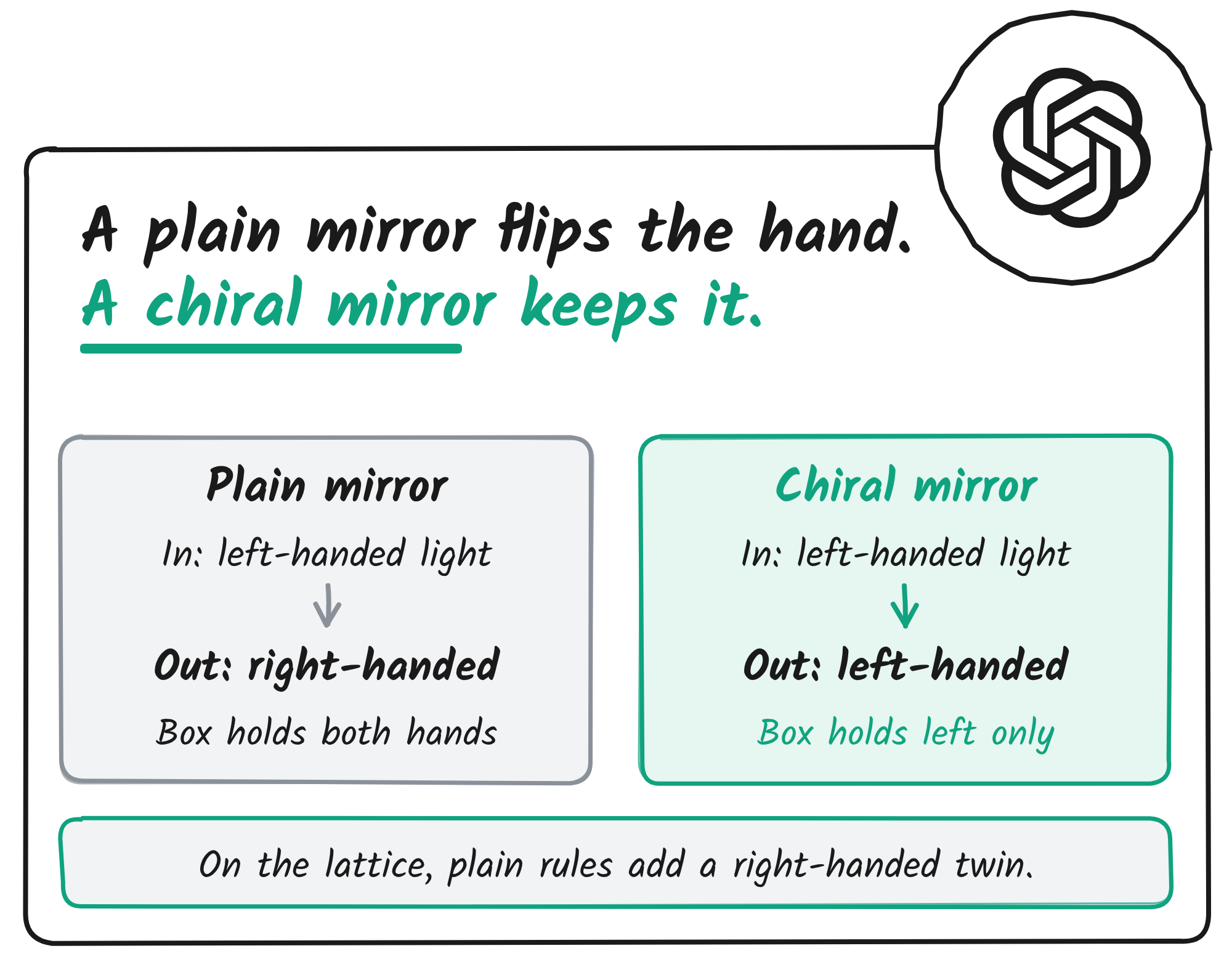
Craig explains it with a laser and a box. With ordinary mirrors at each end, left-circular light turns right-circular on every bounce. “You supplied only left-handed light, and the box supplied the other hand,” he writes. A chiral mirror, a film whose molecules turn slightly from layer to layer in a spiral, sends left-handed light back left-handed. Some scarab beetles have a similar spiral in their shells. The analogy is Craig’s own.
The lattice equivalent took decades to assemble. Paul Ginsparg and the Nobel laureate Ken Wilson set the rules, Rajamani Narayanan and Herbert Neuberger built the mirror itself, known as overlap fermions, and Martin Lüscher showed how to tell the two hands apart. Yoshio Kikukawa and collaborators explored using it for the weak interactions. One piece was missing.
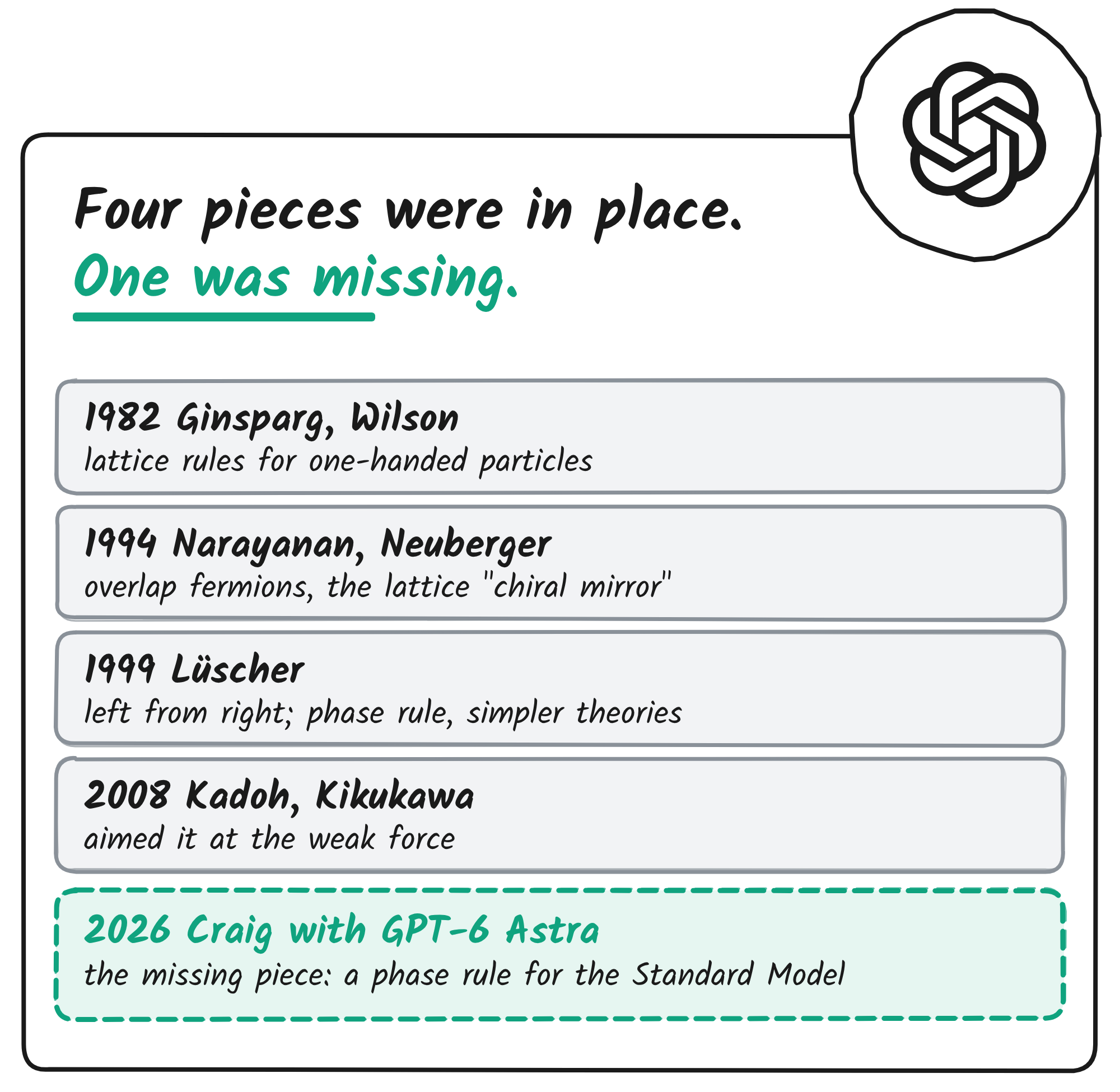
That piece was the phase. In the box, light coming back from a lap has to arrive in step with the laser, and turning one mirror sets the timing. On the lattice the phase depends on what the forces are doing at every grid point. Lüscher had worked it out for simpler theories such as a chiral version of electromagnetism, but for the full Standard Model, Craig writes, the alignment “remained open for more than 25 years.”
Finer grids
Craig’s idea was to describe the same force fields on a series of finer grids. Comparing the allowed fermion states on two neighbouring grids gives one part of the phase correction, and adding the parts up gives the phase rule on the original grid. He writes that the proof shows the correction comes out right around every allowed loop, which gives a measure for the Standard Model at finite lattice spacing under a bound on field strengths at the scale of the grid.
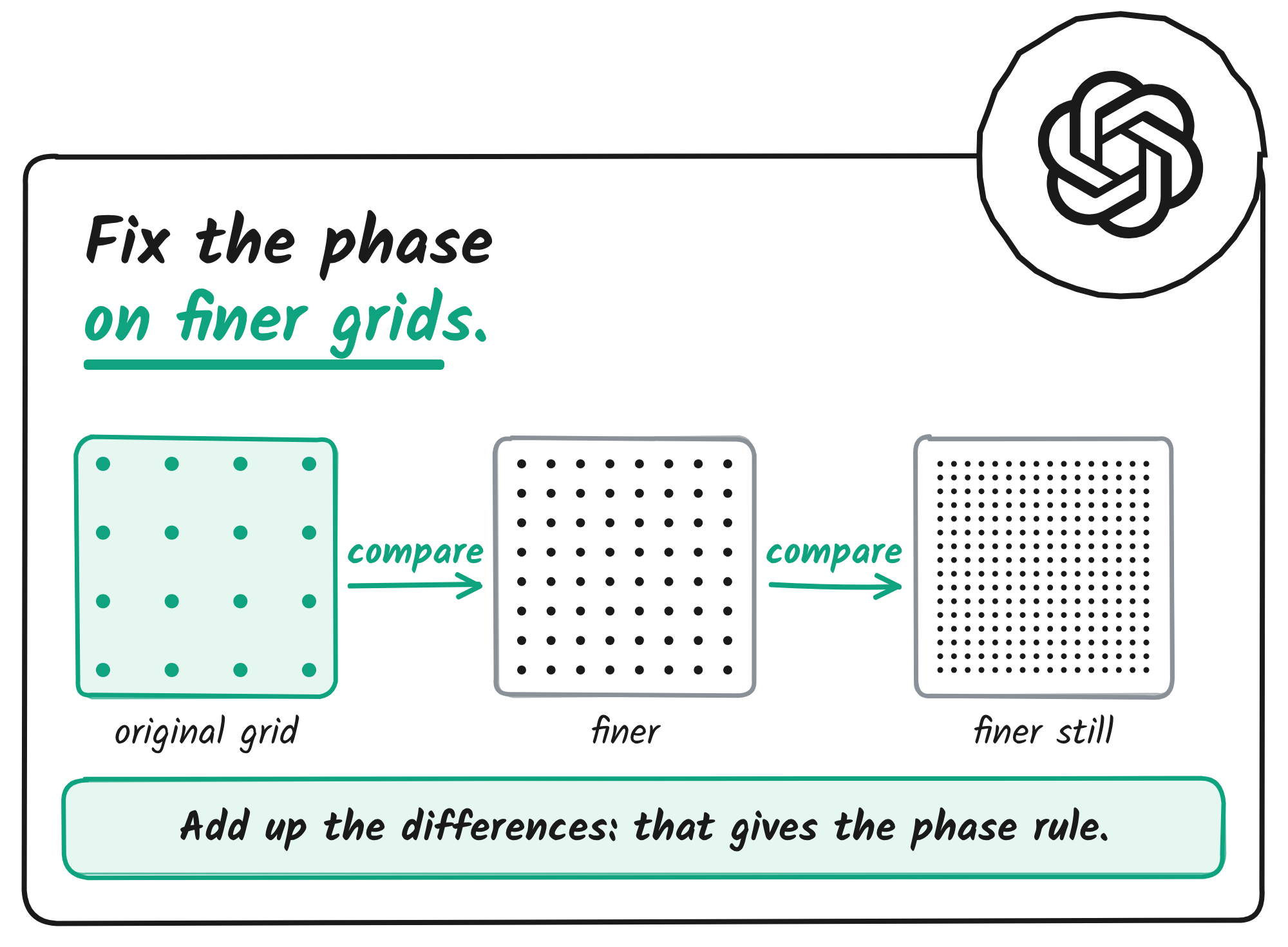
“GPT‑6 Astra was essential to turning the refinement idea into a working construction,” Craig writes. It suggested how to carry a given set of fields onto finer grids, showed the comparisons converge to a definite answer and took the lead in developing the detailed proof. The preprint’s acknowledgements say the manuscript combines sections Craig wrote with extensive rewrites of the Astra-composed proof, and that Astra ran the tests he and his colleagues proposed, including Lean verification.
Lattice field theorists Maarten Golterman, Andreas Kronfeld and Yigal Shamir went through Astra’s proof and asked probing questions, Craig says. The preprint also thanks Golterman and Shamir.
What comes next
Craig calls the result a candidate lattice definition and says the method is “far more an answer in principle than an answer in practice.” He’s now checking whether it satisfies reflection positivity at finite lattice spacing, a condition that ties lattice calculations to a quantum theory in which probabilities are conserved.
For continuous spacetime, he points to OpenAI’s Yang-Mills existence proof, announced on 26 October. Craig says it let OpenAI start from overlap fermions on the lattice, take the continuum limit and prove the existence of the simplest unified Yang-Mills theory that includes the gauge fields and fermions of the Standard Model. A committee led by the Nobel laureate David Gross said on 10 November that the submission “proves the existence of pure Yang-Mills theory according to the problem statements which are standard in physics and mathematics,” Scientific American reports.
Disclosure: I’m an OpenAI, Firecrawl and Devin ambassador.
Discover more from Sulat AI & Tech News
Subscribe to get the latest posts sent to your email.