Jacob Coxon, a former OpenAI and Anthropic pretraining researcher, said on X on 13 November that a slide from Anthropic’s IPO roadshow was “a big factor in my decision to leave”. The slide plots a “pre-training compute multiplier” for code on a logarithmic axis, and Coxon reads its upward bend as accelerating algorithmic progress. The vertical axis carries no numbers.
Coxon wrote that the slide “shows the compute efficiency of pretraining over time”, that the y-axis is a log scale, and that Anthropic is “seeing continued superexponential algorithmic progress”. He added: “Mythos was not a one-time deviation, but a point on a superexponential. They could already retrain Mythos with a fraction of the compute originally needed.” He said that doesn’t strictly imply a software-only intelligence explosion, because Anthropic has also been spending more on research and development, but that algorithmic improvements “are on the verge of being automated”.
This slide from the Anthropic IPO roadshow was a big factor in my decision to leave. It’s an insane plot and I’m surprised they made it public.
— Jacob Coxon (@hilbertspaess) November 13, 2026
What the slide shows
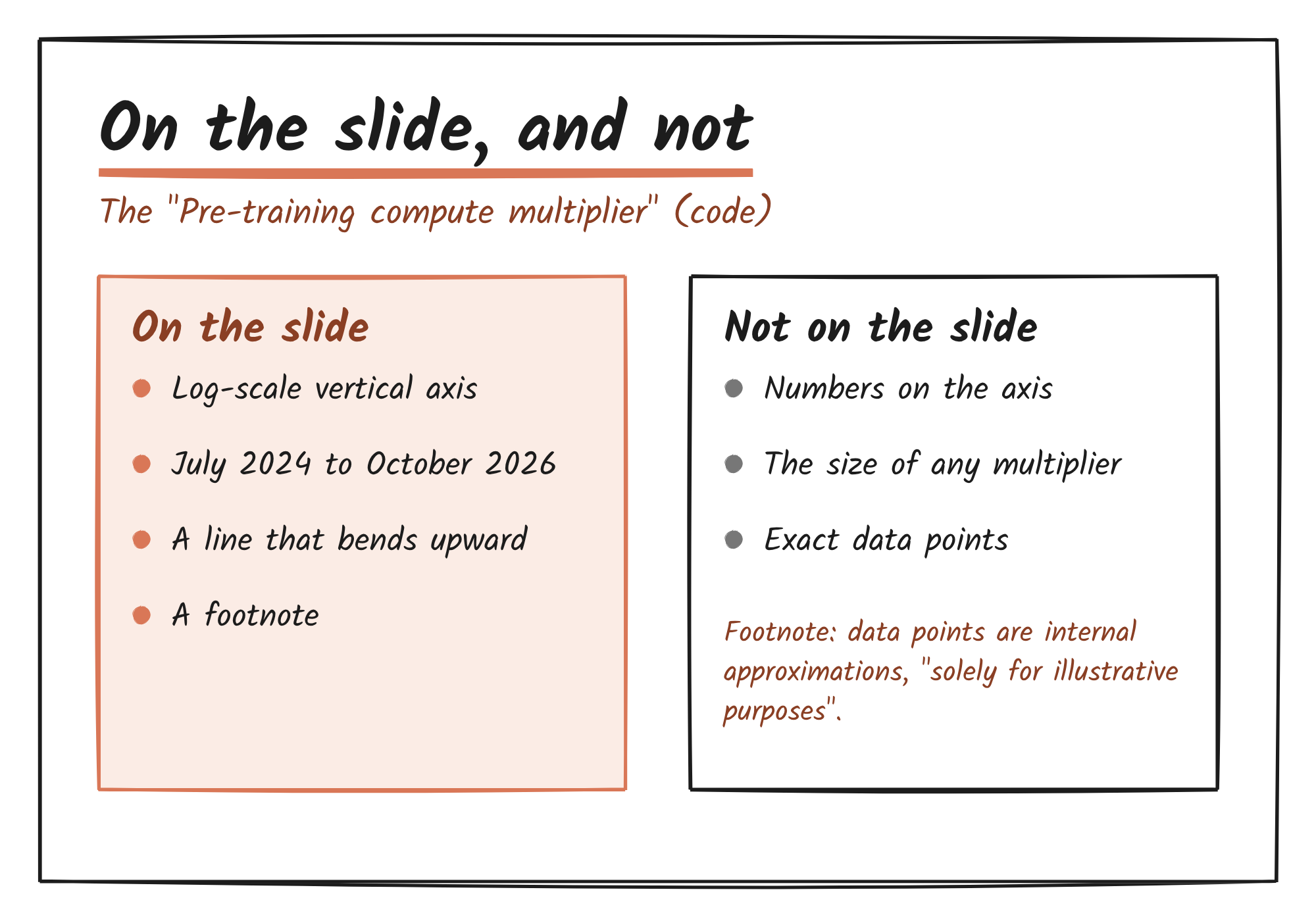
The Decoder, which published the image and credits it to Anthropic, says the chart covers July 2024 to October 2026. Dealroom reports the title as “Pre-training compute multiplier over time (code)” and a footnote saying the placement of the data points “is based on internal approximations and is solely for illustrative purposes”. The Decoder says the axis is compressed so that a 10x and a 100x increase barely look different.
Anthropic’s prospectus defines compute multipliers as “algorithmic and methodological improvements in training and inference that increase the effective output of a given amount of compute”. In the roadshow video, per Simon Willison’s transcript, co-founder Tom Brown gives the arithmetic: a 4x multiplier means a model that needed 100 units of compute can be trained with 25.
On a log axis, each step up is a multiple, not an amount. A straight line means the same multiple every period, and a line that bends upward means the multiple itself is growing. That bend is what Coxon calls superexponential.
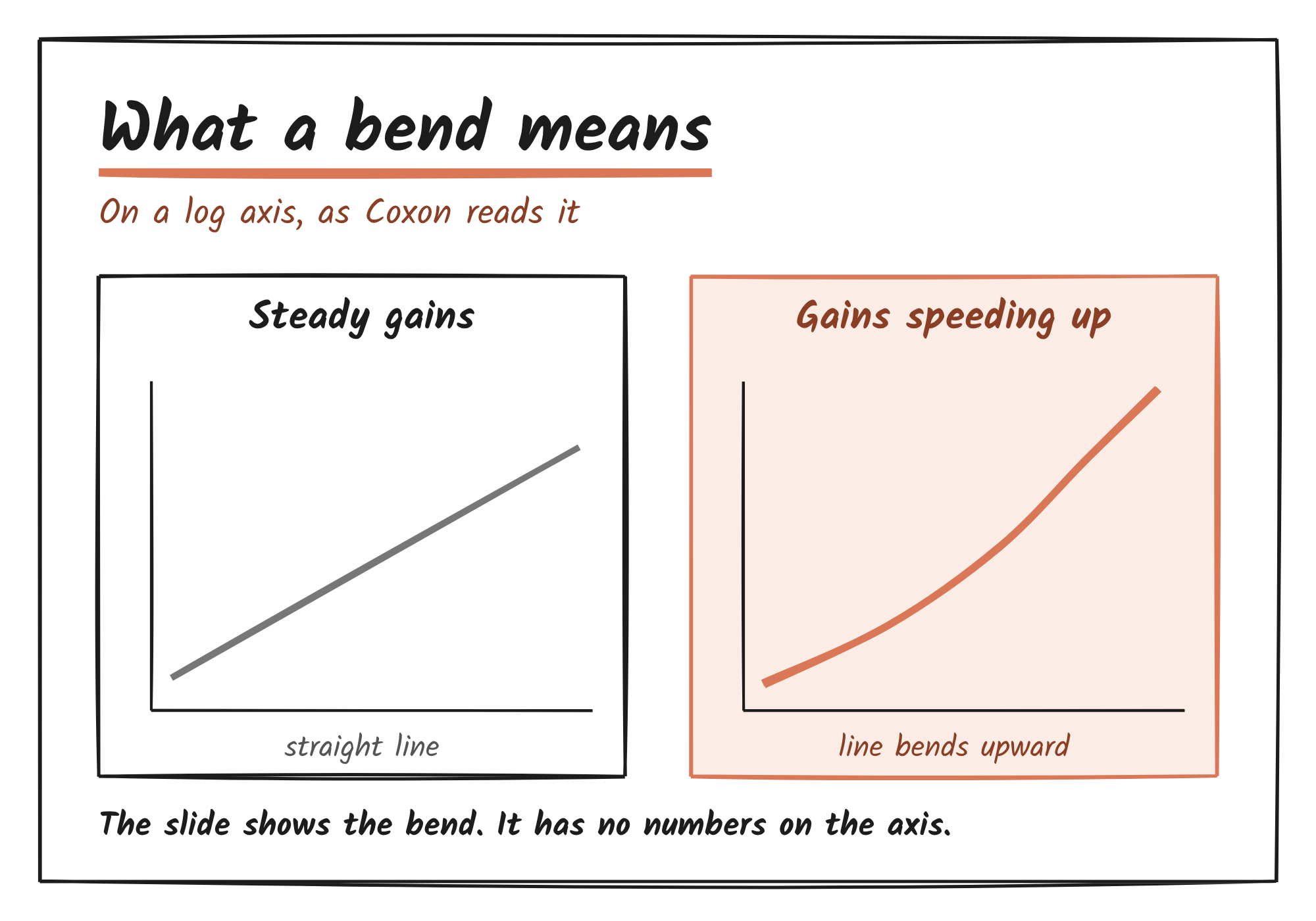
The slide gives no values for any multiplier. Dealroom reports that Anthropic hasn’t commented on the image and that ORIENS couldn’t independently confirm where it came from. Coxon said he wouldn’t break his non-disclosure agreement, and wished “we could talk about the absolute numbers”, according to Dealroom.
What Anthropic has said about multipliers
The prospectus describes a loop in which Claude helps build the next model. “A direct expression of this dynamic is our accelerating pace of producing compute multipliers,” it says. In the roadshow video, Brown says: “We believe that this can accelerate even further as we approach recursive self-improvement. Claude will be able to discover compute multipliers entirely by itself, allowing the number of compute multipliers to grow faster and faster.”
The prospectus also sets a limit. Anthropic says it doesn’t “anticipate being able to safely use Claude to fully autonomously design and build successive generations of frontier models without meaningful human supervision or understanding, if and when that becomes technically possible”, and that it’s considering updates to its Responsible Scaling Policy to keep humans in control of frontier model development.
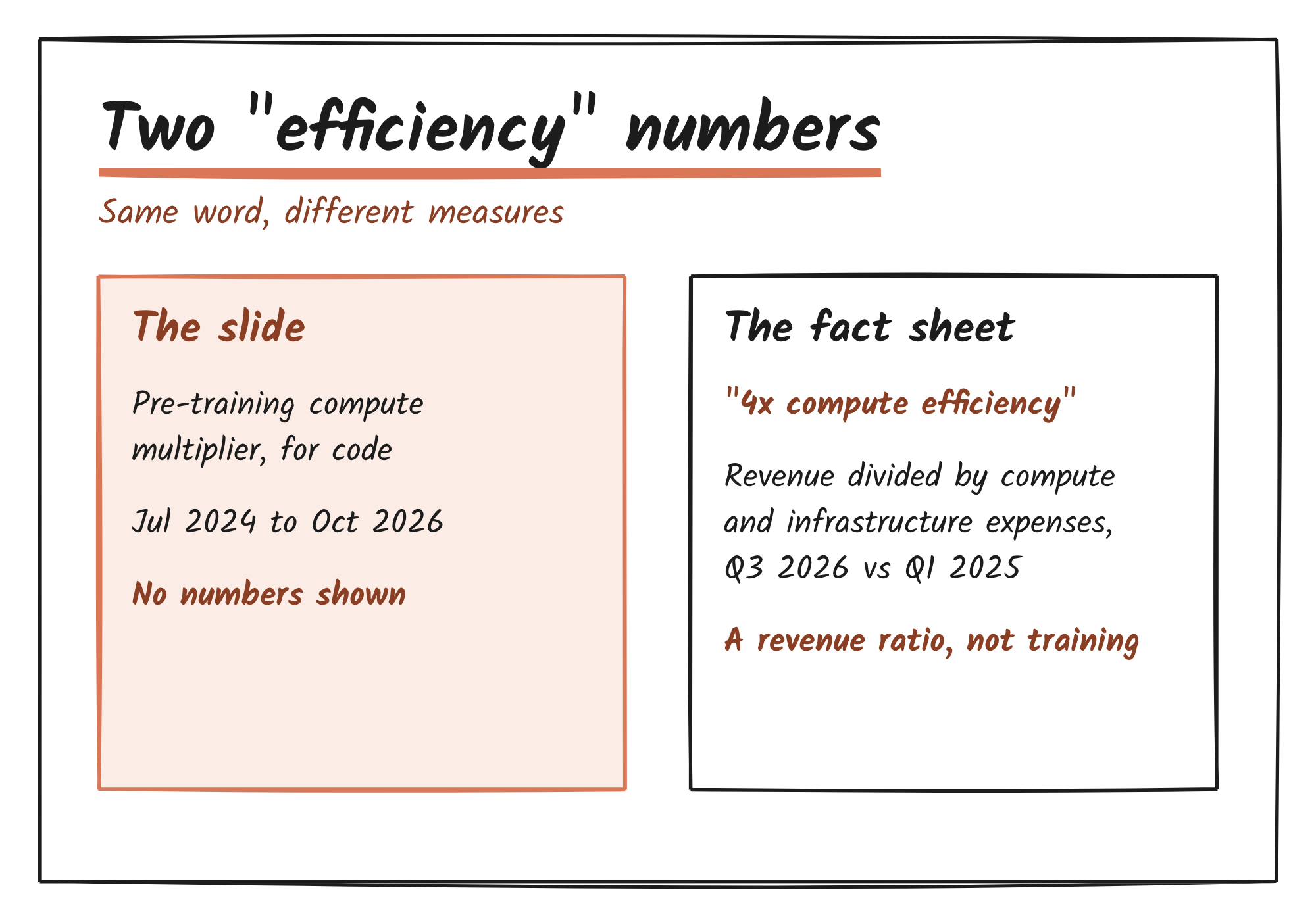
The “4x compute efficiency gain” on the IPO site is a different measure from the slide’s. Anthropic defines it as revenue divided by compute and infrastructure expenses in the third quarter of 2026, divided by the same ratio in the first quarter of 2025. It’s a financial ratio, not a training multiplier.
Timing and reaction
Coxon resigned from Anthropic on 8 September, after about four months there, writing that “neither company is acting responsibly” and that both were “racing straight to self-improving superintelligence”. Anthropic’s roadshow began on 10 November. TokenPost notes that the filing date doesn’t show when the slide was first made, and Coxon hasn’t said when he first saw it.
The footnote split readers, Dealroom reports. MIT researcher Omar Khattab argued that “solely for illustrative purposes” makes the chart content-free. Thariq, who worked on Claude Code at Anthropic until October, replied that it’s standard legal wording and that the graph should be taken seriously.
In a follow-up on 14 November, Coxon said pausing frontier development next year, so competitors can catch up, “would commoditize human-level intelligence. It would only harm OpenAI and Anthropic.”
Anthropic expects to set its share price on 18 November and start trading on Nasdaq as ANT on 19 November, subject to its registration statement becoming effective, as covered earlier. The registration statement hasn’t become effective, and this article isn’t an offer to sell Anthropic securities.
Discover more from Sulat AI & Tech News
Subscribe to get the latest posts sent to your email.