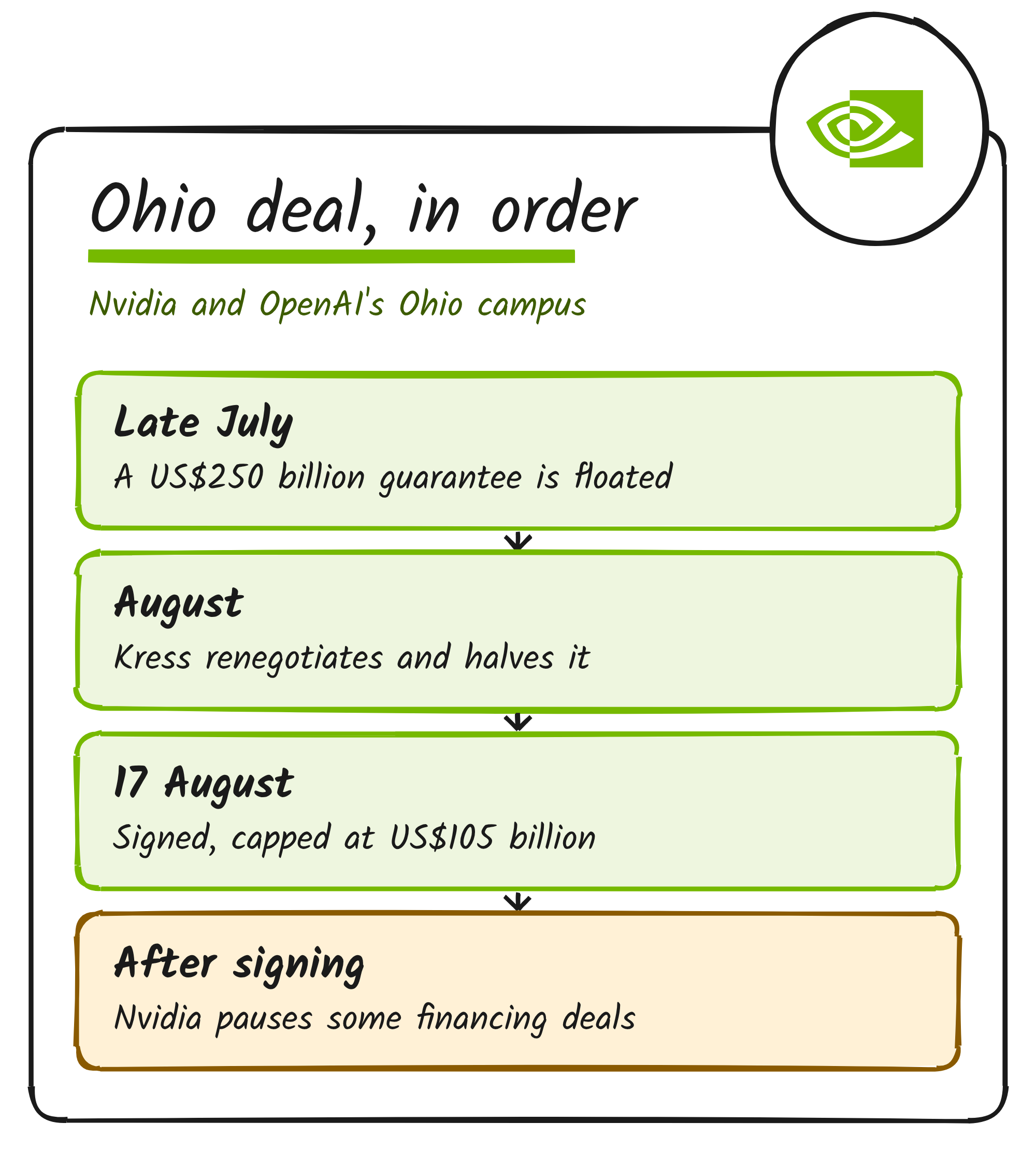
Nvidia signed the guarantees behind OpenAI’s Ohio data centre on 17 August, and its filing with the US Securities and Exchange Commission caps its payment obligation at US$105 billion. That was nearly three months before Jensen Huang resigned as chief executive on 11 November, and before Nvidia paused some financing deals, according to the Wall Street Journal.
What Nvidia agreed to
The agreements are residual value guarantees on leases with SB Energy, which is building the PORTS Technology Campus in Pike County, Ohio, for an affiliate of OpenAI. They cover about 4.25 gigawatts of capacity, the electricity the servers will draw, and Nvidia can add about 3.8 gigawatts more at its sole discretion, the filing says.
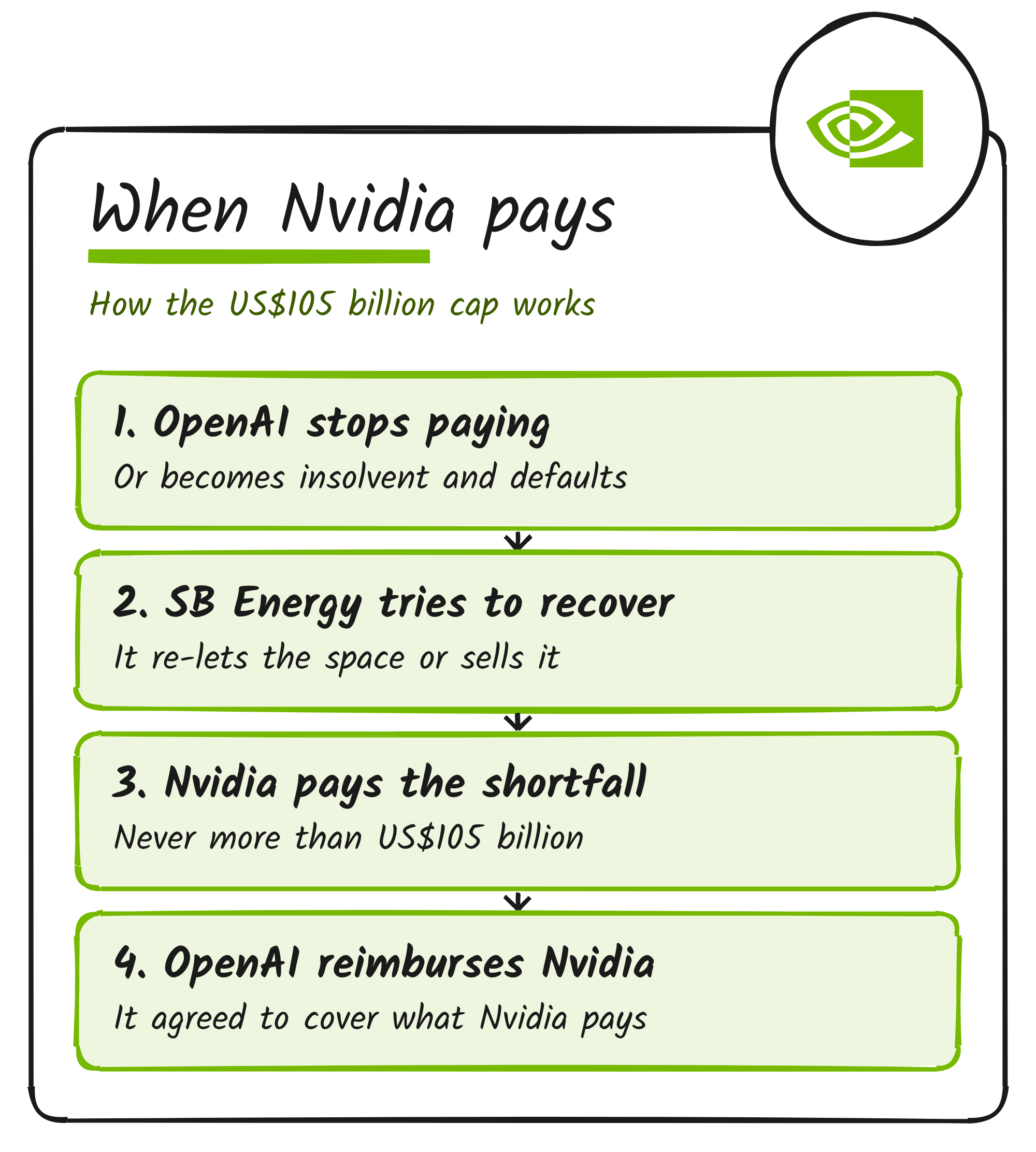
Nvidia pays only if OpenAI becomes insolvent and defaults on a lease, or stops paying under one. It then covers the shortfall between a guaranteed minimum value and what SB Energy recovers by re-letting the space or selling it. OpenAI has agreed to reimburse and indemnify Nvidia for anything it pays.
Nothing is payable yet. Each guarantee takes effect when its lease starts, and Nvidia’s quarterly report, filed on 26 August, says the campus is built in nine phases, with the first expected in fiscal 2029. The same report puts the maximum gross exposure across all of Nvidia’s guarantees at US$108.5 billion, US$105 billion of it for this campus. In return, the report says, the site will host Nvidia’s compute exclusively, with limited exceptions. CNBC reported that Nvidia is also investing US$1.5 billion in SB Energy.
How the figure got there
The Wall Street Journal reported in late July that Nvidia was weighing a US$250 billion guarantee, and that Colette Kress, Nvidia’s chief financial officer and now its interim chief executive, spent the following weeks renegotiating and halved the commitment, according to Guru3D’s write-up of ComputerBase’s summary. The same account says OpenAI wanted to rent the whole campus and fill it with Nvidia chips worth about US$300 billion. That figure is the WSJ’s value for the chips, not the size of Nvidia’s guarantee.
What happened after signing
The same WSJ account says Nvidia later suspended parts of its financing programme for AI customers, and that staff told customers such commitments would now go through review by senior management and the board, so they’d be slower to close. I covered the pause and Huang’s August meeting with his finance team in an earlier piece.
Kress has led Nvidia as interim chief executive since Huang’s resignation. Sources told The Information that she “may take a more conservative approach than Huang did”, AI Weekly reports. Nvidia reports its third-quarter results on 17 November US time, its first with Kress in the job.
Disclosure: I’m an OpenAI, Firecrawl and Devin ambassador.
Discover more from Sulat AI & Tech News
Subscribe to get the latest posts sent to your email.