The Wall Street Journal reported on 13 November that Jensen Huang told Nvidia’s finance team in August that the chip wafers and memory the company had committed to buy were coming at him like an “avalanche”, while big cloud providers were making plans to use other companies’ chips. The same report says Nvidia was in talks to provide billions of dollars in guarantees to companies that couldn’t afford its chips.
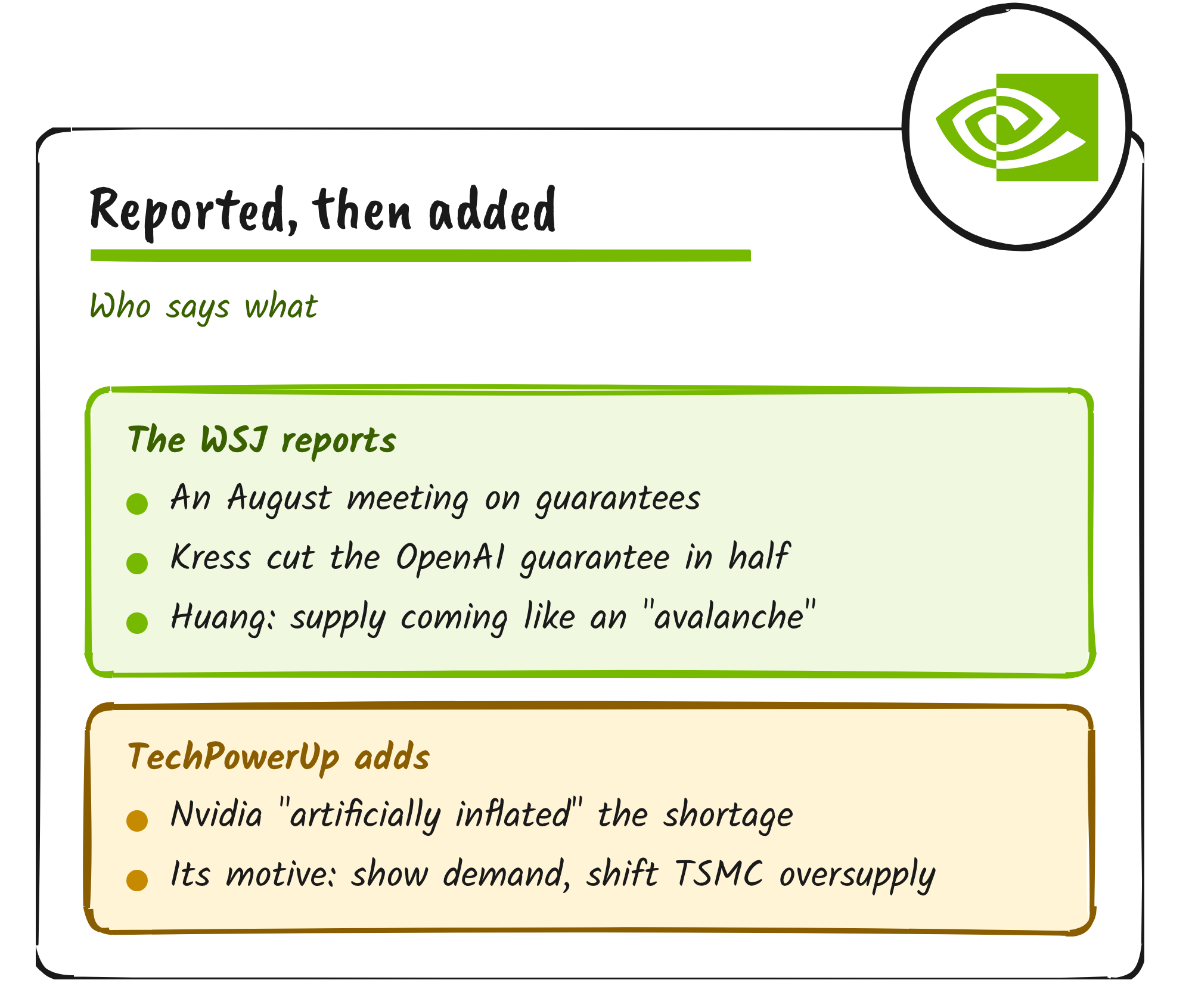
TechPowerUp, an aggregator, headlined its write-up “NVIDIA Allegedly Engineered Scarcity By Funding AI Startups To Buy Its GPUs” and sourced it to the WSJ through Wccftech. The scarcity claim isn’t in the WSJ’s account of the meeting. That account has Huang describing too much supply, not too little.
What the WSJ reported
Huang summoned his top finance executives to his office in August, according to the WSJ’s account as quoted by the investor Michael Burry. He called Colette Kress, Nvidia’s chief financial officer and now its interim chief executive, “a deer in the headlights” and a “reporting CFO” who couldn’t help him define strategy, according to a person familiar with the comments. The WSJ says he called the meeting to diagnose a ballooning problem: Nvidia was in talks to provide billions of dollars in guarantees, meaning promises to back a buyer’s borrowing, to companies that couldn’t afford its chips.
The talks included deals led by Nico Caprez, a Nvidia vice president and Huang’s son-in-law, who had been offering financing to upstart cloud providers and data-centre developers in the hope of turning them into long-term customers. Huang had launched a dealmaking spree and was starting to question whether it had gone too far, the WSJ says, citing people familiar with the matter.
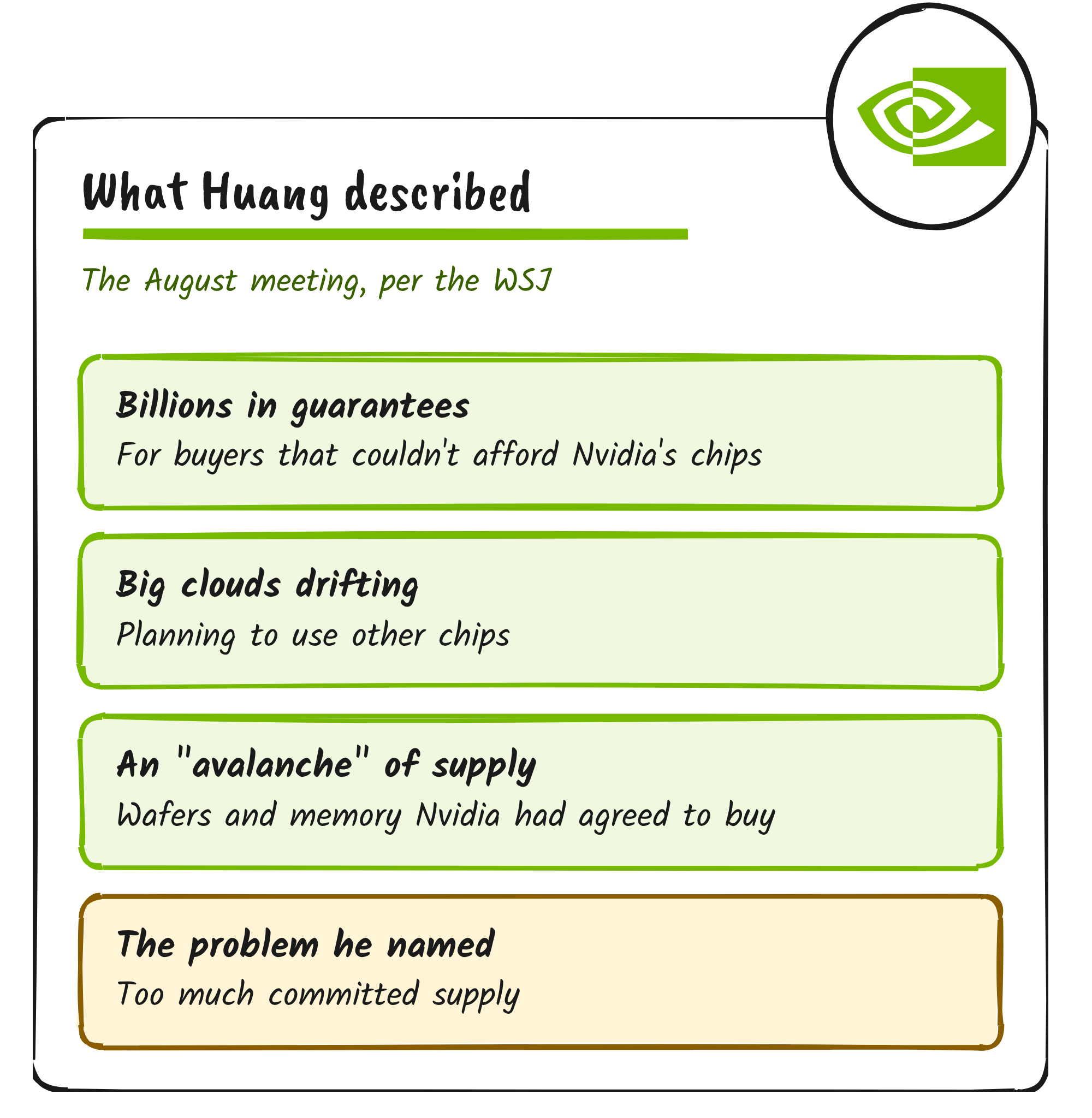
Huang then described the company’s position, the WSJ reports. Major cloud providers were moving away from Nvidia and planning to use alternative chips, and the wafers and memory Nvidia had committed to buy were coming at him like an “avalanche”. A wafer is the silicon disc that chips are cut from; Nvidia’s chipmaker is TSMC.
The report also covers Nvidia’s backing for OpenAI’s data-centre project in Ohio. Silicon Report’s summary of the WSJ says Nvidia sought in August to sign a deal providing US$250 billion in guarantees, and that Kress spent several weeks renegotiating and cut the commitment in half. TechCrunch reported the final commitment at US$105 billion; sources cited by Reuters put it at US$120 billion. The summary adds that Kress asked how Nvidia chose which deals to back, how it valued guarantees and how it calculated returns, as she tried to rein in the deals Caprez brought in.
A detailed summary of the piece by Pasquale Pillitteri says Nvidia paused some credit-support deals at the end of August and told customers that deals would now go through review by senior management and the board.
Where the scarcity claim comes from
TechPowerUp says the WSJ alleges Nvidia “artificially inflated the ongoing GPU and memory shortage” by investing in startups that then bought its GPUs, to keep up the perception of high demand and move an oversupply of chips from TSMC. Wccftech says the funding “effectively created artificial demand”.
Neither aim appears in the WSJ passages that describe the meeting. Huang’s reported words are about Nvidia holding more committed supply than it had buyers for, which is the opposite of scarcity. That financing buyers was meant to absorb the supply is the two write-ups’ reading.
Wccftech also says Nvidia reportedly contacted TSMC to wind down its orders. Taiwan’s Commercial Times reported on 10 November, citing supply-chain sources, that Nvidia may slow its chip orders, TIKR reports. Industry sources told the paper orders were unchanged for now. An Nvidia spokesperson told Business Insider on 11 November: “Our partnership with TSMC and the broader supply chain is strong as always.”
What Nvidia has said in public
Nvidia’s public position on funding its customers predates the WSJ report. On 26 August, Kress told analysts on the second-quarter earnings call: “We recognize the scale of this support, and we know some will call this circular financing. We see it differently.” Nvidia had invested or committed nearly US$50 billion in frontier AI labs, she said, and demand from the labs it backs will account for roughly a quarter of its business next year, AI News reports.
Kress gave three reasons Nvidia’s risk is limited, AI News says. Outside lenders assess every deal on its merits and Nvidia isn’t making loans. The chips go to customers that are investment grade or backed by someone who is. And the equipment can be moved to another buyer if a customer fails.

On supply, Kress said the roughly 70% revenue growth Nvidia expects for the year to January 2028 is limited by supply rather than demand. She also said memory prices are climbing faster than Nvidia expected, and that memory scarcity is driven in large part by the AI buildout itself.
In September, Huang told the Goldman Sachs Communacopia and Technology Conference that Nvidia’s investments are too small next to the business they generate to support the claim that it funds its own demand, and that “In AI, compute is revenue”, InvestingLive reports. Nvidia’s SEC filings show three direct customers made up 16%, 15% and 13% of its first-half fiscal 2027 revenue, the same report says.
What comes next
Nvidia reports its third-quarter results on 17 November US time, its first since Huang’s resignation as chief executive, with Kress now in the job. Senator Jack Reed, the top Democrat on the Senate Armed Services Committee, has asked Congress to examine Nvidia’s financing deals, Reuters reported. A review of a Nvidia director’s trust sales before Huang left is published separately.
Disclosure: I’m an OpenAI, Firecrawl and Devin ambassador.
Discover more from Sulat AI & Tech News
Subscribe to get the latest posts sent to your email.