The Wall Street Journal reports that data centres in Southeast Asia exploited a gap in US sanctions, giving Chinese AI companies computing power on Nvidia chips and cover for alleged chip smuggling. The Journal’s investigation, published at 9pm US Eastern time on 14 November (3pm on 15 November in New Zealand), is built around Malaysia, which data-centre industry leaders say could become the world’s second-largest data-centre hub after Virginia.
Reporters Jon Emont, Stu Woo, Patricia Kowsmann and Raffaele Huang open at a site in Senawang, Malaysia, that stretches across 117 football fields, where the Journal says a Chinese company plans to use Nvidia’s advanced AI chips. It says Chinese AI developers got the chips they needed in two ways: smuggled hardware, or remote access in places like Malaysia.
The Journal ties the story to Jensen Huang, who left as Nvidia’s chief executive on 12 November. It says Huang built a multibillion-dollar business serving Chinese customers through a network of Asian partners, and that revelations about his affair with an executive at one of those partners, whom the Journal calls a possible Chinese intelligence asset, now threaten that network. Nvidia reported US$12.4 billion in China revenue in the six months to 26 July, the Journal says, or 7% of its global revenue.
China has denied the espionage report, and Nvidia has said Huang’s interactions with the executive were “not unusual or unexpected”. I covered those denials, and what Nvidia’s filings show, on 8 November.
Why renting isn’t against the rules
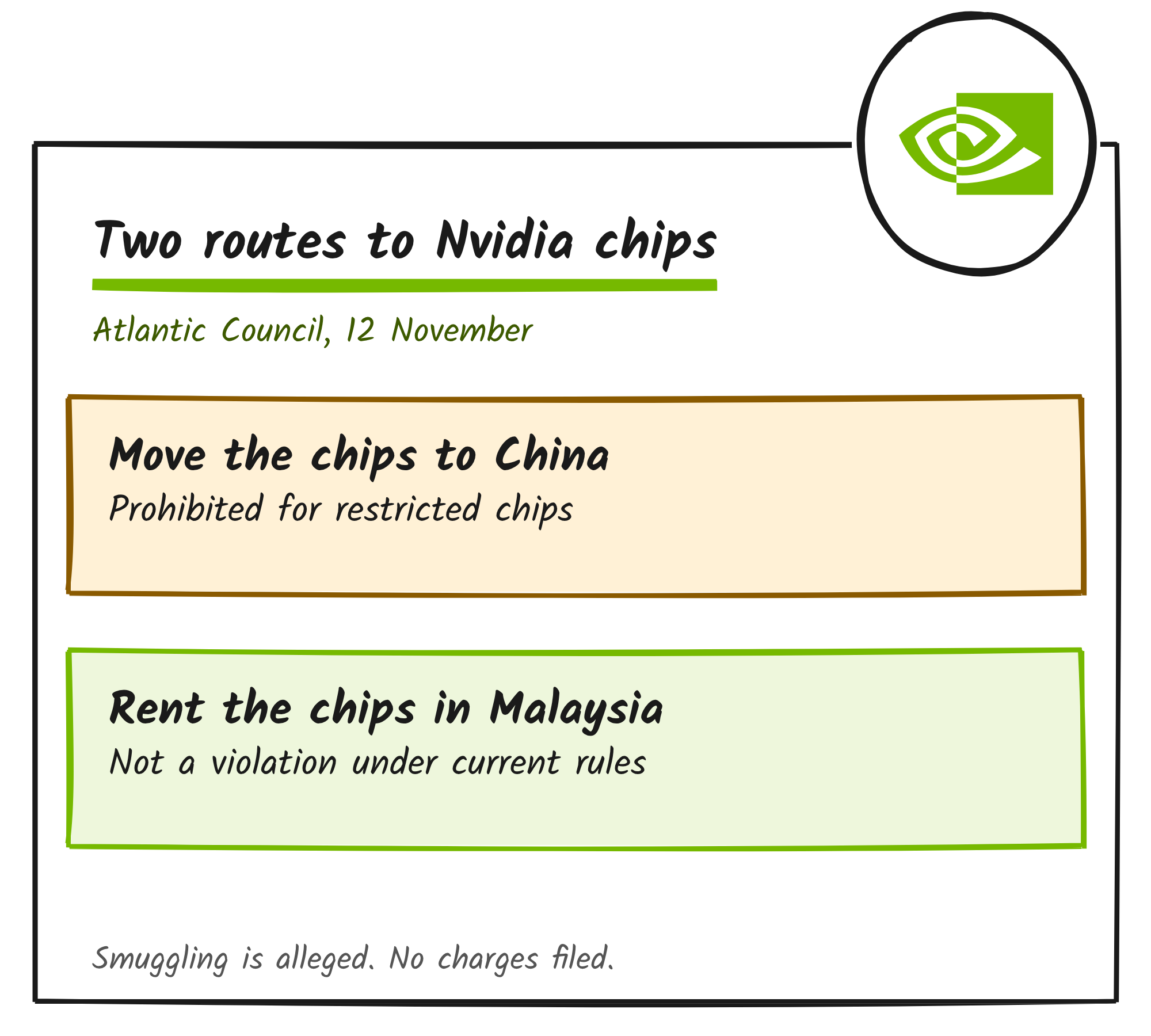
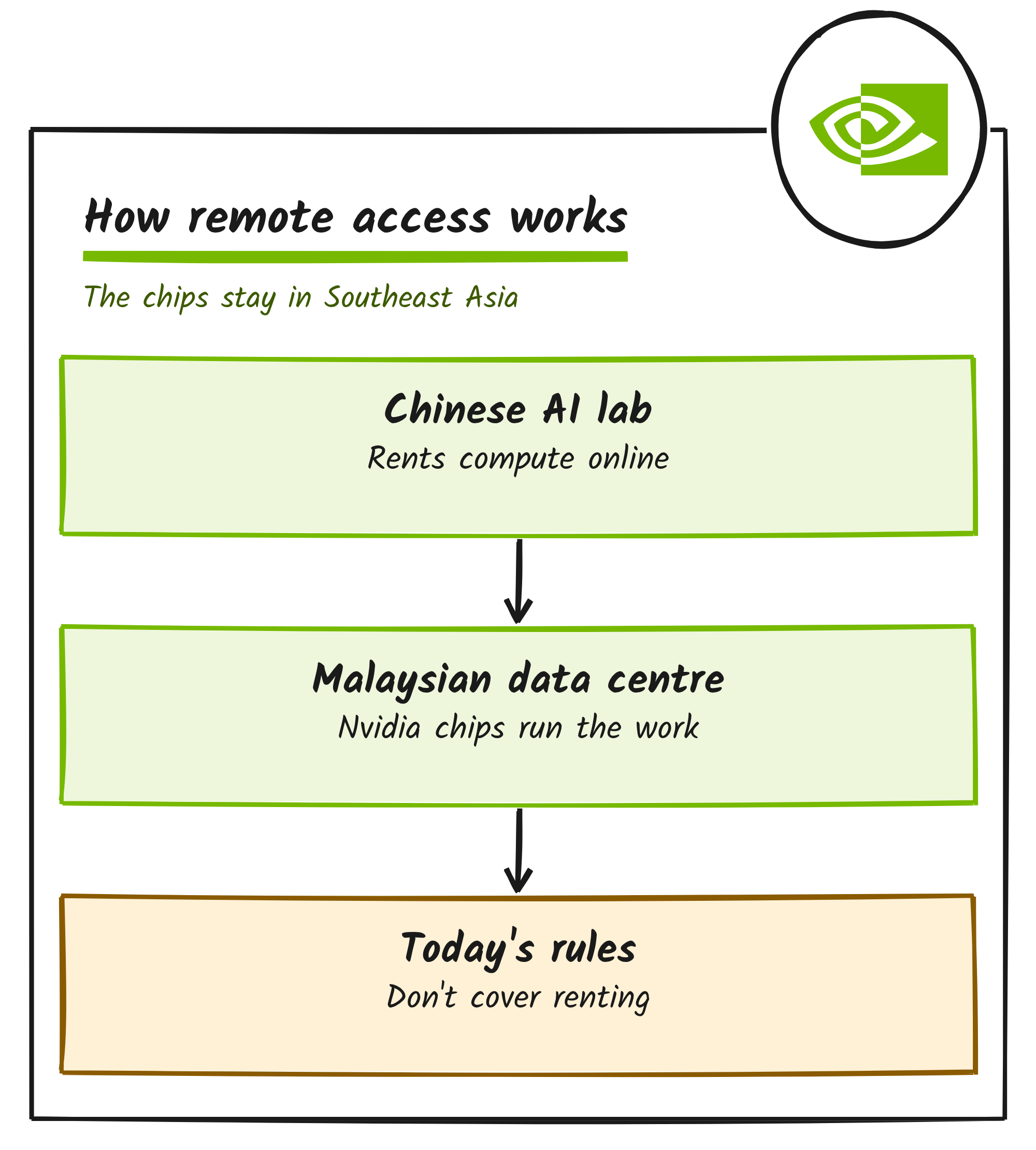
The Atlantic Council explains the gap in a 12 November analysis. Megaspeed, a Singapore-based company that rents out computing capacity at data centres across Southeast Asia, rents Nvidia chips to Chinese tech giants such as Alibaba, and the council says that arrangement doesn’t violate current US export control regulations. Physically diverting restricted chips to China is prohibited, and Megaspeed faces suspicions that it did that. Megaspeed denies wrongdoing, and no charges have been filed.
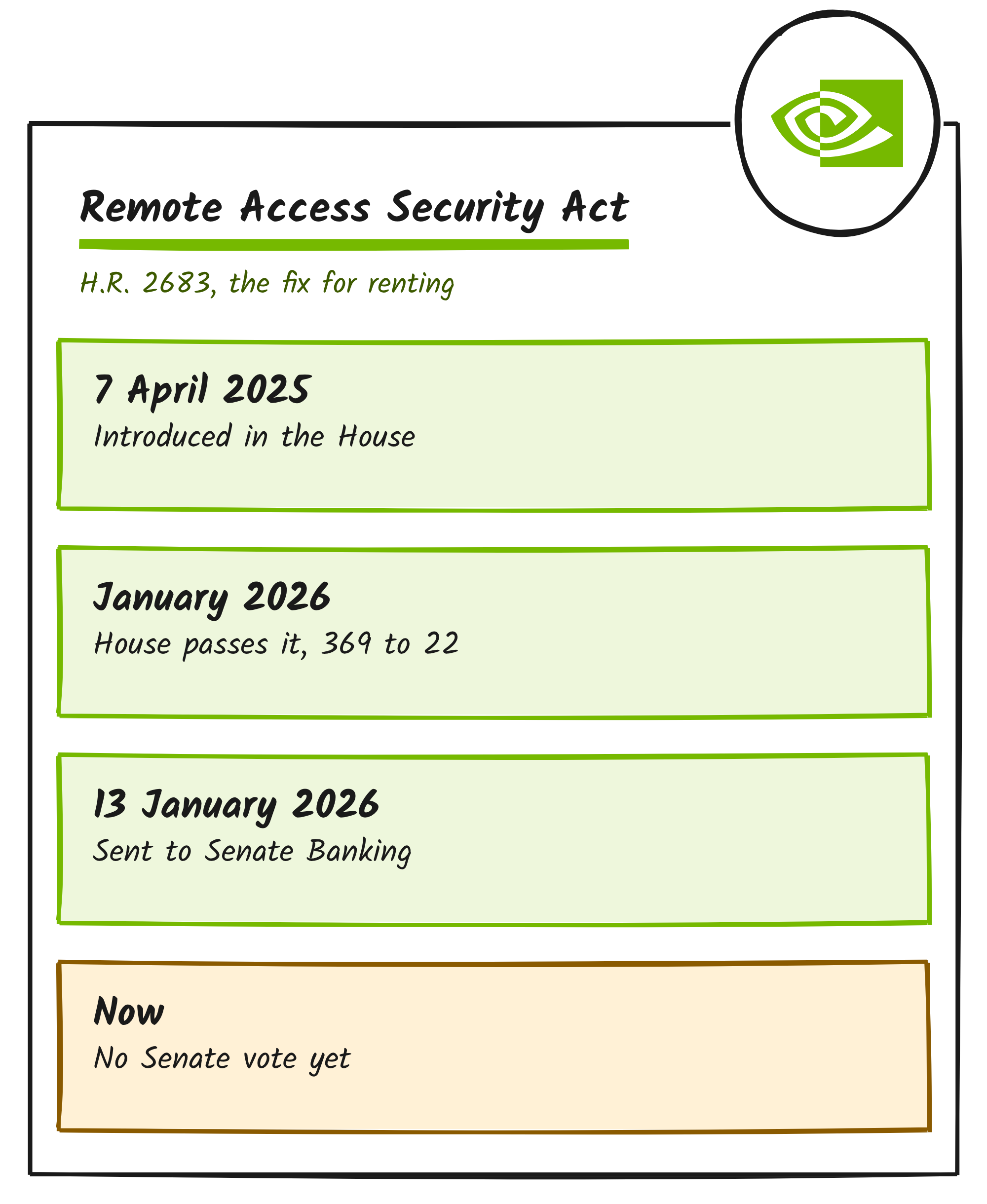
The Remote Access Security Act would close that gap. Its Congressional Research Service summary says it would apply export controls to remote access, meaning access to a controlled item by a foreign person over a network from somewhere other than where the item sits. Rep. Michael Lawler introduced it on 7 April 2025. The House passed it 369 to 22 in January 2026, and Congress.gov shows the Senate received it on 13 January and referred it to the Banking Committee. The Atlantic Council says it hasn’t moved in the Senate.
What Malaysia requires
Malaysia doesn’t require a licence to import AI chips, the Straits Times reports. Since July 2025, US AI chips leaving the country need a permit. Data centres don’t have to say who their end users are, and industry stakeholders estimate that about half of Malaysia’s 1.4 gigawatts of data-centre capacity, a measure of the power the sites can draw, serves the Chinese market. Nvidia requires its cloud partners to give some know-your-customer information and to cap their Chinese business at 49% of services.
Malaysia’s trade ministry said on 13 November that it’s checking with customs whether chips imported by Speedmatrix, Megaspeed’s Malaysian unit, were later re-exported and whether that was lawful. The ministry said it hasn’t cleared Megaspeed or Speedmatrix of wrongdoing. Trade minister Johari Ghani said on 10 November that Speedmatrix wasn’t under investigation because there was no “credible evidence or a formal request from any foreign authority”. Prime Minister Anwar Ibrahim said on 13 November there’s no indication that chips were shipped out of Malaysia.
The money and the US response
The fallout has hit Malaysia’s data-centre market. YTL Power, whose data-centre arm is an Nvidia cloud partner in Malaysia, has lost RM5.5 billion (S$1.7 billion), about an eighth of its market value, since 10 November, the Straits Times reports. Banking executives told the paper that about half of the financing deals for upcoming Malaysian data-centre projects have been put on hold, with delays of up to six months expected until Washington gives clarity.
Chinese buyers are moving too. Reuters reported on 12 November, citing people who declined to be identified, that a major Chinese cloud provider has discussed locking in overseas Nvidia chip capacity and that some companies have contacted data-centre operators about reserving it. Smaller AI labs are considering similar steps, including approaching major providers of rented computing power in Southeast Asia, two of the people said.
In Washington, Senator Michael Bennet’s office published a 10 November letter to Commerce Secretary Howard Lutnick, Attorney General Todd Blanche, Secretary of State Marco Rubio and Director of National Intelligence Jay Clayton. It asks for an update on the US investigation into Megaspeed by 24 November, and asks whether Commerce has sent Nvidia an “Is Informed” letter blocking certain shipments to Megaspeed and whether it will consider adding the company to the Entity List. It also asks what Commerce is doing to close the remote-access gap.
Commerce has twice drafted rules to restore some licensing requirements for Southeast Asia, the Atlantic Council says. The rule for Malaysia and Thailand was never issued, and a global permit framework was withdrawn shortly after it went to interagency review.
Nvidia has said there was nothing unusual about its cooperation with Megaspeed, the Atlantic Council notes, citing Bloomberg. The agencies’ answers to Bennet are due on 24 November.
Discover more from Sulat AI & Tech News
Subscribe to get the latest posts sent to your email.