Nvidia, SK Telecom and Rebellions signed an agreement to pair Korean AI chips with Nvidia GPUs at AI Day Seoul, and Nvidia named stakes in four Korean startups, according to Nvidia’s posts from the event. Jensen Huang resigned as Nvidia’s chief executive on 12 November, three days after the first day, and Korea’s science minister says Nvidia has confirmed its Korean plans go ahead.
AI Day Seoul ran for two days at the COEX centre from 9 November and drew more than 2,000 attendees, Nvidia says. Its wrap-up post, published on 15 November US time, is mostly a headcount and a speaker list. Deepu Talla, Nvidia’s vice president of robotics and edge AI, said Korea is “punching above its weight.” More than 500 developers took part in training workshops, and 10 startups from Nvidia’s Inception programme pitched in a physical AI session. The announcements came earlier, in posts and partner releases dated 9 November.
A Korean NPU goes into Nvidia’s rack
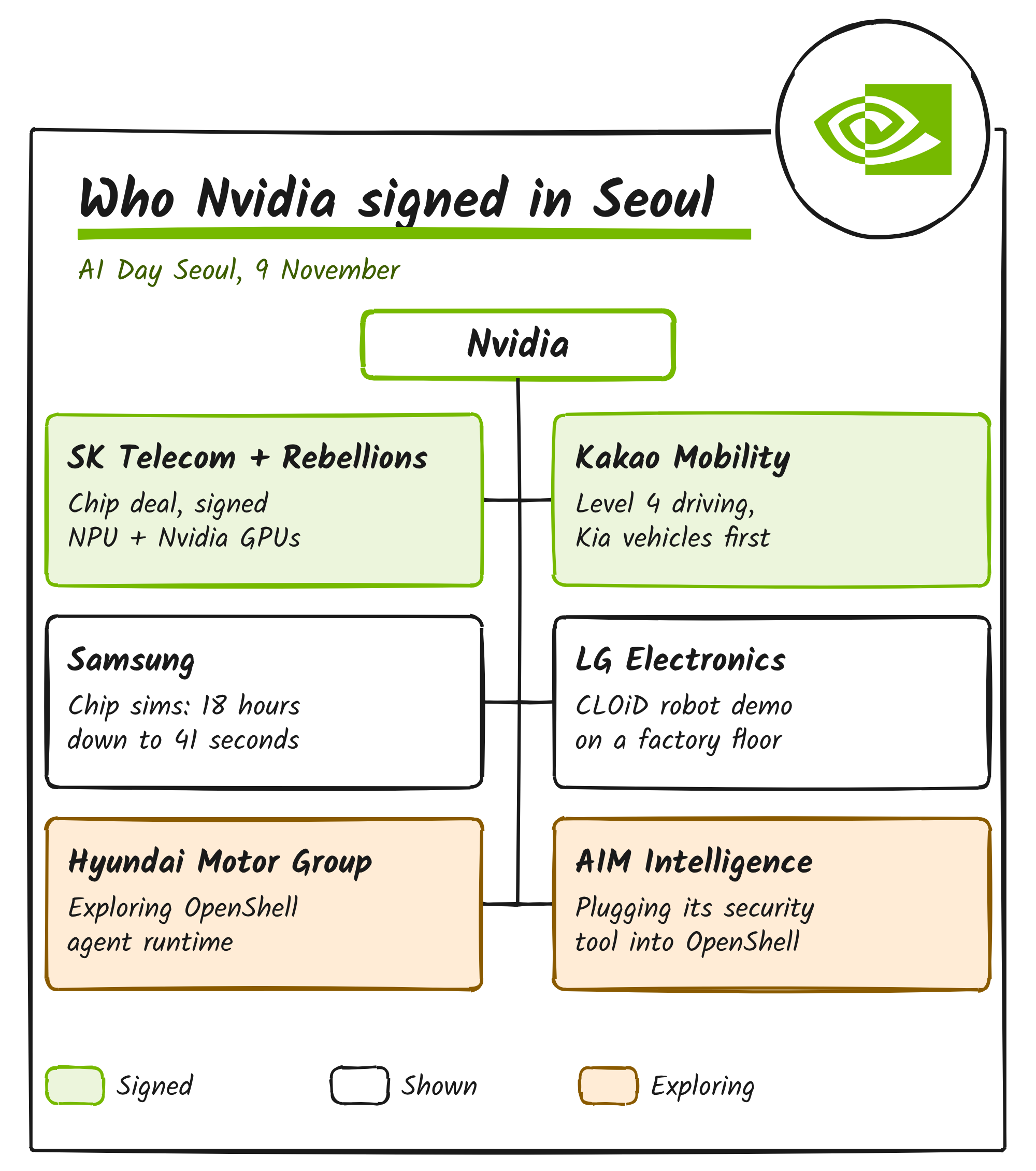
The biggest deal is an agreement between Nvidia, SK Telecom and the Korean chipmaker Rebellions, signed on 9 November, SK Telecom says. Rebellions will connect its R200 NPU, a neural processing unit built for running AI models, to Nvidia’s platform through NVLink Fusion, the technology that lets other companies’ chips share a rack with Nvidia GPUs. The systems will use Nvidia’s MGX rack design, and SK Telecom plans to deploy them in its AI data centre, according to Nvidia.
The three companies also plan to split each AI response between two kinds of chip. Nvidia GPUs would handle prefill, the stage where the model reads the question, and Rebellions NPUs would handle decode, where it writes the answer one word at a time. Nvidia says R200 systems are expected to be ready for deployment in 2028.
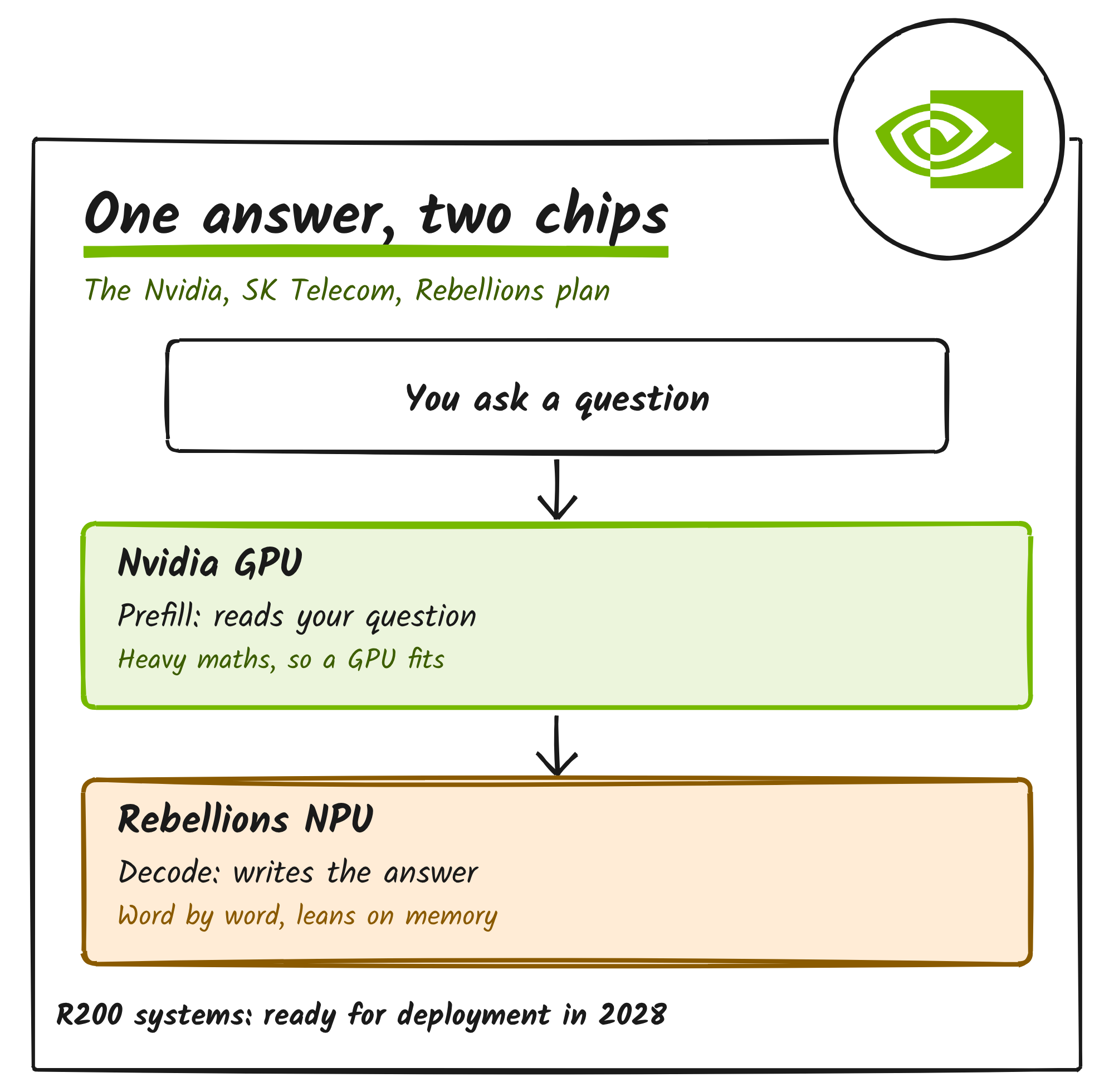
Seoul Economic Daily calls it the first formal Nvidia cooperation with a Korean NPU maker, following Marvell and MediaTek on NVLink Fusion. The Korea Herald reports that the science ministry wants to extend the model to other Korean NPU makers and is pursuing similar links with AMD. Nvidia’s release quotes Huang, then CEO, saying “With NVLink Fusion, Korea’s chipmakers can connect their custom ASICs to NVIDIA’s AI factory platform.”
Four startup stakes, and no amounts
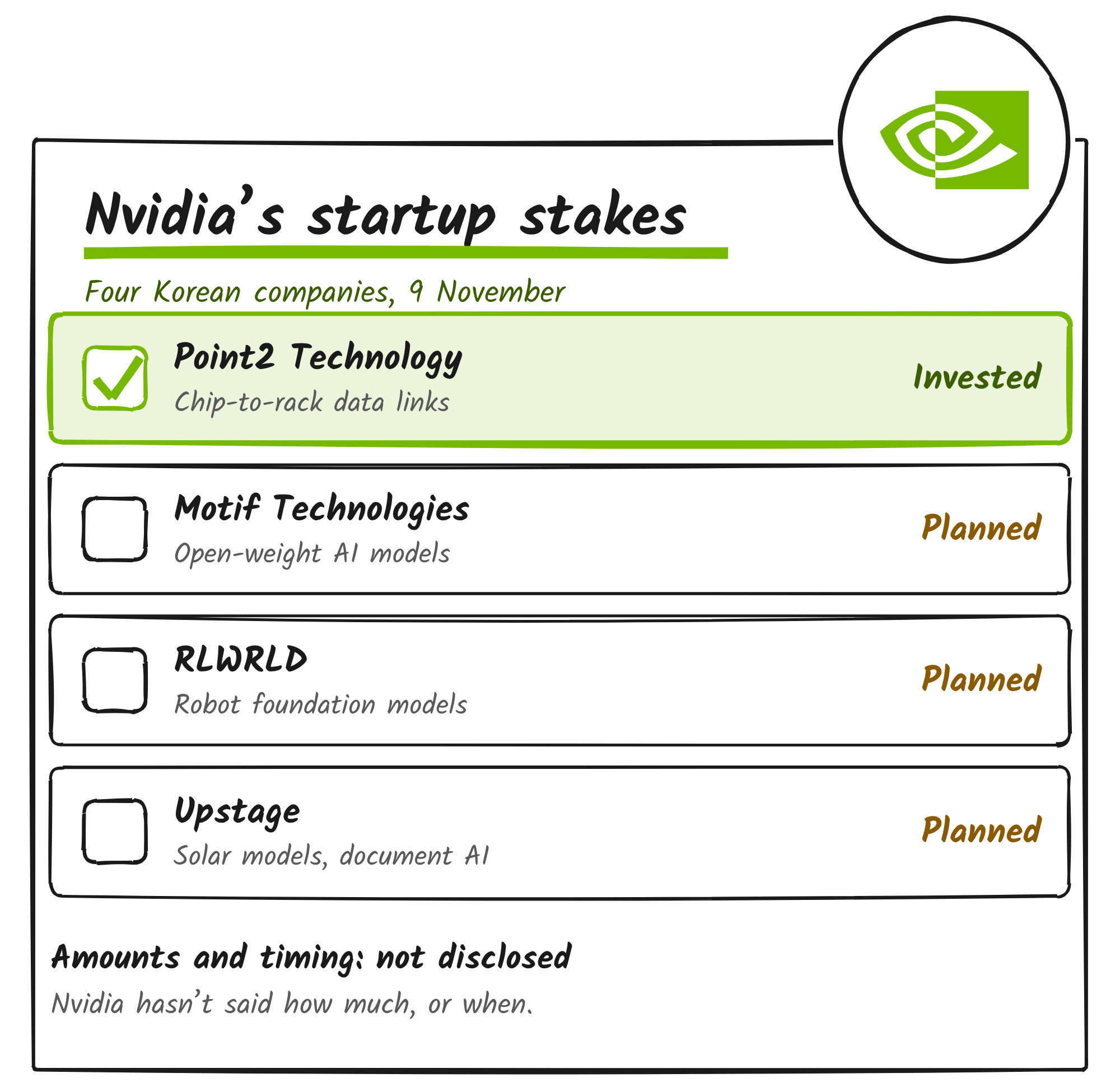
At a forum with the science ministry, Nvidia said it has invested in Point2 Technology and plans to invest in Motif Technologies, RLWRLD and Upstage, Nvidia says. Point2 makes radio-frequency links that move data between chips and racks in AI data centres, as an alternative to copper and optical cabling. Motif builds open-weight language models, RLWRLD builds robot foundation models, and Upstage makes the Solar language models. Nvidia didn’t disclose amounts or timing, Wowtale reports.
Seoul Economic Daily reports that Nvidia is investing directly rather than through its venture arm NVentures, which backed Point2 earlier this year, and that the paperwork for the other three isn’t finished. Upstage said it expects Nvidia to join the second close of its Series C. Motif said Nvidia is expected to invest in the bridge round that funds Motif 4, which it plans to release with open weights in the first quarter of 2027. RLWRLD confirmed Nvidia’s plan. The forum brought together 22 Korean companies, the Korea Herald says, and Nvidia counts more than 1,000 Korea-based members in Inception.
What Samsung, Kakao Mobility and LG showed
Samsung’s semiconductor team gave a session with Nvidia on using AI physics to speed up chip engineering, and Nvidia says one thermal and mechanical simulation fell from about 18 hours on a 32-core CPU to 41 seconds, a roughly 1,600x speedup. The 41 seconds comes from a coarser grid, AI-predicted material properties and a GPU, set against a fine-grid solve on a CPU. Samsung’s materials platform also ran selected quantum chemistry calculations up to five times faster. Samsung’s own write-up describes the session.
Kakao Mobility signed a memorandum of understanding with Nvidia to build a Level 4 self-driving system, one that drives without a person stepping in. It will use Nvidia’s Hyperion sensor and computing design and the Halos safety system, and the first vehicle is Kia’s PV5, Edaily reports. The computing unit will carry two DRIVE AGX Thor chips. Kakao has run a self-driving service in Seoul’s Gangnam district since March, The Elec reports. LG Electronics and Nvidia demonstrated LG’s CLOiD robot doing manufacturing tasks in an actual factory, using Nvidia’s Isaac GR00T robot model.
Agents and open models are at the trial stage
Hyundai Motor Group is exploring Nvidia’s NemoClaw blueprints and the OpenShell runtime, a sandbox that limits what an AI agent can access and do, and no adoption has been announced. AIM Intelligence, a Korean AI security company, is integrating its Starfort agent control platform with OpenShell and is considering a preliminary proof of concept for the public energy sector, Nvidia says.
LG AI Research is opening API access to K-EXAONE-2.5, a model built with Nvidia’s Nemotron datasets. Nvidia also released Dynamo deployment recipes for four Korean open models: SK Telecom’s A.X K2, LG’s K-EXAONE 2.0, Upstage’s Solar Open 2 and Motif’s Motif-3. Five finalists in the Hangul Day hackathon built agents on the OpenShell runtime, and the winner, FlyGate, took home a DGX Spark. Nvidia contributed OpenShell to the Cloud Native Computing Foundation on 10 November.
What Huang’s exit leaves in place
Nvidia announced on 12 November that Huang had resigned and that chief financial officer Colette Kress is interim CEO. I covered the resignation on 13 November. Nvidia is searching for a permanent successor, Seoul Economic Daily reports, and the 15 November wrap-up doesn’t mention Huang.
Deputy Prime Minister Bae Kyung-hoon, who is also science minister, said on 13 November that Nvidia reaffirmed at company level that it will go ahead with the supply of 260,000 GPUs and its cooperation with Korean companies, including linking domestic AI chips to Nvidia’s platform through NVLink, Seoul Economic Daily reports. The National AI Strategy Committee met the same day, and Shin Jin-woo, who chairs its infrastructure subcommittee, said Korea should keep working with Nvidia and also widen its computing options, domestic chips included, the paper reports.
The Rebellions agreement is a memorandum of understanding to develop and test the system, and SK Telecom says it will look at commercial use after proving performance in its data centre. R200 systems aren’t expected until 2028.
Discover more from Sulat AI & Tech News
Subscribe to get the latest posts sent to your email.