Senate Majority Leader John Thune told Semafor on 12 November that there’s a “high probability” Congress imposes more restrictions on chip exports to China. Semafor names three bills as the vehicles: the AI OVERWATCH Act, the Chip Security Act and the MATCH Act. It reports that the Senate’s version of the National Defense Authorization Act (NDAA), the yearly defence bill, carries three chip measures.
Thune and Sen. Roger Wicker, R-Miss., told Semafor there’s no deal yet to put them in the final NDAA, which the House and Senate are still negotiating. House Speaker Mike Johnson told reporters on Thursday that there’s “a developing consensus in Congress” for more restrictions. Sen. Chuck Schumer, D-N.Y., wants all three bills passed “to cut off China’s access to advanced American technology before it’s too late”, Semafor reports, and it says the measures could become law by the end of the year.
What the rule is today
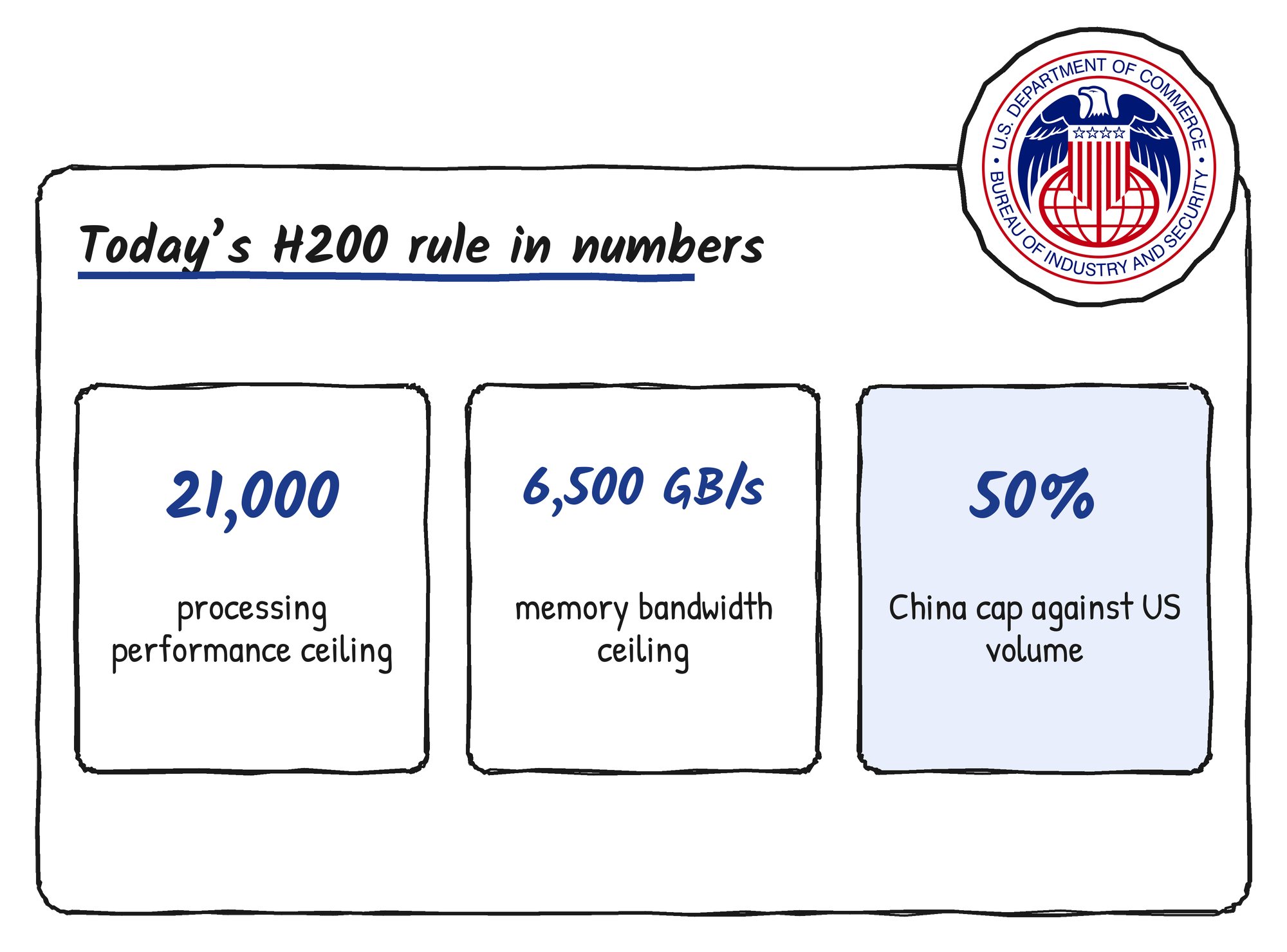
The Commerce Department’s Bureau of Industry and Security (BIS) published a final rule in the Federal Register on 15 January. It changed licence review for China and Macau from a presumption of denial to case by case for chips under two limits: total processing performance below 21,000 and total DRAM bandwidth below 6,500 GB/s. The rule names Nvidia’s H200 and AMD’s MI325X, and BIS says it follows President Donald Trump’s 8 December 2025 announcement.
The rule attaches conditions. Applicants certify that US supply isn’t diverted, and the processing performance shipped to China and Macau can’t exceed 50 percent of what ships for US use. A US third-party lab reviews each shipment, and know-your-customer and remote-access controls apply. Under Secretary Jeffrey Kessler said “Permitting the sale of the H200 to China under controlled conditions will strengthen the American technology ecosystem.”
What each bill changes
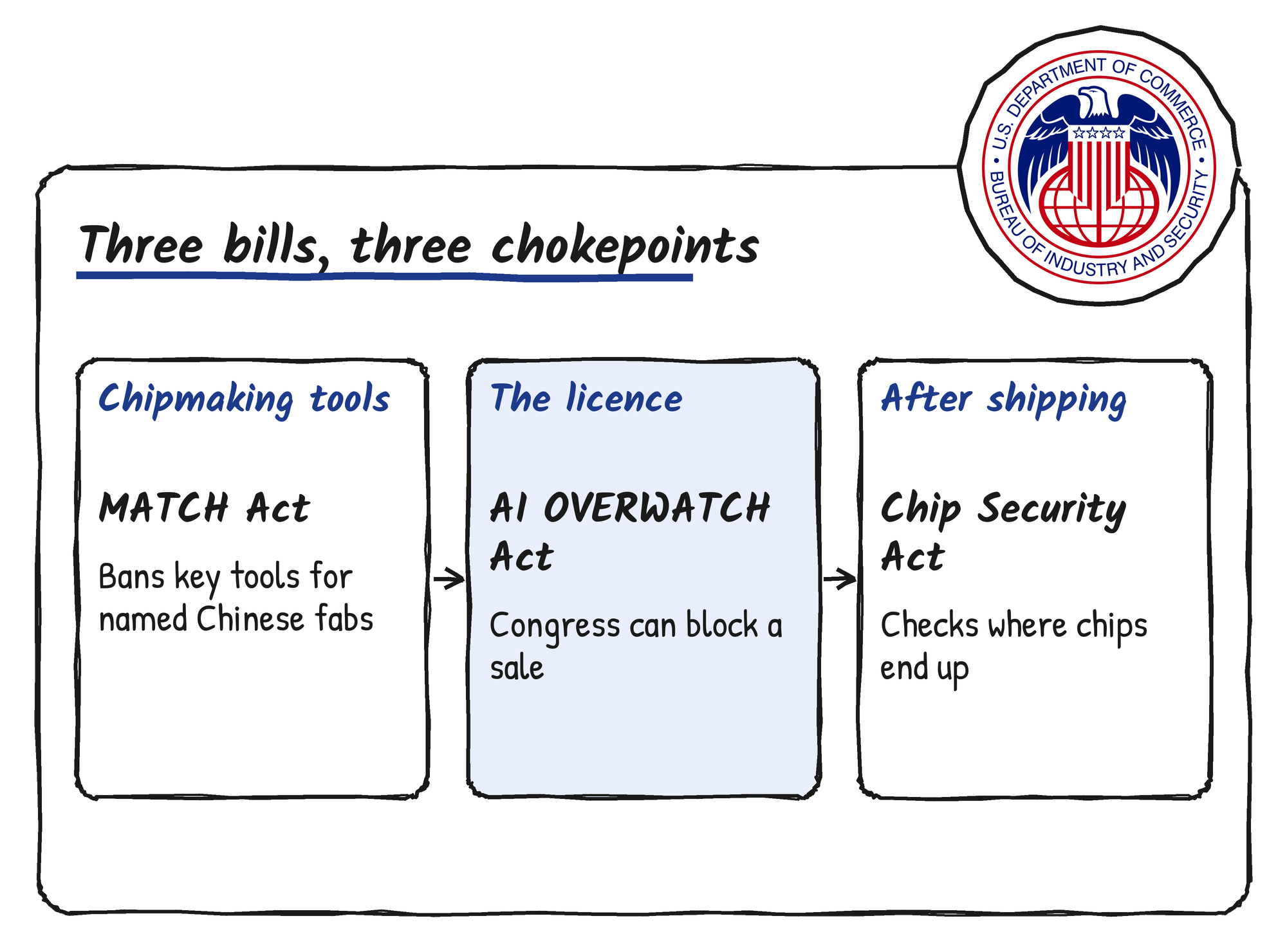
The three bills go after different points in the chain: the licence decision, the chip after it ships, and the tools that make chips.
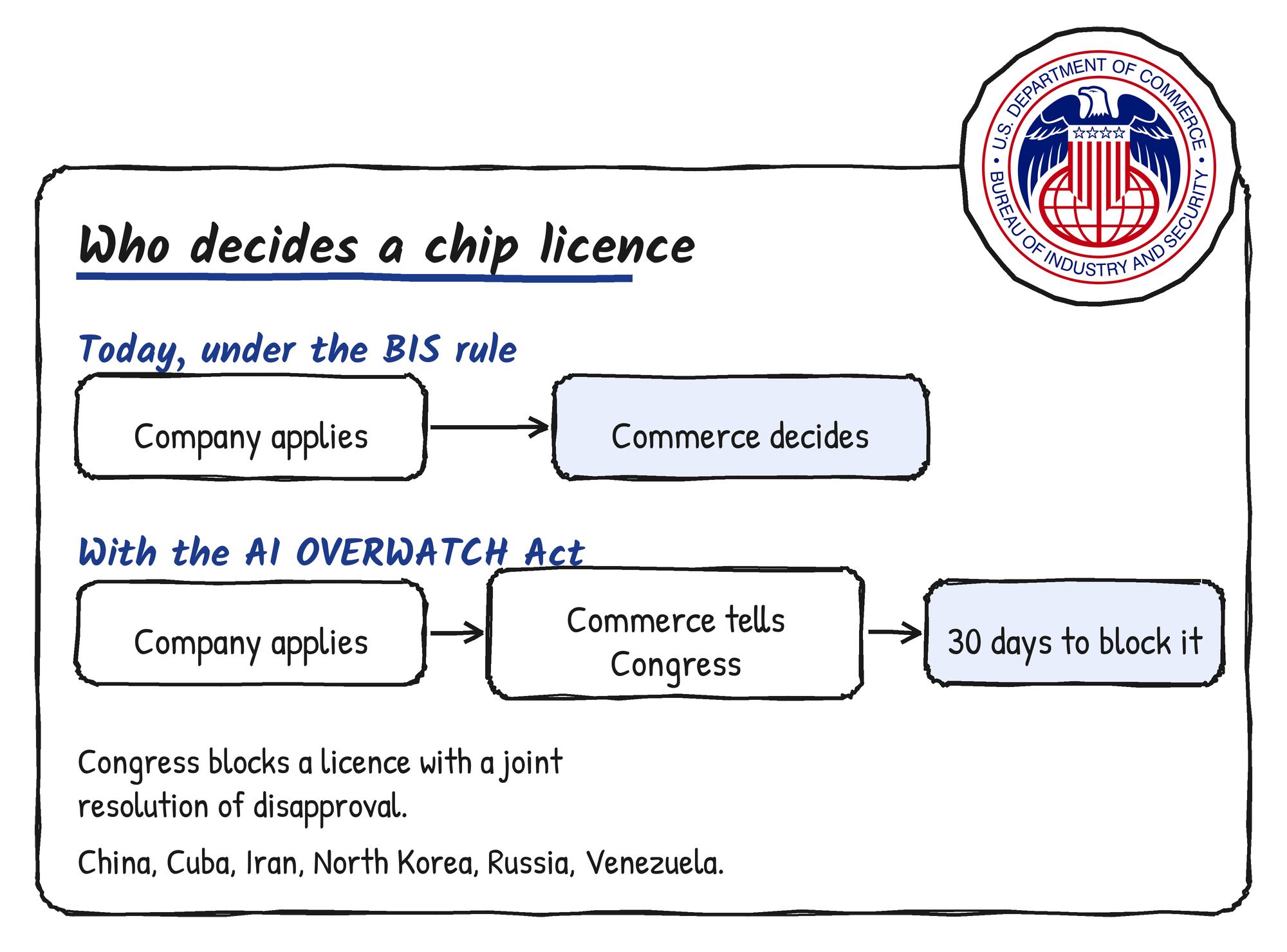
AI OVERWATCH Act. Rep. Brian Mast, who chairs the House Foreign Affairs Committee, introduced it on 19 December 2025. Commerce would have to notify Congress before approving advanced AI chip exports to China, Cuba, Iran, North Korea, Russia and Venezuela’s Maduro regime. Congress would then have 30 days to block the export with a joint resolution of disapproval. Mast said “America must win the AI arms race.” Al Jazeera reported on 21 January that the committee voted to advance it.
Chip Security Act. The House Foreign Affairs Committee passed it on 26 March, according to the House Select Committee on the CCP. It requires location verification for advanced AI chips and mandatory reporting by chipmakers when they have credible information about diversion, and it tells Commerce to study further safeguards.
MATCH Act. Rep. Michael Baumgartner introduced it in the House on 2 April with Reps. John Moolenaar and Bill Huizenga among the original cosponsors. Sens. Pete Ricketts, R-Neb., Andy Kim, D-N.J., Jim Risch, R-Idaho, and Schumer introduced the Senate version, S. 4281, on 13 April, and it sits in the Banking Committee. It targets chipmaking equipment, not chips: a countrywide ban on key tools including deep-ultraviolet immersion lithography and cryogenic etch machines for named Chinese fabs. Baumgartner’s office says Commerce acts alone if allies haven’t matched the controls within 150 days.
House Democrats have their own bill, which Semafor doesn’t list. Rep. Gregory Meeks, D-N.Y., introduced the RESTRICT Act on 18 December 2025 with 13 other House Democrats. It directs the Under Secretary of Commerce for Industry and Security to deny licences for advanced chips to countries of concern, and it names the H200.
Who’s lined up
Semafor reports that Anthropic has publicly backed all three bills and that OpenAI is warming to them. The Information Technology Industry Council says the bills would “undermine the American tech stack.” Semafor also notes that the GAIN AI Act, an earlier version of the AI OVERWATCH Act, was in last year’s Senate NDAA and was dropped from the House version after pressure from Nvidia, the chip industry and the White House.
What’s next
The House-Senate negotiation on the NDAA decides whether any of the three reaches the final bill. Thune and Wicker said on 12 November that no deal exists yet.
Discover more from Sulat AI & Tech News
Subscribe to get the latest posts sent to your email.