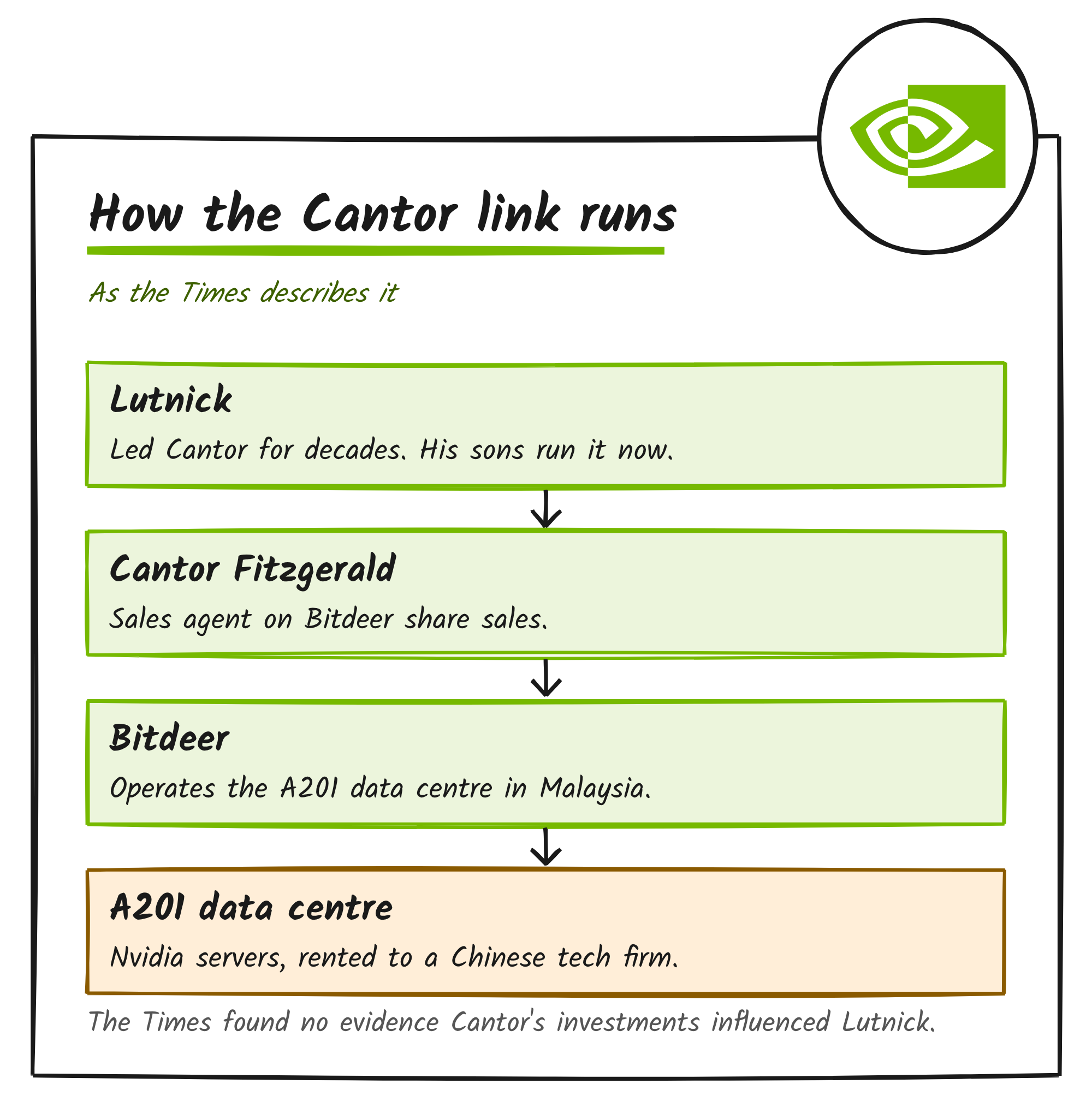
The New York Times reports that Commerce Secretary Howard Lutnick has been pushing a narrower version of the US rules on Nvidia chip sales to overseas data centres, and that one data centre those rules would affect is run by a client of Cantor Fitzgerald, the firm he led for decades and his sons now run. The Times says it found no evidence that Cantor’s investments influenced his deliberations.
The investigation, by Ana Swanson, Aaron Krolik and Paul Mozur, was published on 15 November. It opens at A201, a data centre in Johor, in southern Malaysia, that the Times says will open next year with hundreds of millions of dollars of Nvidia’s most advanced AI servers. The Times says A201 plans to supply that computing power to a Chinese tech company, and that the setup is legal and sidesteps the US ban on selling the most advanced AI chips directly to Chinese firms.
I covered how that rental gap works on 15 November, and Jensen Huang’s resignation as Nvidia’s chief executive on 13 November.
What the Times says Cantor did
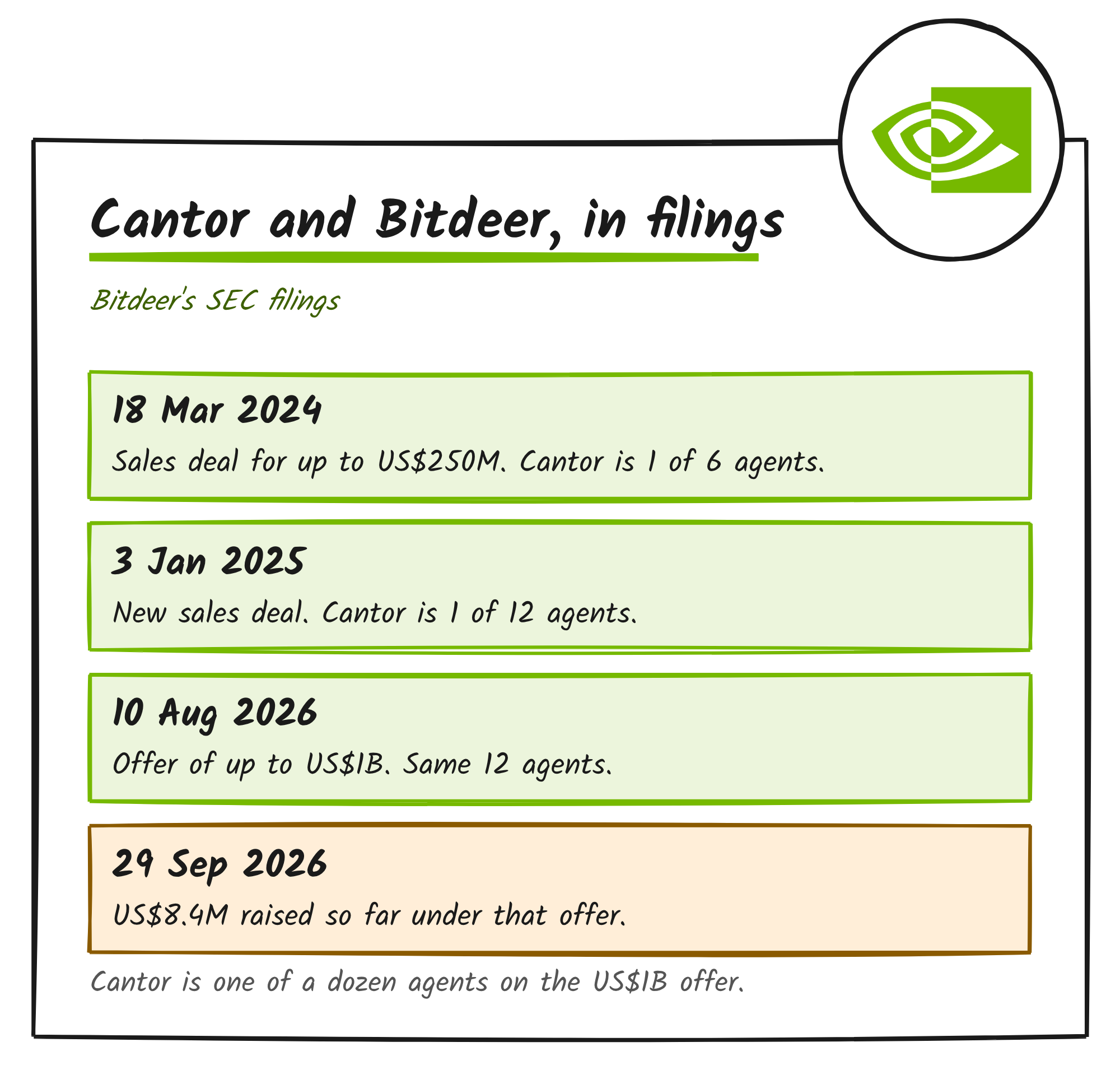
The Times says Bitdeer, the Singapore-based company that will operate A201, is a Cantor client. Cantor served as a designated sales agent for an equity offering of up to US$1 billion by Bitdeer this year, and the relationship dates to 2024, when Cantor helped Bitdeer arrange an offering of up to US$250 million. In an earlier report on 12 November, the Times said Cantor has also acted as a financing or placement agent for other companies that develop or operate data centres in Southeast Asia, including Gorilla Technology Group.
Bitdeer’s SEC filings show where Cantor sits in that arrangement. The 10 August prospectus supplement for the US$1 billion offering lists Cantor as one of 12 sales agents under a programme dated 3 January 2025. The 18 March 2024 agreement for up to US$250 million named six agents, Cantor among them. A 29 September filing says Bitdeer had sold 767,199 shares under the 2026 supplement for about US$8.4 million in net proceeds.
Bitdeer’s 29 September release describes A201 as a roughly 21.7 megawatt, liquid-cooled site built for Nvidia’s GB300 NVL72 rack systems, with power-on due in the first quarter of 2027. It says more than 70% of the capacity is covered by off-take commitments, meaning customers have agreed in advance to buy it, worth more than US$1.7 billion in expected revenue over five years. Bitdeer says it has bought more than 100 GB300 NVL72 racks from an unaffiliated third-party supplier. The release doesn’t name the customers.
What the draft rule would do
The Times says China hawks in the administration see Southeast Asian data centres as a way for Beijing to get around the chip ban, and that Lutnick is the official most prominently pushing against going too far in limiting Nvidia’s ability to sell in Asia. Recently, it says, he has advocated a less stringent version of the controls under consideration. The Times says even that version could cut into Nvidia’s business by giving the US government more oversight of chip sales to international data centres.
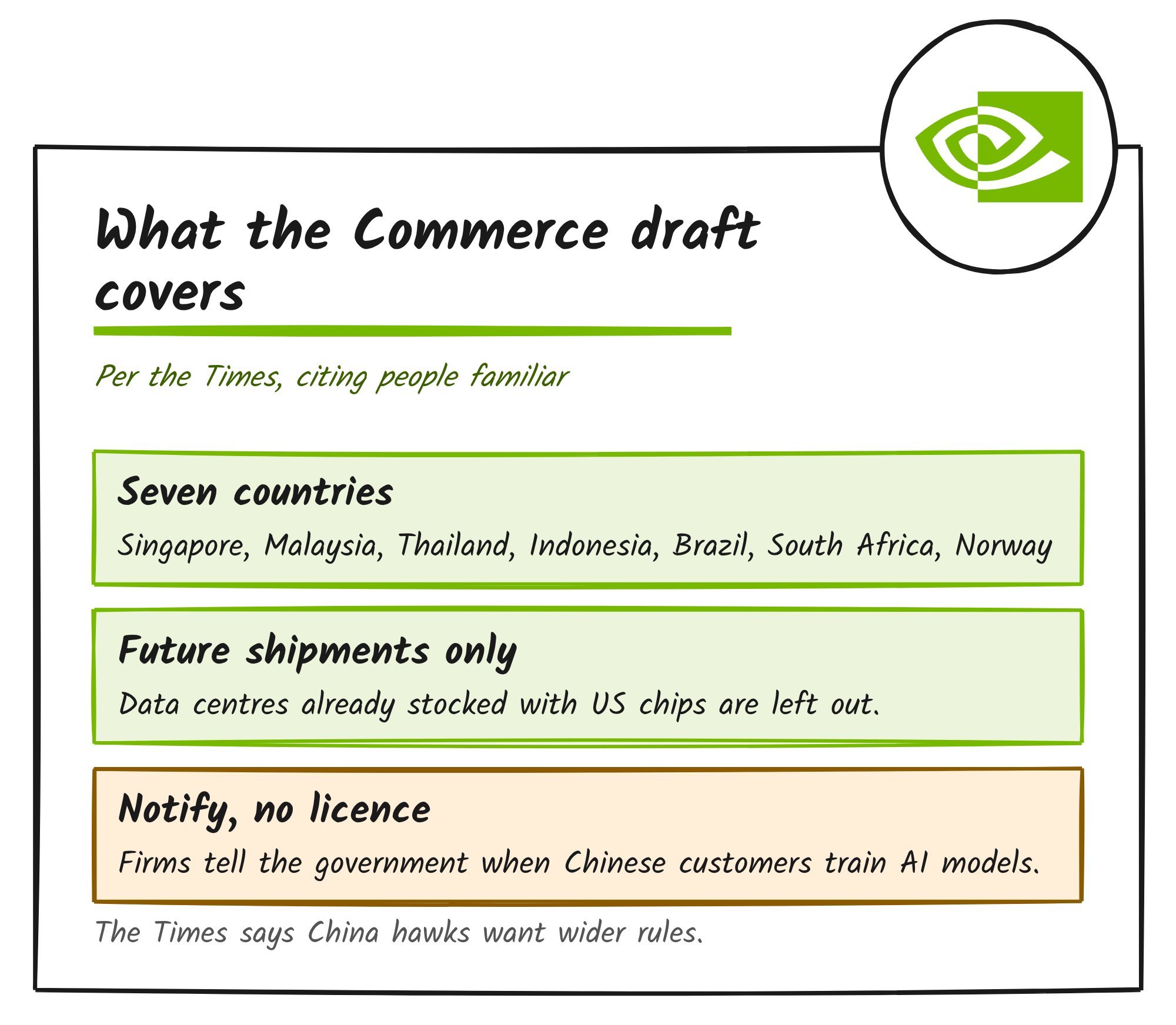
Citing people familiar with the discussions, the Times reports that the Commerce draft would cover seven countries: Singapore, Malaysia, Thailand, Indonesia, Brazil, South Africa and Norway. It would apply only to future shipments, and companies would have to notify the government when Chinese customers use their data centres to train AI models instead of automatically needing a licence.
The Times reports that the Trump administration revoked the Biden administration’s global rules on remote access to US chips and promised a replacement that hasn’t appeared. The Atlantic Council says Commerce has twice drafted rules to restore some licensing requirements for Southeast Asia: the rule for Malaysia and Thailand was never issued, and a global permit framework was withdrawn shortly after it went to interagency review.
What Lutnick and Commerce say
A Commerce Department spokeswoman told the Times that Lutnick makes policy decisions in the best interests of the United States, doesn’t discuss department matters with his sons, and that they don’t discuss Cantor’s business with him. A Commerce spokesperson told NPR on 14 November that Lutnick has “fully complied with the terms of his ethics agreement, including all divestiture and recusal requirements” and has “divested all financial interests in Cantor Fitzgerald, Newmark, and BGC”.
The Times says Lutnick transferred his remaining Cantor ownership to his family as of October 2025. A Schedule 13D amendment filed by Cantor entities says the sale of his interests in Cantor and CF Group Management was completed on 6 October 2025, leaving him with no voting or dispositive power over the securities it covers. The Times says the dealings it reviewed are a tiny part of Cantor’s business, which runs from investment banking and trading to real estate.
Senator Michael Bennet’s office has asked Commerce for an update on its Megaspeed investigation, another Southeast Asian chip-rental case, by 24 November, according to his 10 November letter to Lutnick and three other officials.
Discover more from Sulat AI & Tech News
Subscribe to get the latest posts sent to your email.