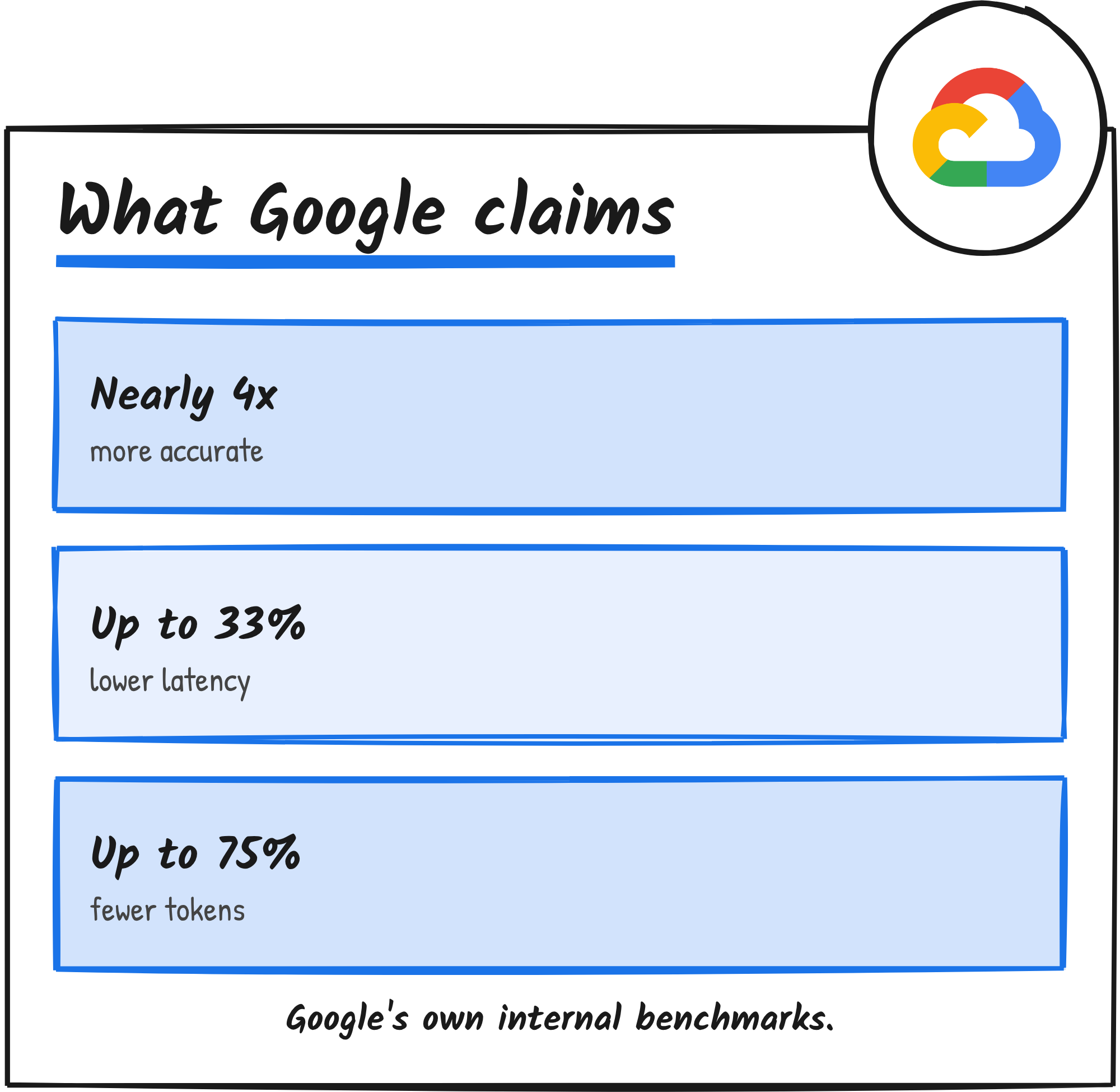
Google Cloud has put self-learning enrichment and a new Knowledge Studio into preview in Knowledge Catalog, the service it calls its “universal context engine” for AI agents. Google says grounding agents in the catalog makes them nearly 4x more accurate, with up to 33% lower latency and up to 75% fewer tokens, based on its internal benchmarks.
Google announced the preview on 22 October and repeated it on 4 November in an Agentic Data Cloud roundup by Sirish Chandrasekaran, VP of product strategy and growth for Data Cloud, and Raj Pai, VP of product management. Knowledge Catalog was called Dataplex Universal Catalog until 10 April 2026, the release notes say. The API, client library, CLI and IAM names didn’t change.
What Knowledge Catalog does
Knowledge Catalog collects metadata, business definitions and relationships across a company’s data into a context graph. In Google’s description, tables, semantic models, glossary terms and data products are the nodes. Lineage, schema keys, joins mined from real query history and the join paths declared in semantic models are the edges. A semantic model is a company’s agreed definition of a metric, such as net revenue. Agents read the graph through the Model Context Protocol (MCP, the open standard that lets agents call outside tools) or through the catalog’s APIs, the docs say.
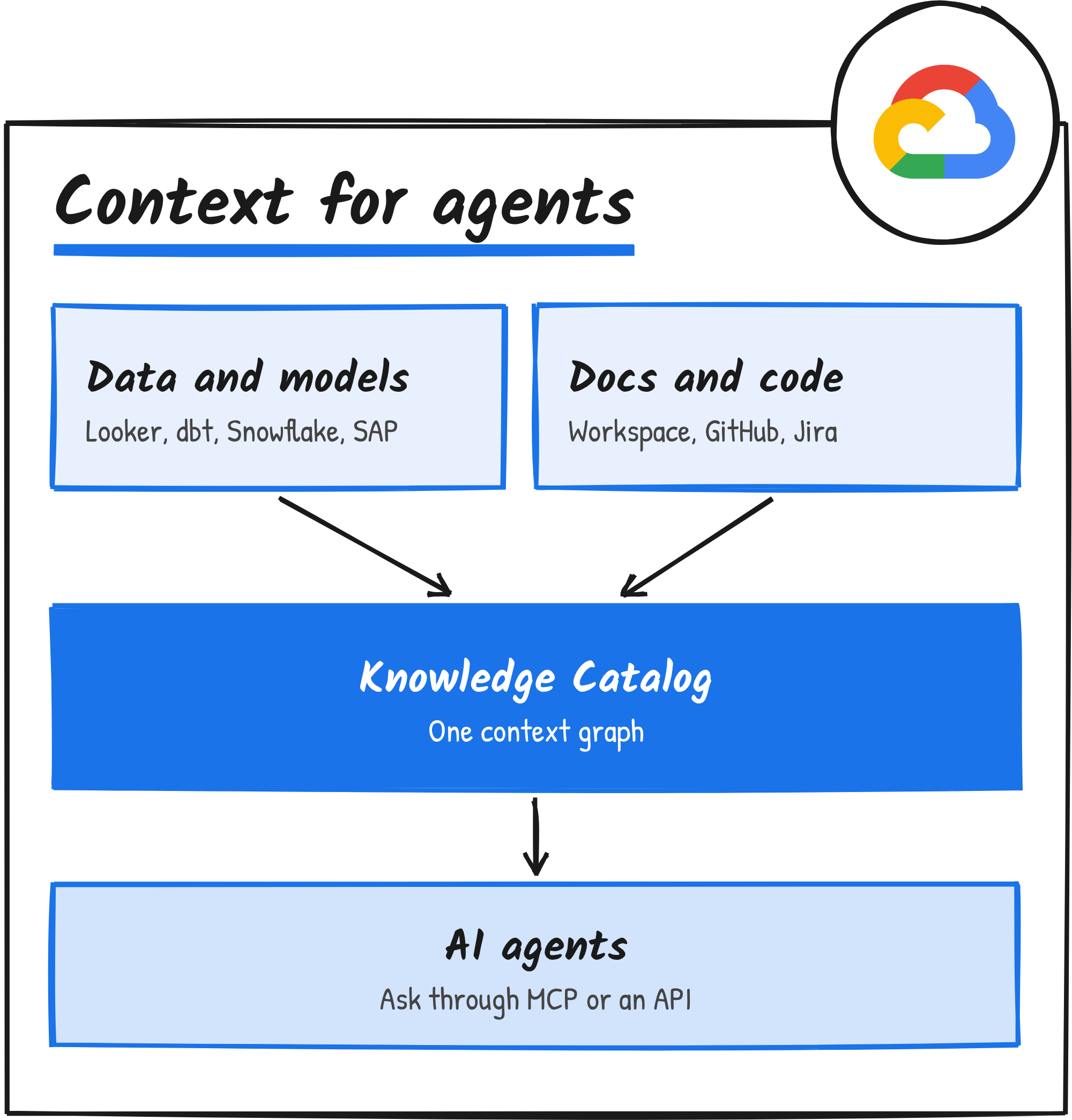
Semantic model support is generally available. Google says the catalog ingests models and metric definitions from Looker LookML, BigQuery Graph, dbt MetricFlow, Snowflake Semantic Views, Databricks Metric Views and SAP Core Schema Notation, without moving the data.
What’s in preview
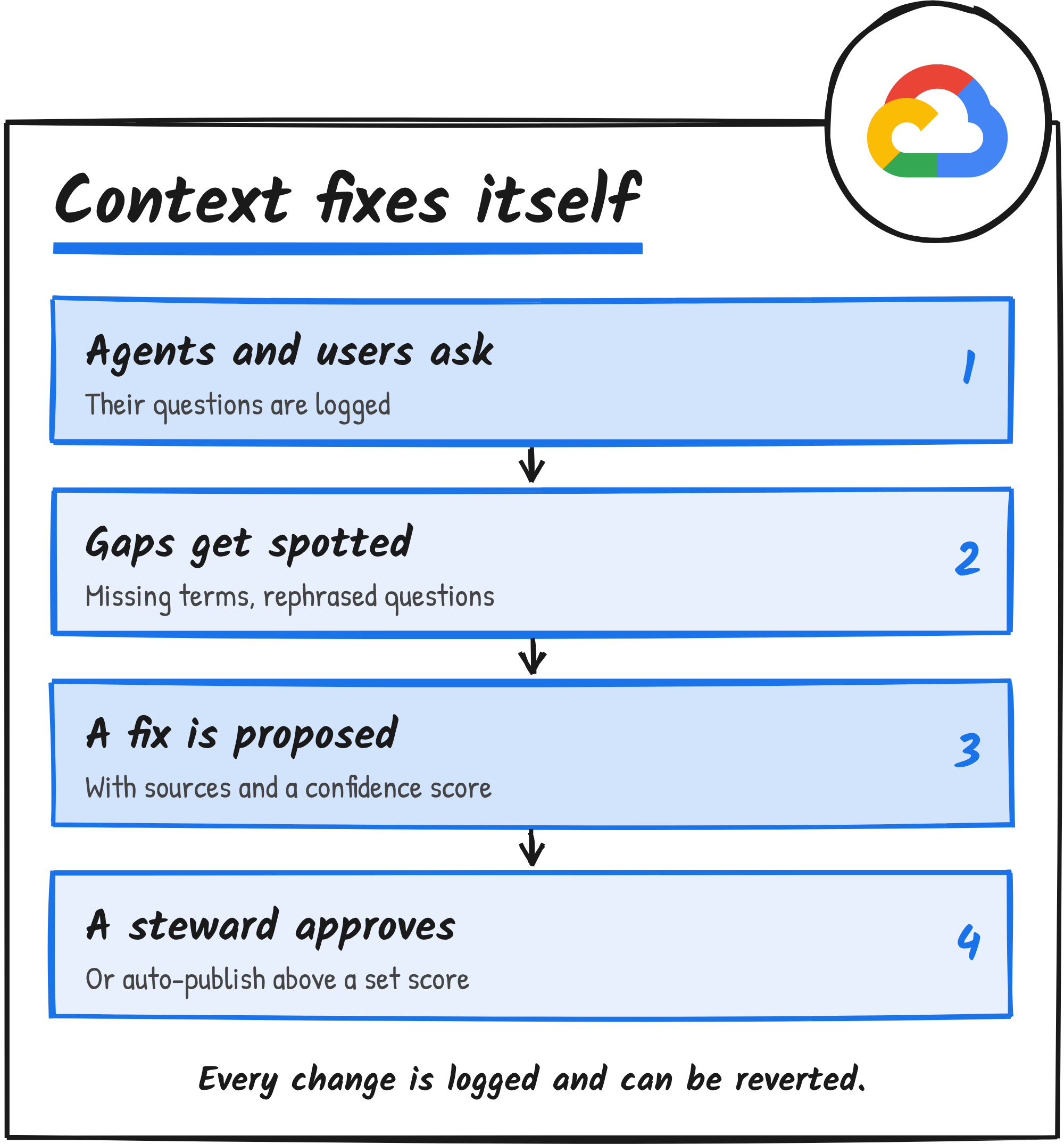
Self-learning enrichment is the main addition. Google’s 22 October post says a Gemini-powered enrichment task connects to Cloud Storage, Google Workspace, GitHub, Confluence and SharePoint, and the 4 November post adds Jira. It proposes business definitions, table and column descriptions, join relationships, golden queries (vetted example queries) and task-specific agent instructions. Each proposal carries source citations and a confidence score.
It also learns from use. Enrichment can read interaction traces from Gemini agents, Conversational Analytics in BigQuery or custom agents, with personal data redacted, and flag where agents struggled: ambiguous column lookups, ungrounded metrics, missing definitions or users rephrasing the same question.
Google says admins can switch auto-publishing on or off and set the confidence score at which a change is approved automatically, with 85% as its example. Anything below the threshold, and sensitive updates such as deletions, becomes a change request for a data steward to approve, edit or reject. Every change is logged and can be reverted, Google says, and Google never uses customer data to train its models.
Knowledge Studio is the console for that review. Google says context engineers and data stewards use it to explore the graph in natural language, see a visual map of their data estate and approve proposed changes with versioning and rollback. The docs say enrichment tasks are managed in the Google Cloud console, and REST APIs and gcloud commands for managing them aren’t available in preview.
Context sets are curated subsets of the graph for a domain, team or agent. Google’s example binds a sales agent to a Sales set and a finance assistant to a Finance set, because “net revenue” can mean different things to each group. Access to each set is controlled with IAM, and the docs say a set doesn’t bypass permissions on the underlying tables. Sets build on the Open Knowledge Format (OKF), so a bundle can be imported and exported.
Google also says Knowledge Catalog is now on by default in Gemini, in preview. When a user connects BigQuery, AlloyDB, Cloud SQL or Spanner, it resolves business terms, finds trusted tables and works out join paths before Gemini writes the SQL, under that user’s permissions.
The numbers
Google’s three figures appear in its 22 October, 29 October and 4 November posts, each tied to “internal benchmarks”. The posts don’t describe the questions, the baseline agent or the models used.
| Piece | Stage | Where Google says so |
|---|---|---|
| Semantic model support | Generally available | 29 October blog post |
| Self-learning enrichment | Preview | 22 October blog post |
| Knowledge Studio | Preview | Release notes, 4 November |
| Context sets | Preview | Context sets docs |
| On by default in Gemini | Preview | 4 November blog post |
Cost and limits
During the preview, running enrichment tasks and staging unapproved change requests are free, the context sets docs say. Standard BigQuery query processing and Cloud Storage charges apply when a task uses customer-managed resources such as storage buckets or BigQuery agent-analytics tables. Standard Knowledge Catalog metadata storage charges apply once entries are created in a context set.
Knowledge Studio’s docs list what the preview doesn’t cover: Assured Workloads compliance regimes including FedRAMP, CJIS, IL4/IL5 and HIPAA, data residency commitments, customer-managed encryption keys and VPC Service Controls. Google tracks each change from preview to general availability in the Knowledge Catalog release notes.
Discover more from Sulat AI & Tech News
Subscribe to get the latest posts sent to your email.