Muhammad Zulali says Claude Code and OpenAI’s Codex read the engine computer of his 1994 Jeep Cherokee, copied its program and ran their own code inside it, using a US$3 Arduino Nano and about US$15 of parts. He describes the week-long project in a YouTube video posted on 10 November, and published the wiring, code and agent instructions as xj-scanner on GitHub.
The Cherokee has no OBD2 port, the standard diagnostic socket, and no scan tool that works on it, Zulali says in the video description. It was failing California’s smog check on nitrogen oxide emissions at 25 mph, Tom’s Hardware reports, and Pasquale Pillitteri’s write-up of the video puts the cost of each retest at about US$100. In the video, the Jeep passes.
Three wires and a US$3 board
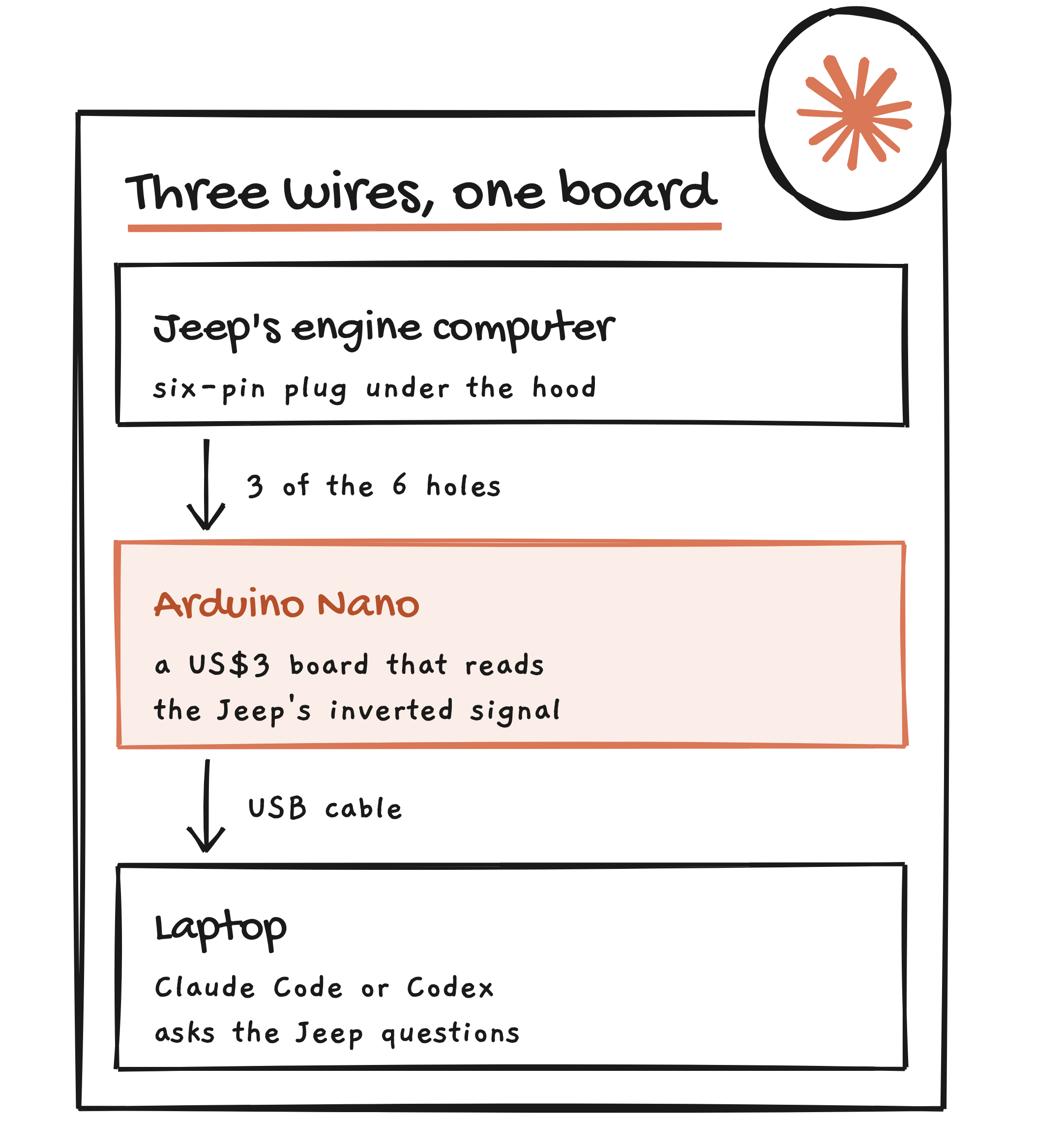
The engine computer, a Chrysler SBEC unit, talks over a serial line called SCI. The project’s protocol notes put it at 7812.5 baud, and the signal is electrically inverted compared with an ordinary serial port. The Nano flips it in software, so no inverter chip is needed. Three wires run from three of the six holes in the diagnostic plug under the hood (ground, receive and transmit) to the Nano, and the Nano plugs into the laptop over USB. The Drive reports that Claude identified the protocol and suggested the Nano as the translator.
Once connected, the scanner reads about a dozen live parameters, including coolant temperature, battery voltage, engine speed and spark advance, in roughly half a second, and logs a drive to a file. It can also run the computer’s built-in actuator tests, which switch real hardware: the fuel pump, injectors, coils and fans. The repo’s agent instructions tell the agent to ask before each one and say what it will do.
Claude Code finds a wrong number
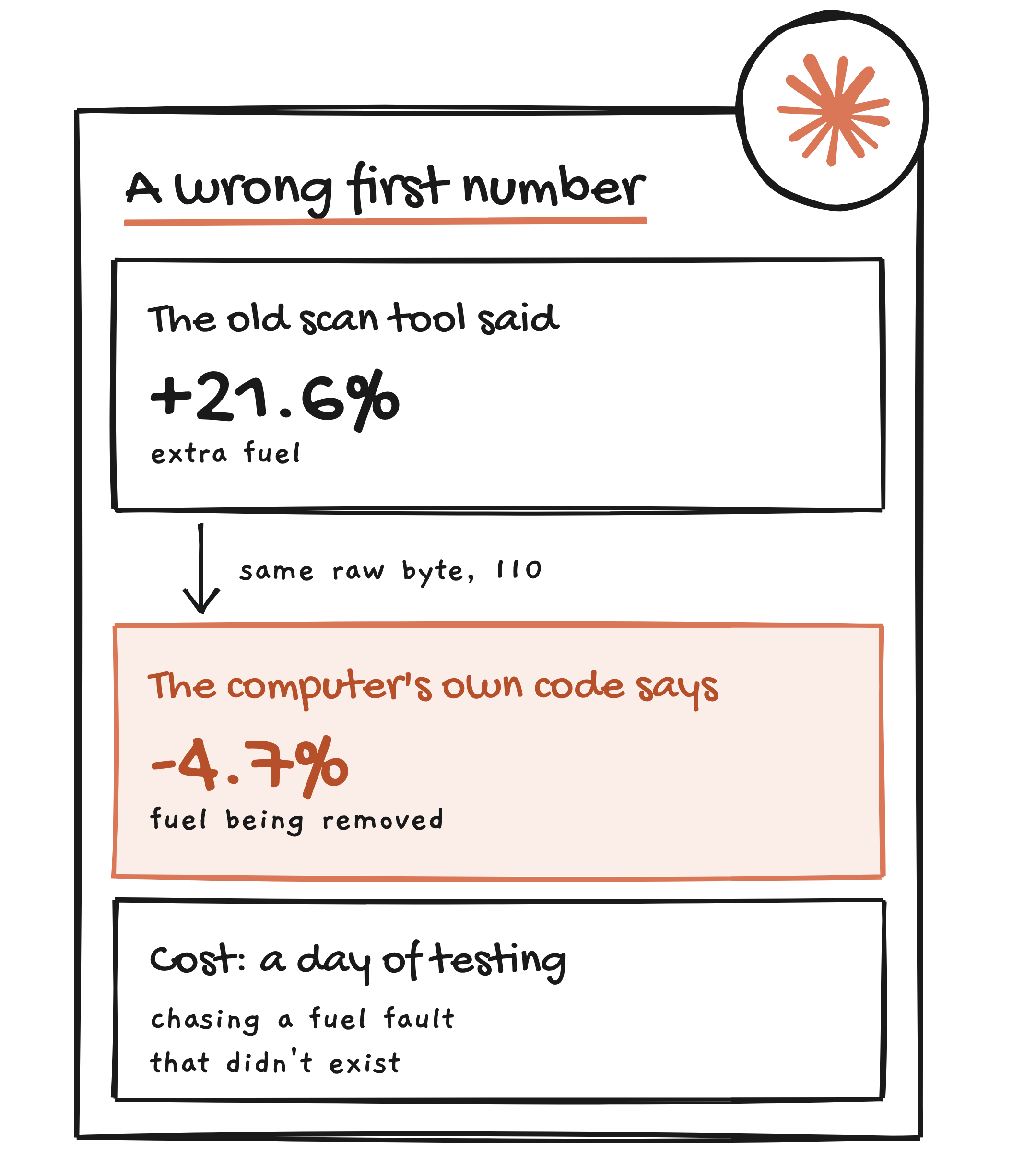
The first readings sent Zulali after a fuel problem that wasn’t there. The open-source ChryslerScanner formula for long-term fuel trim treats the top bit of the byte as a sign. The xj-scanner parameter notes say that turns a raw value of 110 into +21.6%, when the computer’s own code means -4.7%, fuel being removed. That cost a day of testing on the test car. The correct scale was settled from the computer’s code and from the disassembly in AR1972’s jeep_2.5L project. The notes also say vehicle speed reads double on this car.
Along the way Claude asked to run the fuel pump, and it ran. Pillitteri’s write-up says the pump stayed on for about 10 seconds until Zulali asked to stop it, the first time the agent acted on the car instead of only reading it.
Claude then copied the computer’s whole program to the laptop. The protocol notes say a read-only command returns one byte at a time, so the 32 KB copy takes about 18 minutes. Zulali says the copy shows this is the California version of the computer, which cuts fuel more than the federal version at the loads used in a smog test, and he calls that a possible cause of the failure.
Codex runs code inside the computer
Rewriting the computer with the federal settings was the obvious fix. Claude prepared a full reflash kit, but the computer wouldn’t enter programming mode. Pillitteri reports it was built in December 1993, about four months before these computers became reprogrammable. Codex found another way in: the computer accepts a small program sent over the same three wires and runs it on every pass of its main loop. HotHardware reports that Codex then wrote custom code into the EEPROM, the memory that keeps its contents when the battery is disconnected.
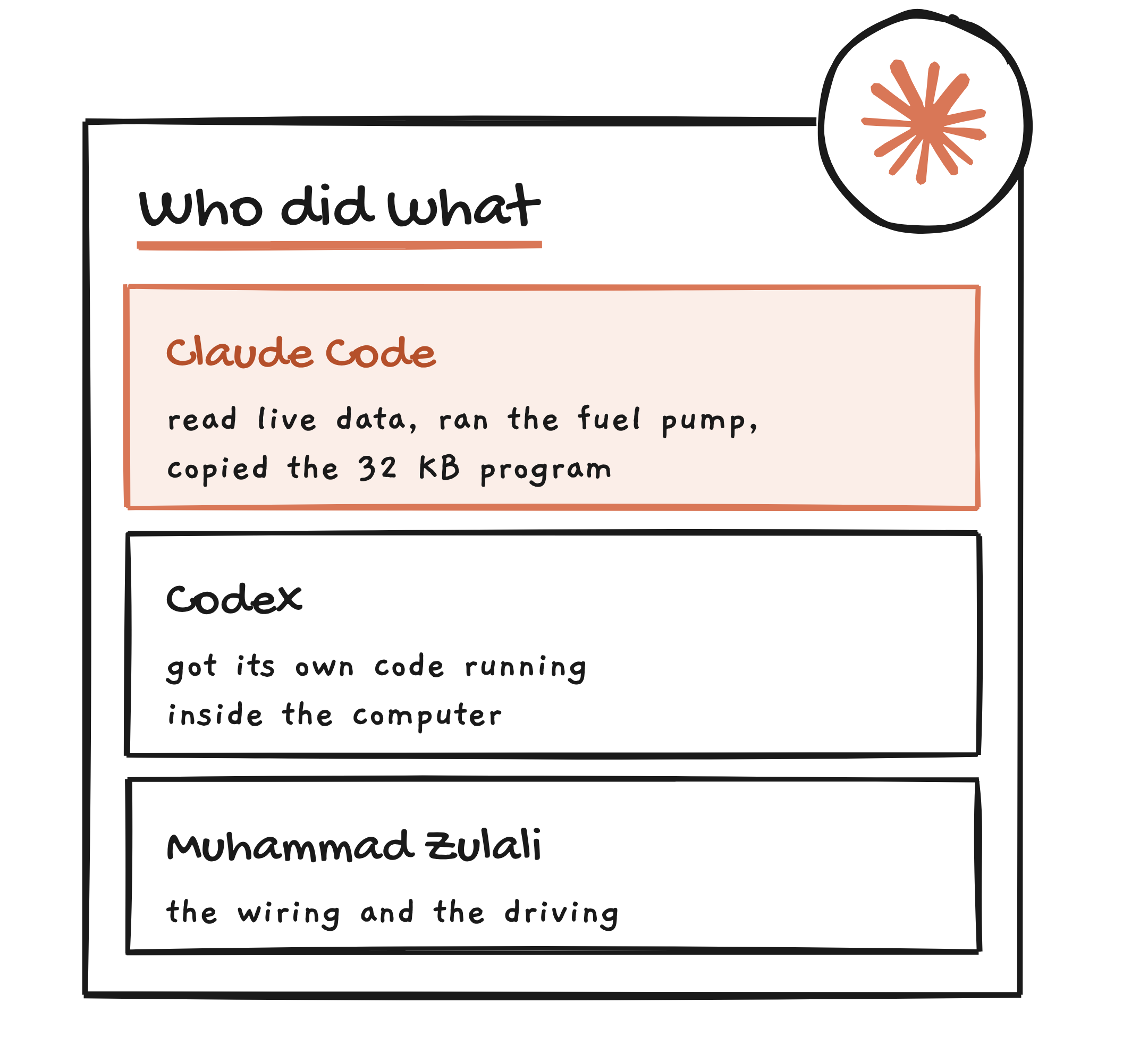
Zulali splits the credit the same way. “I just did the wiring and the driving,” he says in the video, as HotHardware quotes him. On smog day, Pillitteri reports, the first station’s test rig was broken and the second wanted a full tank, and after many tries the Jeep passed.
Trying it on another Jeep
The repo is GPLv3 and aimed at 1991 to 1995 Chrysler and Jeep computers of the same family. It was built and tested on one car, a 1994 Cherokee XJ 4.0L with computer 56030117. The README’s route is to clone the repo, open it in an agent such as Claude Code or Codex and say “Help me hook this up to my Jeep.” It lists an Arduino Nano clone, a breadboard, three wires, three spade terminals and a multimeter, about US$15 in all.
The README’s one hard rule is that cavity 6 of the plug carries 12 volts with the key on and nothing should ever be connected to it. On the test car its wire is the same colour as the ground wire, so the README says to check every cavity with a meter first.
Disclosure: I’m an OpenAI, Firecrawl and Devin ambassador.
Discover more from Sulat AI & Tech News
Subscribe to get the latest posts sent to your email.