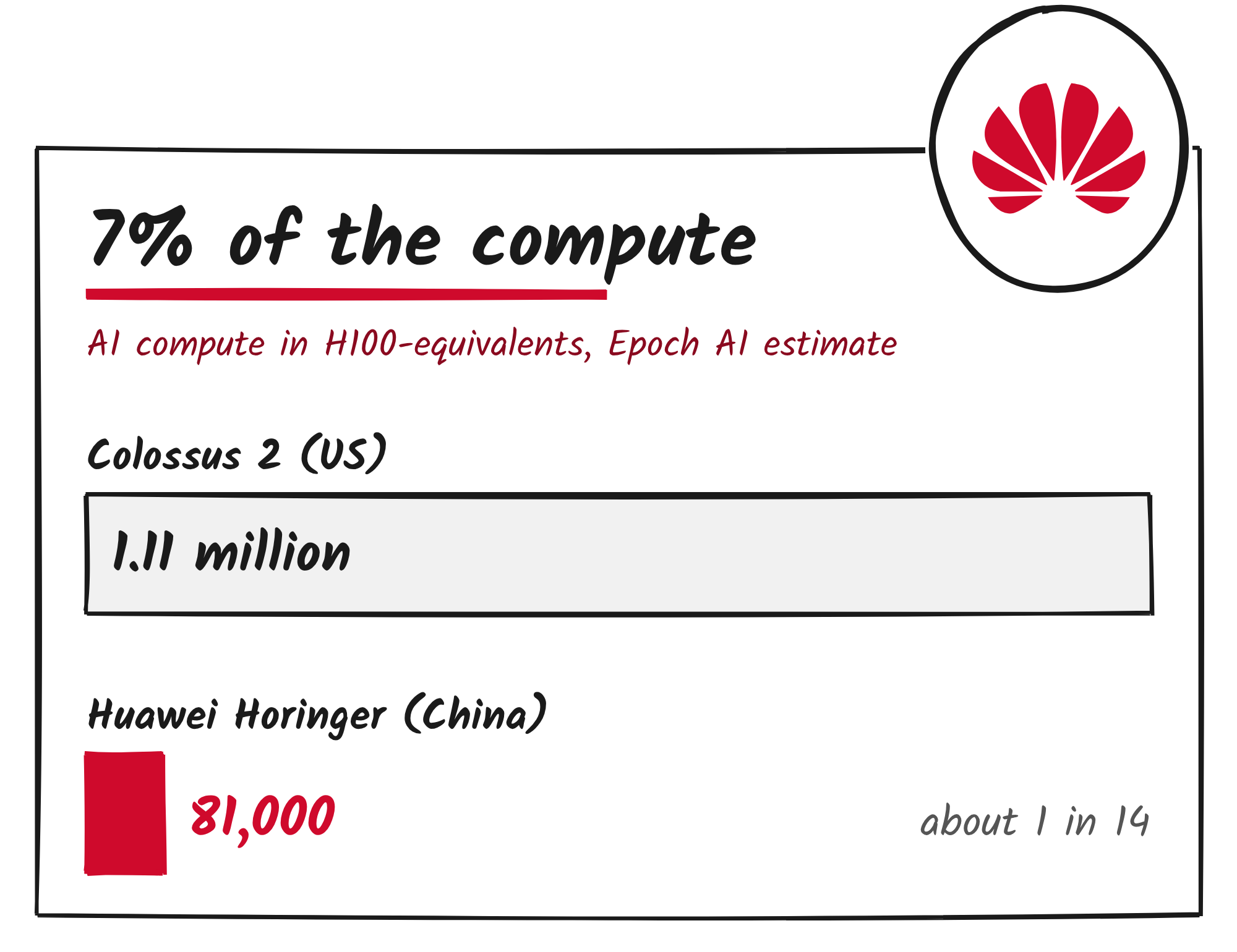
Epoch AI estimates that Huawei’s AI data centre at Horinger, in Inner Mongolia, holds about 81,000 H100-equivalents of computing capacity, roughly 7% of the 1.1 million at SpaceX’s Colossus 2 in Tennessee. The estimate comes from a 6 November report by Epoch senior researcher Ben Cottier, built from satellite imagery and public sources.
An H100-equivalent is Epoch’s yardstick for comparing chips: one unit is the peak 8-bit speed of Nvidia’s H100. Epoch says Colossus 2 has about 14 times Horinger’s capacity, and that Horinger is still probably one of the largest AI data centres in China. Only VNET’s Bayin Ulanqab site and Huawei’s own Wuhu campus are likely to match or slightly exceed it, Epoch says.
How Epoch sized the campus
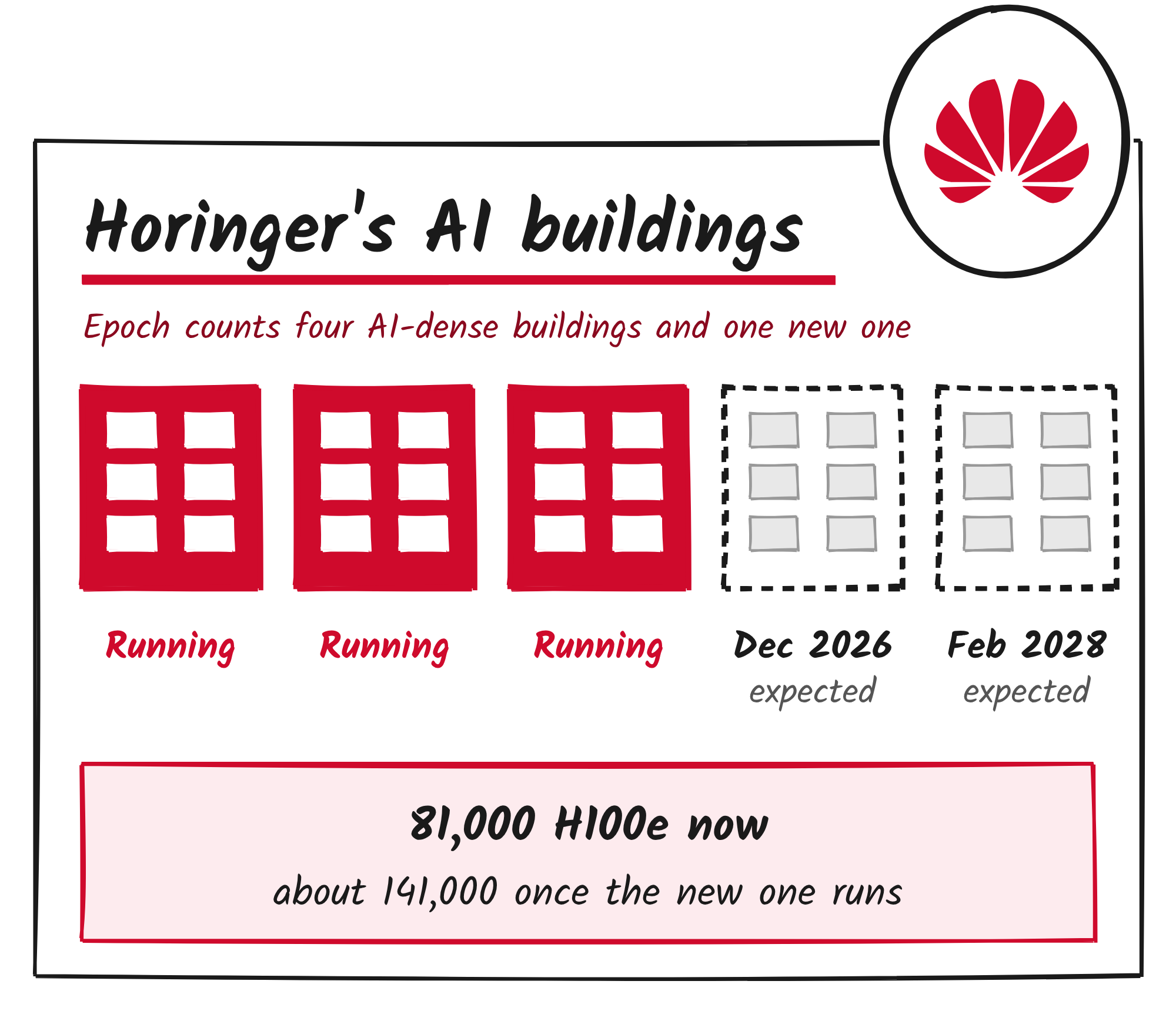
Horinger is a three-zone Huawei campus, split into West, South and North, inside the Horinger New Area, which is part of China’s East Data West Computing programme launched in 2022. Epoch counts six buildings so far. It set aside the two in the North zone because they have far fewer cooling towers, which points to low-power racks rather than AI servers. That leaves four dense buildings, two in the South zone and two in the West.
From the number and size of the cooling units visible in satellite images, Epoch’s model puts those four buildings at up to 286 megawatts of IT power capacity. Two cross-checks land in the same range: 304 megawatts from substation details and 230 from backup generators. Epoch says three of the four buildings are already running and expects the fourth, in the West zone, to start by December. Its data page lists 170 megawatts of IT power for the site today.
To turn power into chips, Epoch assumed the same 76% rack occupancy reported for the whole Horinger area in September 2026. It then filled the racks using Huawei’s chip sales, with a four-month lag between sale and installation. That gives about 105,000 Ascend 910C chips and 8,000 Ascend 910B chips running, and the 81,000 figure carries a 90% range of 36,000 to 141,000. Epoch assumes the site holds no export-controlled Nvidia chips, because Horinger is a public cloud and Huawei has every reason to use its own silicon.
Why the same power buys less
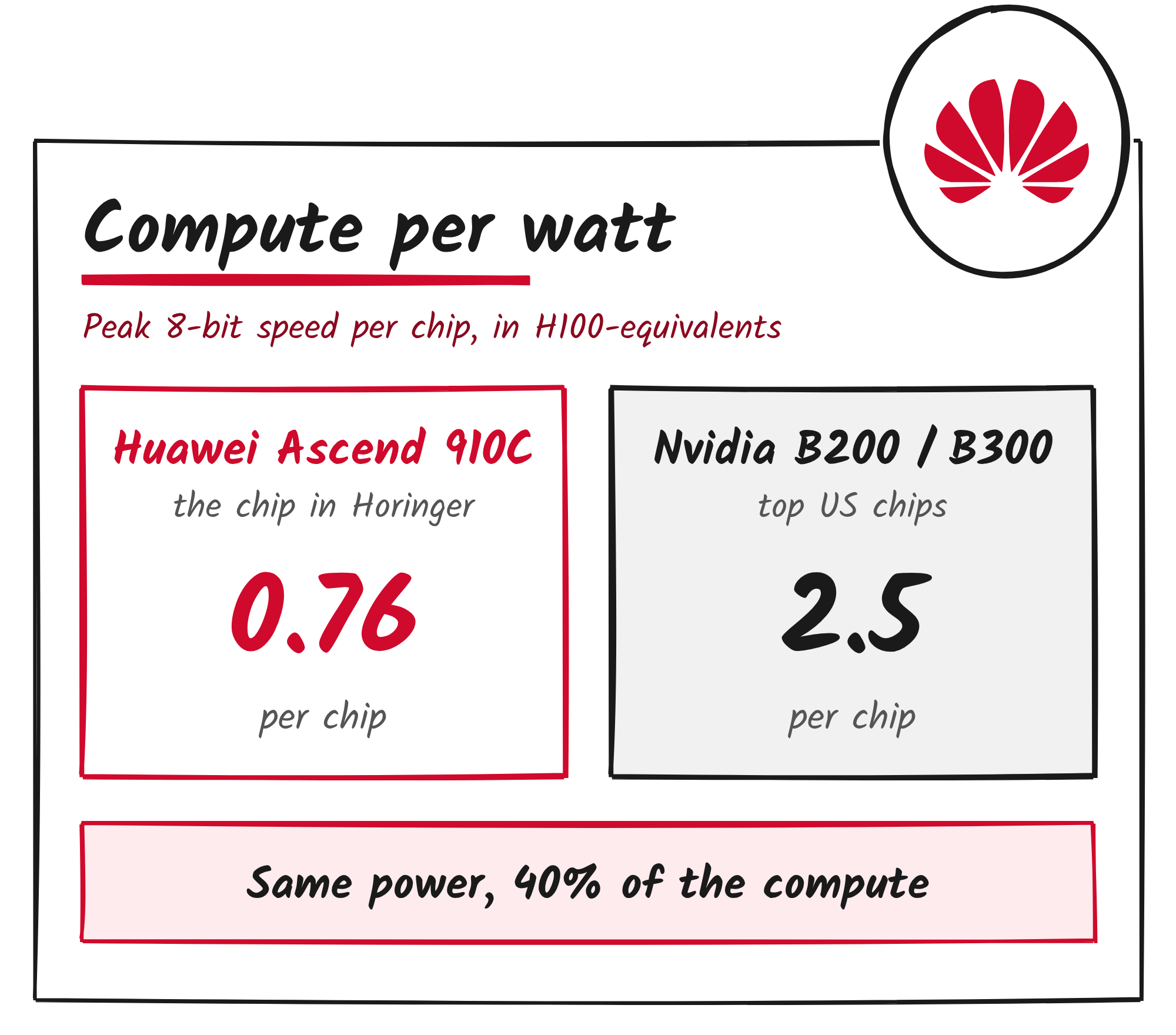
By Epoch’s numbers, Huawei’s 910C scores about 0.76 H100-equivalents per chip, against about 2.5 for Nvidia’s B200 and B300. Epoch, citing SemiAnalysis, says the Nvidia chips are also about 2.5 times more energy-efficient. It says that means a given amount of power capacity supports 40% of the compute it would in a leading US facility. Epoch also notes that US AI data centres run at close to 100% rack occupancy, while Horinger’s area sits at 76%.
| Epoch estimate | Huawei Horinger | Colossus 2 |
|---|---|---|
| AI compute | 81,000 H100e | 1,112,000 H100e |
| IT power | 170 MW | 946 MW |
| Capital cost | US$6.4 billion | US$35.8 billion |
| Chips | Ascend 910C and 910B | Nvidia B200 and B300 |
Epoch’s footnote adds that the 910C doesn’t natively support FP8, an 8-bit format useful for AI training, so the 0.76 figure arguably oversells the chip. Huawei hasn’t definitively reported the 910C’s specifications, so Epoch derives the number from a per-die figure in a Huawei research paper.
What 81,000 can train
Epoch says the compute in a campus is often split into several densely networked clusters, so the total can’t necessarily go into one training run. Even so, it calculates that 10% of Horinger’s compute, 8,100 H100-equivalents, could train a model at the scale of DeepSeek-V4-Pro in a month. If all of it were combined for one run, a model at the scale of GPT-6 Astra would take about a year, on Epoch’s median estimate of that model’s training compute.
What’s coming at Horinger
One more building is under construction in the South zone, and Epoch expects it to open in February 2028. A public announcement says it will support 100,000 accelerator cards and use Huawei’s next-generation Ascend 950 chips. Epoch assumes about 76,000 of the 950DT variant drawing 135 megawatts, which would lift Horinger by more than 70% to roughly 141,000 H100-equivalents, with a 90% range of 65,000 to 227,000. Epoch expects Colossus 2 to reach at least 1.8 million by 2028, so Horinger would stay at about the same share or a smaller one.
Epoch says that doesn’t mean China’s frontier falls further behind. Huawei’s Wuhu campus is projected to reach 151,000 H100-equivalents by December 2027. Epoch’s conclusion is that China has the energy for data centres but that its compute constraints are unlikely to ease in the next two years.
What the estimate doesn’t show
Epoch doesn’t know who Horinger’s customers are. It says the campus likely serves a mix of users: Huawei itself is a major customer of Huawei Cloud, and Zhipu and iFLYTEK are possible customers, but Epoch doesn’t know where Zhipu’s chips are hosted. It withheld some sources to protect their availability and makes them available to researchers on request. The calculations are in a public spreadsheet, and Epoch’s data pages are published under a CC-BY licence.
Discover more from Sulat AI & Tech News
Subscribe to get the latest posts sent to your email.