Australia’s music, publishing, film and media groups launched a national campaign called Not AI’s to Take on 17 November, asking the Albanese government to reject any copyright change that would let AI companies train on Australian work without permission and agreed payment. The government hasn’t announced a change. A spokesperson for Attorney-General Michelle Rowland told AAP and 7NEWS the government is “continuing to consult with creators, media organisations and AI companies on a range of options”.
ARIA and the Phonographic Performance Company of Australia lead the campaign, and its press release lists APRA AMCOS, Copyright Agency, Free TV and Foxtel among its supporters. Jimmy Barnes, Paul Kelly and Peter Garrett are backing it, the Guardian reports. Kelly is quoted on the campaign’s website: “Australia has had some of the best copyright laws, something to be proud of. Now is the time for our government to show some backbone.”
What the government has decided
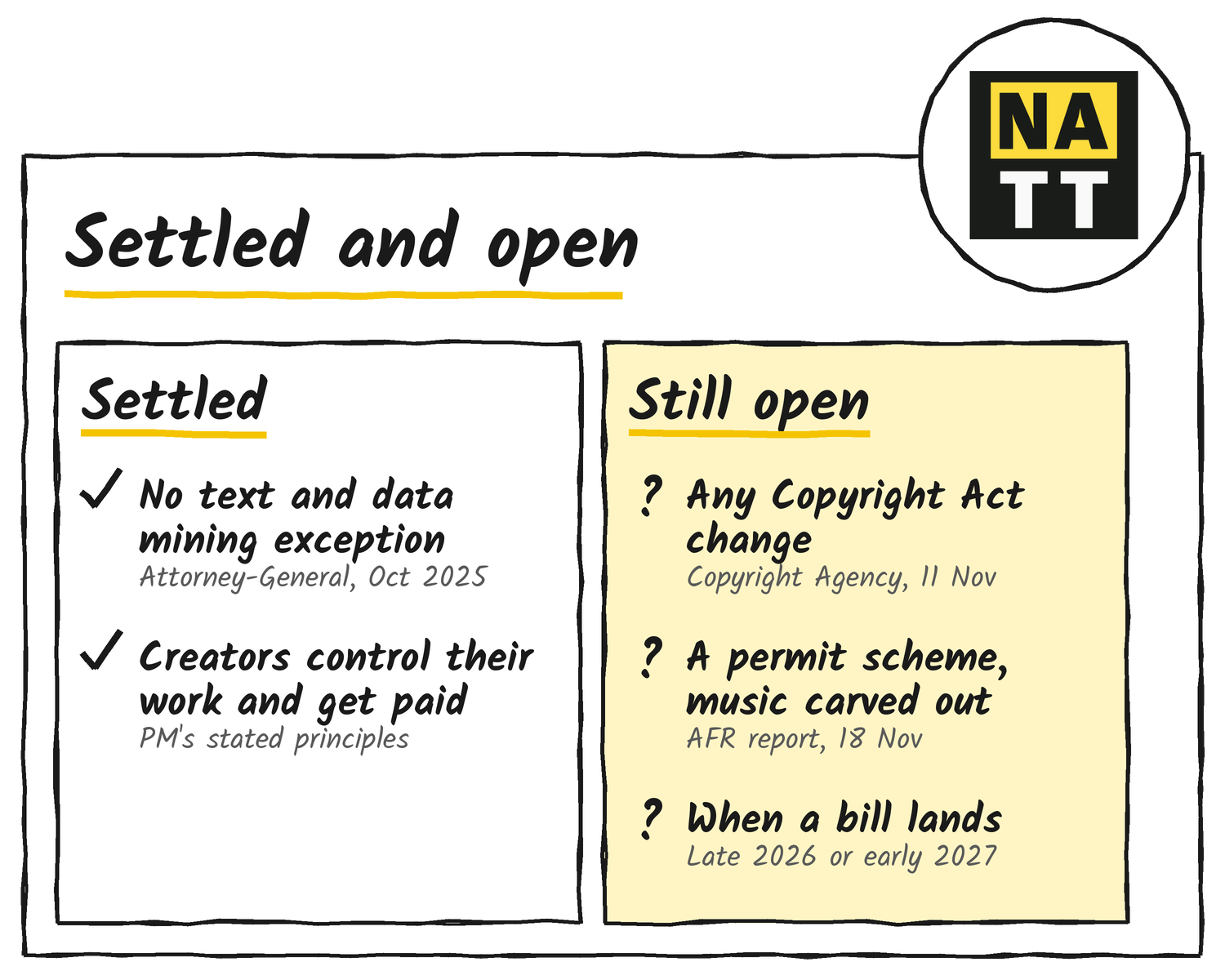
In late October 2025 the Attorney-General announced that the government wasn’t considering a text and data mining exception, a rule that would let AI developers use creators’ work for training without permission or payment, according to the Attorney-General’s Department. The open question since is what replaces it. Prime Minister Anthony Albanese’s stated principles are that artists control their work and are compensated when it’s used. On 10 November, asked about Barnes’s concerns, Albanese said Barnes “needs to be clearer about his view on these things” and that his position on those principles “certainly hasn’t changed”.
Industry Minister Tim Ayres said on 17 November that “the status quo is no good” for the creative sector, the Guardian reports. Copyright Agency said on 11 November that the government is still considering whether to change the Copyright Act at all, and that “it is not currently clear what the changes might be”. AAP reports draft AI legislation is due late this year or early next.
What’s reportedly on the table
ABC reported on 15 September that leaked consultation documents set out two options. Under one, AI companies could train on online material whose owners hadn’t opted out, as long as they paid a central body and met other conditions, and the body would share the money with registered copyright owners. Under the other, they could gain permission after striking a minimum number of deals with rights holders, without paying other creators whose work they used.
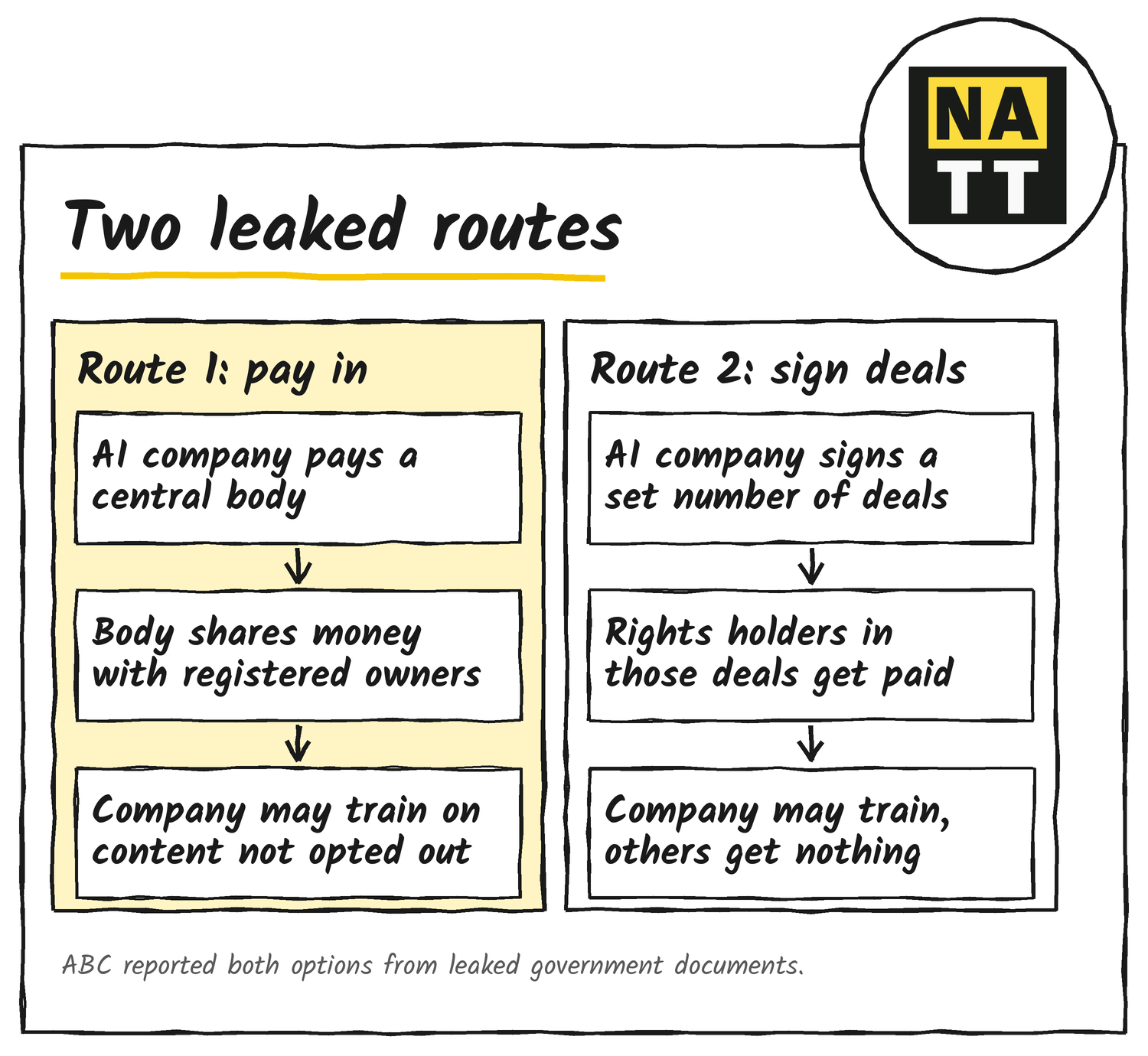
The Australian Financial Review reported on 18 November that AI labs such as Anthropic and OpenAI would have to buy a permit to train on Australian content, and that music is likely to be carved out of the regime. None of these options has been announced as government policy. On 19 October, overseas publishers and music groups including the Association of American Publishers and Broadcast Music, Inc. wrote to Albanese asking him to reject reported proposals that would give AI developers a safe harbour in exchange for donations into a funding pool or a set number of deals.
What the AI companies asked for
Anthropic and OpenAI lodged submissions with parliament’s Joint Select Committee on Artificial Intelligence, made public on 22 September. Anthropic has accepted it won’t get US-style exemptions, the AFR reports, and proposed a narrow form of conditional approval for training, with “do not crawl” signals in robots.txt files, according to the Guardian. It told the committee, as Reuters reports, that it’s open to considering conditions “designed to support the future of Australian creators and cultural endeavours”. OpenAI asked for “a balanced copyright framework that allows models to learn from publicly available information” while giving rightsholders chances to collaborate, and said Australia can play a significant role in the global build-out of AI infrastructure if copyright policy and partnerships are right, per Capital Brief.
The Monthly reports that the labs’ proposal would see them make a one-off payment, collectively in the hundreds of millions of dollars, into a central fund the government of the day would control, in return for access to copyrighted content in perpetuity.
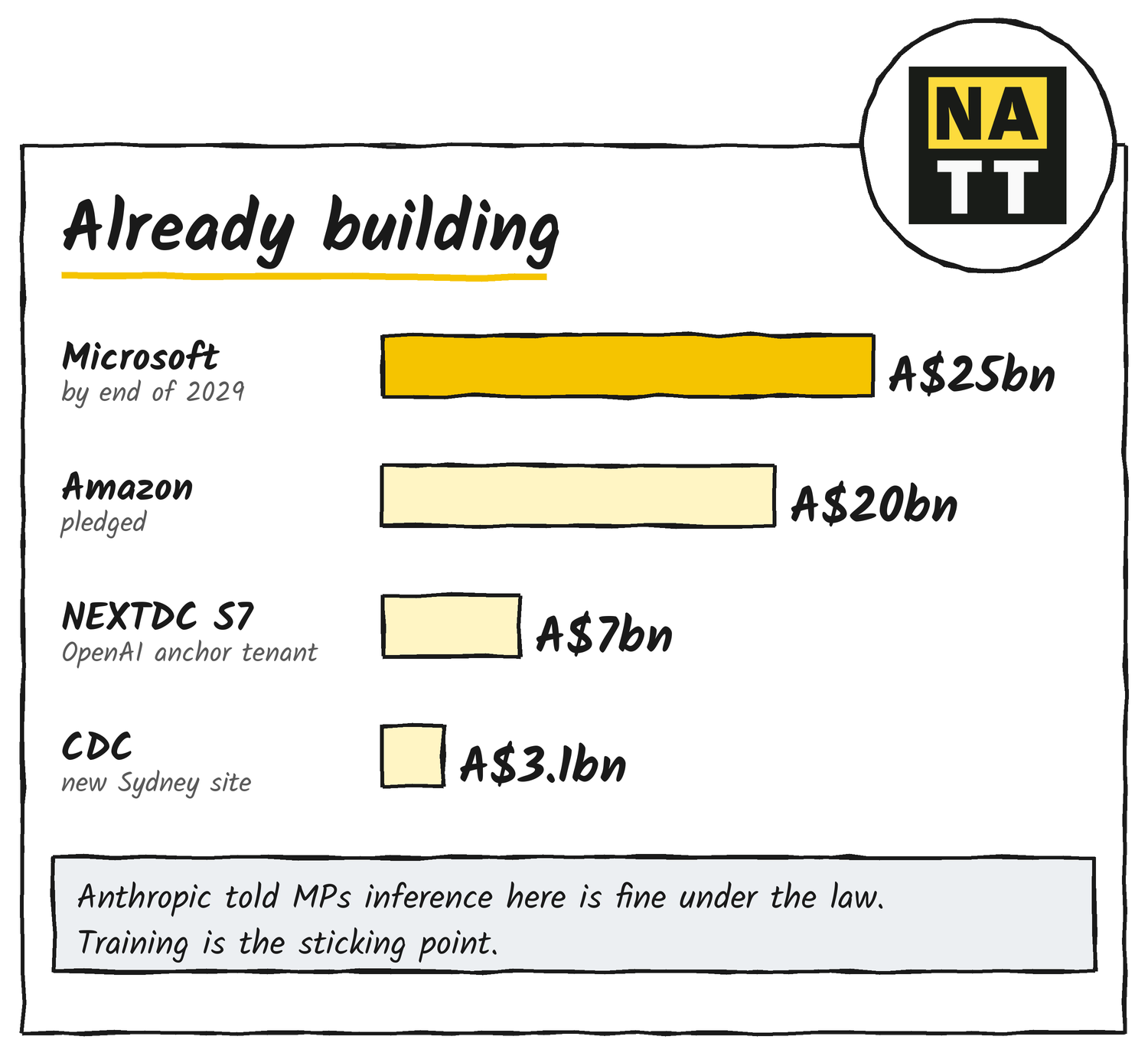
At a 6 October hearing, Anthropic special envoy Jeffrey Bleich told the committee the company will do inference in Australia, meaning running a finished model to answer queries, because Australian law raises no issue for it. Training, he said, “creates a different situation”, according to the Hansard transcript. The committee’s 12 October letter to the Prime Minister says “Frontier AI labs indicate existing copyright settings are a barrier to undertaking training in Australia”, and recommends the government prioritise creators keeping control and being paid.
The datacentres already going up
Microsoft said in April it would invest A$25 billion in Australian AI and cloud infrastructure by the end of 2029, DatacenterDynamics reports. AAP reported that Amazon pledged A$20 billion, that CDC Data Centres announced a A$3.1 billion Sydney facility, and that NEXTDC’s near-complete A$7 billion S7 site in Sydney has OpenAI as its anchor tenant. All of that is being built under current copyright law. Capital Brief reports that both labs say copyright changes are a condition of investing billions in Australian datacentres.
What the critics say
APRA AMCOS chief executive Dean Ormston said “a government’s job isn’t to shield AI companies from the consequences of taking creators’ work. It’s to get them to the table to negotiate licences creators are free to accept or reject.” ARIA chief executive Annabelle Herd said “AI companies must ask first”. Greens arts spokesperson Sarah Hanson-Young said Australia “must not become the Cayman Islands of copyright”, in a release backing the campaign. Former ACCC chair Rod Sims said “AI companies are seeking to get in Australia what they cannot get in the USA or elsewhere”, in a speech reported on 18 November.
The committee’s final report is due on 30 November, and the government’s AI legislation is expected late this year or early in 2027. The government hasn’t said whether that package will include a permit or a fund.
Discover more from Sulat AI & Tech News
Subscribe to get the latest posts sent to your email.