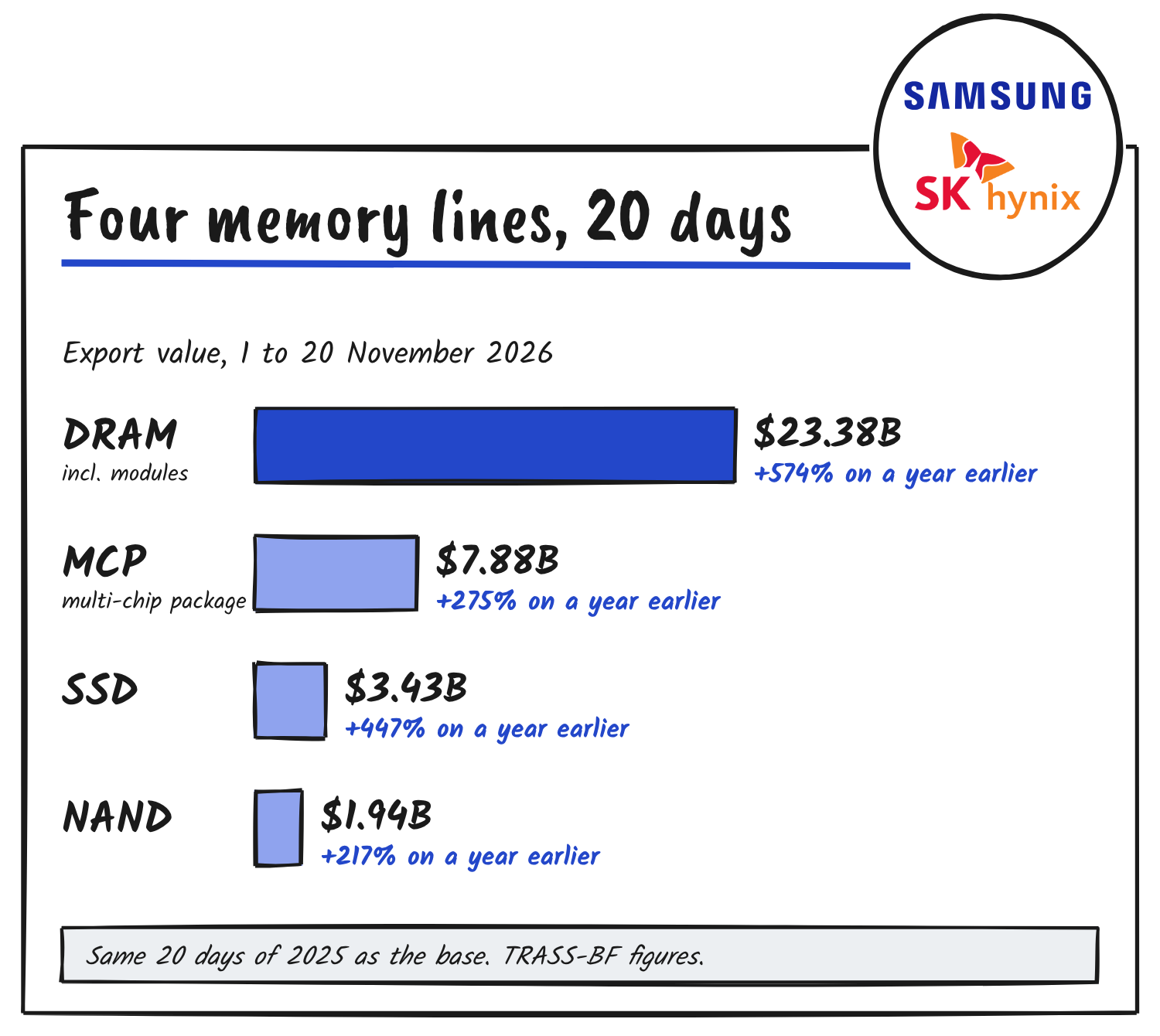
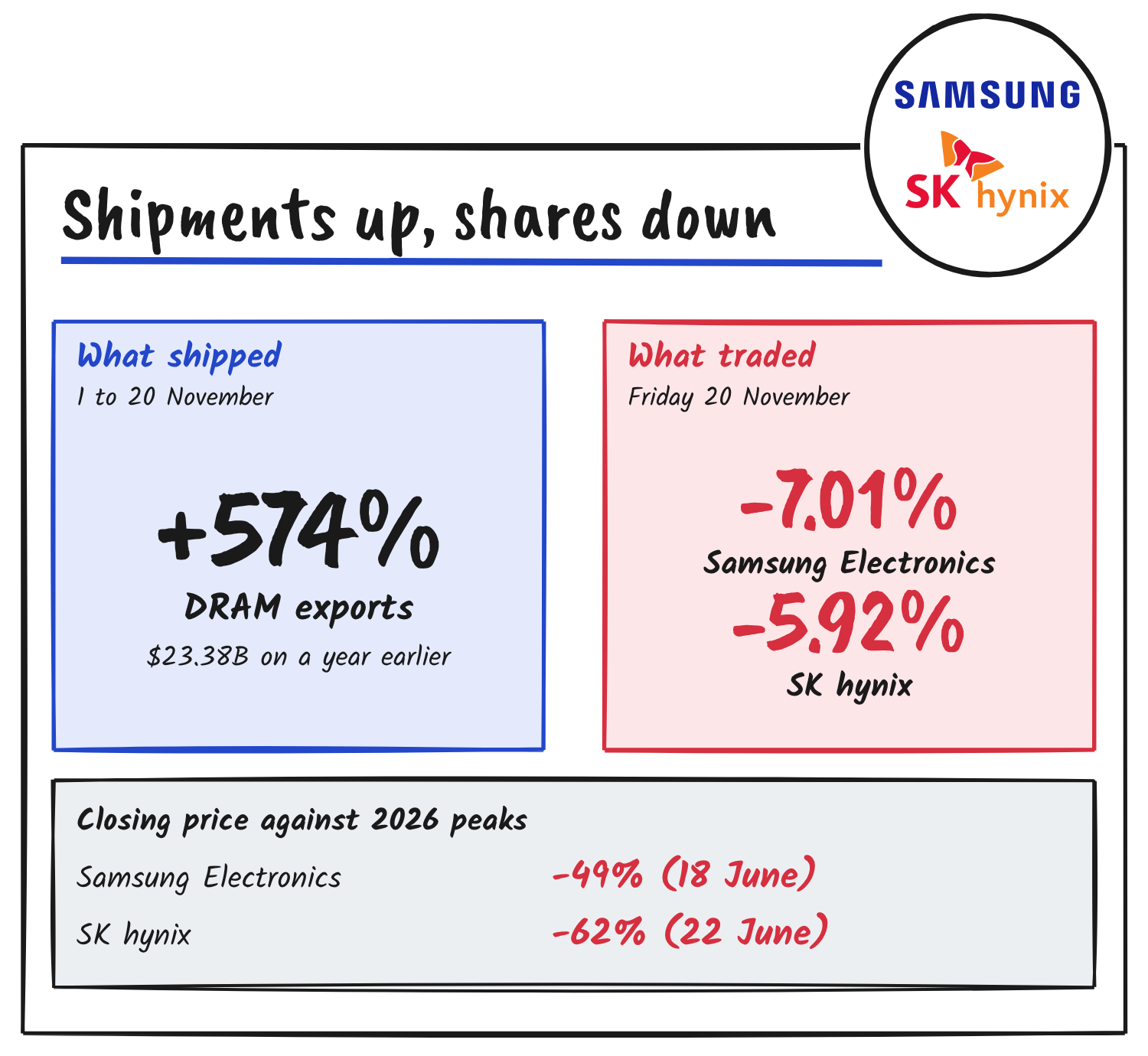
South Korea shipped US$23.38 billion of DRAM in the first 20 days of November, up 574% on the same days of 2025, according to a chart posted on X on 21 November. On Friday 20 November, Samsung Electronics fell 7.01% and SK hynix fell 5.92%. Those two facts sit together more easily than they look.
What the post says
The post cites TRASS-BF data and charts four memory lines against the same days of 2025. DRAM, which the chart counts with modules, reached US$23.38 billion. MCP reached US$7.88 billion, up 275%. SSDs reached US$3.43 billion, up 447%, and NAND reached US$1.94 billion, up 217%. The post doesn’t say what the BF in TRASS-BF stands for.1
+574%
DRAM export value, 1 to 20 November, against the same days of 2025
+331.2%
Semiconductor exports, 1 to 10 November, in the Customs Service’s own release
+259.4%
Semiconductor exports for the whole of October, to US$56.44 billion
TRASS is the trade statistics service run by the Korea Trade Statistics Promotion Institute, the body Korea’s Customs Act designates to produce and hand out trade statistics. Its numbers come from customs declarations, so they show what left the country. They stay provisional until the Korea Customs Service confirms them. I couldn’t find the Customs Service’s own 1 to 20 November release. It’s due on 21 November, and its press release list had nothing for those dates when I checked.
The direction matches what the official data already showed. The Customs Service reported on 11 November that semiconductor exports for 1 to 10 November were US$16.632 billion, a record for the opening ten days of any month. The industry ministry said October semiconductor exports rose 259.4% to US$56.44 billion, and that the fixed price of 16GB DDR5 memory climbed from US$8.70 in October last year to US$50 last month.
Price or volume
That DDR5 price is the key to reading the 574%. The chart also lists how much the average price per unit rose. When I divide value growth by that price growth, most of the jump disappears. DRAM works out at roughly 50% more weight shipped, MCP about 57% more, SSDs about 9% more, and NAND about 20% less.
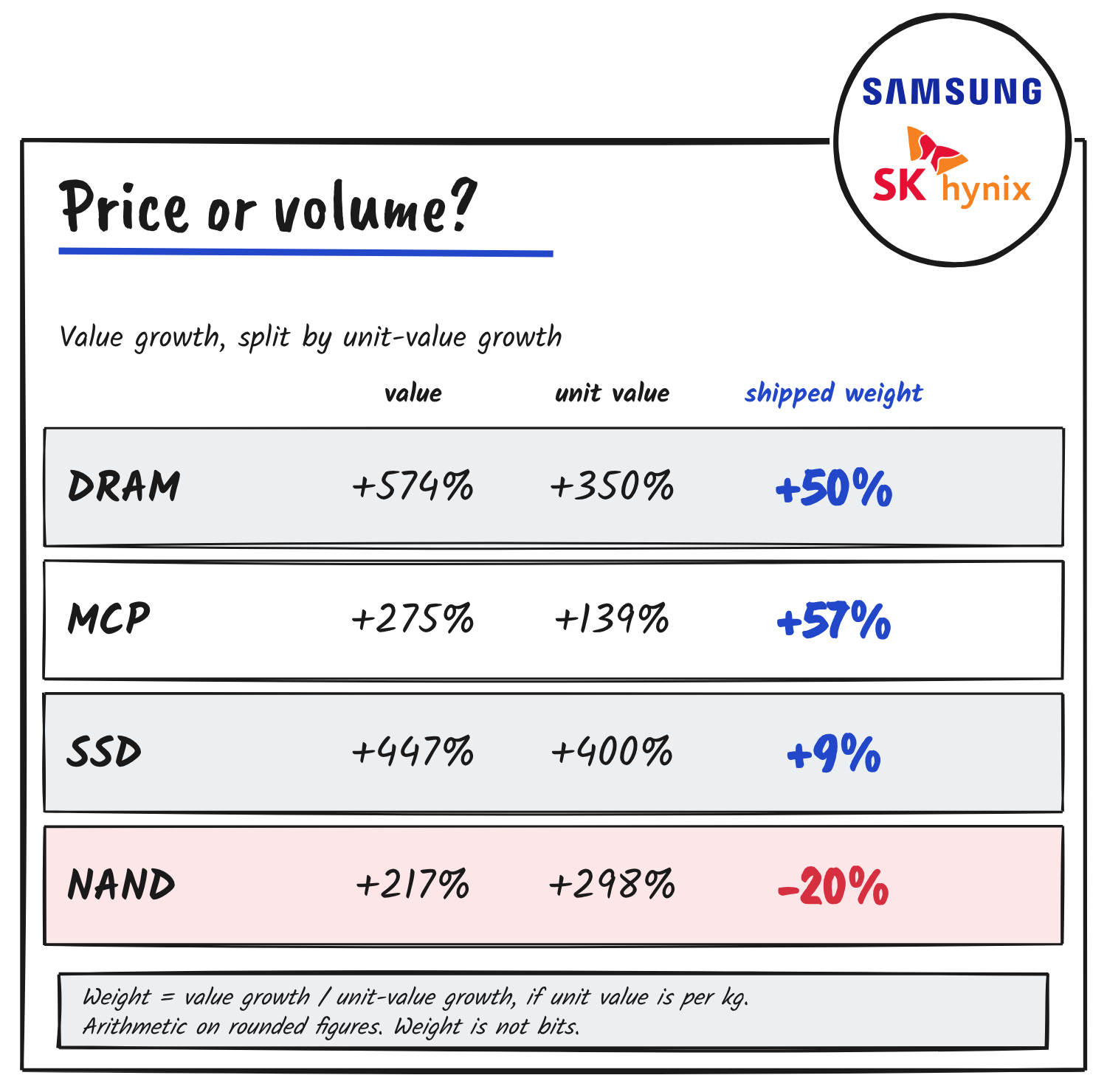
Buyers paid far more for each chip. The volumes rose by much less.
Export unit prices and volumes remained high as global big tech companies continued capital investment to secure leadership in the AI industry.
Ministry of Trade, Industry and Resources, on October’s semiconductor exports, 2 November 2026
How I worked out the weight column
I divided each line’s value growth by its unit-value growth, using the multiples (1 plus the percentage). For DRAM that’s 6.74 divided by 4.50, or about 1.50. The method assumes the unit value is priced per kilogram, the way analysts who use TRASS quote it. Weight isn’t a count of bits, so a denser chip can ship fewer kilograms and more gigabytes. Treat the result as a rough guide, and note that it rests on rounded figures read off a chart.
Why I wouldn’t read MCP as HBM
MCP is a multi-chip package, a customs category that bundles several kinds of memory into one product. High-bandwidth memory sits inside it, but so does much else. The line is a hint about the HBM trade, not a figure for it.
Why the shares fell anyway
A share price prices what investors expect next. On 20 November the KOSPI closed at 4,869.96, down 5.21%, its lowest since mid-January. Samsung closed at 183,100 won and SK hynix at 1.113 million won. On closing prices, Samsung is 49.49% below its 18 June peak of 362,500 won, and SK hynix is 61.87% below its 22 June high of 2.919 million won.
Korean outlets tied the fall to the United States, not to Korean exports. The Nasdaq had dropped 2.25% overnight and the Philadelphia Semiconductor Index 2.41%. AMD fell about 7.7% after a short report, Nvidia fell 3.30%, and investors worried that Washington would tighten chip export controls on China. Samsung Securities analyst Seo Jeong-hoon said investors likely sold other stocks to buy Anthropic shares after its debut. Foreign investors net sold 1.1411 trillion won of KOSPI stocks.



Memory prices add a second tension. Spot prices for NAND have fallen, while contract prices, which drive earnings, are still rising. Some brokerages told Bloomingbit that the sell-off shouldn’t be read as worsening earnings for that reason. Export data can’t settle the argument. It records price times quantity on the day goods clear customs, and it says nothing about orders for next year.

What’s confirmed and what isn’t
| Claim | Status | Basis |
|---|---|---|
| DRAM US$23.38 billion, up 574%, for 1 to 20 November | Unconfirmed | The post’s chart only. The Customs Service release wasn’t out when I checked. |
| Semiconductors US$16.632 billion, up 331.2%, for 1 to 10 November | Confirmed | Customs Service release of 11 November, as reported by MoneyToday and The Edge |
| Samsung down 7.01%, SK hynix down 5.92% on 20 November | Confirmed | Edaily, SBS News and Bloomingbit |
| DRAM weight up about 50%, NAND weight down about 20% | My arithmetic | Value growth divided by the chart’s unit-value growth, on rounded figures |
| Why the shares fell | Reported, not provable | Korean outlets citing analysts, with no single cause established |
- TRASS
- Korea’s trade statistics service, run by the Korea Trade Statistics Promotion Institute. It’s built on customs declarations.
- Ten-day release
- The Korea Customs Service’s provisional export figures for the first 10 and first 20 days of a month, published around the 11th and 21st. The ministry’s full-month figures come around the 1st.
- Unit value
- Export value divided by export weight. It moves with price and with product mix, so it isn’t a clean price index.
- Sidecar
- A temporary halt to program trading that the KOSPI and KOSDAQ triggered on 20 November as selling accelerated.
What to watch next is the Customs Service’s confirmed 1 to 20 November release, then the ministry’s full-month figures on 1 December. If the confirmed numbers differ from the post’s chart, I’ll update this piece.
Sources
- MojoTrick on X, 21 November 2026 (TRASS-BF chart)
- Korea Customs Service, 1 to 10 November trade release, 11 November 2026
- Ministry of Trade, Industry and Resources, October exports, 2 November 2026
- Seoul Economic Daily, exports top US$1 trillion, 19 November 2026
- MoneyToday, gains have yet to spread beyond chips, 19 November 2026
- Edaily, KOSPI plummets 5%, 20 November 2026
- SBS News, Samsung and SK Hynix plunge, 20 November 2026
- Bloomingbit, shares sink again as the KOSPI falls below 5,000, 20 November 2026
- TRASS, service overview (Korea Trade Statistics Promotion Institute)
- I couldn’t find a definition of BF in the post or on the TRASS pages I checked. Treat the label as the post’s description of its source, not something I’ve verified. ↩︎
Discover more from Sulat AI & Tech News
Subscribe to get the latest posts sent to your email.