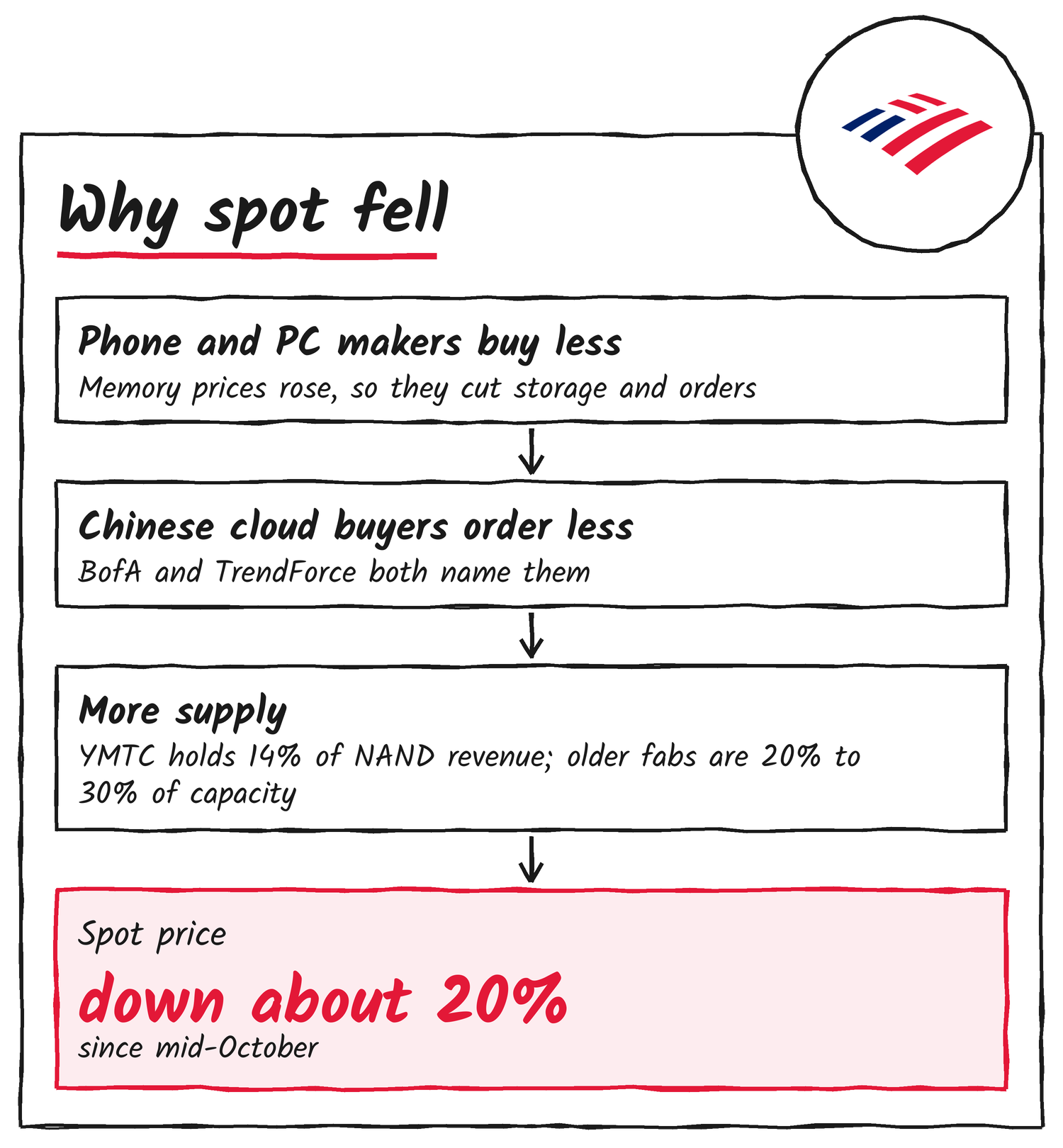
Bank of America says NAND flash spot prices have fallen about 20% since mid-to-late October, in a report dated 13 November that Seoul Economic Daily covered on 16 November. The bank says phone and PC makers are buying less storage, large Chinese cloud companies are ordering less, and suppliers are competing harder on price.
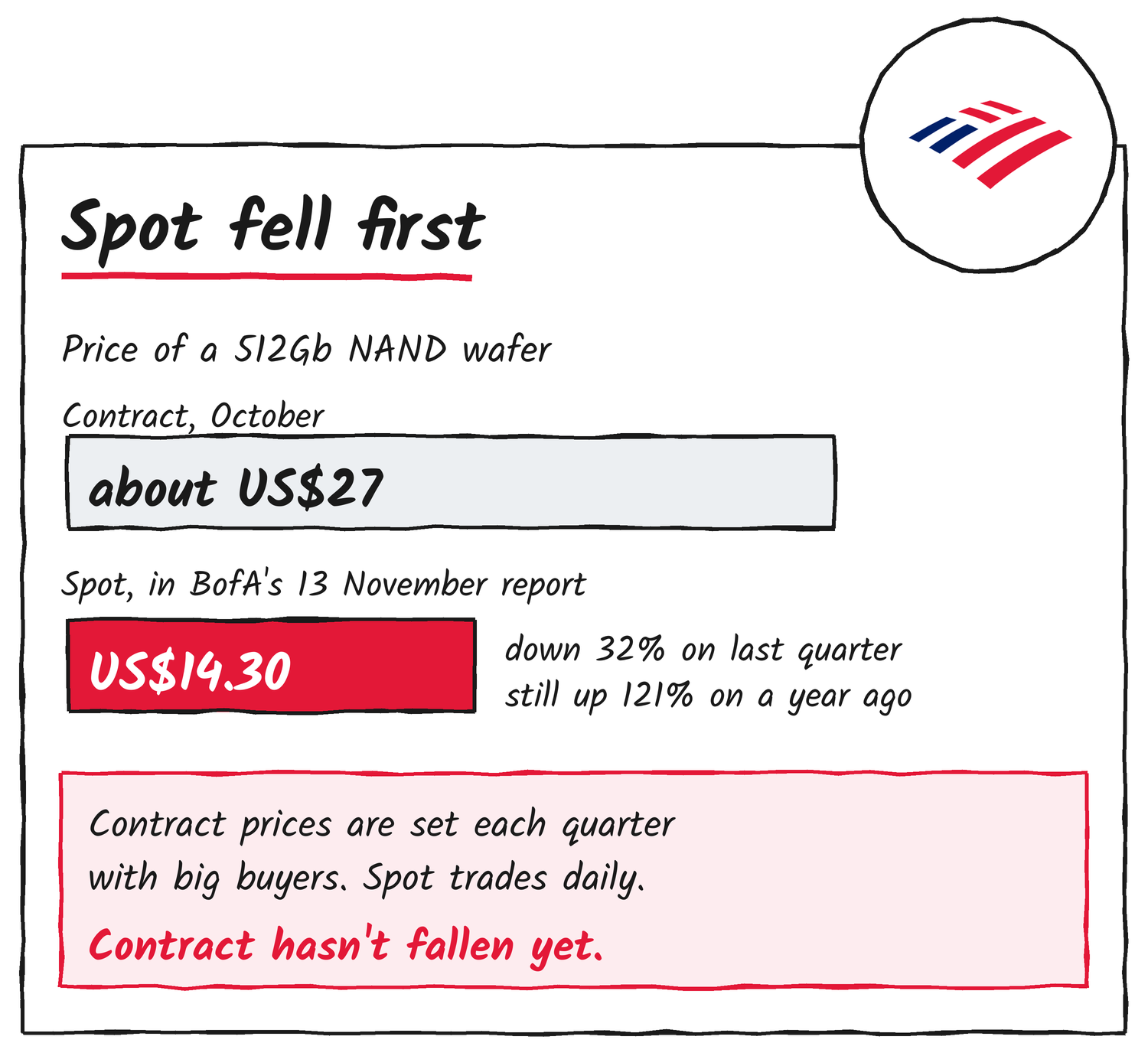
NAND flash is the memory inside phones, PCs and solid-state drives (SSDs). The spot price is what buyers pay on the open market for quick delivery. The contract price is the one big buyers agree with suppliers each quarter, and TrendForce says the spot decline hasn’t triggered broad contract cuts yet.
Seoul Economic Daily reports the spot price of a 512Gb NAND wafer was US$14.30, down 12% in a week and 32% on the previous quarter. Zhitong Finance, citing DRAMeXchange, puts a 1Tb wafer at US$24.90, down 19% on the quarter. Both are still well above where they were a year ago, up 121% and 194% respectively. Zhitong also reports TrendForce’s October contract price for a 512Gb wafer at about US$27.
Why spot prices fell
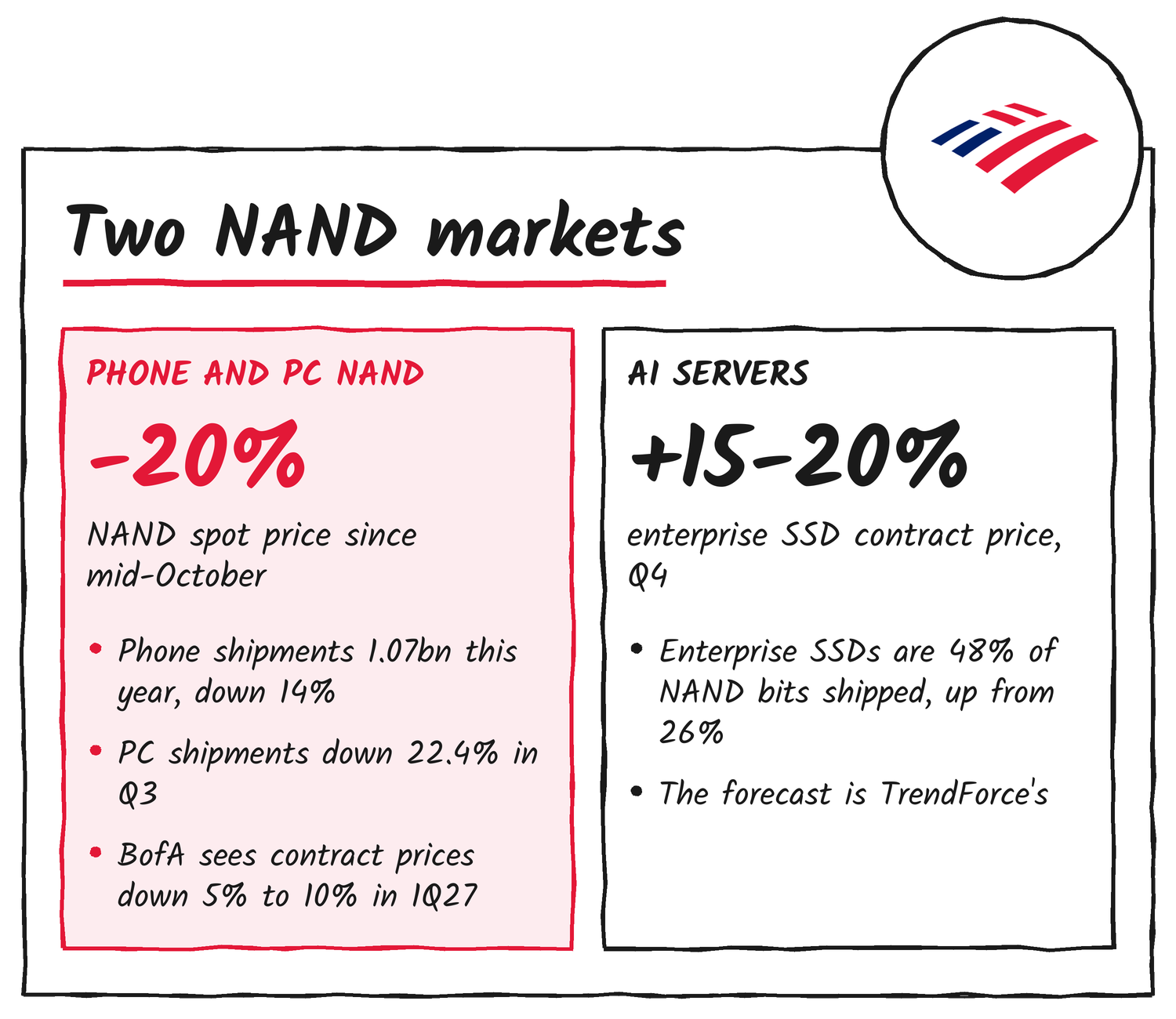
Phone and PC makers are the main buyers of commodity NAND, the cheaper flash used in everyday devices, and they’ve cut back. Counterpoint Research projects 1.07 billion smartphone shipments this year, down about 14% from 1.25 billion. Gartner says PC shipments in the third quarter were 55.35 million, down 22.4% on a year earlier. Seoul Economic Daily reports that makers are responding to higher memory prices by raising device prices or cutting base storage, which lowers the NAND in each device. TrendForce adds that module makers are clearing inventory.
Chinese cloud demand is the second factor. BofA points to weaker orders from large Chinese cloud companies. In a research note dated 17 November, TrendForce says GPU shortages, high inventory and stalled AI monetisation have led Chinese cloud providers to cut their 2027 enterprise SSD orders sharply. TrendForce also says Chinese traders are trimming inventory, and that the 20% fall in spot prices took two weeks.
Supply is the third. NAND has six major suppliers: Samsung, SK hynix, Micron, Kioxia, SanDisk and YMTC, a Chinese maker. Counterpoint puts YMTC’s share of NAND revenue at 14% in the second quarter, tied with Kioxia for fourth behind Samsung at 28%, SK hynix at 19% and Micron at 15%. Seoul Economic Daily reports YMTC is gaining ground in price-sensitive consumer products. BofA says older fabs that make 20% to 30% of the world’s NAND wafers can’t produce the advanced NAND that enterprise SSDs need, so they keep making flash for general IT use. TrendForce notes that Reuters reports YMTC’s planned fourth fab will make NAND with more than 300 layers.
AI storage is on a different path
Enterprise SSDs, the drives that go into AI data centres, are priced separately. Counterpoint says they made up 48% of NAND bits shipped in the second quarter, up from 26% a year earlier. TrendForce forecasts enterprise SSD contract prices will rise 15% to 20% in the fourth quarter. BofA stressed that it hasn’t seen orders cut for chips used in US AI data centres, Seoul Economic Daily reports.
Dell’s liquid-cooled Exascale storage node, which holds up to 32 NVMe drives and is due in the first half of 2027, is one example of the AI storage hardware those drives go into.
What comes next
BofA expects NAND prices for general IT use to fall another 5% to 10% in the first quarter of 2027, which would pull the overall average selling price down slightly. Market expectations were for gains of more than 10%, Seoul Economic Daily reports. BofA kept its DRAM forecasts at an 8% rise in the fourth quarter and 5% in the first quarter of 2027.
TrendForce’s research note is firmer on timing. It says NAND contract prices will start falling in the second quarter of 2027, a quarter earlier than it expected, and drop faster in the second half of the year. TrendForce says the Chinese cuts to enterprise SSD orders fully offset extra demand from North American cloud providers, and that the NAND market will flip to oversupply.
Investors reacted on 16 November. Seoul Economic Daily reports Samsung Electronics shares fell 4.47% and SK hynix 7.89%, and the paper also named controversy over Nvidia’s leadership and a US lawsuit alleging DRAM price-fixing among the pressures on chip stocks.
BofA’s report isn’t public, so the figures above come from Seoul Economic Daily and Zhitong Finance’s accounts of it. TrendForce’s full research note is paid, and the findings here come from its public summary.
Discover more from Sulat AI & Tech News
Subscribe to get the latest posts sent to your email.