Sonnet Xu, whose bio reads “cs @ stanford”, posted a chart on 20 November that pairs five AI infrastructure companies with the open-source work behind each. Xu’s point is that the companies monetise that expertise very differently, and an Inferact co-founder replied within the hour to dispute how the chart describes his company’s offer.
Roger Wang, one of Inferact’s founders, wrote that production-grade vLLM is what Inferact already ships upstream and not how it differentiates. He said the difference is control, continuous optimisations and efficiency, and that he wasn’t sure about the other four.
What the chart claims
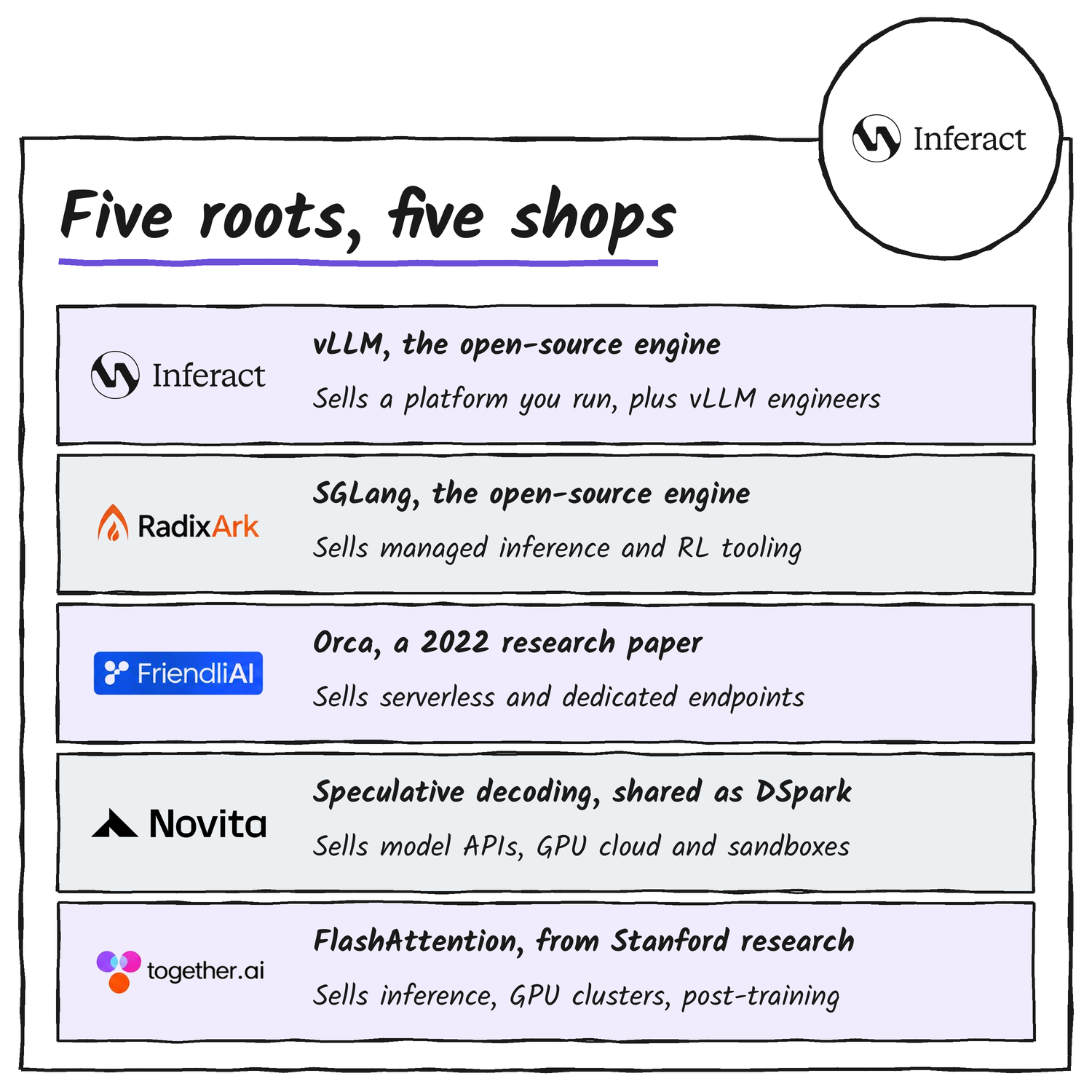
The chart has four rows: open-source roots, core technology, how each company monetises and what differentiates it. The table keeps the first and third in the chart’s own words. The framing text says open-source success buys credibility, distribution and a head start on the technology, but that the customers and business model look different.
| Company | Open-source roots | How they monetise |
|---|---|---|
| Inferact | vLLM, inference engine | Enterprise inference software and support |
| RadixArk | SGLang, inference engine | Managed inference and RL infrastructure |
| FriendliAI | Orca, continuous batching | High-performance inference platform and deployment |
| Novita | Speculative decoding, inference optimization | Optimized inference and model serving (inc. speculative decoding) |
| Together AI | Open kernels and systems research (e.g. FlashAttention) | Compiler, kernels, and full-stack inference platform |
Five roots, not one pattern
The chart sets the five roots side by side as if they were the same kind of thing. They aren’t.
Two are open-source engines that their maintainers turned into companies. Inferact is led by maintainers of vLLM, and RadixArk launched on 5 May around SGLang. TechCrunch reports that both engines were incubated in 2023 at the UC Berkeley lab of Ion Stoica, a Databricks co-founder.
FriendliAI’s root is a paper. Its site says CEO Byung-Gon Chun led the Seoul National University team behind continuous batching, introduced in the Orca paper at OSDI 2022, and that continuous batching has become the standard across modern inference engines. Orca is a research paper describing a serving system, so the root is an idea other engines adopted rather than an engine with its own community.
Novita runs the other way. Its blog describes DSpark as a speculative decoding method that Novita published, and says it released DSpark draft models for two Kimi models and integrated them with vLLM. Here the research comes from the company rather than leading to it.
Together AI’s link is a person. Its chief scientist is Tri Dao, who wrote FlashAttention, and Together introduced him alongside the release of FlashAttention-2. The chart’s row for Together covers a body of work, with FlashAttention as the example.
Five different cheques
The funding behind the five is just as uneven. Together AI raised US$800M on 1 July at a US$8.3B valuation, in a round Reuters says Aramco Ventures led. Together also said its new investors had secured commitments for more than 500 MW of compute capacity, to be financed separately from the equity.
US$800M
Together AI, Series C
US$150M
Inferact, seed
US$100M
RadixArk, seed
US$20M
FriendliAI, seed extension
The other three announced rounds are seeds. Inferact raised US$150M at a US$800M valuation on 22 January, co-led by Andreessen Horowitz and Lightspeed. RadixArk raised US$100M at a US$400M post-money valuation on 5 May, led by Accel with Spark Capital co-leading. FriendliAI announced a US$20M seed extension on 28 August 2025, led by Capstone Partners.
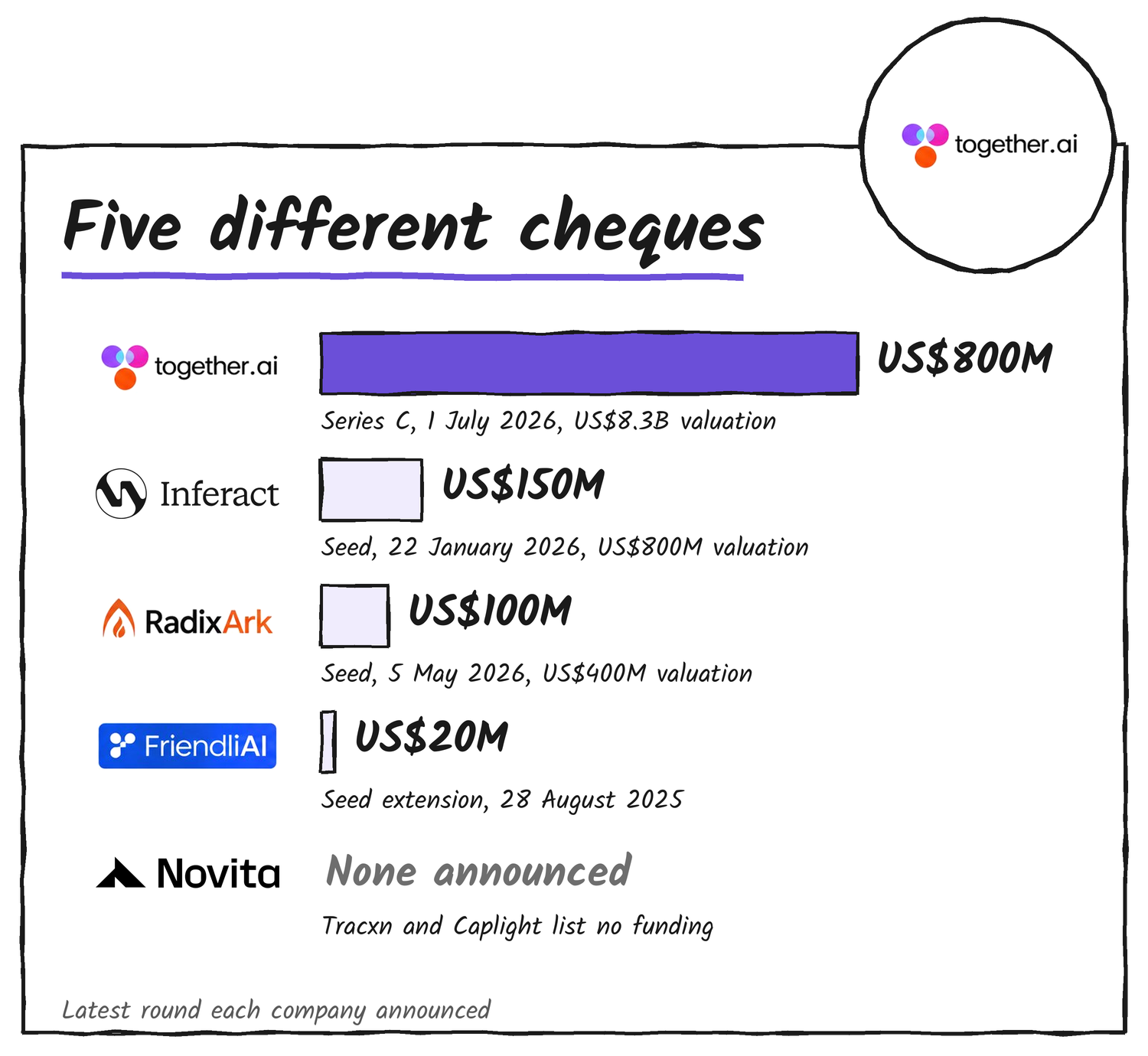
Novita is the gap. Tracxn lists no funding raised, and no announced round turned up in a web search. That doesn’t prove there isn’t one, only that it hasn’t been announced.
So the chart’s columns hide a bigger split. Together is a Series C company with a compute-backed round, and the other four are seed-stage or unfunded as far as announcements show.
Where Inferact disagrees
production grade vLLM is what we already ship in upstream and not how we differentiate. It’s more about control, continuous optimizations and efficiency
Roger Wang, Inferact, on X
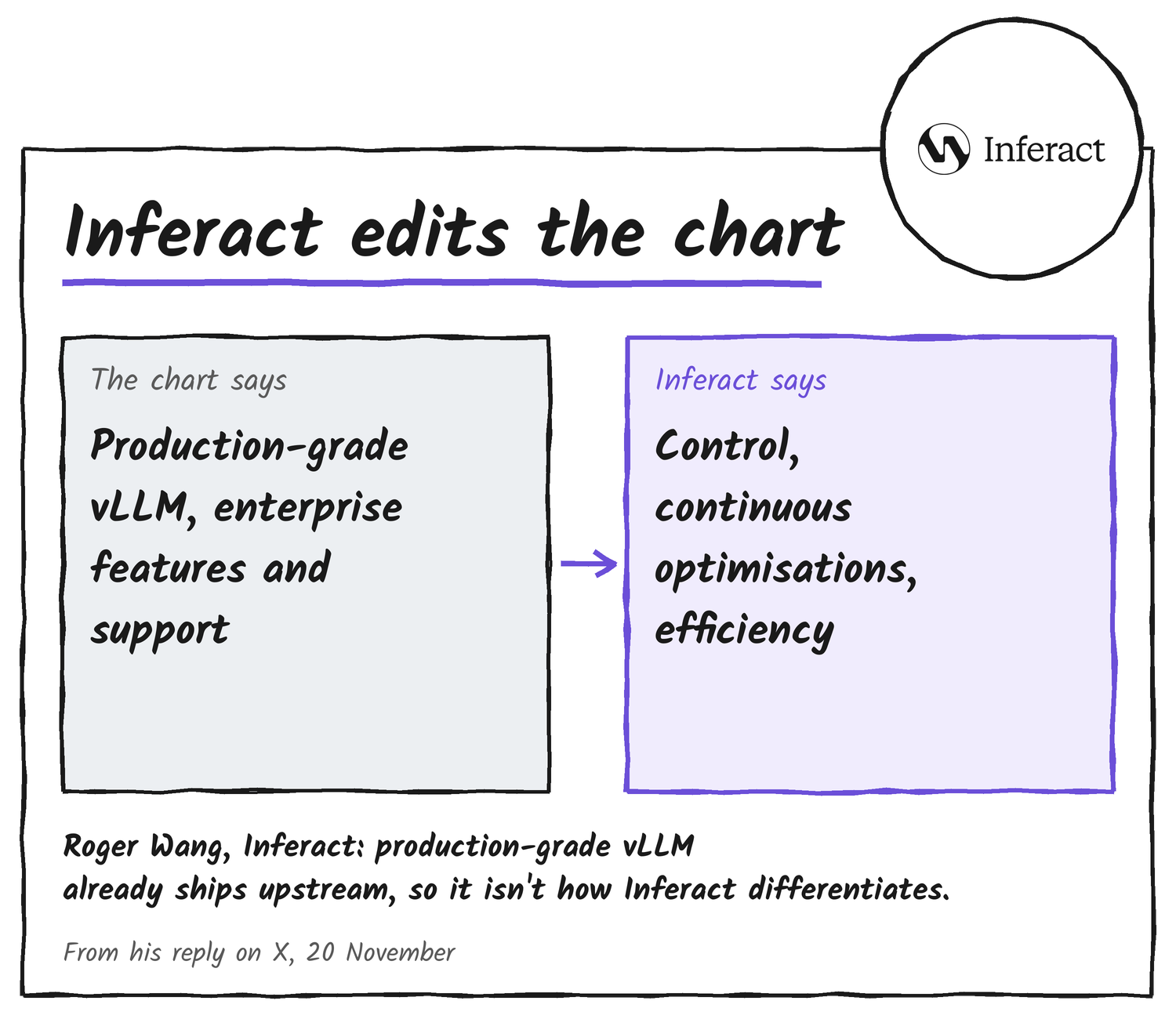
That matters most for the Inferact column, where the chart’s differentiation row reads as a pitch for supported vLLM. Inferact’s own site headline is “Frontier Inference You Control“, which lines up with Wang’s reply on control. No other company has replied in the thread.
What the chart can’t tell you
The chart is a sketch. It gives no revenue, customer or pricing figures, so it can’t show which of the five models earns more. Its open-source roots row mixes a codebase, a paper, a technique and a research area, and its differentiation row is Xu’s reading, which one of the five has already pushed back on.
If you’re choosing among these vendors, the question the chart raises is the right one: what do you pay for on top of the free software? Inferact’s answer, in Wang’s words, is control and efficiency rather than supported vLLM. Ask each of the others directly, because the chart’s answers for them are one observer’s, not theirs.
Terms in this post
- Inference engine
- Software that runs a trained model to answer requests. vLLM and SGLang are two open-source examples.
- Continuous batching
- Scheduling that adds and removes requests from a running batch as they arrive and finish, instead of waiting for a whole batch. The Orca paper introduced it.
- Speculative decoding
- A small draft model proposes several tokens and the main model checks them in one pass, which speeds up generation without changing the output.
- FlashAttention
- A faster, more memory-efficient way to compute the attention step in transformer models.
- Seed extension
- An additional round raised on top of an earlier seed round.
Sources
- Sonnet Xu on X, 20 November 2026
- Roger Wang on X, 21 November 2026 NZ time
- TechCrunch: Inference startup Inferact lands $150M to commercialize vLLM, 22 January 2026
- RadixArk: Our $100M Seed, 5 May 2026
- FriendliAI: Why FriendliAI
- FriendliAI: Orca research page
- FriendliAI: $20M seed extension, 28 August 2025
- Novita: Scaling Kimi inference with DSpark speculative decoding in vLLM, 10 July 2026
- Tracxn: Novita company profile
- Together AI: Announcing our $800M Series C, 1 July 2026
- Reuters: Together AI raises $800 million at $8.3 billion valuation, 1 July 2026
- Together AI: Introducing Chief Scientist Tri Dao
- Princeton CS: Tri Dao
Discover more from Sulat AI & Tech News
Subscribe to get the latest posts sent to your email.