Pragmatik Labs, the Shanghai agent startup founded by former Alibaba Qwen head Lin Junyang, has closed new funding at a US$5 billion valuation, Bloomberg reported on 20 November, citing people familiar with the matter. The round raised tens of millions of dollars. Lin has never said why he left Alibaba in March, and the accounts from Alibaba and from unnamed sources differ.
The round and the price
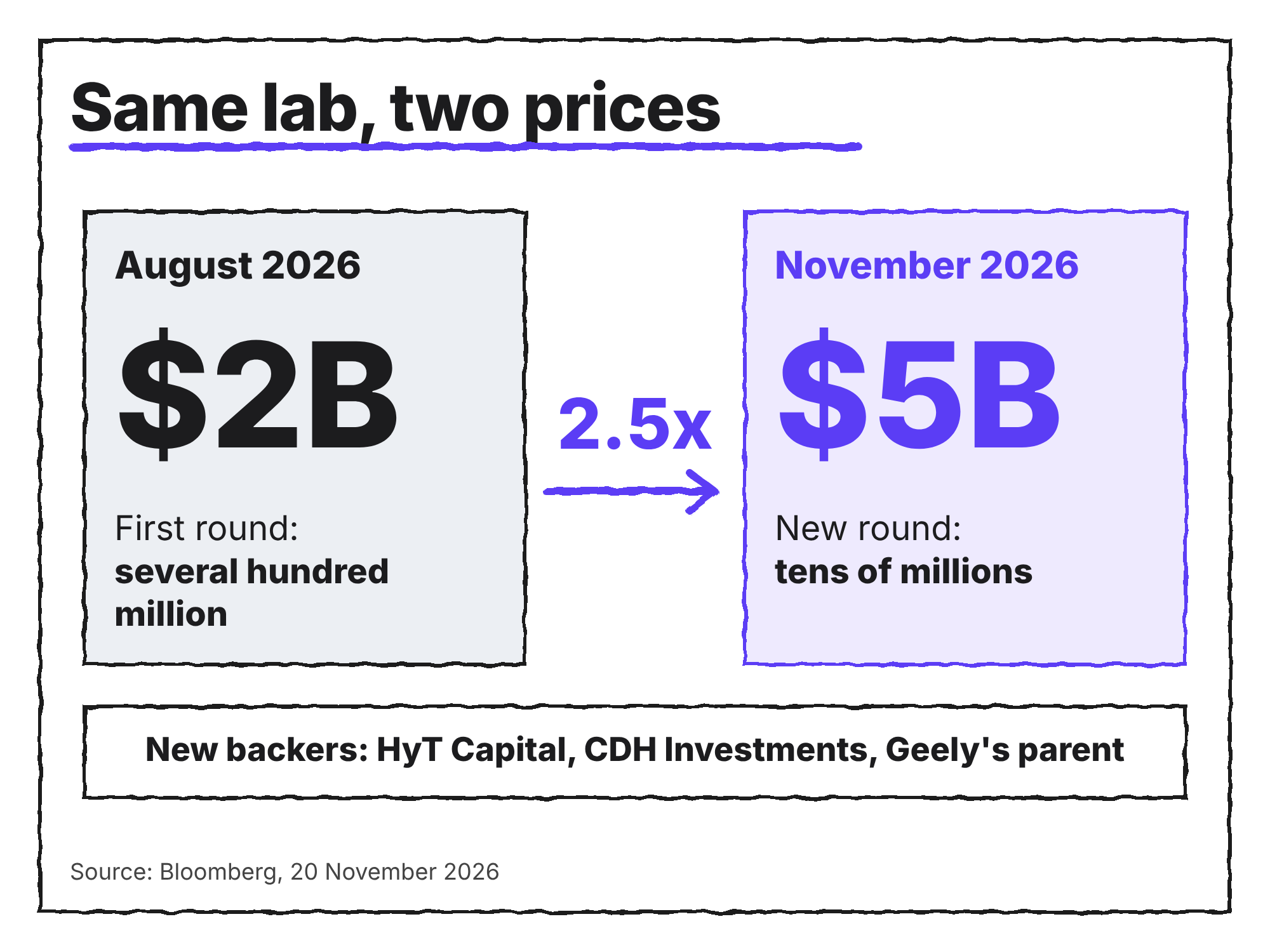
Bloomberg’s sources put the August valuation at US$2 billion, from a first financing of several hundred million dollars. The new price is 2.5 times that, on a much smaller cheque. Bloomberg named HyT Capital, CDH Investments and the parent company of Geely as new investors. Pragmatik Labs didn’t reply to PYMNTS’ request for comment, and every figure comes from unnamed sources.
Lin announced the company on X on 11 August. He said Gaorong Ventures and HSG, formerly Sequoia China, co-led the first round, with Tencent and the Shanghai Engine Fund also backing it. Yicai reported that June coverage had already put that round’s post-money valuation at US$2 billion, and that Lin hadn’t commented on the figure. His one-line description of the work is next-generation agents across digital and physical worlds.
Who owns it
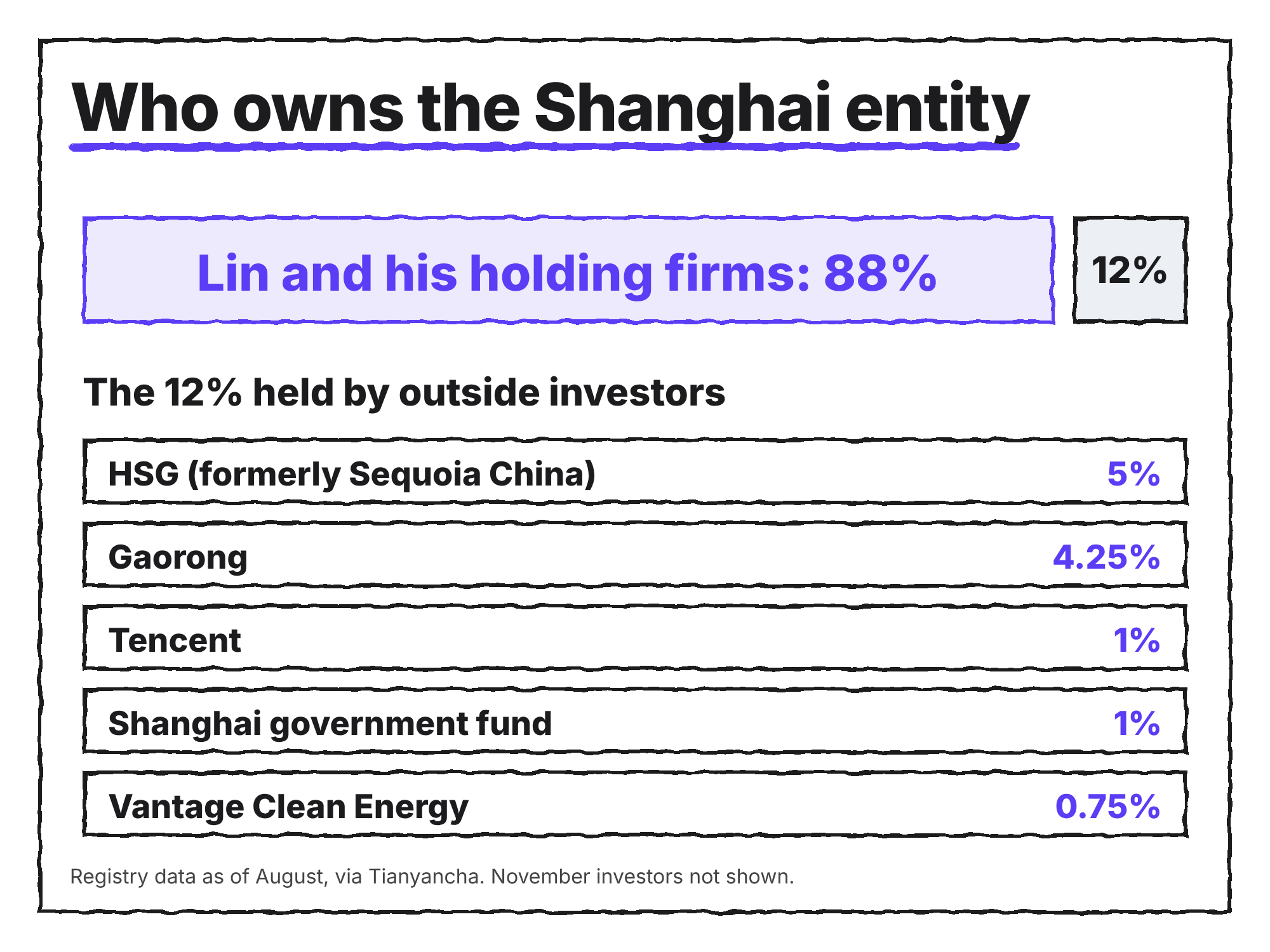
China Daily, citing registry data from Tianyancha, reported that the main operating entity, Yuyong (Shanghai) Technology Co Ltd, was incorporated on 13 May 2026. Lin is its legal representative and it has 10 shareholders. Its registered capital was raised to 1.25 million yuan, about US$174,000. The same registry showed, as of August, that Lin and his holding firms owned 88%, with HSG on 5% and Gaorong on 4.25%. It doesn’t show the November investors or how the money raised is held.
The company’s website describes digital agents for knowledge work, operations and industry-scale workflows, and physical agents, meaning embodied systems that act on long-horizon tasks. No model or product has been reported.
What happened in March
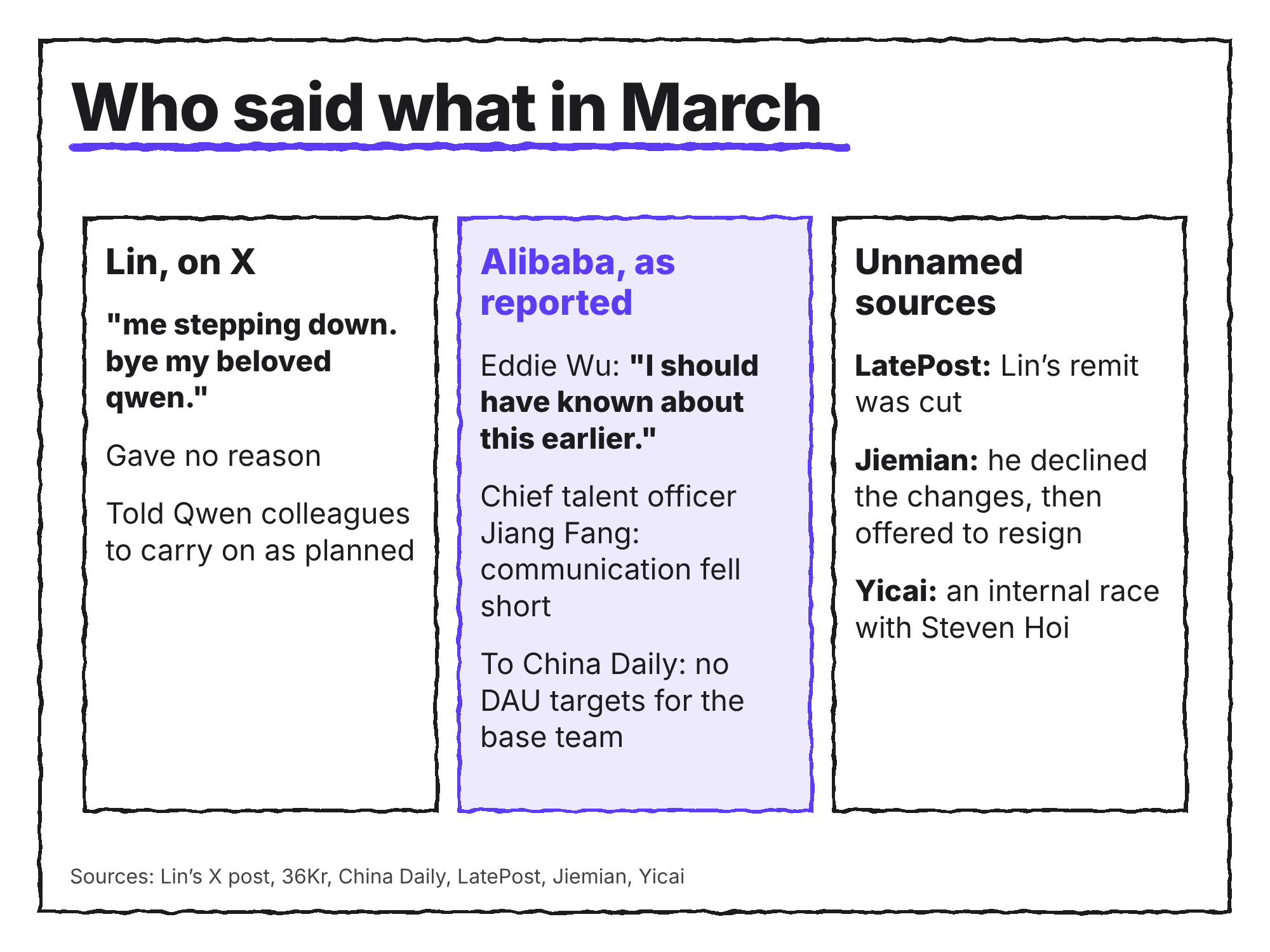
On 2 March, Qwen open-sourced four small Qwen 3.5 models. Late on 3 March in the US, at 00:11 on 4 March in Beijing, Lin posted on X:
me stepping down. bye my beloved qwen.
Lin Junyang, on X, 4 March (Beijing time)
He gave no reason. 36Kr confirmed he had submitted his resignation on the afternoon of 3 March. Reuters counted him as the third senior Qwen executive to leave in 2026, and China Daily said Yu Bowen, head of post-training, announced his own departure shortly afterwards.
Colleagues reacted in public. TechCrunch reported that Qwen research scientist Wenting Zhao called it “the end of an era”, and that contributor Chen Cheng wrote “I know leaving wasn’t your choice”. Lin’s own message to colleagues, reported by 36Kr, told the Qwen team to carry on as planned.
What Alibaba said
Alibaba held an emergency all-hands at Tongyi Lab at about 1pm Beijing time on 4 March, 36Kr reported. Group CEO Eddie Wu told staff:
I should have known about this earlier.
Eddie Wu, Alibaba Group CEO, at the all-hands on 4 March, as reported by 36Kr
Executives told staff Qwen wasn’t shrinking and that the changes were an expansion with no link to infighting. Chief talent officer Jiang Fang said the organisational change hadn’t been communicated well. On 5 March, an internal email from Wu approved the resignation, kept Zhou Jingren in charge of Tongyi Lab, set up a foundation model support group of Wu, Zhou and Fan Yu, and said Alibaba would keep its open-source strategy. The email gives no reason for the resignation and names no successor to Lin. Alibaba told China Daily that the base model team has never been assessed on daily active users and that the team remains stable.
What unnamed sources said
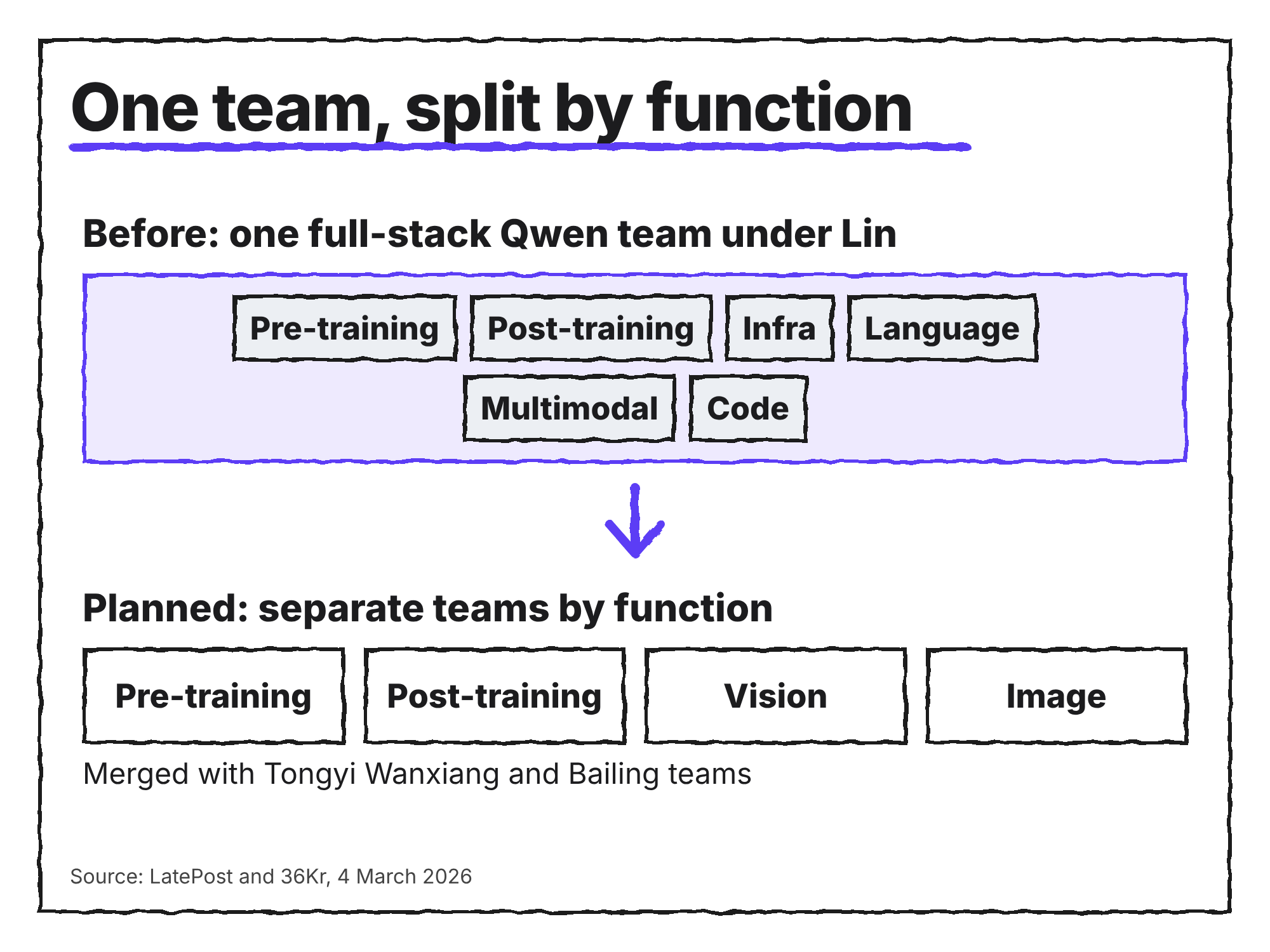
36Kr reported that Tongyi Lab wanted to split the Qwen team, which had its own pre-training, post-training and infrastructure groups, into teams by function: pre-training, post-training, vision and image. Some would merge with other Tongyi Lab teams such as Tongyi Wanxiang and Tongyi Bailing. Zhou Hao, a former Google DeepMind researcher hired this year, came up in staff questions at the all-hands, and 36Kr said his role and reporting line were still under discussion.
Jiemian, as relayed by 36Kr, reported that Alibaba wanted more senior hires for the base model team, that this changed the scope of Lin’s role, and that after several rounds of talks he declined the changes and offered to resign. A source who spoke to Yicai tied the exit to Alibaba’s internal racehorse system, where teams compete on the same project, and said Lin had been competing with Steven Hoi, a scholar who joined in 2025. Both reported to Zhou Jingren, the source said. Alibaba hasn’t publicly confirmed either account.
What’s at stake
Alibaba says foundation models are a core priority and open source stays. PYMNTS reported that its capital spending rose 60% year on year to US$7.5 billion in the earnings report on 19 November. Pragmatik’s US$5 billion price rests on a company with a stated research focus and no reported model or product. As of August, Lin’s 88% gave him control of the Shanghai entity.
The round’s exact size, the new investors’ stakes and the post-round ownership haven’t been disclosed. Lin hasn’t said why he left.
Discover more from Sulat AI & Tech News
Subscribe to get the latest posts sent to your email.