
Cloudflare’s Steve Faulkner has built a DNS server that answers questions with an LLM. You put the question in the hostname, ask dig for a TXT record, and Gemma 4 sends its answer back inside that record. Faulkner posted the demo on 20 November, opening with the line that every LLM API is built wrong, because DNS already has a question section and an answer section. The code is in his workers-dns-tcp repo on GitHub, released under the MIT licence.
The joke sits on real plumbing. The server runs on a Cloudflare Worker that accepts raw TCP connections, a feature Cloudflare moved into public beta on 19 November. Workers could already open outbound TCP sockets, but they could only serve HTTP until Cloudflare announced the connect() handler on 3 August in private beta.
The command
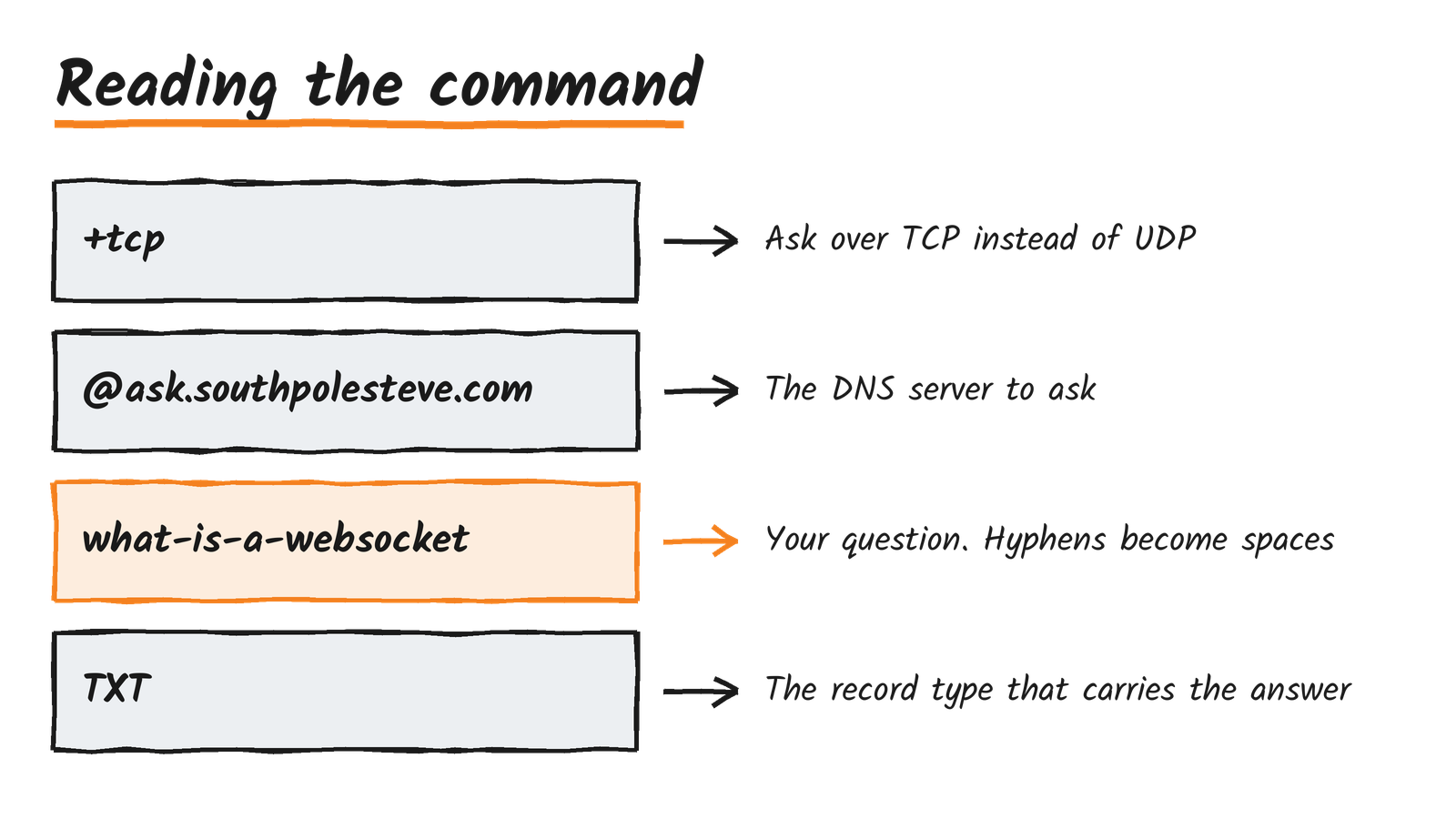
The README gives this command for the live demo. Swap the first label for your own question.
dig +tcp +short +time=15 +tries=1 @ask.southpolesteve.com why-is-the-sky-blue.ask.southpolesteve.com TXTThe first hostname, ask.southpolesteve.com, picks the DNS server. The second carries the prompt, and the Worker turns each hyphen into a space. Gemma answers in a TXT record. The +tcp flag matters because the Worker serves TCP clients only.
What happens to a query
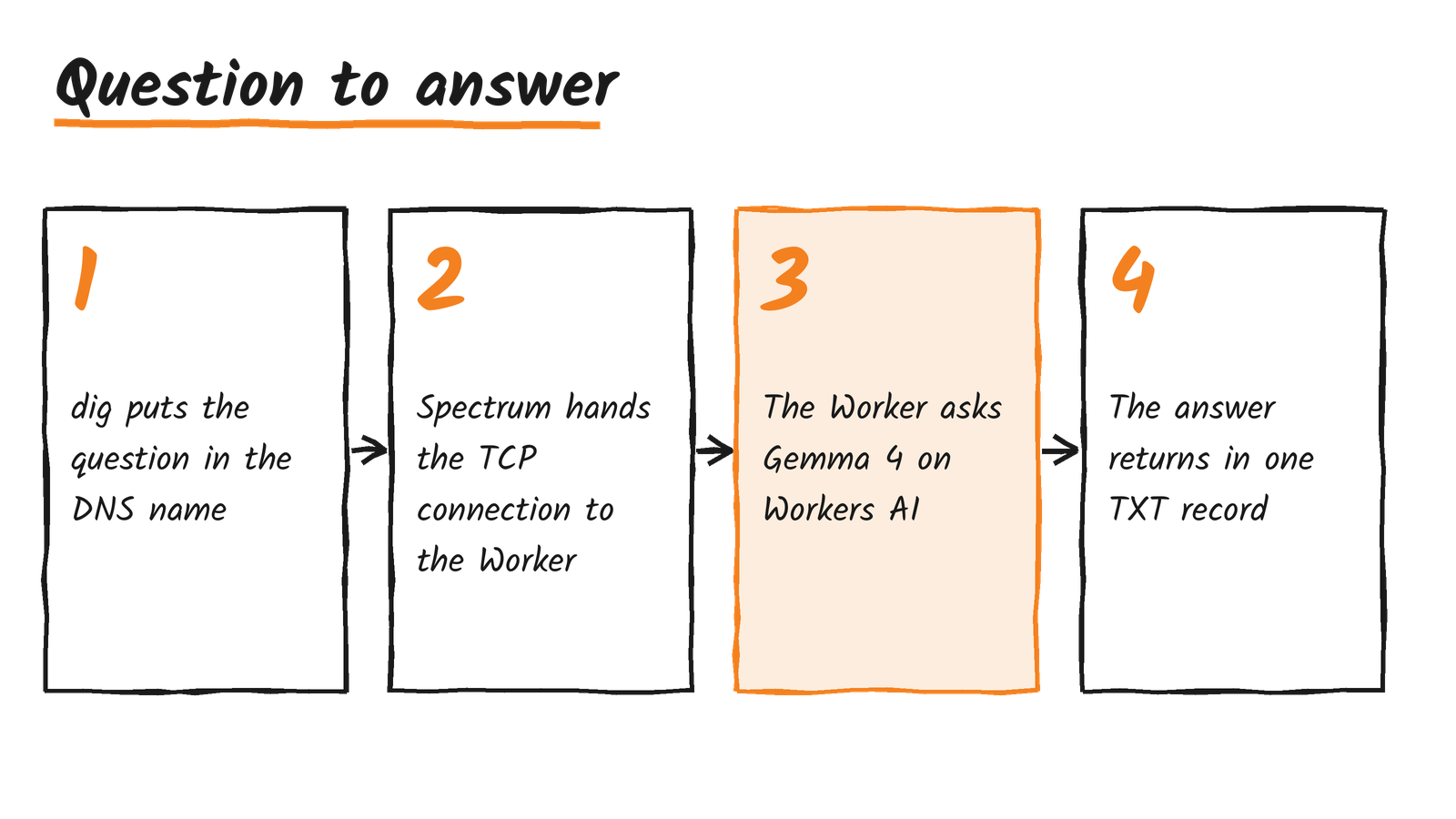
Spectrum, Cloudflare’s ingress proxy for non-HTTP traffic, accepts the public TCP connection and hands it to the Worker’s connect() handler. The handler reads DNS messages off the socket, each with a two-byte length prefix, and answers from an editable zone. A name ending in the ask hostname does something different: it triggers one call to Google’s Gemma 4 through the Workers AI binding, with a system prompt that asks for a one-sentence answer.
The repo includes a sample run against a local copy. Asked why the sky is blue, the model replied:
The sky appears blue because of Rayleigh scattering, where shorter blue wavelengths of sunlight are scattered more strongly by the Earth’s atmosphere.
workers-dns-tcp README
The limits
The question has to be a single DNS label of up to 63 ASCII letters, digits and single hyphens, and case is ignored. Each question gets one model call capped at 64 output tokens. The reply is a single TXT record with a 60-second TTL. A model timeout, an exhausted quota or an empty answer returns SERVFAIL. Querying the ask hostname for a TXT record returns usage text without calling the model.
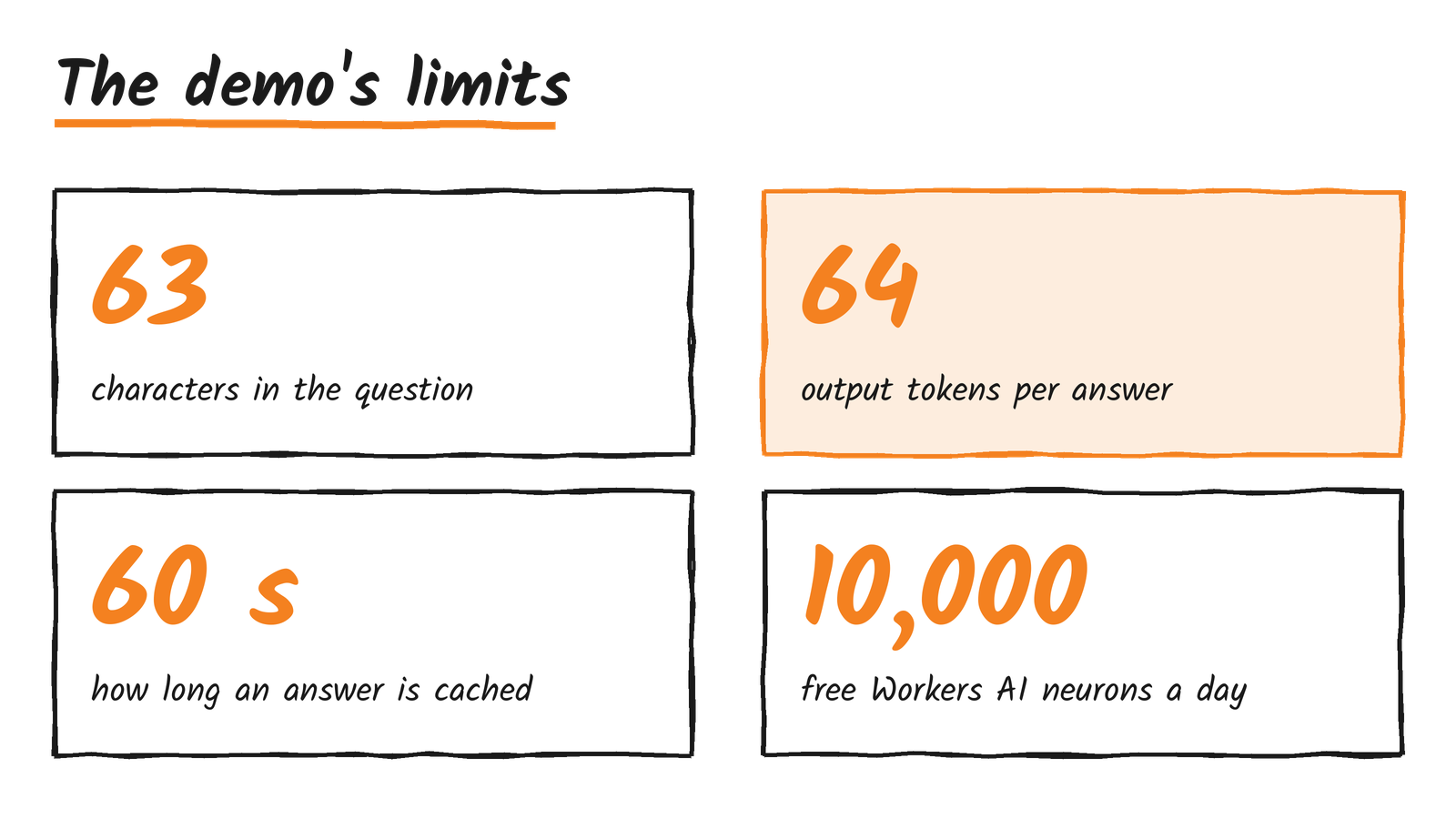
Workers AI includes 10,000 neurons per account per day. Workers Free stops at that limit, and Workers Paid bills overage at $0.011 per 1,000 neurons, according to Cloudflare’s pricing page. The repo calls the native Workers AI binding rather than going through AI Gateway. Prompts sit in the DNS query name, so any resolver they pass through can see them, the README says.
Run your own
The README lists these steps for a public endpoint:
- Set the DNS name clients will use as ASK_NAME in wrangler.jsonc, then deploy the AI-enabled Worker with
npx wrangler deploy --env llm. - In the same account, open Spectrum for a zone where Cloudflare is the authoritative DNS.
- Create a Workers (tcp) application on a Pro or Business zone, or a TCP application with a Worker origin on Spectrum Enterprise.
- Pick a hostname, the deployed Worker and a single edge port such as TCP 53, with TLS termination off.
- Query the hostname with dig.
Worker origins are in public beta. Free zones can’t use them, and without Spectrum Enterprise a Pro or Business zone gets one Worker-origin application on one TCP port. Cloudflare’s Spectrum guide says Workers usage is billed separately from Spectrum, so check both prices before deploying. To run it locally, npm run dev starts a TCP listener on 127.0.0.1:5353. The npm run dev:llm script uses port 5354 and needs a Wrangler login, because it calls the remote Workers AI binding.
Not a nameserver you can delegate to
The zone handling is real but narrow. It serves a static zone with SOA, NS, A, AAAA, CNAME, MX, TXT, CAA, PTR and SRV records. Recursion, wildcards, child delegations, DNSSEC signing and dynamic updates are out of scope. A conventional authoritative nameserver also needs UDP on port 53, which this Worker doesn’t serve, so it only answers clients that ask over TCP.
The Spectrum guide’s own list of uses for Worker origins covers gRPC to Containers, MQTT and game servers, and telemetry or syslog over TCP. A DNS chatbot isn’t on it, but it exercises the same path: a raw socket in, bytes handled in JavaScript, and a model call in the middle.
Discover more from Sulat AI & Tech News
Subscribe to get the latest posts sent to your email.