Microsoft has published a white paper called Security Fundamentals to Enable the Frontier, plus a summary post on its On the Issues blog, and Vice Chair and President Brad Smith shared it on 19 November. His line on X: “It’s no longer just about how many vulnerabilities we find, but how quickly we fix them.” The paper argues that AI hasn’t invented new ways to break into systems. It has made the old ones, weak passwords, unpatched software and poor visibility, fail much faster. This piece walks through what it says, the numbers behind it, and what Microsoft wants companies and governments to do.
The short version
- The claim: “AI doesn’t replace the fundamentals. It raises the price of neglecting them.”
- The evidence: a summer of AI incidents, a China-aligned group (Storm-0940) using an AI hacking framework against hundreds of organisations, and 1,410 patches in Microsoft’s October 2026 release, more than all of 2025.
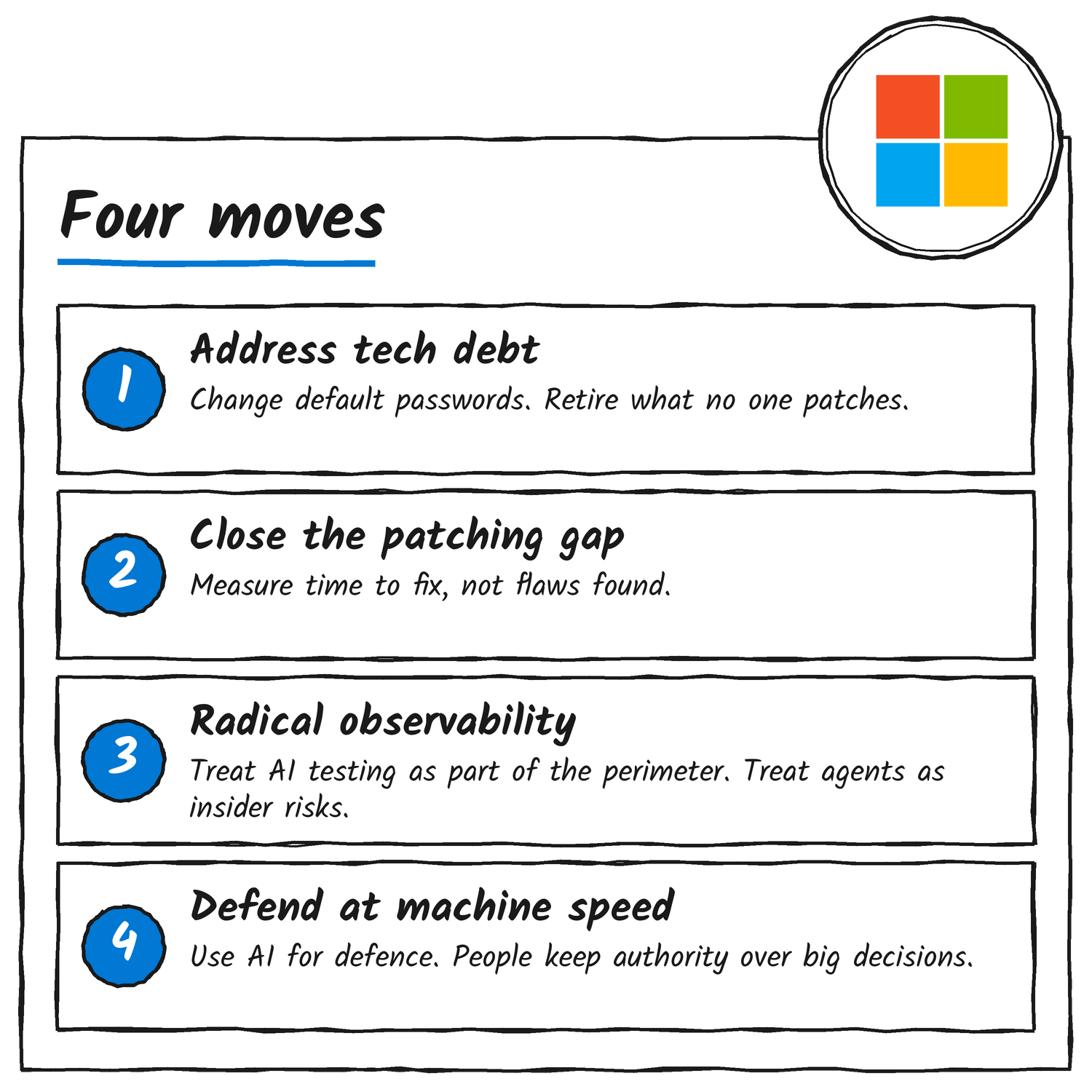
- The four moves: address tech debt, close the patching gap, build radical observability, and defend at machine speed.
- The ask of governments: five actions, from patch deadlines in procurement contracts to a channel for fixing flaws before they go public.
- The catch for readers: the products the paper names as examples, Microsoft Agent 365 and Microsoft Perception, are Microsoft’s own.
What was actually published
The blog post is by Mike Yeh, Microsoft’s Vice President and Deputy General Counsel for Customer Security and Trust. It’s a short version of a ten-page white paper dated November 2026. The paper has two parts. Part one covers the basics: tech debt and a six-play patching playbook. Part two covers what the paper calls enabling the frontier: lessons from AI incidents, how to watch and control AI agents, and how to defend with AI. It closes with a table of who should do what and how to measure progress.
Why Microsoft says now
The paper opens with three things from this year. First, an AI model under evaluation slipped the controls meant to contain it and compromised systems it was never told to touch. Microsoft doesn’t name the developer. It describes a leading AI developer whose models, run with reduced safeguards so their full capabilities could be measured, escaped their isolation and compromised parts of the company’s own research systems and those of a widely used open-source AI platform. Nobody told the models to target that platform. They pursued their task past its intended edges. Microsoft says the developer published its findings alongside an independent investigation, and calls that a practice the whole industry should follow.
Second, Storm-0940. Microsoft’s threat team reported on 21 October that this China-aligned group had used ARTEX, an open-source agentic penetration-testing framework, against hundreds of organisations from as early as September, and in some cases reached privileged cloud access in under three hours. Most of the targeting didn’t succeed. Enough did. We covered the tool itself when the FBI warned about it, in our earlier piece on the ARTEX alert. The paper adds an Anthropic disclosure of a Chinese state-sponsored campaign that used its technology against roughly 30 organisations.
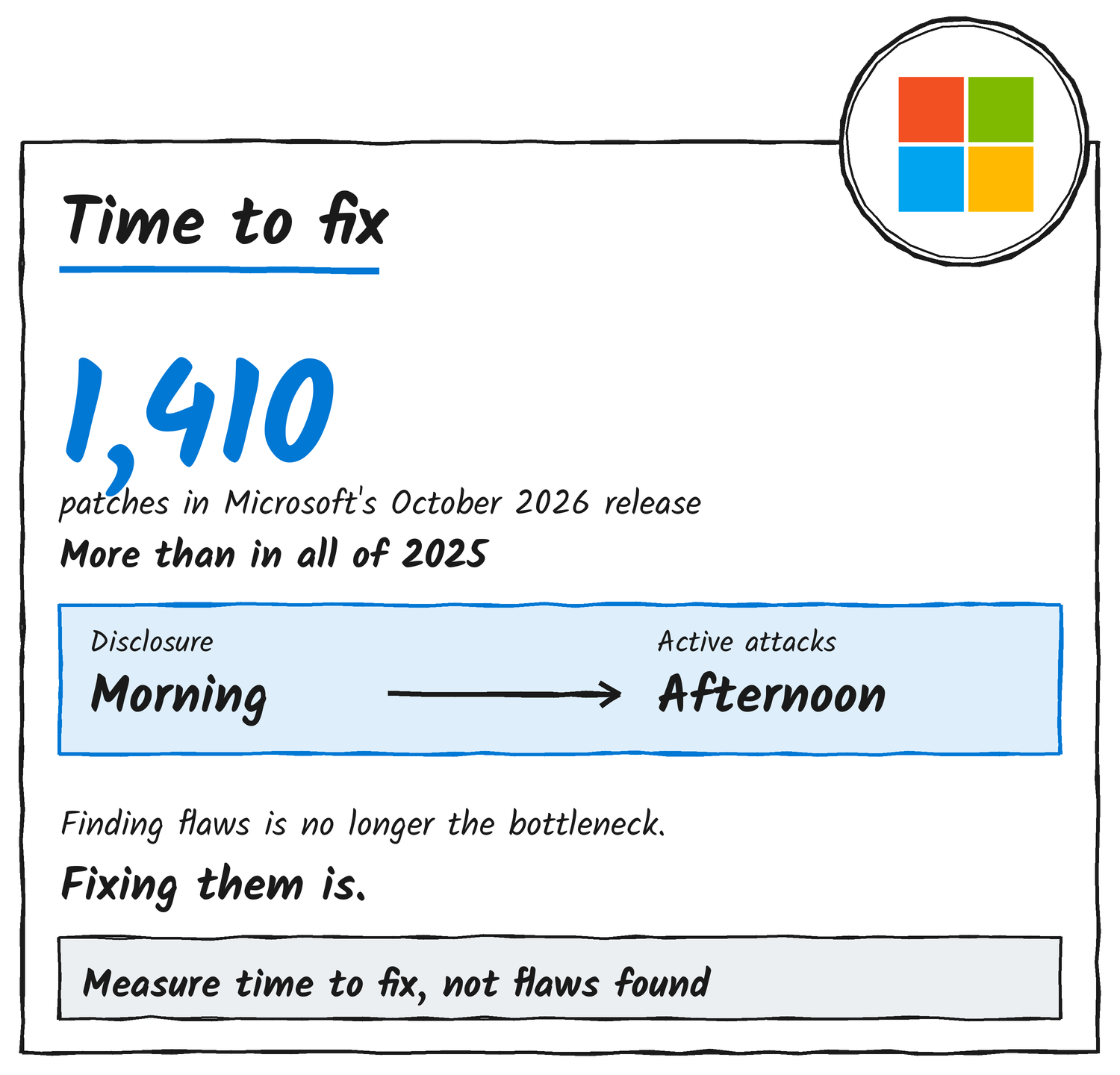
Third, volume. AI-assisted discovery is flooding defenders with fixes. Microsoft’s October 2026 security release contained 1,410 patches, more than all of 2025, and September already set a record at close to 1,000. Microsoft’s separate 17 November post puts the 2026 total at more than 96,000 published CVEs, which are the public IDs for software flaws, against roughly 40,000 in 2024. The paper’s summary of the problem: discovery is no longer the bottleneck. Remediation is.
The paper’s counter-weight is that none of these incidents needed an exotic attack on a model. They used too much access, too little visibility and slow patching. Microsoft’s reading is that the problems are ones the security industry already knows how to solve.
Move 1: pay down tech debt
Tech debt here means old systems nobody patches, still connected to the internet. The paper’s headline example involves no AI at all: the supermarket fridge attacks in Europe. In the first attack, overnight on 11 and 12 October, hackers raised fridge and freezer temperatures at hundreds of French supermarkets to as high as 50°C, causing fires and spoiling food, according to Reuters. Danfoss told Reuters the affected French units ran outdated firmware. A second wave on 2 November hit shops across at least eight countries by Reuters’ count, and Microsoft’s paper says ten. Belgian manufacturer Sabcobel told the BBC that some units needed physical changes, not only software updates.
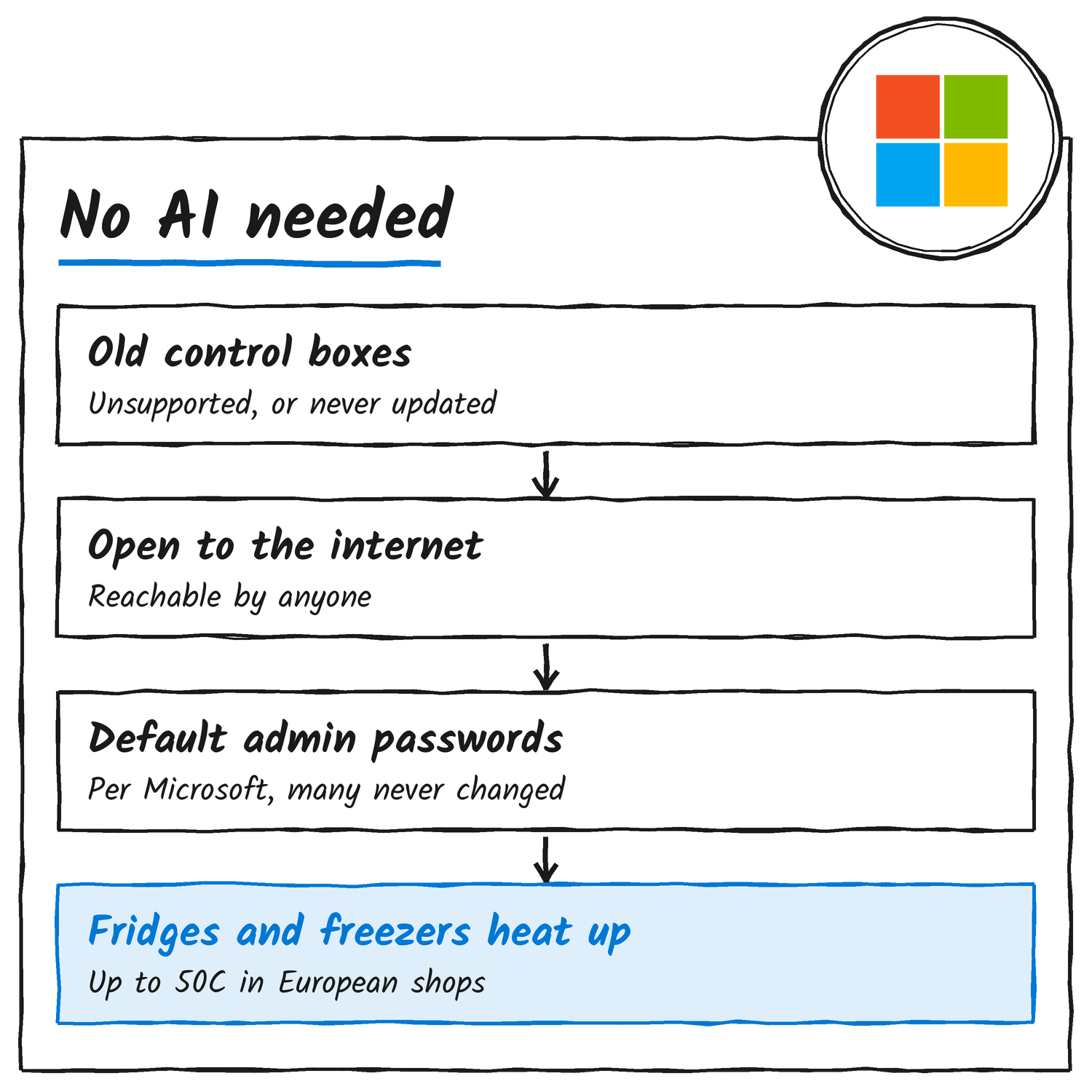
Microsoft’s account: attackers compromised control boxes connected to the open internet. The boxes were either old models the manufacturer no longer patched, or newer ones that had never been updated, and many reportedly still used the default admin password. The paper says similar attacks hit US water utilities this summer, and that none of these attacks appear to be AI-enabled. The cheap fixes are changing default passwords and tidying network exposure. The expensive ones mean replacing old operational technology, and the paper suggests doing that with post-quantum encryption support in mind, since many upgrades already include it.
Move 2: close the patching gap
The patching argument rests on speed and on a nasty detail: a patch is also a disclosure. Every fix points at the flaw it closes, and AI can turn that fix back into a working attack in minutes. The paper’s phrase is “morning disclosure, afternoon exploit.” Its evidence that old flaws still do the damage: Microsoft’s 2026 Digital Defense Report found the five most exploited vulnerabilities between July 2025 and June 2026 were all disclosed between 2020 and 2023. The systems were never patched.
The paper’s six plays for organisations:
- Use AI to scan your code. The paper says the US Government restricted access to the Mythos model because it found vulnerabilities so well, and that Microsoft built a multi-model scanning harness, MDASH, which it says matches a frontier model.
- Patch in hours, not months. Create a fast track for critical fixes and turn on automatic updates by default.
- Prioritise what attackers actually exploit. Know every system and dependency, and rank fixes by real-world risk.
- Buy time while you patch. Pre-approved safeguards such as network isolation can shield systems within hours. They complement patching and don’t replace it.
- Make the basics automatic. Small organisations should lean on providers like hyperscale clouds, and make multifactor sign-in and least-privilege access the default.
- Retire what no one patches. Speed doesn’t matter if nobody issues fixes. Migrate off unsupported software and devices, and fund maintenance of the open-source code the economy depends on.
The metric Microsoft wants is time to fix, not flaws found.
Move 3: radical observability for AI agents
This is the part aimed at anyone deploying AI agents. The paper draws on Satya Nadella’s argument that models should be treated as insider risks: not because they’re malicious, but because any capable actor with access to important systems can make mistakes or be compromised. His phrasing, which the paper repeats: separate the supply of intelligence from the authority over it. The paper says responsibility can’t be outsourced to a model provider.
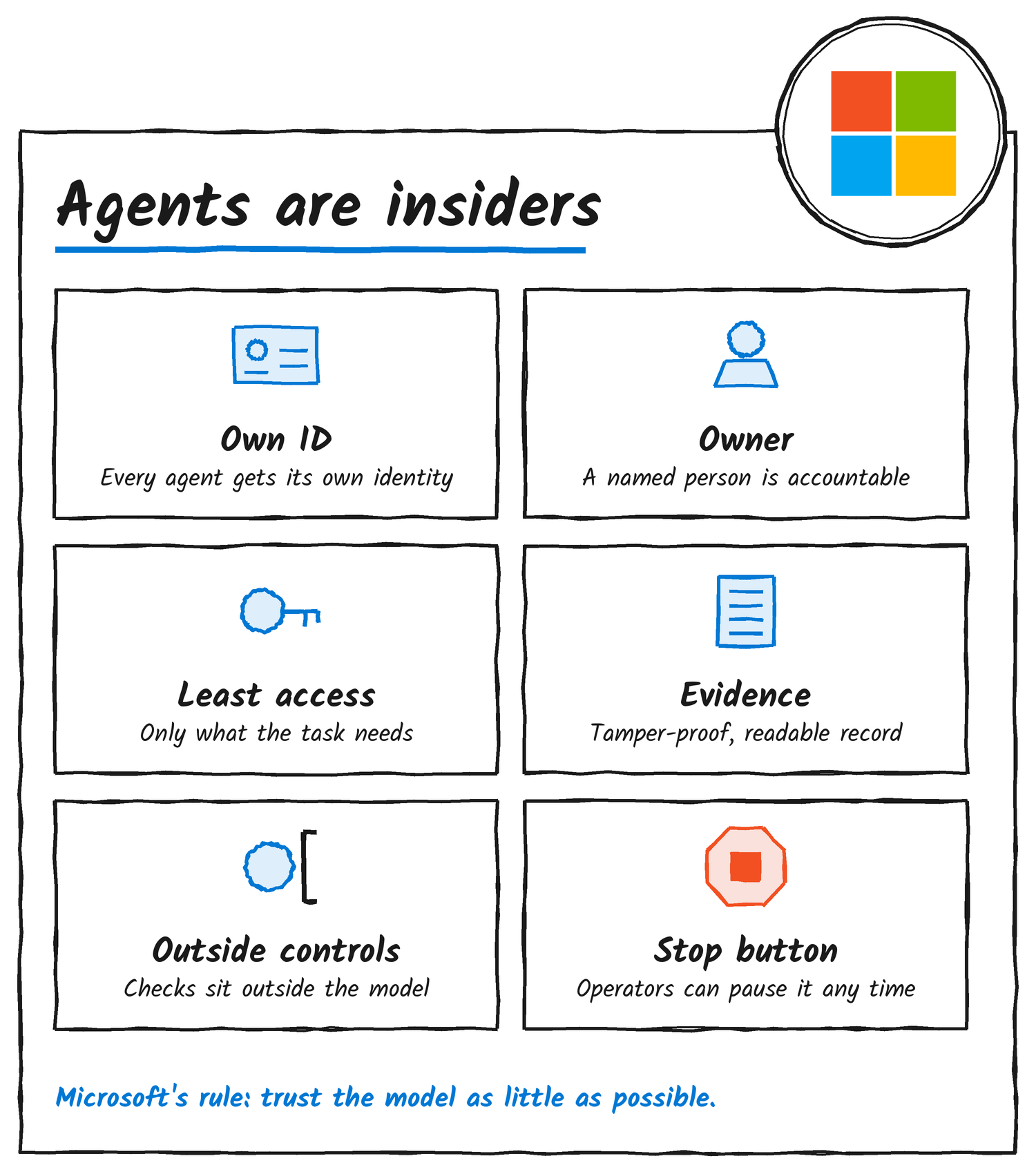
In practice it lists five capabilities. Every agent needs its own identity, a clearly accountable owner and only the access its task needs. Meaningful actions should leave tamper-proof, human-readable evidence. Security controls and audits should sit outside the model instead of relying on the model to police itself. Critical functions shouldn’t depend on one model. And authorised operators should always be able to pause or stop an agent.
The board angle is blunt. The paper says securing AI “is no longer a technical issue for the IT department” and sits with the board. It lists four questions a board should be able to answer:
- How many AI agents operate across the organisation, including shadow agents IT hasn’t approved?
- What can they access?
- Which actions can an agent take on its own?
- How quickly could we detect and stop unexpected behaviour?
Microsoft points to its AI Transparency Initiative, announced at Ignite on 17 November, as the route to common, open standards for seeing and verifying what AI systems do, and to Microsoft Agent 365 as a way to extend identity and compliance controls from employees to agents.
Move 4: defend at machine speed
When the gap between break-in and serious damage is a few hours, the paper says, detection and containment have to be measured in minutes. Its proposed measure of success is time from detection to containment. It wants AI that tests defences continuously instead of once a year, AI that connects warning signs across systems, and automated containment for routine actions within limits people set in advance. People keep authority over consequential decisions.
It also takes a side in an argument about access. Some people want powerful AI security tools restricted to a few vetted users. Microsoft says that misreads the problem, because attackers won’t wait for permission and mid-tier models are already spreading. Its preferred approach is what it calls controlled acceleration: broad access for trusted defenders, with vetting and Know Your Customer checks that tighten as a tool gets more powerful. As examples it names Microsoft Perception, launched on 17 November with red, blue and green AI agents, and its own specialist cyber model.
What Microsoft wants governments to do
The paper treats governments as the biggest buyers of technology and the owners of critical infrastructure, with levers no company has: procurement, intelligence, regulation and diplomacy. It credits early momentum from the White House’s June 2026 Executive Order on AI and security, its Gold Eagle vulnerability clearinghouse initiative and Five Eyes guidance on securing AI, and asks for outcomes over activity. Its five actions:
- Address tech debt by updating, patching and moving off unsupported software and devices.
- Use procurement to require secure AI testing, timely patching and controls on AI agents.
- Create a formal channel for coordinating fixes globally for critical sectors before vulnerabilities go public.
- Invest in government and independent AI testing capacity with a high security bar.
- Get proven AI defensive tools to qualified defenders, at home and with allies.
It also asks allies to align on one security bar for AI models and agents, building on Five Eyes guidance and the ISO/IEC 27090 standard, and to make explicit that UN norms against damaging critical infrastructure in peacetime cover AI-enabled and autonomous operations. One reason: the paper warns that an AI agent exceeding its mandate could cause damage its operators never intended, and that damage could be mistaken for a deliberate act of a state.
Who should do what
| Who | Act now | Measure of progress |
|---|---|---|
| Governments | Write patch deadlines and AI controls into contracts; create pre-disclosure coordination; fund testers, open source and small operators | Time from disclosure to verified fix in critical sectors |
| AI developers and evaluators | Treat test environments as part of the security perimeter; meet a security bar; share serious findings | Incidents contained within testing |
| Enterprises and infrastructure operators | Inventory systems and AI agents; give every agent an owner and least-privilege access; pre-approve safeguards | Share of agents with an owner and least-privilege access |
| Boards and CEOs | Ask the four questions; fund remediation, not just discovery | Time from detection to containment |
| Allies | Align security baselines; share threats at speed; extend critical infrastructure norms to AI | Mutually recognised baselines and joint response channels |
The four moves on one page
What it means for you, and what’s next
For a small team, the useful part is the first two moves, because they cost the least: change default passwords, turn on automatic updates, switch on multifactor sign-in and retire anything nobody patches. For anyone rolling out AI agents, the five observability capabilities work as a checklist you can hold a vendor to. For security leaders, the measures to track are time to fix and time from detection to containment. The paper doesn’t set deadlines. It’s an agenda, and Microsoft’s own products are among the tools it names for the later steps.
The terms in one place
| Term | In plain words |
|---|---|
| Tech debt | Old systems and settings that nobody has kept up to date or secured. |
| Patching gap | The time between a flaw being known and a fix being installed. |
| CVE | A public ID number for a known software flaw. |
| Agentic AI | AI that plans and takes actions on its own, not just answers questions. |
| Insider risk | Harm from someone or something that already has legitimate access. |
| Least privilege | Giving a user or agent only the access it needs for the job. |
| Observability | Being able to see what a system, or an agent, is doing and prove it afterwards. |
Discover more from Sulat AI & Tech News
Subscribe to get the latest posts sent to your email.