
Bitwarden has told people who run their own servers to update to v2026.11.0 straight away, because the nginx web server bundled with it carries two flaws that can let an attacker run code inside the nginx container. Updating isn’t always enough on its own. Bitwarden says images pulled before it rebuilt its nginx image reported 2026.11.0 but still held nginx 1.31.8, which is vulnerable.
The notice went up on Bitwarden’s status page and community forum on 18 November US time. It covers self-hosted installs, where nginx is the default web server. The two flaws are CVE-2026-123007 and CVE-2026-123633, both in nginx’s HTTP/2 code and both fixed in nginx 1.31.9. Bitwarden says they can potentially allow remote code execution within the nginx container.
What Bitwarden tells self-hosters to do
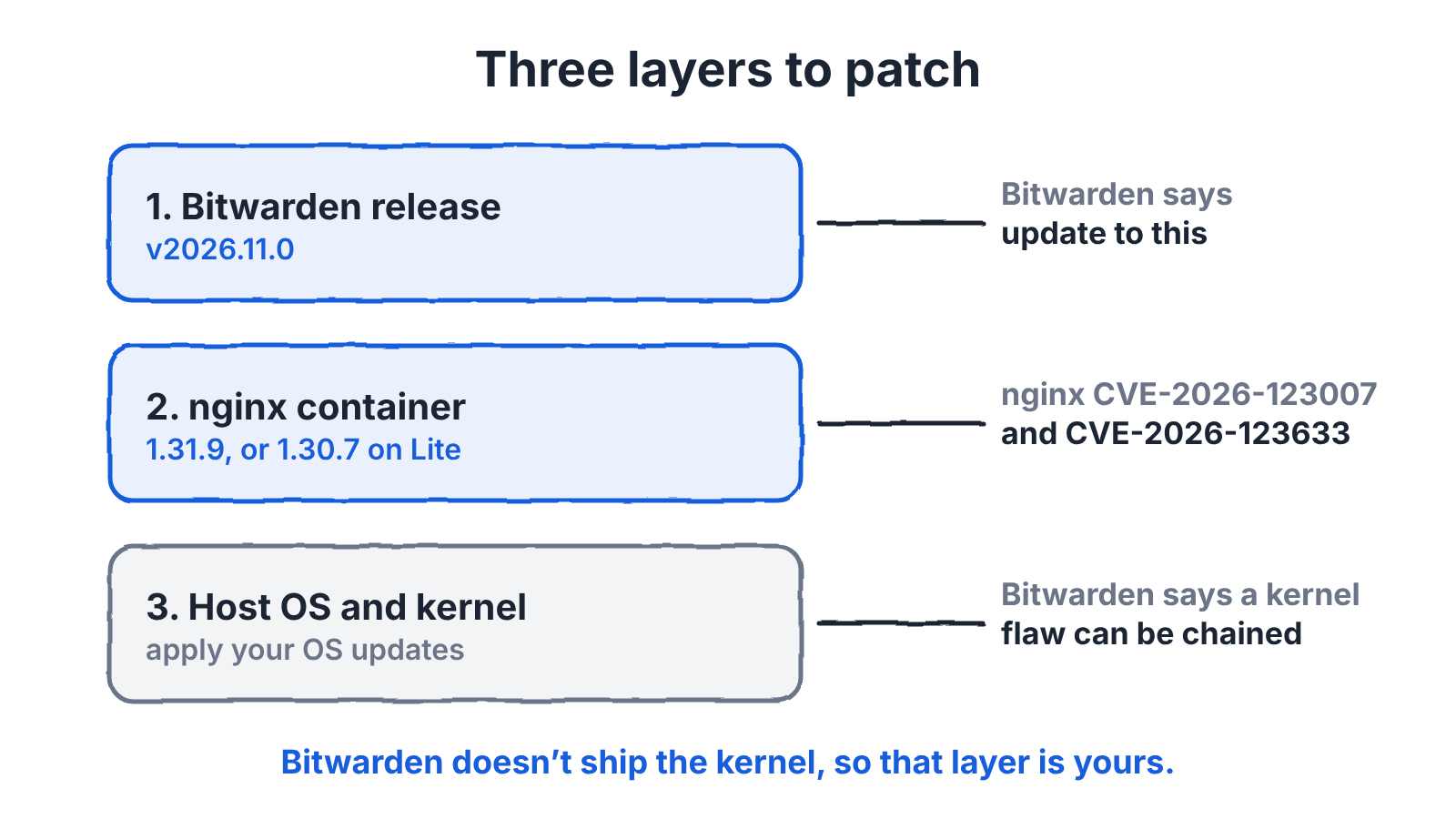
Update to v2026.11.0 and apply any other OS-level updates in the same maintenance window. The second part is there because unrelated Linux kernel flaws can be chained with the nginx flaw for a further exploit. Bitwarden’s notice names the kernel flaw as CVE-2026-72447 and says it doesn’t ship the kernel, so that patch comes from your distribution. The notice offers no workaround. The update is the fix.
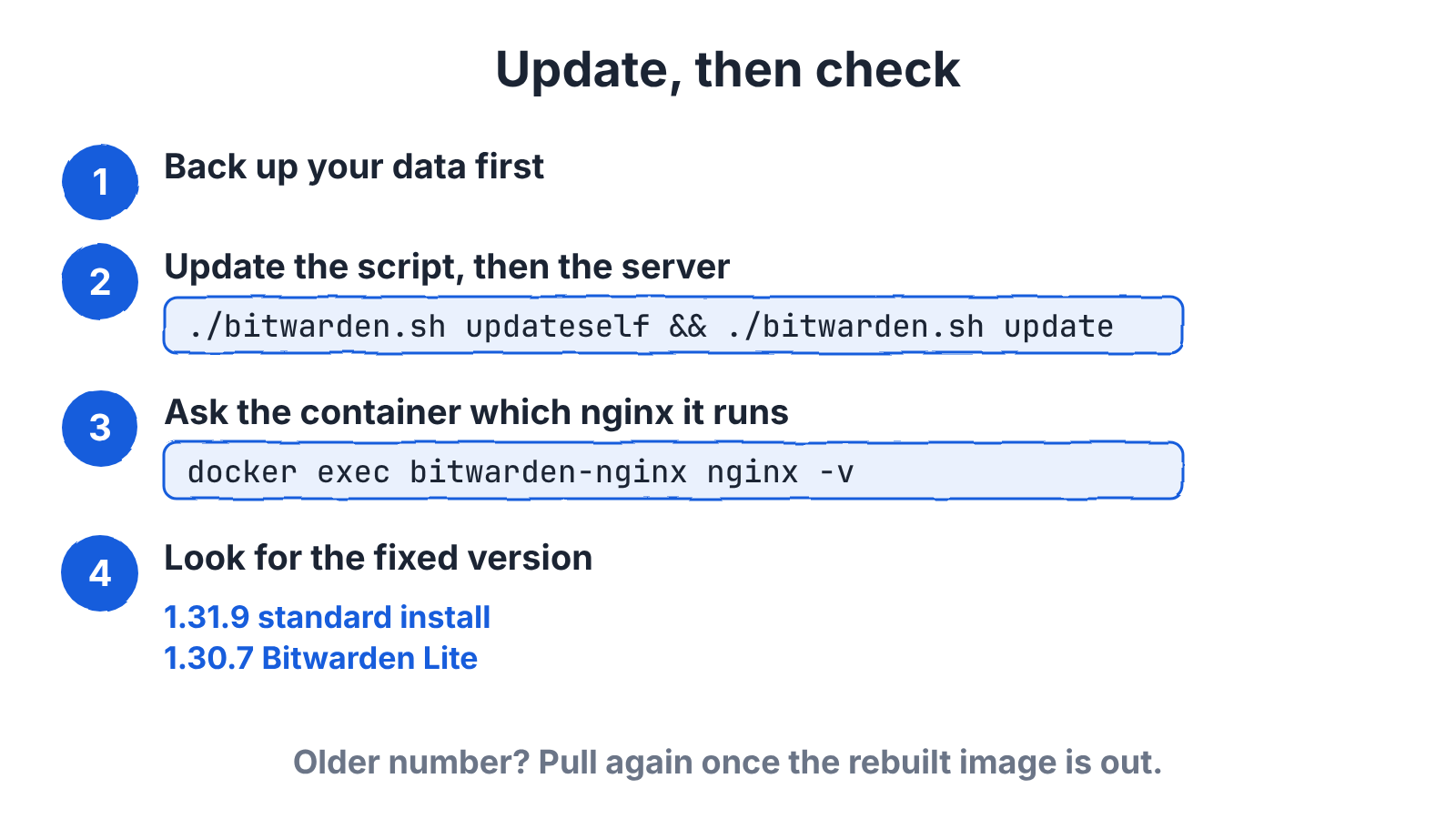
Bitwarden’s update guide recommends a backup first. For a standard install it then runs two commands, the first refreshing the script and the second updating the server:
./bitwarden.sh updateself
./bitwarden.sh update
For a Helm install, the guide pulls the latest chart, compares the new default values against yours, then runs helm upgrade:
helm repo update
helm show values bitwarden/self-host --version <new-version-number> > new-defaults.yaml
helm upgrade bitwarden bitwarden/self-host --namespace bitwarden --values my-values.yaml
Check the nginx version, not the release number
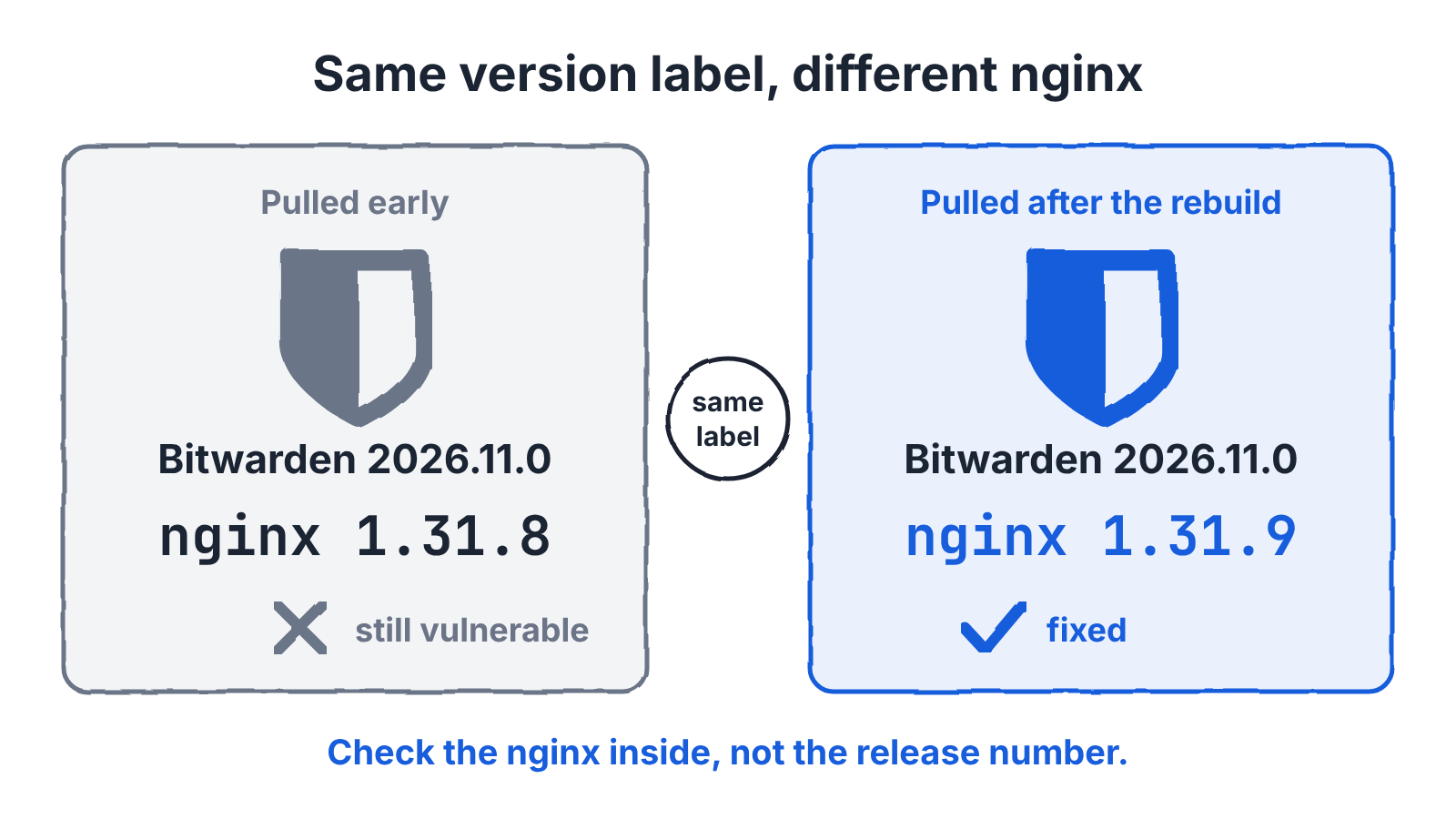
This is the catch. The 2026.11.0 number tracks the Bitwarden server release, while the nginx version comes from the base image used when the container images are built. Bitwarden says nginx 1.31.9 came out the same day as 2026.11.0, so anyone who pulled before its nginx image was rebuilt got a server that reported 2026.11.0 but still ran nginx 1.31.8.
Bitwarden’s own check after updating is a single command against the nginx container:
docker exec bitwarden-nginx nginx -vThe output should read 1.31.9, or 1.30.7 on Bitwarden Lite. If it still says 1.31.8, run the update again and recheck.
What the two flaws do
CVE-2026-123007 is an HTTP/2 flow-control bug that corrupts memory in an nginx worker. It affects nginx from 1.9.5 to 1.31.8 and applies to configurations that use HTTP/2. CVE-2026-123633 is a use-after-free that bites when nginx accepts HTTP/2 connections, proxies the requests to a backend and runs low on worker connections. It affects 1.19.7 to 1.31.8. F5, which maintains nginx, rates both 9.2 (critical) on CVSS 4.0 and fixed them in nginx 1.31.9 and 1.30.7 on 18 November.
Rapid7 published a proof of concept for CVE-2026-123007 that runs code against a stock nginx 1.31.8 Docker image with HTTP/2 and TLS on. Its exploit depends on a particular memory-copy routine that x86-64 glibc picks on CPUs with AVX-512 features, and Rapid7 says no alternative route is known. Wiz confirmed code execution through both flaws and has held back its exploits. CERT-EU reported no exploitation in the wild on 18 November, and StepSecurity says CVE-2026-123007 isn’t in CISA’s Known Exploited Vulnerabilities catalogue.
The same nginx release fixes ten vulnerabilities in total, including the other three nginx2root flaws, so landing on 1.31.9 covers all of them (nginx advisories). I’ve covered the full set, including how Xint chained one flaw with a kernel bug to reach root from inside a Docker container, in nginx2root: five critical nginx flaws let attackers run code.
Patch all three layers
Treat this as three patches, not one. The Bitwarden release and the nginx container arrive together once your image is current. The host kernel doesn’t. Bitwarden doesn’t ship it, so install your distribution’s pending updates and reboot if it asks you to.
Discover more from Sulat AI & Tech News
Subscribe to get the latest posts sent to your email.