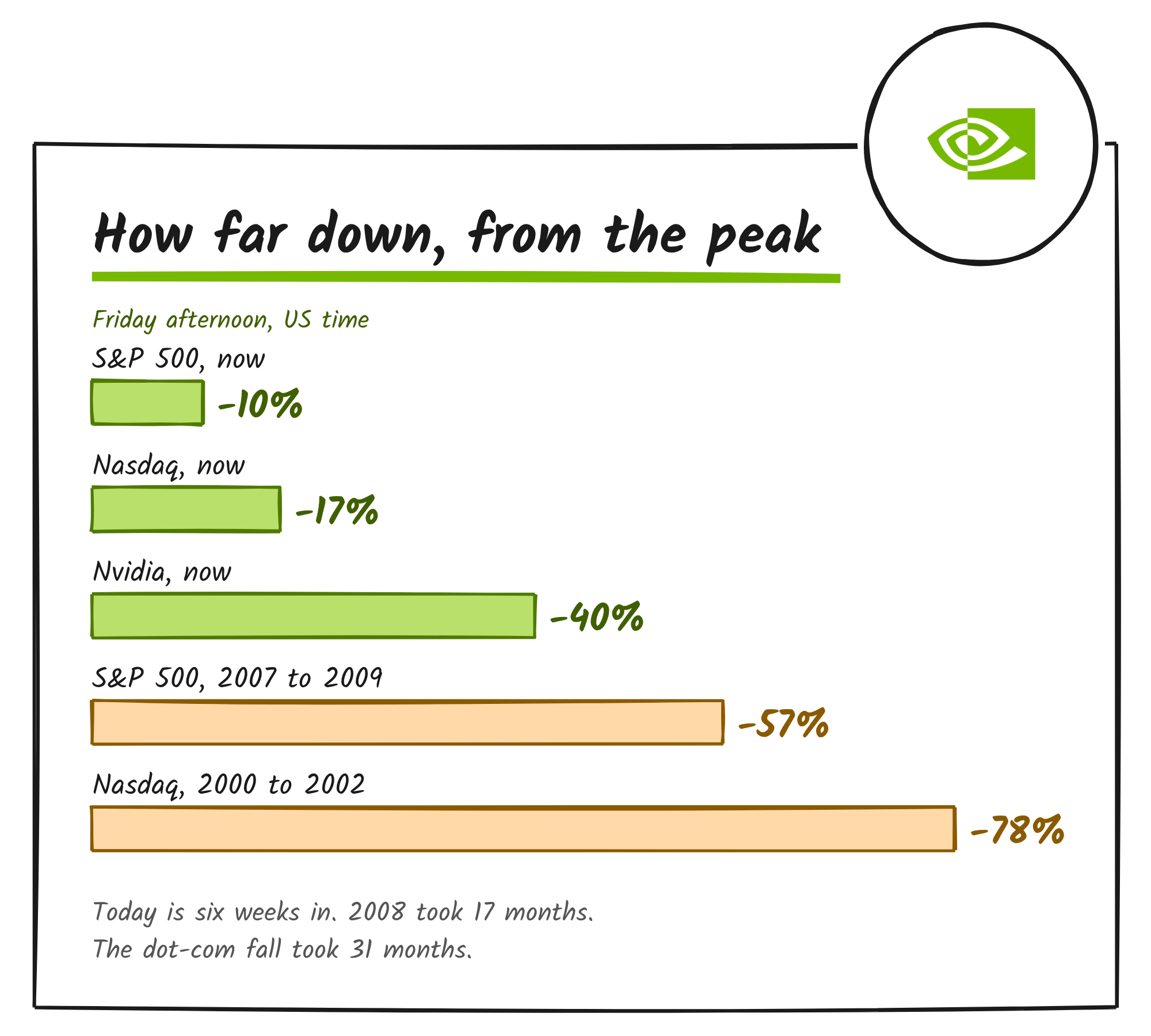
The S&P 500 and the Dow Jones Industrial Average dipped into correction territory on Friday 20 November US time, and the Nasdaq Composite wiped out its gain for 2026, as investors kept selling AI stocks, CNN reports. In afternoon trading the Nasdaq was down 3.6% and the S&P 500 down 2.2%, on track for a seventh straight losing day, its longest run since February 2020.
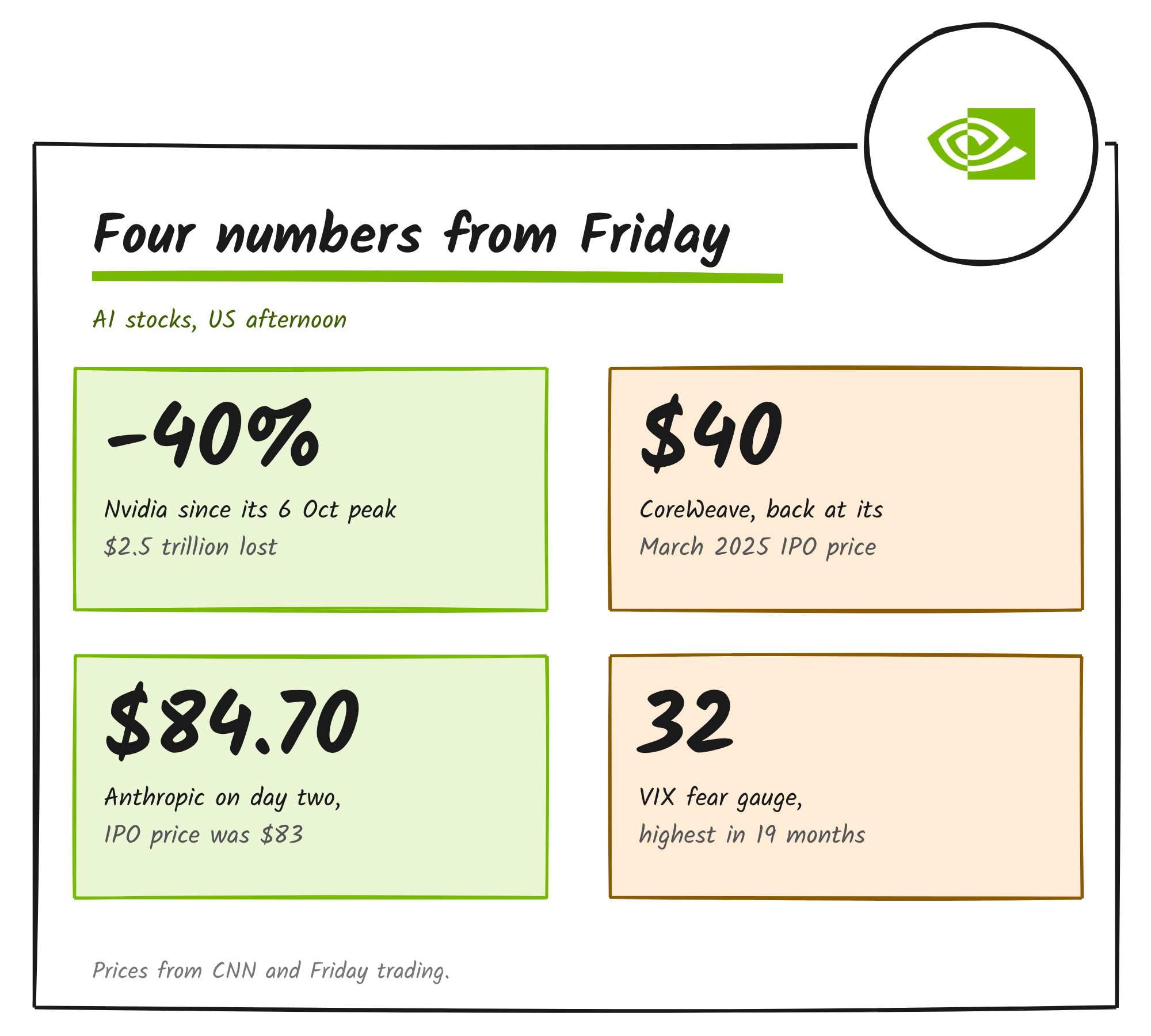
Nvidia has lost more than 40% since its 6 October peak, CNN says, and about US$2.5 trillion in market value. CoreWeave, the cloud company Nvidia backs, fell 10% to US$40, the price it listed at in March 2025. Anthropic, which listed on Thursday, fell almost 13% to about US$84.70, against an offer price of US$83.
Where the indexes stand
Thursday’s closes were already lower. Reuters had the S&P 500 at 7,175.83, the Nasdaq Composite at 23,879.20 and the Dow at 49,097.06, each down more than 2% on the day. Applying CNN’s Friday afternoon moves to those closes puts the Nasdaq about 17% below its record close of 27,599.89 on 6 October. The S&P 500 and the Dow are each 10% below their own peaks, the usual definition of a correction.
Wall Street’s usual line for a bear market is a 20% fall from a peak. Nvidia is past it and the Nasdaq, at about 17%, is three points short.
| Index | Close on Thursday 19 November | Friday afternoon | Position |
|---|---|---|---|
| S&P 500 | 7,175.83 | Down 2.2% | In correction, 10% below its peak |
| Nasdaq Composite | 23,879.20 | Down 3.6% | About 17% below its 6 October record; down almost 1% for 2026 |
| Dow Jones Industrial Average | 49,097.06 | Down 0.7% | In correction |
Six weeks of selling
The Nasdaq closed at its record on 6 October. On 5 November the S&P 500 fell 4.4%, its worst day since the April 2025 tariff shock, and the Nasdaq fell 5.5% to 11.9% below that record, AP reported.
On 12 November Jensen Huang resigned as Nvidia’s chief executive after Nvidia opened an internal investigation into an affair he admitted to, and chief financial officer Colette Kress became interim chief executive, TechCrunch reports. Nvidia reported results on 17 November, beat expectations and raised its guidance, the Wall Street Journal reports. Its shares still fell for a sixth straight session on Thursday, to US$145.98, Reuters reported.
The Federal Reserve’s minutes from its 27 to 28 October meeting, released on 18 November, say many participants “viewed the AI buildout as a material source of inflation risk”. CNBC reports that almost all officials said further rate rises “would likely be appropriate”.
Anthropic priced its listing on Wednesday at US$83 and raised US$81.3 billion, opened on Thursday at US$111.50 and closed at US$97.17, CNBC reports. The Nasdaq still lost 2.25% that day. AMD fell 7.7% after Hunterbrook Media published an investigation alleging that AMD firmware kept turning up at a blacklisted Chinese server maker, CNBC reports. Hunterbrook’s affiliated fund is short AMD, and the firm says so in its published report.
Why investors say they’re selling
CNN lists three worries: how newly elected Democratic governors will affect the pace of the data centre buildout, what Nvidia’s role in the AI industry looks like after Huang’s exit, and whether the hundreds of billions of dollars companies are spending on AI will earn a return. Some of that money is coming from debt and new share sales, CNN notes.
“The market was already questioning some of the cost-benefit analysis … and you’re coming off of relatively euphoric levels,” Steve Sosnick, chief strategist at Interactive Brokers, told CNN. “There is a real exodus out of tech stocks.” The VIX, which tracks expected volatility, rose to 32 this week from 19.3 last Friday, its highest in 19 months, CNN says.
Not every strategist is alarmed. David Kelly, chief global strategist at JPMorgan Asset Management, told CNN that corrections are “inevitable”: “This is not a fatal illness. It’s not even the flu.” Arun Sundaram of CFRA Research told CNN he doesn’t “fully understand it, as the fundamentals don’t really justify all this selling.”
How it compares with the dot-com crash and 2008
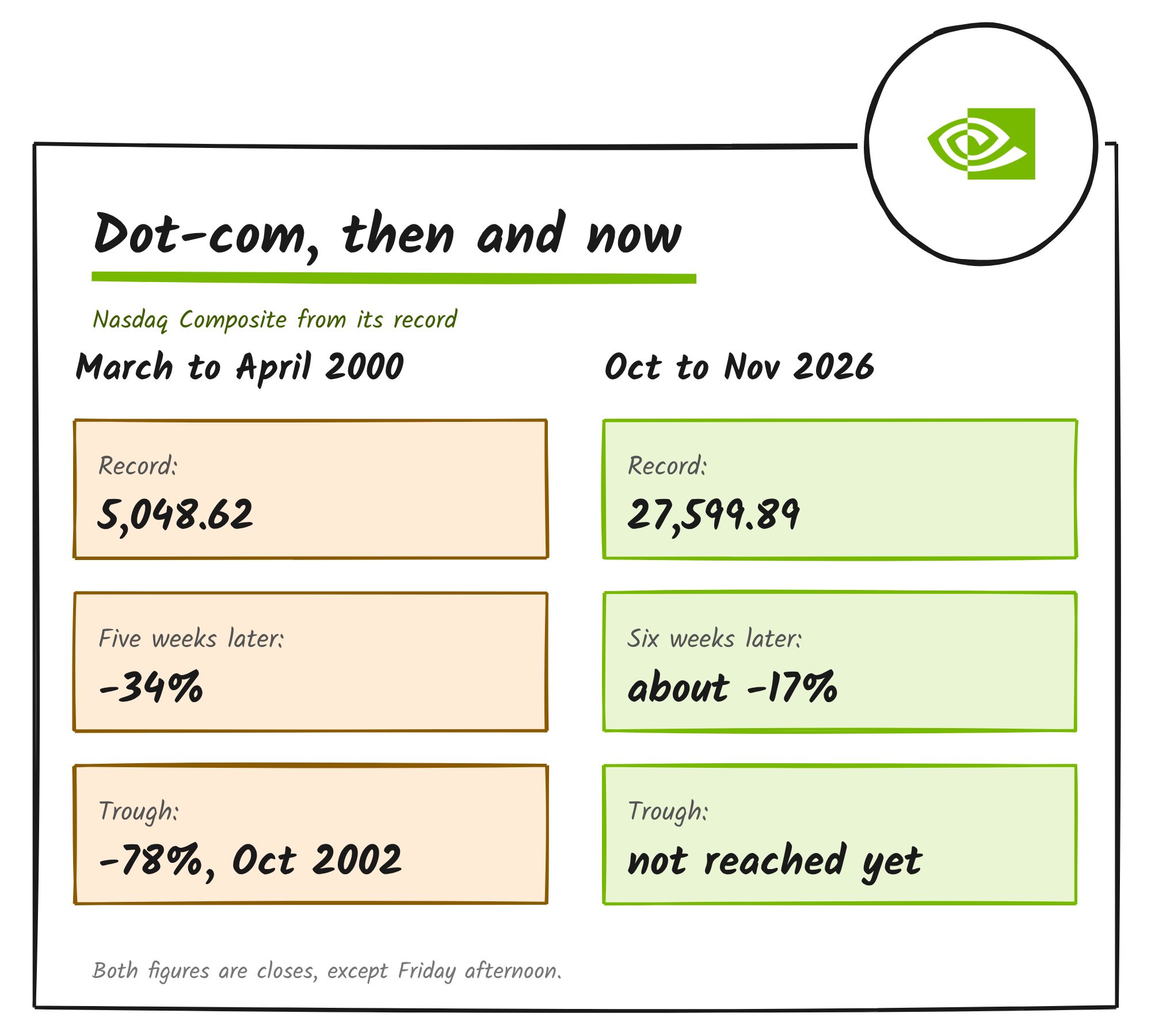
The Nasdaq Composite closed at 5,048.62 on 10 March 2000. Five weeks later, on 14 April, it was 34% lower, and it bottomed 78% below the peak on 9 October 2002, according to closes from the Federal Reserve Bank of St. Louis. It didn’t close above the 2000 peak again until 23 April 2015. The S&P 500 peaked at 1,565.15 on 9 October 2007 and fell 57% over 17 months to March 2009, the Federal Reserve’s history of the Great Recession says.
| Episode | Peak | Fall at the bottom, or so far | Time from peak |
|---|---|---|---|
| Dot-com, Nasdaq Composite | 5,048.62 on 10 March 2000 | 78% at the bottom | About 31 months |
| Financial crisis, S&P 500 | 1,565.15 on 9 October 2007 | 57% at the bottom | 17 months |
| AI sell-off, Nasdaq Composite | 27,599.89 on 6 October 2026 | About 17% so far | Six weeks so far |
On those figures the Nasdaq’s first five weeks in 2000 were steeper than its first six weeks now. Nvidia alone has fallen further than the index did then: more than 40% in six weeks. Both earlier falls ran for more than a year, and this one is six weeks old.
The companies at the centre differ too. Goldman Sachs’s account of the dot-com bubble says that “most of these internet startups would never generate any revenue or profit.” Nvidia, by contrast, beat expectations and raised its guidance last week. Its forward price-to-earnings ratio, a measure of its share price against expected profit, is the lowest since 2002, CNN reports, citing FactSet. The forward ratio for the S&P 500’s tech sector entered Friday at its lowest since March 2020.
Who else was hit
Bloomberg reports a gauge of chipmakers fell 9% on Friday. Asia opened the day lower: Reuters reported that MSCI’s broadest Asia-Pacific index was heading for a 7% weekly fall, its worst week since March 2020. SoftBank fell as much as 16% in Tokyo. On Thursday California’s attorney general served Nvidia with a subpoena.
Money moved to safer assets. Treasury bonds rallied and defensive sectors such as healthcare and consumer staples rose, CNN reports, which cushioned the Dow.
What comes next
US markets reopen on Monday 23 November, and Japan’s are closed that day for a public holiday. The Fed’s next decision is in December, and Reuters reported that futures pricing makes a rise all but certain. Nvidia hasn’t named a permanent chief executive; Kress is interim. The figures here are from Friday afternoon, before the US close at about 10am on Saturday 21 November NZ time.
Discover more from Sulat AI & Tech News
Subscribe to get the latest posts sent to your email.