
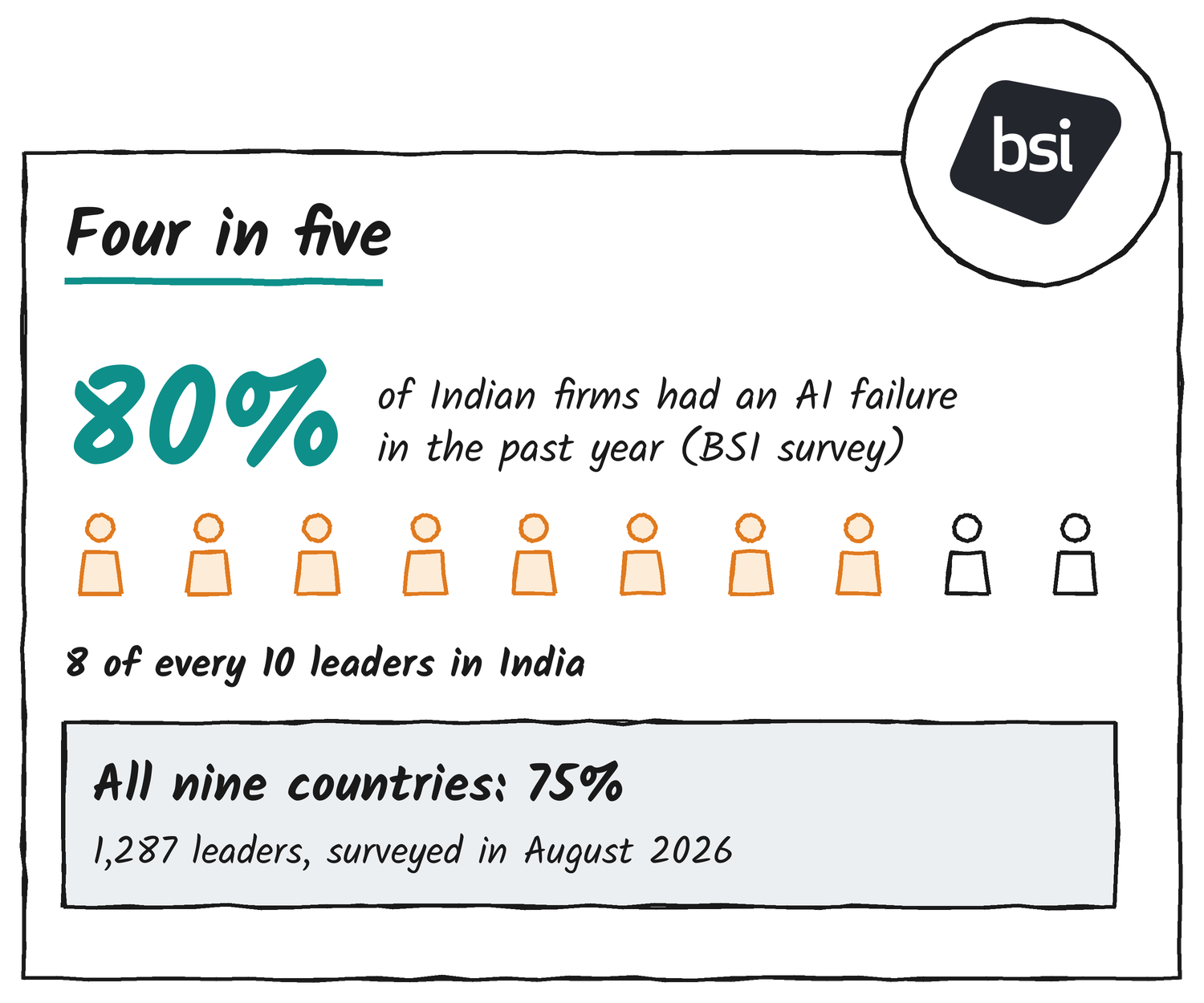
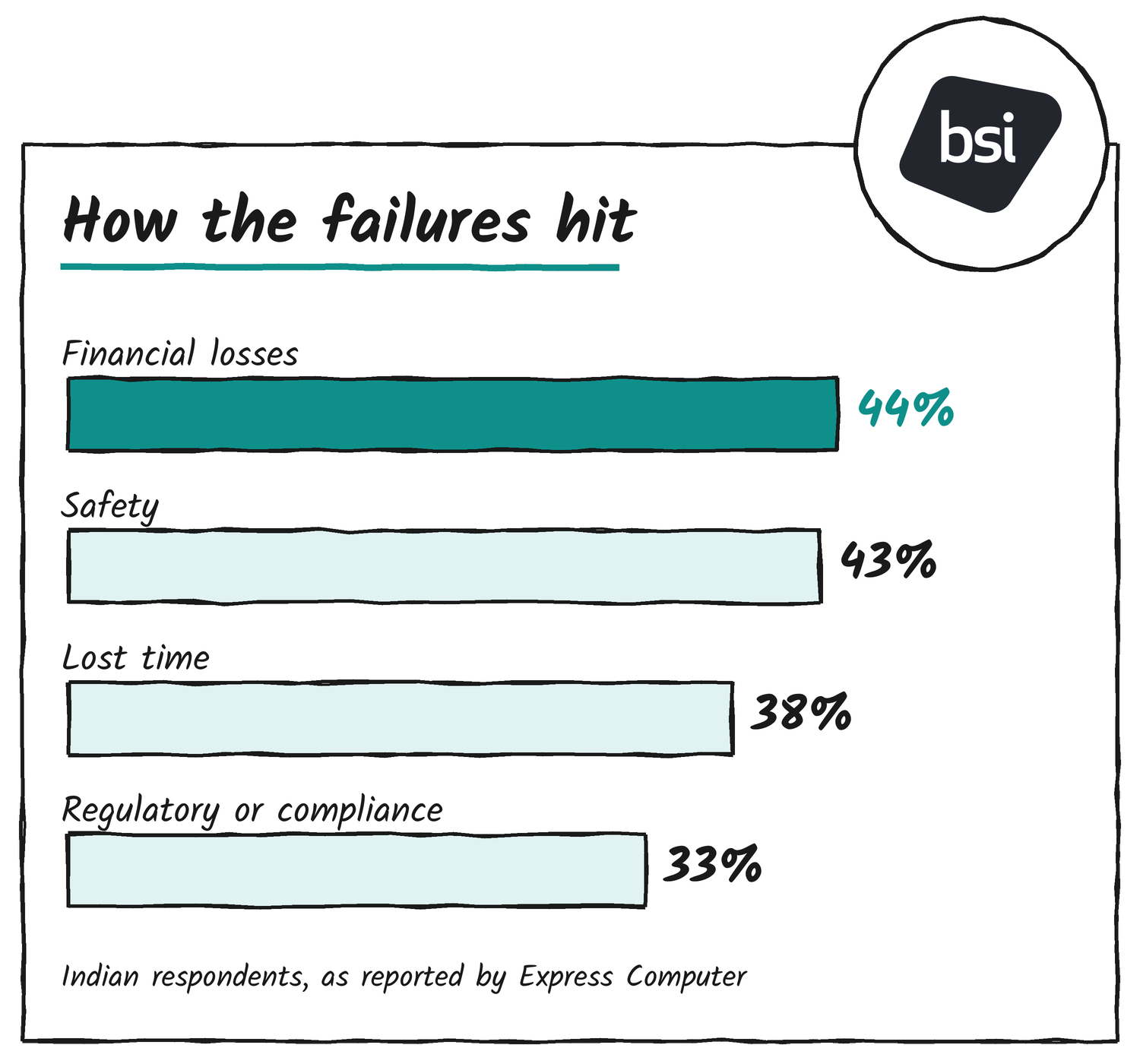
A BSI survey found 80% of Indian business leaders had at least one AI failure in the past year, Express Computer reports, against 75% across all nine countries BSI polled. The Indian results also have 44% of respondents reporting financial losses, 43% safety implications, 38% lost time and 33% regulatory or compliance issues.
BSI is the British Standards Institution, the UK’s national standards body. It published the first AI management standard, BS ISO/IEC 42001, in late 2023 and certifies businesses to it, so the survey’s conclusion that organisations need stronger AI governance points at a service BSI sells. The findings come from its report The cost of AI failure, which BSI released on 20 October. Express Computer carried the India breakdown on 20 November, and BSI’s South Asia and Southeast Asia managing director Emmanuel Herve said businesses need to plan for what happens when AI systems fail, with governance, safeguards and shared lessons from incidents.
How the survey was run
BSI commissioned the polling firm FocalData, which surveyed 1,287 business leaders from manager level up to the C-suite. They sat in nine countries (the Netherlands, Japan, India, Australia, the US, the UK, France, China and Germany) and seven sectors, and answered between 5 and 18 August 2026. The questions repeated those from BSI’s summer 2025 poll so it could compare year on year.
BSI defines an AI failure as an AI system making an error, malfunctioning, degrading in performance or producing a biased output that the developer, deployer and user didn’t expect. It counts failures in real-world use, not in development or testing, and leaves failures of frontier models out of scope. The report draws the definition from the taxonomy of the Center for Security and Emerging Technology.
Neither the report nor the release says how many Indian leaders answered or breaks results out by country. Spread evenly, 1,287 respondents across nine countries comes to about 143 each. The India figures here come from Express Computer’s account of the study. They record what leaders said about their own organisations, not audited incident logs.
What Indian respondents reported
Express lists four consequences for India: financial losses at 44%, safety implications at 43%, lost time at 38% and regulatory or compliance issues at 33%. The shares add up to more than 100%, so respondents could name more than one. BSI’s release doesn’t say whether consequence percentages are shares of all respondents or only of those who had a failure, and Express doesn’t say for India.
India against the global figures
BSI’s global release gives the same consequences for all nine countries combined. In the India figures, financial losses and safety implications run above the global shares, and lost time runs below.
| Measure | India (via Express Computer) | All nine countries (BSI) |
|---|---|---|
| Had an AI failure | 80% | 75% |
| Financial losses | 44% | 27% |
| Safety implications | 43% | 28% |
| Lost time | 38% | 44% |
| Regulatory or compliance issues | 33% | 29% |
| Process for managing AI incidents | 46% | 47% |
| Expect AI investment to rise | 89% | 78% |
| AI governance programme in place | 42% | 38% |
Confidence ahead of controls
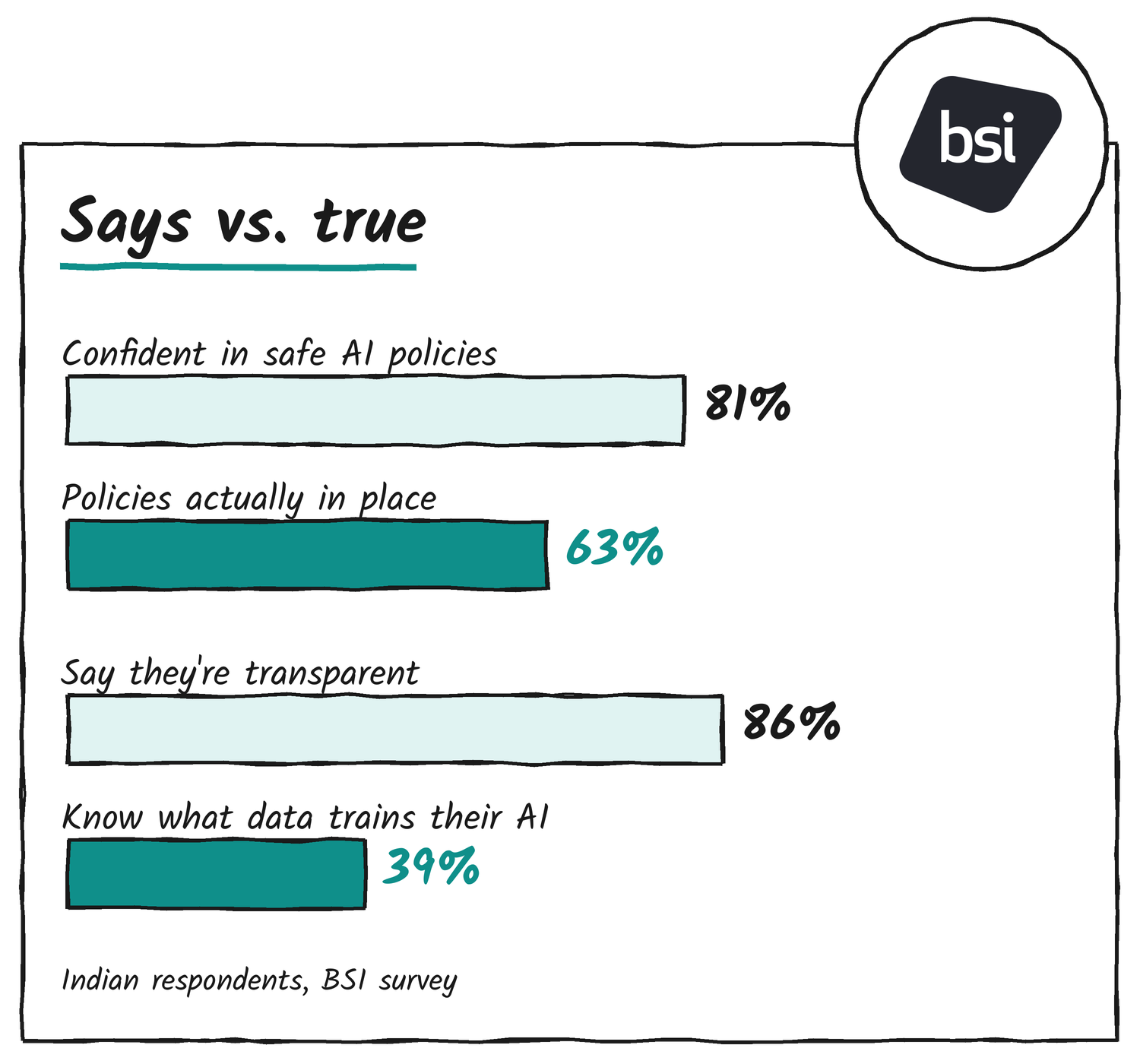
Express reports a gap between confidence and controls among Indian respondents. 81% were confident their organisation has safe AI policies, but 63% said such policies were in place. 86% believed their organisation was transparent about AI data and algorithms, but 39% said they understood what data was used to train or deploy its systems. Globally BSI reports 68% and 39% on the transparency pair.
Some of the India numbers moved the right way. The share of Indian organisations with an AI governance programme rose from 24% to 42%, Express says, and the share with risk assessment approaches rose from 30% to 57%. Only 46% have a process for managing AI incidents and responding in time, against 47% globally.
Agentic AI and the 3.6% figure
In India, 24% of organisations deploy agentic AI at scale, Express says, meaning systems that carry out multi-step tasks and take actions in other software, and another 26% use it for specific applications. BSI’s global figure for deployment at scale is 13%. Of the Indian respondents, 58% named security as an emerging AI risk and 44% named inadequate AI governance, and 89% expect their AI investment to rise, against 78% globally.
The 3.6% figure Express repeats isn’t a survey result. It comes from economic modelling by Alma Economics, commissioned by BSI, which estimates agentic AI failures could put up to 3.6% of annual market revenue at risk in certain sectors. Alma built it from seven public incidents, and the report itself says they aren’t representative of all AI failures and the numbers are illustrative.
BSI has also issued country results for the US, where it puts the failure rate at 69%, and for Australia, where it’s 76%.
Discover more from Sulat AI & Tech News
Subscribe to get the latest posts sent to your email.