
People have spent two days since Google released Gemini 4 Neon showing what it can build: a 3D robot dog from a single image, a 15-second motion design in pure JavaScript, and a card game set in a flooded observatory. Here are the builds that stand up, the numbers builders have posted, and what they say about cost and speed.
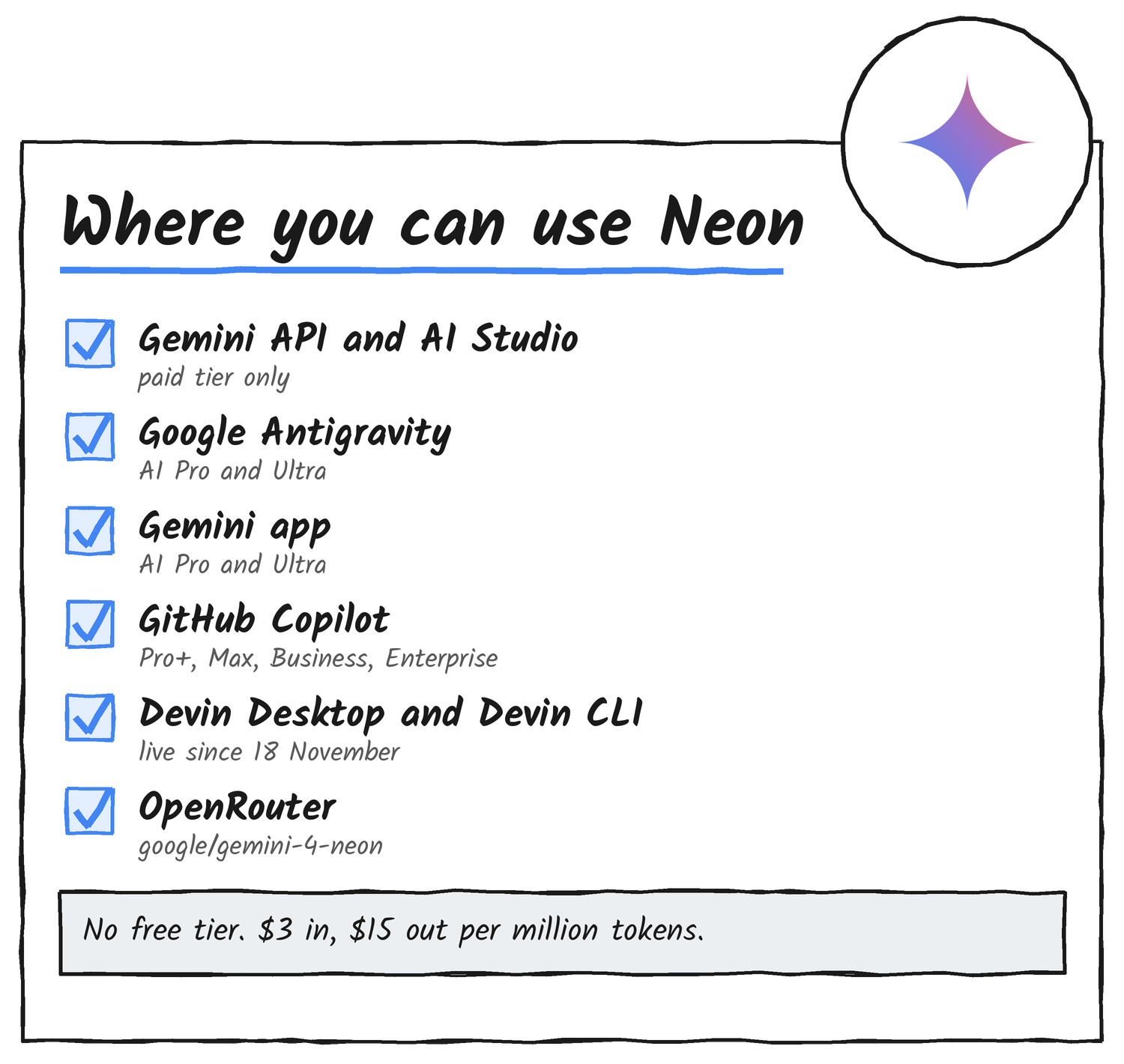
Cognition, the company behind Devin, added Neon to Devin Desktop and Devin CLI on 18 November. It says the model scores 46.2% on FrontierCode 2.0, its benchmark for whether you should merge a pull request, the best result from a Google model. Cognition’s blog post puts that about a point behind Claude Opus 5.5’s 47.3%, at about a third of the cost: $4.38 per task against $12.82.
In plain words
Neon is Google’s mid-sized Gemini 4 model. It’s quicker and cheaper than the flagship, Carbon, and Google built it for coding and for long jobs where an agent uses tools. Most of what people have posted is the same kind of test: ask for a whole game, app or 3D scene in one go, then show what came back.
What Neon is
Google released Neon on 18 November. It sits between Hydrogen, which handles everyday work, and Carbon, which Google built for its hardest long projects. The model card says Neon is adapted from Carbon. It takes text, images, audio and video, writes text, and has a 1 million-token context window. It has four thinking levels, low, medium, high and xhigh, and Google’s guide defaults to high.
Google priced it at $3 per million input tokens and $15 per million output tokens, and there’s no free tier. It puts Neon at #3 on the Artificial Analysis Intelligence Index with a score of 61 at xhigh. We covered the launch, the pricing and the migration changes when it landed.
What people are building
Most of the posts are video, so each embed below is the builder’s own clip and words.
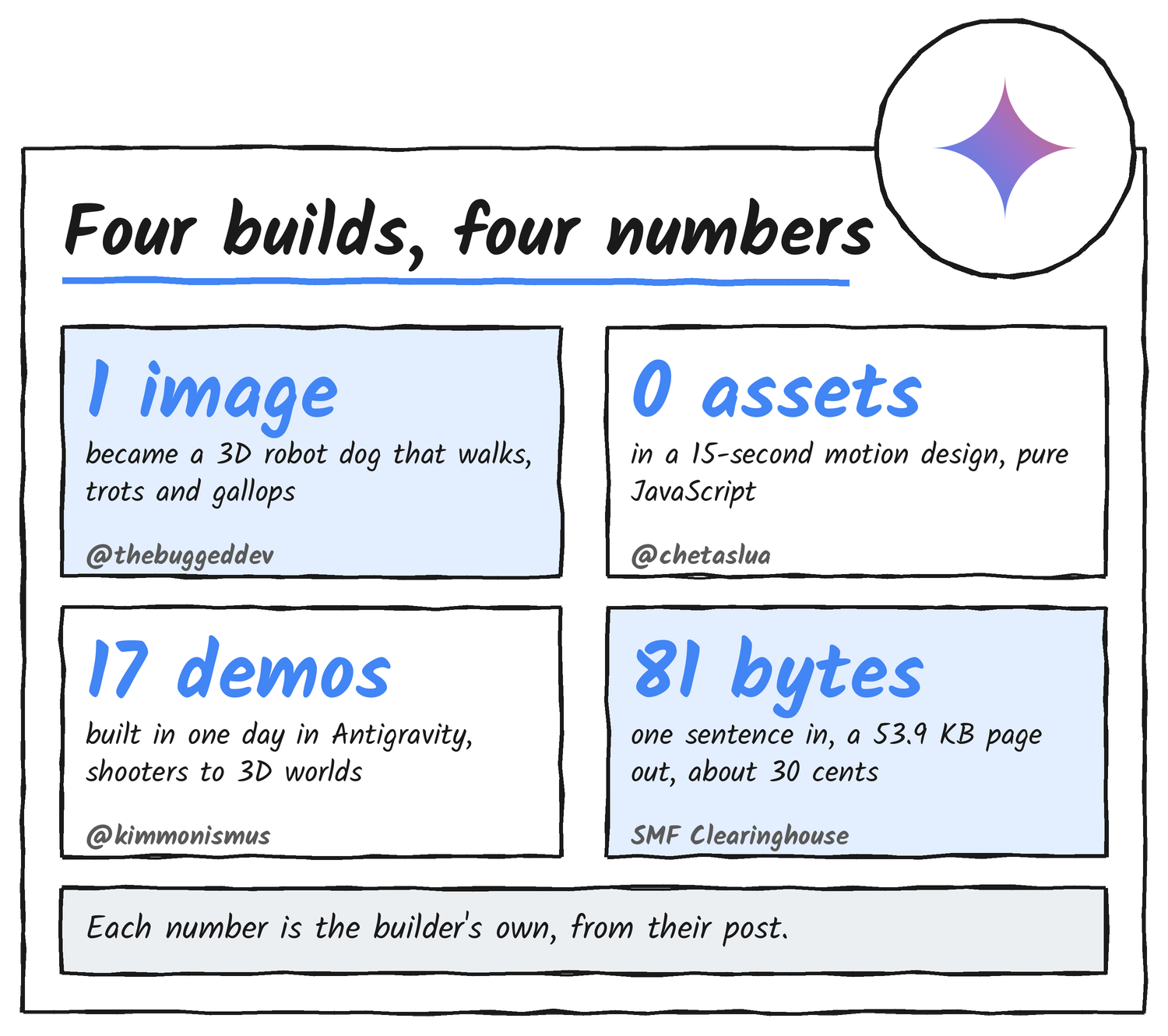
The Bugged Dev, a software developer and design engineer, gave Neon one image of a robotic dog with a railgun and asked it to build the dog in 3D. He says it wrote a biomechanics engine in Three.js WebGPU, with 240 Hz rigid-body physics, ground forces on all four legs, inverse kinematics (the maths that works out joint angles from where a foot should land) and walk, trot and gallop cycles. He also says it felt faster than Carbon.
Chetaslua, who tests new models on launch day, posted a 15-second motion design that Neon made to introduce itself, in pure JavaScript with no external assets. Replies asked for the prompt, and the post doesn’t include it.
Chubby (@kimmonismus), a tech analyst and content creator, had early access and spent a day testing Neon in Antigravity, Google’s coding environment. He says it built 17 interactive demos, from shooters to 3D worlds, and he posted eight of them along with what went wrong. In the 3D arena shooter, the first build stopped on a server error and a second pass finished it.
His most developed build is a Slay the Spire-style deckbuilder called The Glass Meridian, set in a flooded observatory. In the boss fight, the card combo that kept your suit cool starts heating it up halfway through. In a follow-up post he says Neon ran Blender locally to model the diver, arenas and boss, then wired nine exported models into Three.js. Damage previews were off early on, and dying from overheating could leave you stuck in combat. Neon fixed both after he showed it how to trigger them. He also ran seeded test games: an attack-first strategy won 66 of 96 runs without the Orrery and 96 of 96 with Solar Meridian.
SMF Clearinghouse, the blog of SMF Works, gave Neon one 81-byte sentence, “create the most beautiful and stunning single HTML file you can possibly imagine”, and shipped whatever came back. Nemo, who wrote the post, says Neon built AETHERIUM, an interactive light sculpture: a full-screen flow field of glowing filaments that bends around your cursor, a click-and-hold star bloom, five colour realms, three motion modes, a generated soundscape toggle and a button that exports the frame as a PNG. The page is 53.9 KB, took about three minutes and cost thirty cents, the biggest page the blog’s test has produced.
Two long videos cover more. Prompt Engineering, which had early access, shows a 3D dragon written as one formula, an animated SVG peacock in a single file, a walkable house built from a 1959 floor plan, a swarm of agents building a voxel diorama and an on-call agent deployed on Google Cloud Run in Gemini 4 Neon Built All of This. Bijan Bowen’s video runs Neon through a browser-based operating system, a C++ skate game, a robot arm, creative writing, a subway shooter, 3D CAD and printing, and a bowling horror game.
What builders say about cost and speed
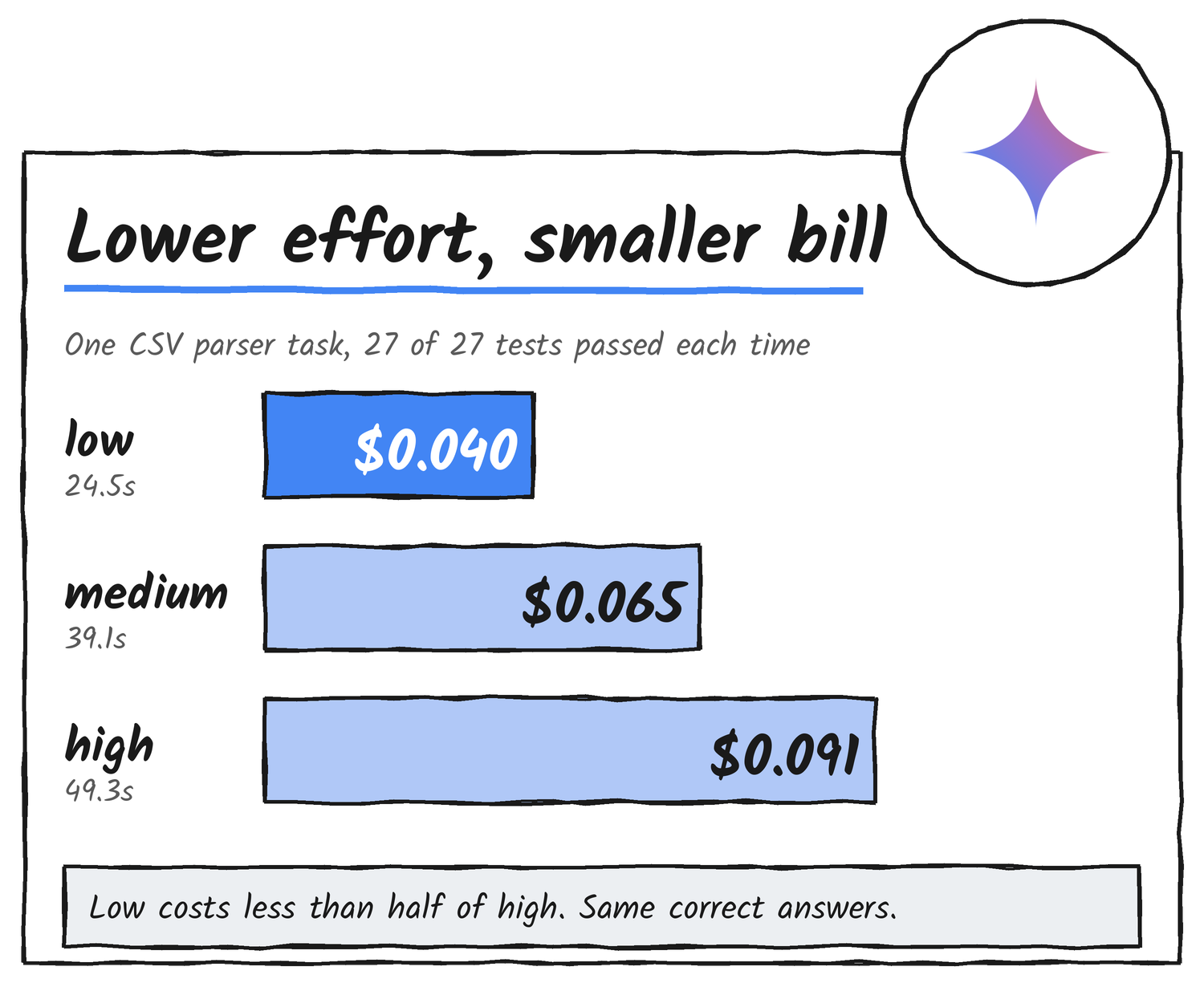
Developer Flavio Copes ran Neon through OpenRouter and checked every coding answer against tests he’d written first. In his write-up, Neon got every test right and wrote well. On a CSV parser task it passed all 27 checks in 49.3 seconds for $0.091 at high effort, where Carbon took 308.5 seconds and $0.198. Neon spent 5,495 tokens thinking before it wrote about 70 lines of code, which he says is why short tasks cost more than he expected.
At low effort, Neon passed the same tests in 24.5 seconds for $0.040, less than half the cost of high. His advice is to start at low for small, well-specified functions and keep high for agents, where the extra thinking has more to work on.
Long inputs are where he found the saving. He put 23 of his posts, about 100,000 tokens, into one prompt and asked which ones mention OpenRouter. Neon found both in 13.9 seconds for $0.33. Claude Opus 5.5 found the same two for $0.57.
SMF ran Neon through its 157-test Cold Iron suite with no effort level named. It scored 66.9% and took 66 minutes, the slowest of the nine models it tested. Neon scored 28 of 30 on reasoning and 29 of 30 on instruction following, and the post puts it bluntly: “The ceiling is fine.” The default settings, it says, cap how much of that shows, so SMF advises naming the effort yourself. Both write-ups point the same way.
Google’s own showcase
Google’s launch post has its own demos, all built in Antigravity. Neon wrote a first-person WebGL2 ski simulator on real Mont Blanc and Chamonix terrain, with 10,200 lines of custom shaders and 120 Hz ski physics and no pre-made assets. Using /swarm, it pulled archival photos to recreate Alan Turing’s 1936 study at King’s College, Cambridge in interactive 3D. A Neon agent swarm turned one image into a 100,000-cell Google Sheet that relights the scene with more than 500,000 live formulas and no Apps Script. Google DeepMind’s Koray Kavukcuoglu added one more: given a raw Smithsonian 3D scan of a woolly mammoth, Neon split it into bones, rigged a full skeleton and generated a museum walkthrough.
Where to use it
Google doesn’t offer Neon on a free tier. GitHub made it generally available in Copilot on 18 November for Pro+, Max, Business and Enterprise users, billed at Google’s list price. It’s on OpenRouter as google/gemini-4-neon.
Carbon’s introductory price of $2 per million input tokens and $10 per million output tokens ends on 30 November. From 1 December Carbon costs $4 and $20, which makes Neon about 25% cheaper per token.
Terms in this piece
- Antigravity: Google’s coding environment, where agents plan, write and test code.
- Three.js: a JavaScript library for drawing 3D scenes in the browser.
- Effort: the setting that picks the thinking level. Lower effort is quicker and cheaper.
- Thinking level: how long the model reasons before it answers. More thinking costs more tokens and time.
- Token: a chunk of text, roughly three-quarters of a word.
Disclosure: I’m an OpenAI, Firecrawl and Devin ambassador.
Discover more from Sulat AI & Tech News
Subscribe to get the latest posts sent to your email.