Signal is restricting screenshots of its app on iOS 27 and switching on its Screen security setting on Android whenever an AI assistant tries to read the screen. The aim is to stop the AI agents built into phone operating systems from capturing chats. Signal president Meredith Whittaker laid it out in a 20 November blog post, which also calls the fix incomplete.
In order to protect your privacy in Signal from the latest agentic AI assistants on mobile operating systems, we are rolling out a new default to restrict screenshots in the Signal app.
— Signal (@signalapp) November 20, 2026
You can re-enable screenshots in your settings.https://t.co/KHQF3bgaam
What changes on each system
On iOS 27, Signal is preventing screenshots inside the app, and its post shows a new Block Siri AI setting in Signal’s own settings. The target is Apple’s Siri AI and its onscreen awareness feature, which Apple’s 14 September announcement says lets Siri AI answer questions and take actions based on what’s on a user’s screen.
Android works differently. On many vendors’ versions of the system, Signal can’t reliably tell when someone attempts a screenshot if screenshots are already disabled, and it didn’t want screenshots to simply stop working and confuse people. So it watches for an AI assistant trying to access the screen and turns on Screen security in Signal Android automatically. Signal names Google’s Gemini Intelligence as one of the agentic features behind the change. Reuters reports that, depending on the device, users get a pop-up with an option to disable the block when Signal detects a screenshot attempt or an assistant reaching for the screen.
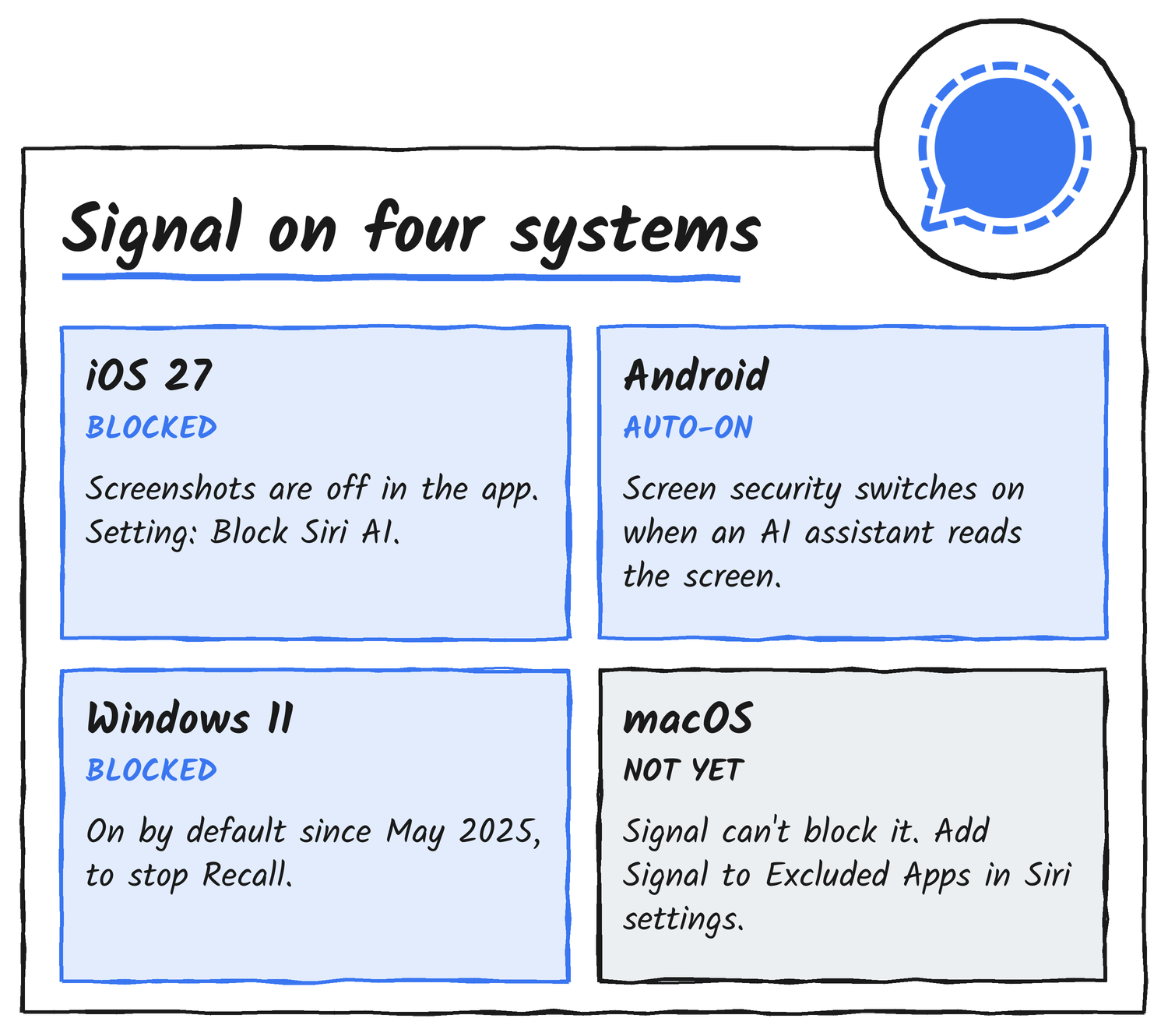
Windows 11 has had the same protection since May 2025, when Signal blocked screenshots by default to keep Microsoft’s Recall feature from capturing chats. On macOS, Signal says it can’t reliably block screenshots because Apple doesn’t document an API that does the job. The only advice it has for macOS 27 users is to add Signal to the Excluded Apps section under Siri in System Settings.
Why Signal is doing it
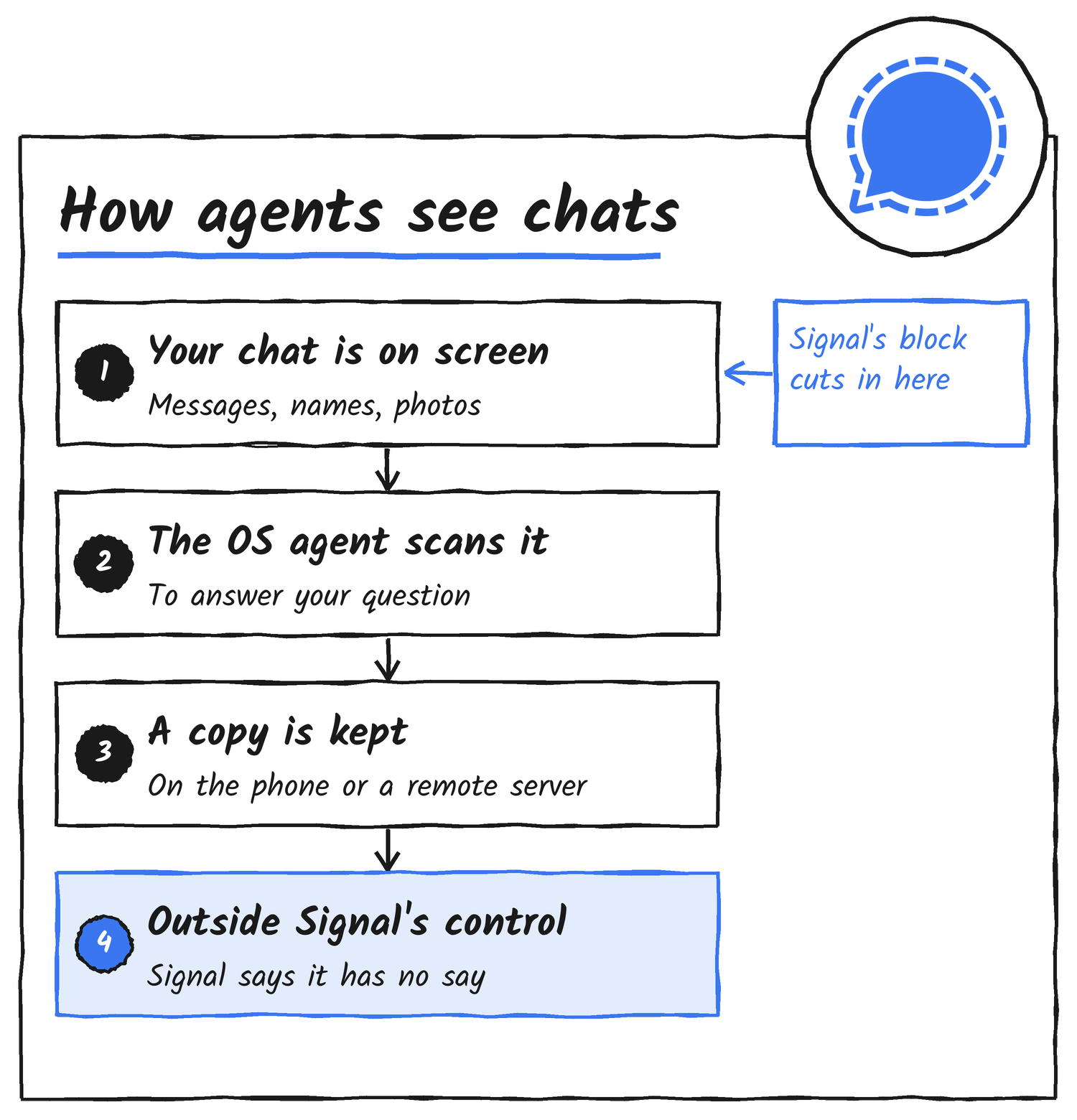
Signal says these agents work by scanning what’s on your screen. That captures Signal data and passes it to the agent so it can answer your questions and act for you. From there, Signal says, the data can end up in whatever local database or remote server the agent uses, out of Signal’s hands, and it affects everyone in a conversation, not only the person who asked the agent. The post calls the trend an existential threat and says it undercuts Signal’s ability to guarantee privacy on its own, even though its open source code and encryption protocol haven’t changed.
What the block doesn’t cover
Signal calls its own remedy incomplete. Blocking screenshots doesn’t stop an agent reading content that’s already on the device through the filesystem. The Android protection depends on Signal spotting an AI assistant, so it won’t catch every Android device, and macOS has no protection yet.
Anyone who wants screenshots back can switch the protection off in Signal’s settings. Signal warns that doing so can expose your content and your contacts’ content to these agents and break its privacy guarantees.
Third-party agents are a separate problem. Signal wants tools to stop agents such as Meta’s Muse reaching app data through the deep permissions people are encouraged to grant during setup, and says many of them lean on accessibility settings that were meant to help people use their apps, not to act as a skeleton key. Reuters reported earlier this week that Muse bypassed Meta’s own Connector tool to read Signal message text on an Apple computer and on an Android phone, using permissions granted at setup. Meta told Reuters that agents need to see and interact with people’s computers to work on their behalf, and that Muse reaches other apps only through permissions users explicitly grant.
What Signal wants from Apple, Google and Microsoft
Signal says developers lack robust tools to stop AI agents undermining app-level privacy, and that Google, Apple and Microsoft don’t offer an easy way to restrict AI data access without drastic compromises to an app’s core experience. Because the documentation is thin, it says it spent months on forensic work across Android and iOS to learn what these systems actually do with app data. Its two requests:
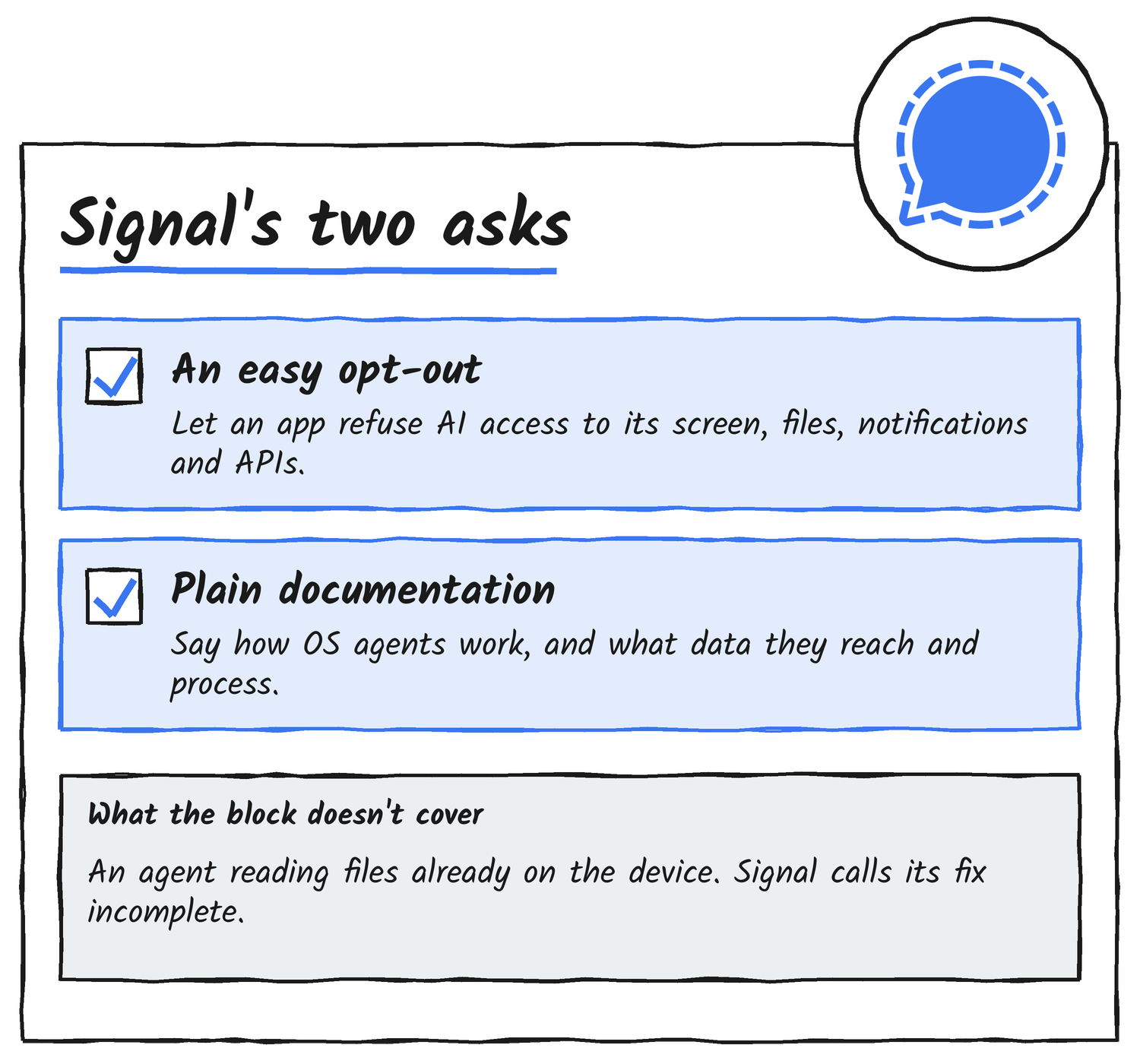
- An easy opt-out. A well-documented way for a developer to opt an app out of AI data access and processing, including screen reading, filesystem access, notifications, APIs and other system frameworks, without breaking the app.
- Plain documentation. Better technical specifications for how the agents work, especially what data they access and process. Signal says confidential computing isn’t a complete answer, because it still leaves the power to set the privacy guarantees with the provider.
Signal says it’s cautiously optimistic that Google and Apple are engaging and hopes to share more soon. Apple has already moved part of the way. The Electronic Frontier Foundation reported on 28 October that iOS 27.2 added an Excluded Apps setting under Siri, and that excluding Signal stops Siri AI reading anything in the app. The EFF also says Signal doesn’t appear in the Android Gemini app access list because it doesn’t support that feature at all.
Signal’s post doesn’t list app versions or a rollout date for the change.
Discover more from Sulat AI & Tech News
Subscribe to get the latest posts sent to your email.