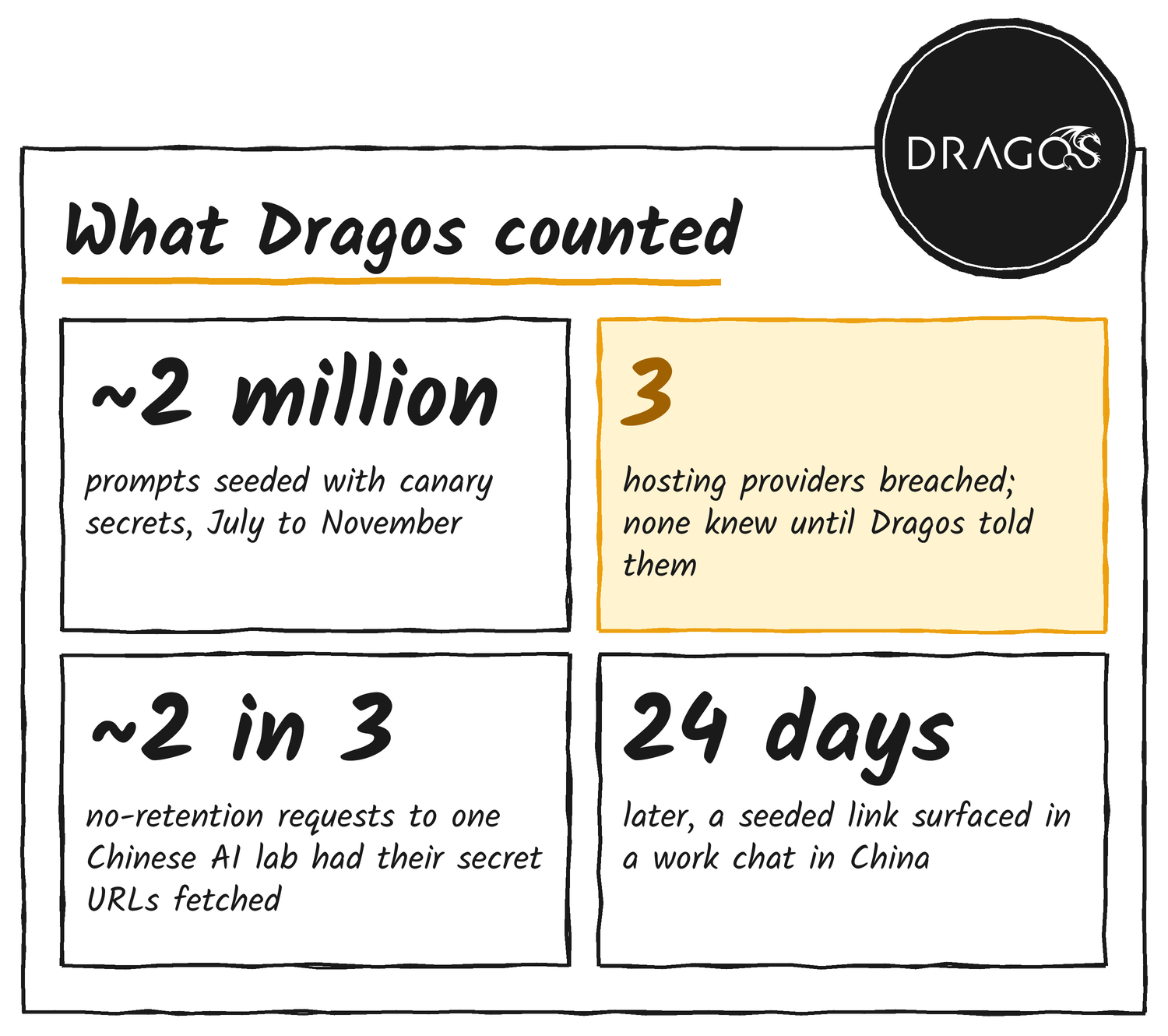
Dragos says it sent about two million AI prompts seeded with canary secrets to widely used AI services between July and November, and found evidence that at least three providers had been breached. HD Moore, the firm’s chief research officer, published the results on 19 November, and Dragos says none of the three providers knew about their breach until it told them.
We seeded 2m canaries into popular AI services and tracked where they were stolen and abused.
— HD Moore (@hdmoore) November 19, 2026
This identified:
– Three compromised providers
– Resellers stealing prompts via built-in logging
– Providers ignoring ZDR & privacy flags
Anthony Ronning, the CTO of Maple AI, quoted Moore’s post on X and wrote that Zero Data Retention (ZDR, the setting that tells a provider not to store a prompt) is a lie, and that people should use inference built on trusted execution environments (TEEs, hardware-sealed areas of a server that its operator can’t look into). Maple sells that kind of service. Dragos’s report doesn’t mention TEEs.
ZDR is a lie, inference providers are reselling and getting hacked left and right.
— Anthony Ronning (@anthonyronning) November 20, 2026
Use TEE based inference with providers you can verify the code and supply chain on.
What Dragos did
Dragos built a service that gives every prompt its own hostnames, URLs and credentials, then watches for anyone using them. Moore says the work began in July with Thinkst Canarytokens. The AWS keys in the prompts are real keys tied to empty accounts with full logging, so any attempt to use one shows up. Dragos also traced about 2,000 routes through AI routers, which forward a request to one of several model hosts, by sending slightly broken requests and reading the nested error messages. Several hundred routes included a system it couldn’t identify, and a handful sent its test image to a company that wasn’t on the advertised path.
Three providers were breached
Dragos says attackers were stealing data from three hosting providers, and the earliest incident dates to mid-July. The largest involved a couple of hundred of its AWS keys, each sent in exactly one request, all inside a few short windows in late October. Every request Dragos sent during those windows was stolen, including some the provider rejected before a model ran. Dragos says that points to copying at the provider’s front door rather than deeper in the inference stack.
In the other two breaches, some of the stolen requests were marked ZDR. The attackers tested the bait keys, sometimes within hours, then used them to list S3 buckets, search Secrets Manager and Parameter Store, and try to switch on Bedrock models and add their own users. Dragos counts tens of thousands of AWS API calls. It says one attacker appears to have compromised two of the providers at once, and that on 1 November the attacker added ARTEX, an LLM-driven penetration-testing framework, which made only a handful of calls.
The first provider thought the activity was a misconfiguration of internal tooling, then a partner data problem, until the investigation showed an attacker had compromised its internal credentials tool. Dragos says that provider still hasn’t disclosed the incident publicly, and stolen data led to attempted logins as of late October. Dragos hasn’t named any of the three.
Where the ZDR setting didn’t hold
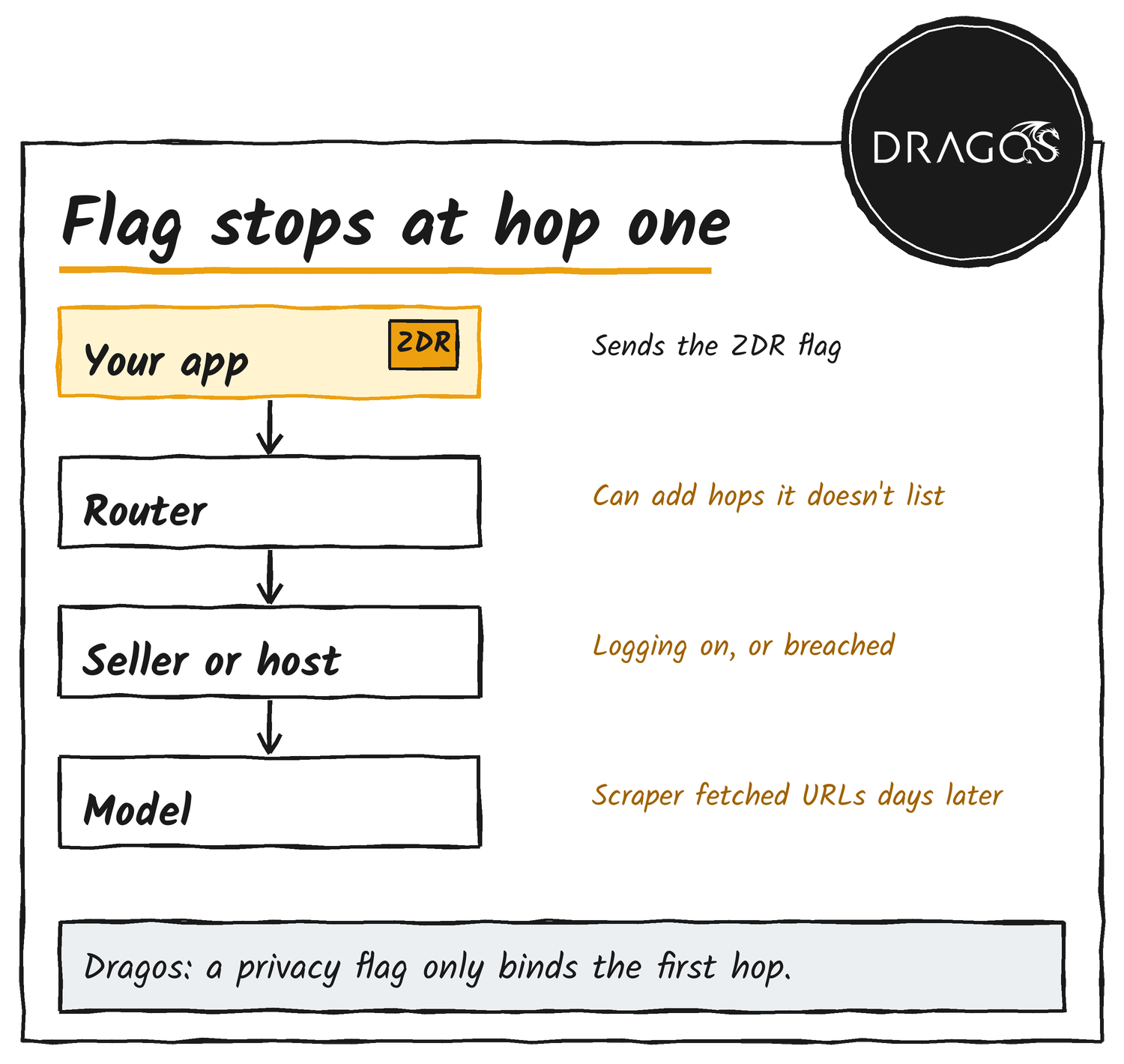
Dragos says a privacy setting only binds the first company that receives the request. Sellers on an inference marketplace, where the lowest price wins the traffic, only had to turn on request logging to read customer prompts, according to Dragos. About a day and a half after two prompts went through one seller’s offer, someone on a home connection opened both secret URLs and started guessing usernames at the login page. A Mac on a home line in France typed root SSH passwords taken from two prompts by hand. Prompts for the same model sent through a different seller were never touched, so Dragos says the leak follows the seller, not the marketplace.
The clearest ZDR failure involved a Chinese AI lab that Dragos doesn’t name. Its systems fetched the secret URLs from more than half the prompts sent to its models between July and October, including about two-thirds of the requests marked no data collection or ZDR, usually two or three days later. US hosting providers that resell the lab’s models triggered the same scraper. Twenty-four days after Dragos sent a prompt to a Chinese provider, the secret link from it was posted in a Feishu chat and opened within two minutes from three desktops and three phones in Beijing and Shanghai. Dragos says whoever shared it was reading a stored copy of the full prompt.
Two large US providers, also unnamed, showed their own habits. One kept crawling a secret URL more than two months after a single call to its search endpoint, and another runs a scraper that comes back days after each request, whichever router carried it.
How much of Ronning’s post the evidence covers
| Ronning’s claim | What the sources show |
|---|---|
| ZDR is a lie | Dragos describes ZDR-marked requests stolen in two breaches and fetched by one Chinese lab. It publishes no failure rate and names no provider. |
| Providers are reselling and getting hacked left and right | Dragos found three breached hosts and resellers logging prompts on one marketplace. Phala (10 November) and NEAR AI (9 November) have published separate breach reports, and Fireworks AI disclosed two incidents in October. Dragos hasn’t linked any of those to its three. |
| Use TEE based inference with providers you can verify | Dragos doesn’t mention TEEs. It recommends self-hosting, one first-tier provider, careful router use, your own canaries and secret filtering. |
Phala’s report is the closest match to what Dragos describes. Phala says a third-party researcher put unique canary credentials in requests to it from 1 July to 7 November, and only the ones sent on 21 and 22 October were later misused. Dragos says one of the providers hit in the late-October batch has published a preliminary notice. Neither names the other, so the match rests on dates and method.
Phala says an attacker chained a legacy internet-facing service with management interfaces that trusted local callers without authenticating them, then took control of an inference VM on a new GPU server that was serving production traffic “without our full production security hardening.” That made in-flight requests visible. Phala tells users whose DeepSeek V4 Flash 0731 requests OpenRouter routed to it between 21 October and 8 November to treat them as exposed. Phala runs confidential virtual machines, the environment TEE inference relies on, and its report doesn’t say whether the compromised inference VM ran inside a TEE.
Fireworks AI, a separate case, disclosed two incidents, one in early October and one on 23 October, according to BleepingComputer.
What the TEE record looks like this month
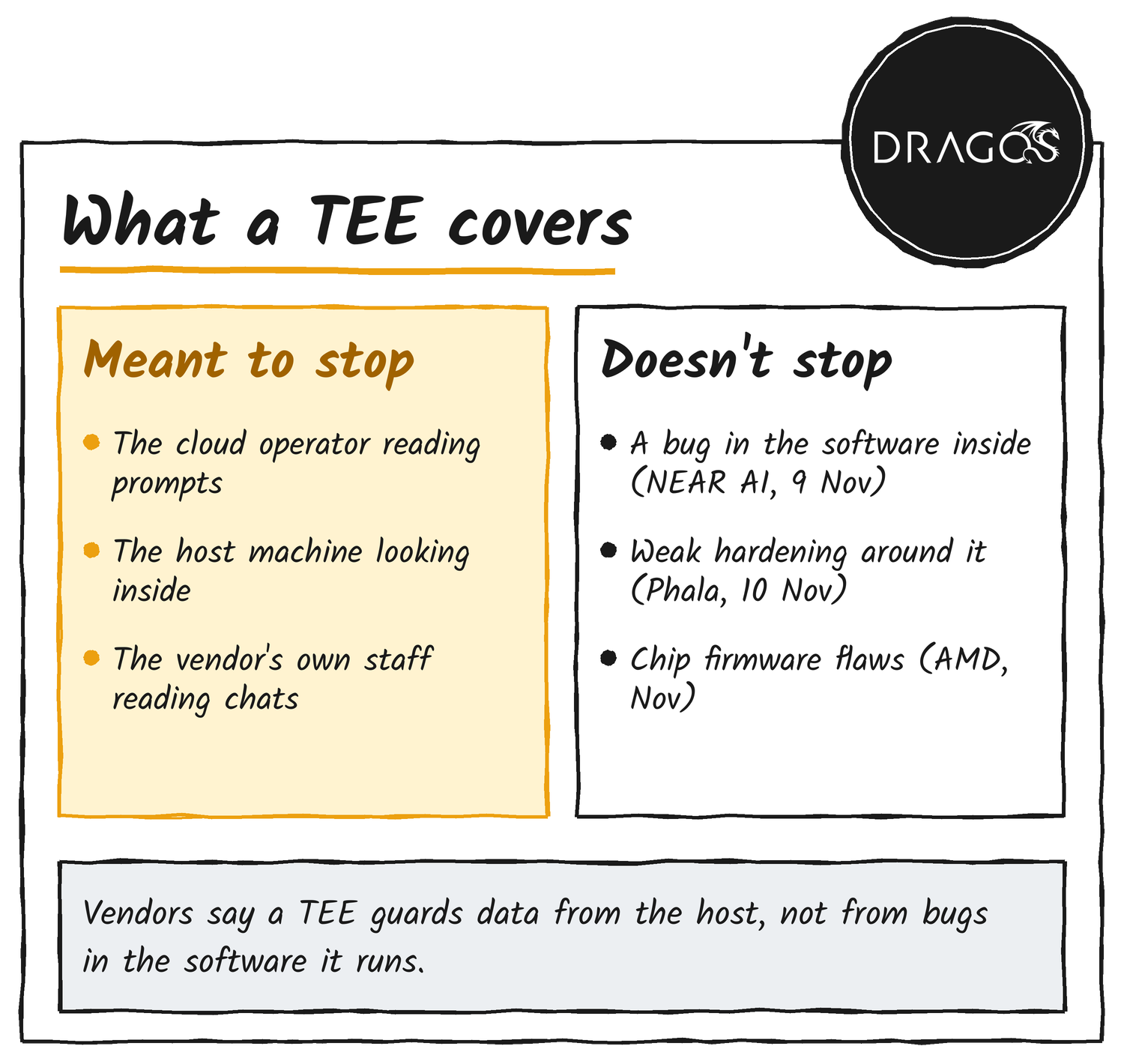
NEAR AI runs its cloud inference in TEEs. In its 9 November incident report, the company says an attacker used a remote code execution flaw in SGLang, the open-source inference engine on its servers, to run code on one inference server and reach internal systems. It says the attacker could have seen requests processed on that server on 8 November, including confidential-mode requests, and took account details for about 100 users and data from 18 agents on a legacy deployment that wasn’t in its TEE. NEAR AI wrote that confidential computing “does not protect against a vulnerability in the software running inside the environment.” It hasn’t named a CVE or an SGLang version. It also says the code, dependencies and deployment configurations for its confidential inference stack are public, so anyone can verify what’s running.
AMD’s bulletins describe two flaws in SEV-SNP, its confidential-VM feature: CVE-2026-0462, known as Mior and scored 5.9, and CVE-2026-40671, known as Skyfall and scored 4.9. AMD says Mior needs a malicious hypervisor, the layer that hosts the VM, and Skyfall a privileged attacker. It lists firmware fixes dated 12 August and says platform updates reach customers through server makers, with Mior’s targeted for December.
What Maple says it does
Ronning is Maple’s co-founder and CTO. Maple’s proof page says prompts are encrypted on the user’s device and decrypted only inside an AWS Nitro Enclave running open-source code, and that the app checks a signed fingerprint of the enclave before it sends anything. It lists four things the proof rests on: Amazon’s Nitro hardware, the published code, Maple’s signing key and the model’s own enclave. The page also says a matching fingerprint shows Maple approved that software, not that it was built from the public source, and that the browser version of the check is served by Maple on each page load.
Maple publishes its client and server code, which fits the condition in Ronning’s post about providers whose code you can verify. NEAR AI publishes its stack too, and that didn’t stop the SGLang breach. Dragos doesn’t say whether it tested Maple.
What Dragos recommends
Dragos says none of this means stopping use of AI services, and that where prompts go is a decision the lowest price will otherwise make for you. Its five steps:
- Host it yourself, if you can afford it. It’s the only option where nobody else reads your prompts. Dragos prices the hardware from US$6,950 for an NVIDIA DGX Spark to US$570,000 or more for an eight-GPU server.
- Go directly to a first-tier provider. That gives one contract and one privacy policy, and it can still leak through data-sharing agreements or a breach.
- Use routers with care. Pick the upstream providers yourself, check that privacy settings change where requests go, and stay away from reseller marketplaces.
- Seed your own canaries. Put a fake credential in the context your agents already send and treat any use of it as an incident. A free Thinkst Canarytoken is enough to start.
- Turn on secret filtering where a provider offers it. Dragos says it can’t hurt but isn’t a cure, because plenty of sensitive prompt data isn’t shaped like an API key.
Phala has said it will publish a full root cause analysis. Dragos says it’s working with about a dozen providers and expects the list to grow, and that stolen keys and secret URLs are still being accessed months after the first incidents.
Discover more from Sulat AI & Tech News
Subscribe to get the latest posts sent to your email.