1Password Developers (@1PasswordDev) posted a 10-post thread on X at 9:29 am UTC on 17 November, which was 10:29 pm that night in New Zealand. The thread reads Google’s Q4 2026 AI Threat Tracker as a warning about credentials and patch speed. Its closing post says “the common thread is speed. Long-lived credentials and slow patch cycles are what it punishes most.”
The tracker comes from Google Threat Intelligence Group (GTIG) and went out on 16 November; an earlier article covers it in full. 1Password sells credential-management software, and the thread doesn’t name one of its products. Here’s how the thread compares with the report, and with the two Google guides its advice comes from.
Google believes it has found the first cyberattack run end to end by AI.
— 1Password Developers (@1PasswordDev) November 17, 2026
A framework compared software before and after each patch, worked out the bug, wrote the exploit, and launched it. No human in the loop.
Here’s what it means for anyone in Tech 🧵(1/9)
What the report says about exploit_agent
GTIG says it found exploit_agent, a multi-agent framework, on an exposed staging server. The report says it was set up to compare code before and after patch announcements, work out the flaw, draft an exploit and run it without human involvement. GTIG calls it the first time it has seen LLM frameworks fully automate vulnerability discovery and exploitation with no human in the loop. An LLM, or large language model, is the kind of AI behind chatbots.
The server also held scripts for what comes after a break-in: internal reconnaissance, brute-forcing, and installing and removing webshells. A webshell is a small program planted on a web server that gives an attacker remote control.
Where the thread goes past the report
Most of the thread tracks the report closely. The zero-day figures, the US$100,000 day, the US$1 million worst case and the line that these tools trade stealth for speed all match Google’s text. Four points go further than the report does.
| The thread says | The report says |
|---|---|
| Google found “the first cyberattack run end to end by AI” | GTIG’s first is narrower: LLM frameworks fully automating vulnerability discovery and exploitation with no human in the loop. The post-compromise scripts are listed as further items found on the same server. |
| Five sub-agents, from patch diffing to data theft | The report calls exploit_agent multi-agent and doesn’t number five sub-agents. ARTEX, CAIRN, CyberStrikeAI and PentAGI are separate open-source frameworks. GTIG saw CAIRN and PentAGI deployed in the wild and CyberStrikeAI and HexStrike AI in experimentation. |
| “The speed shows up in the numbers”: 8, 11 and 22 zero-days a month | exploit_agent works on patched flaws, known as n-days. The 8, 11 and 22 figures count zero-days, which are exploited before a patch exists. The report gives 11 for 2026 overall, doesn’t link the August figure to the framework, and says disclosures and exploits nearly doubled between January and August. |
| “The methods have not changed,” in Google’s words | The phrase isn’t in the report or in Google’s summary post. The closest line says “the mechanics of the intrusions remain the same”. |
The thread’s advice doesn’t depend on those four points. It comes from Google’s guides, covered below.
Why credentials run through the report
The report says compromised credentials “have long served as the fundamental bedrock for initial access, privilege escalation, and lateral movement”. It adds that attackers now harvest session tokens and platform credentials from victim endpoints and continuous integration environments, then use them to run their own LLM tooling.
In the LLMJacking cases Mandiant handled this year, the chain starts with a credential. One attacker harvested exposed corporate LLM API keys from public GitHub repositories and tested them with single-token requests. Another used CVE-2026-40217, a sandbox escape in LiteLLM, to turn limited-access “Virtual Keys” into full administrator credentials. Others created unauthorised identity and access management (IAM) and service accounts, subscribed victim accounts to pay-as-you-go plans, and used a “burn and rotate” method of creating and deleting short-lived service accounts to get past rate limits.
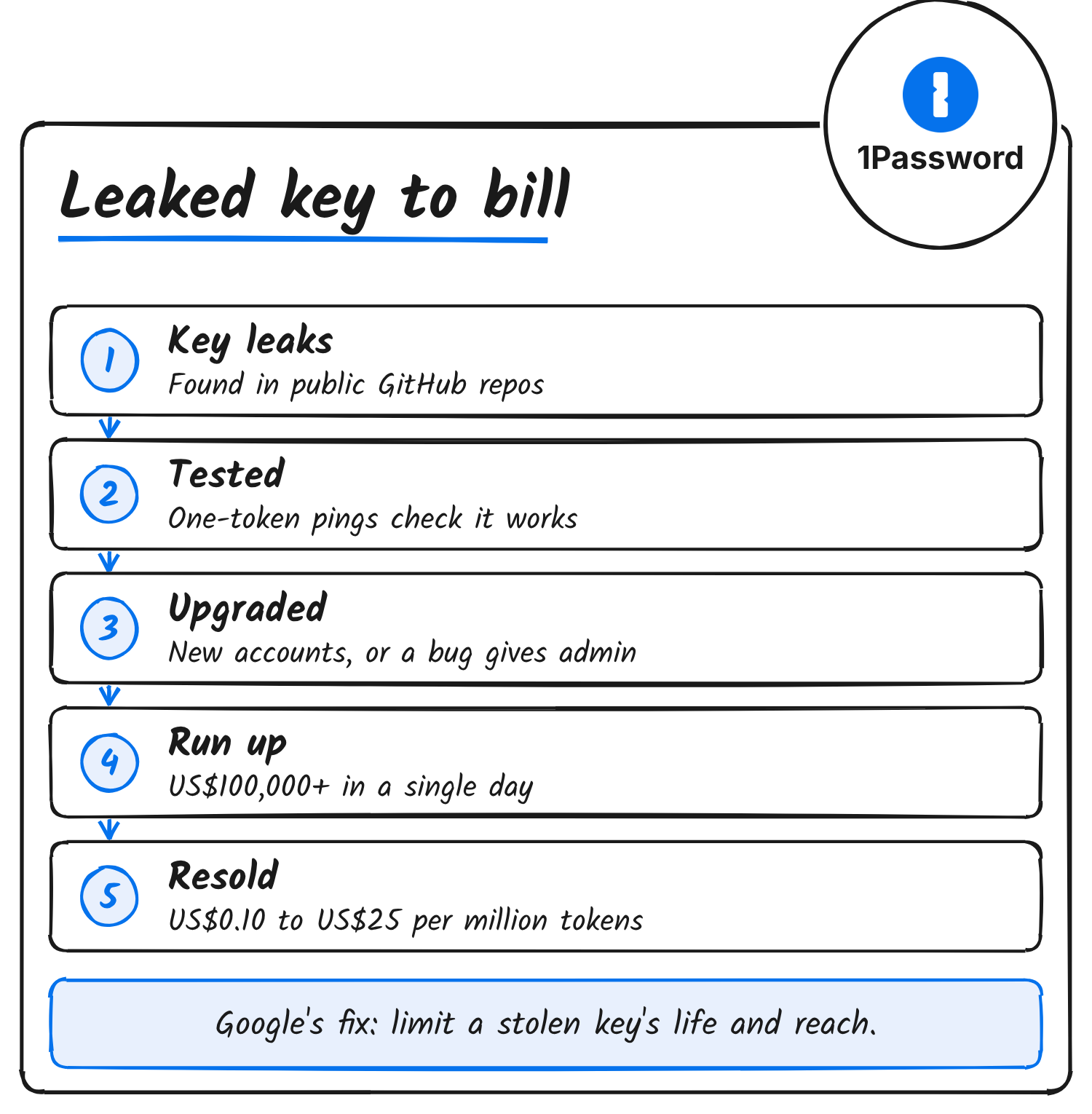
In one investigation, two attackers used the same legitimate credentials, which Google describes as potentially sold or leaked on underground forums. A botnet or proxy service sent millions of LLM API calls within about a day. Its noisy traffic got the credentials revoked before the other attacker ran any queries. The staging server’s environment file holds LLM API keys too, and its comments, which Google translated from Russian, tell the operator to enter the keys by hand for the exploit_agent pilot.
Short lifetimes are only part of Google’s advice. In one LLMJacking case, an attacker used token-creation privileges on a compromised workload’s service account to generate temporary credentials for high-privilege service accounts. It then pulled infrastructure credentials, database passwords and third-party API keys out of cloud secret managers. Google’s guide pairs short lifetimes with narrow permissions, limits on where an identity can authenticate from, and isolated secret stores.
Where the thread’s advice comes from
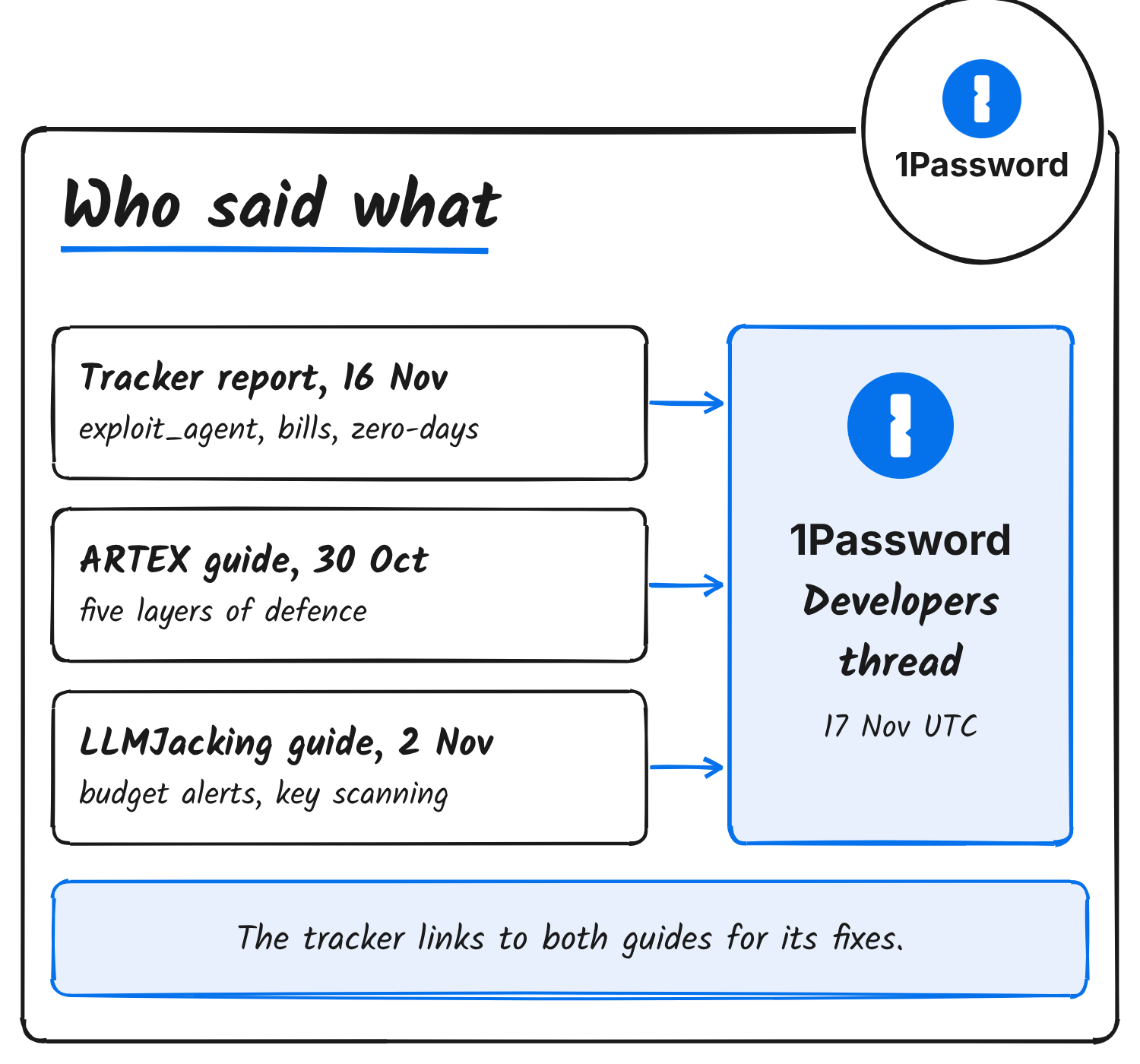
The tracker doesn’t list fixes. It points to Mandiant’s hardening guide for ARTEX-style frameworks, published on 30 October, and to its LLMJacking guide, published on 2 November. The thread’s five items come from those two guides.
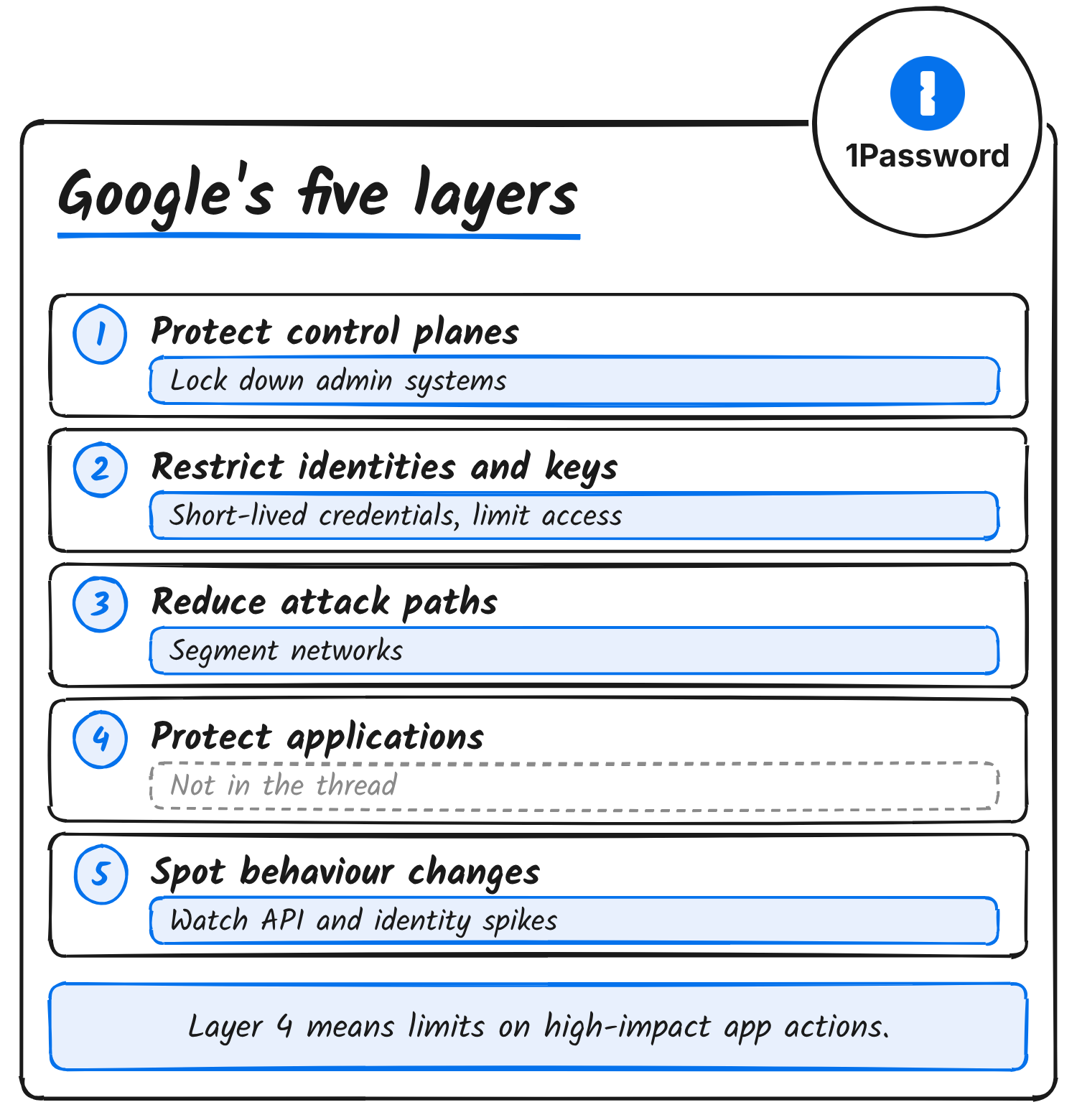
The ARTEX guide sets out five layers of defence: protect control planes, restrict identities and keys, harden configurations and reduce attack paths, add application protections, and detect behavioural and volumetric change. The thread’s items sit in layers 1, 2, 3 and 5. Layer 4 is missing. It covers guardrails on high-impact application functions, such as retrieving credentials, sending email or creating users, with rate limits, recipient limits and transaction thresholds.
The thread’s last two suggestions are budget alerts and scanning code for leaked keys. Budget alerts come from the LLMJacking guide, and both guides cover secret scanning. The LLMJacking guide also lists phishing-resistant multi-factor authentication, API-key scopes split by model, environment and usage limit, and monitoring for one-token requests, which attackers use to test stolen keys. The thread doesn’t mention those three.
One item in the ARTEX guide bears on vault vendors. Its instruction reads: “Place enterprise password vaults and secret management systems behind tightly controlled administrative and network paths.” It also says to alert on bulk secret queries, enumeration or export. The guide lists the vault as a system to protect.
How it lines up with 1Password’s own guide
1Password’s developer guide of 12 November lists five credential checks: find exposed credentials, remove hardcoded secrets, remove unnecessary access, restrict agent and tool access, and test credential replacement. Three overlap with Google’s guides. Scanning repositories and their history for secrets matches Google’s call for continuous secret scanning. Cutting permissions and setting spending limits matches least privilege and budget alerts. Replacing and revoking credentials matches Google’s push away from long-lived secrets.
That guide says Developer Watchtower doesn’t cover repository history, so teams need a separate secret-scanning tool. It also says permissions and spending limits on retrieved API keys are set with the issuing providers. Google’s LLMJacking guide puts API quotas, spending caps and key scopes in the same kind of place, on the model and cloud services themselves.
On agents, 1Password’s guide says hiding a password from an agent doesn’t limit what the agent does after it signs in, which is why it tells readers to review the account’s permissions. The product behind that step is 1Password for Agents. Google’s least-privilege layer covers the same gap.
GTIG says it expects attackers to keep adopting these frameworks and to move closer to fully agentic intrusions.
Sources
- 1Password Developers thread, X
- GTIG AI Threat Tracker: Agentic Threat Activity Crosses a Significant Threshold, Google Cloud
- ARTEX and Friends: Enter Agentic Offensive Frameworks, Google Cloud
- The Rise of LLMJacking, Google Cloud
- The era of autonomous attacks has arrived, Google
Discover more from Sulat AI & Tech News
Subscribe to get the latest posts sent to your email.