Box CEO Aaron Levie said in a post on X that token spend per employee “still has no ceiling in sight”, pointing to Ramp data that puts the top 1% of US businesses at US$10,199 per employee a month on AI in October. Tokens are the chunks of text, often a word or part of one, that AI companies meter and charge for.
The post quotes The Kobeissi Letter’s summary of the November edition of the Ramp AI Index, which Ramp lead economist Ara Kharazian published on 11 November. Ramp builds the index from payments by more than 85,000 US businesses that use its corporate cards and bill pay.
The chart of token spend per employee still has no ceiling in sight. And the closer you are to AI right now the deeper the sense is that we’re actually still in the early part of the curve of token use and adoption. This summer and fall’s model releases have continued to push the state of the art forward at a rate that already felt hard to maintain.
Aaron Levie (@levie) November 17, 2026
As a result, for most productive use-cases the models are only now starting to actually work, and the feeling is that things will only accelerate from here. Coding, in retrospect, was basically trash even 12 months ago. Now it’s finally starting to get good. And now that coding is actually working, you’re getting tool and computer use, which open up a wide variety of knowledge work domains that weren’t possible to throw agents at before.
Once you have agents that can code, use computers, leverage any tool out there, and understand a variety of domains, you can begin to throw them at a wide variety of knowledge work tasks that were hard to bring automation to across finance, life sciences, cyber, and more. So that brings agents to a broad set of work that we’re not really using them in yet at scale. Then comes the new form factors of agents.
Agent swarms and background agents are going to eat up vastly more tokens than anything we can imagine. You’ll have agents running in most enterprises workflows processing data, validating work, doing research, providing decision support, and so on. And we’ll have swarms that fan out in parallel in areas like cyber, life sciences, coding, and more. So basically tokens are only going up from here.
What Levie argues
Levie says the models “are only now starting to actually work” for most productive uses, and that “Coding, in retrospect, was basically trash even 12 months ago.” Now that coding works, he says, tool use and computer use let companies point agents at knowledge work in finance, life sciences and cyber security.
His forecast rests on two new forms of agent. “Agent swarms and background agents are going to eat up vastly more tokens than anything we can imagine,” he writes, and he sums it up as “tokens are only going up from here.”
What Ramp’s October numbers show
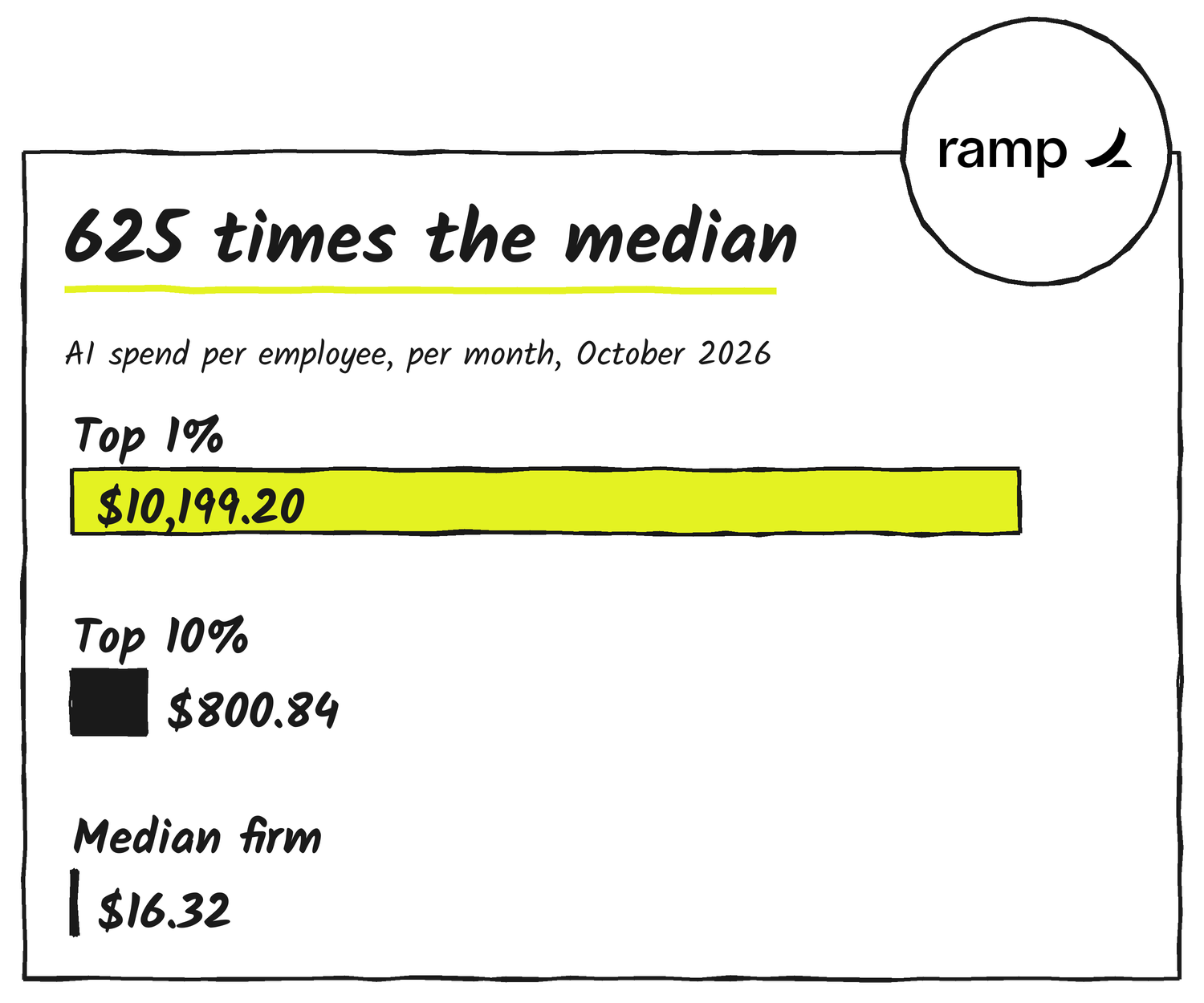
Ramp’s figures cover firms that pay for AI. The top 1% of those firms spent a median US$10,199.20 per employee in October, up US$852.70 on September. The top 10% spent US$800.84, and the median firm spent US$16.32, up 93 US cents. The top 1% is spending about 625 times what the median firm does. The Kobeissi Letter says the top 1% figure has more than tripled since January 2026.
| Group of firms paying for AI | October 2026, per employee a month | Change on September |
|---|---|---|
| Top 1% | US$10,199.20 | +US$852.70 |
| Top 10% | US$800.84 | +US$7.59 |
| Median firm | US$16.32 | +US$0.93 |
Across all businesses, Ramp says AI spending reached a new peak in October, up 1.65% on September. Adoption rose 1.0 percentage point to 56.8% of businesses on Ramp, and AI took 5.43% of business spending outside payroll, down from 5.68% in September.
Who pays the bill
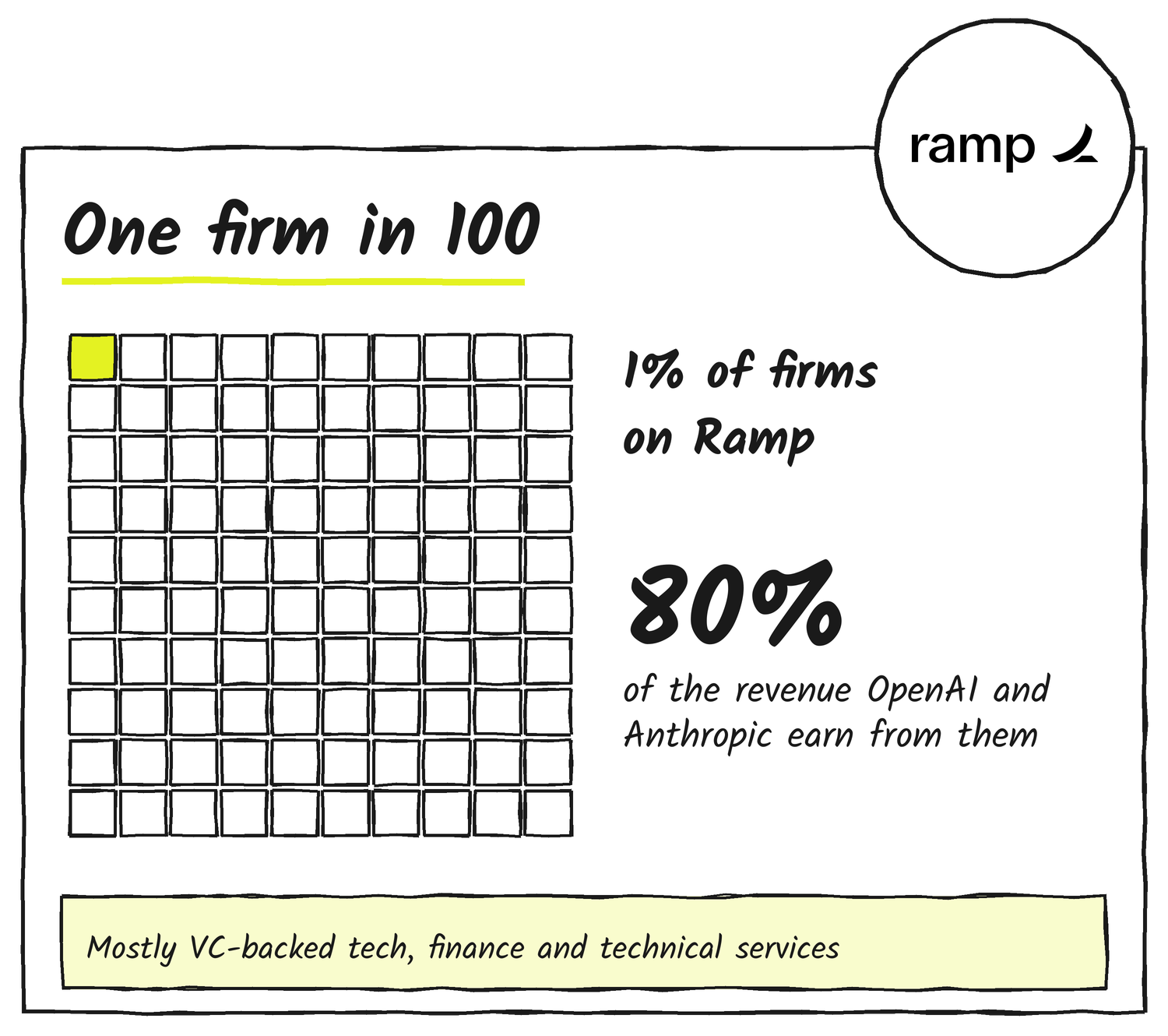
Kharazian writes that “1% of businesses drive 80% of the revenues to OpenAI and Anthropic,” and that this group is largely venture-backed companies in tech, finance and technical services. He calls growth in the median and top 10% groups “relatively sluggish.” In Ramp’s October update, the top 1% figure had slipped from a July high of US$9,873 before it set a new high in October. Ramp says the top 1% estimate swings more than the others because the group is small.
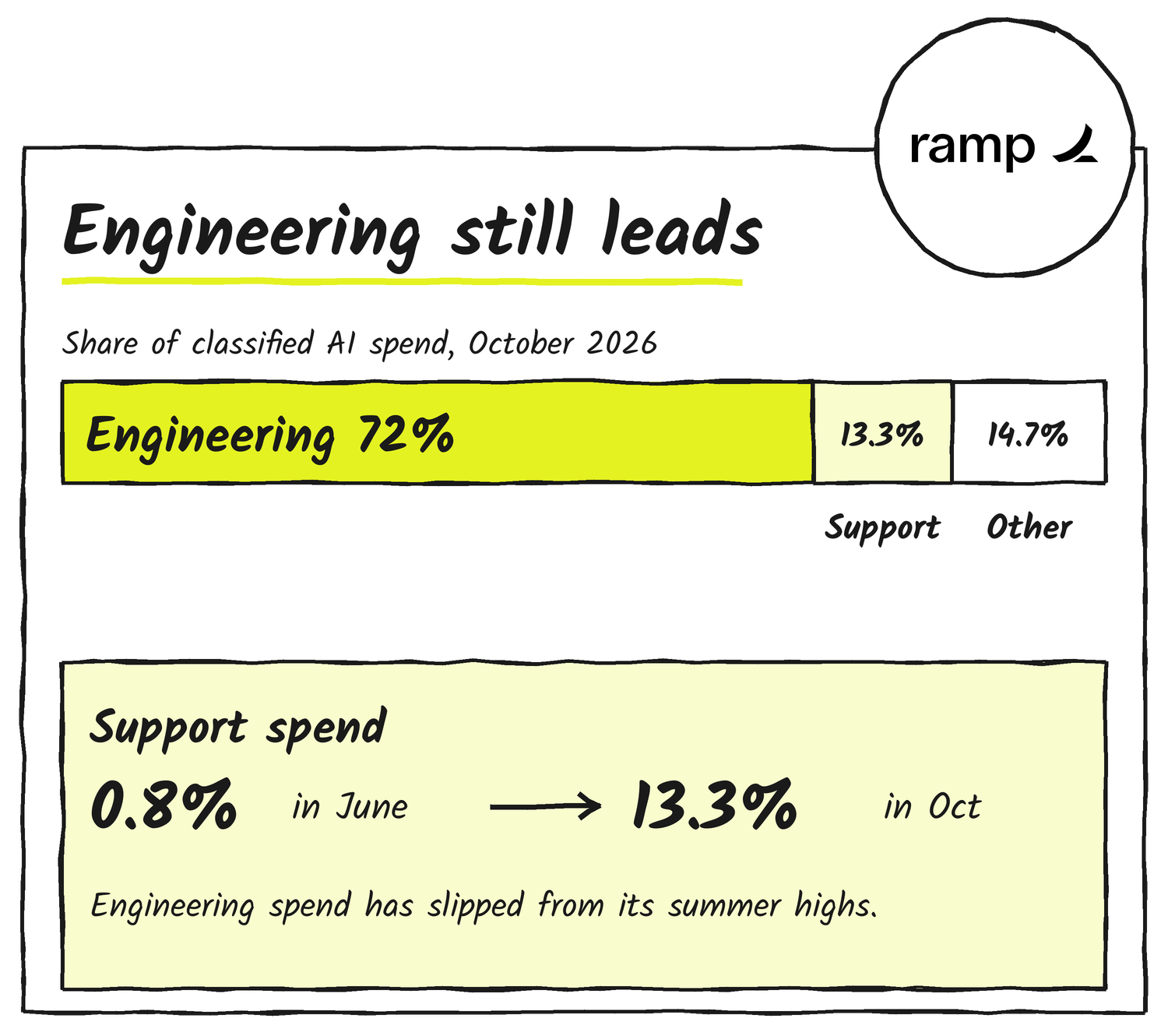
Ramp’s new department view shows engineering teams drove 72% of classified AI spend in October, below the highs Ramp saw earlier in the summer. Customer success and support operations drove 13.3%, up from 0.8% in June. Kharazian says customer service work is a good candidate for cheaper, faster models rather than the top-priced ones, and that frontier models (Opus, Fable, Sol and Astra) took 69.5% of spend in October, up from 67.7%.
Prices and volume
Kharazian says the average price per million tokens fell 21% over the month, and that token volume keeps growing faster than token spend. Token spend grew 2.1% at OpenAI and 0.5% at Anthropic in October. Levie’s post doesn’t cover price per token, the 80% concentration or the median firm.
What the index covers
Ramp’s sample is businesses that pay through its platform, and spend per employee counts only firms paying for AI. Free AI tools and personal accounts leave no payment to count, Ramp says, so its adoption and spend figures can miss them. Its token volume and price figures come from businesses using its AI Spend Management product and aren’t representative of all Ramp AI spend, Ramp says.
Ramp says department-level data will soon be available for weekly tracking on the Ramp AI Index dashboard.
Discover more from Sulat AI & Tech News
Subscribe to get the latest posts sent to your email.