WorkOS opened early access to Atlas on 16 November US time. The platform hosts the internal apps that staff build with coding agents such as Claude Code, Cursor and Codex, and wraps each one in company sign-in, data connections and admin controls. Ryan Fitzgerald wrote the announcement for the first day of WorkOS’s launch week, and founder Michael Grinich pushed it on X that day.
Grinich posted twice that day. The first calls Atlas “a game-changer” for anyone using AI to build internal tools. The second argues that vibe coding becomes “a security nightmare” once you’re running hosting, logins and API keys yourself, and says Atlas takes that part over.
If you are using AI to build internal tools, then Atlas is a game-changer.
— Michael Grinich (@grinich) November 16, 2026
Get it today: workos.com/atlas
Vibe coding is fun until you’re in charge of hosting, logins, and a pile of API keys. Then it becomes a security nightmare.
— Michael Grinich (@grinich) November 16, 2026
WorkOS Atlas handles that part. It hosts your AI-built apps, connects company data, and lets coworkers SSO with their work account.
Build it. Send the link. Get back to your job.
The first post tells readers to get Atlas “today”. The page it links to leads with a Request early access button, and the announcement says “We’re onboarding teams one by one and setting up Atlas alongside each of them.” The changelog agrees: teams come on individually.
Two products now carry the Atlas name
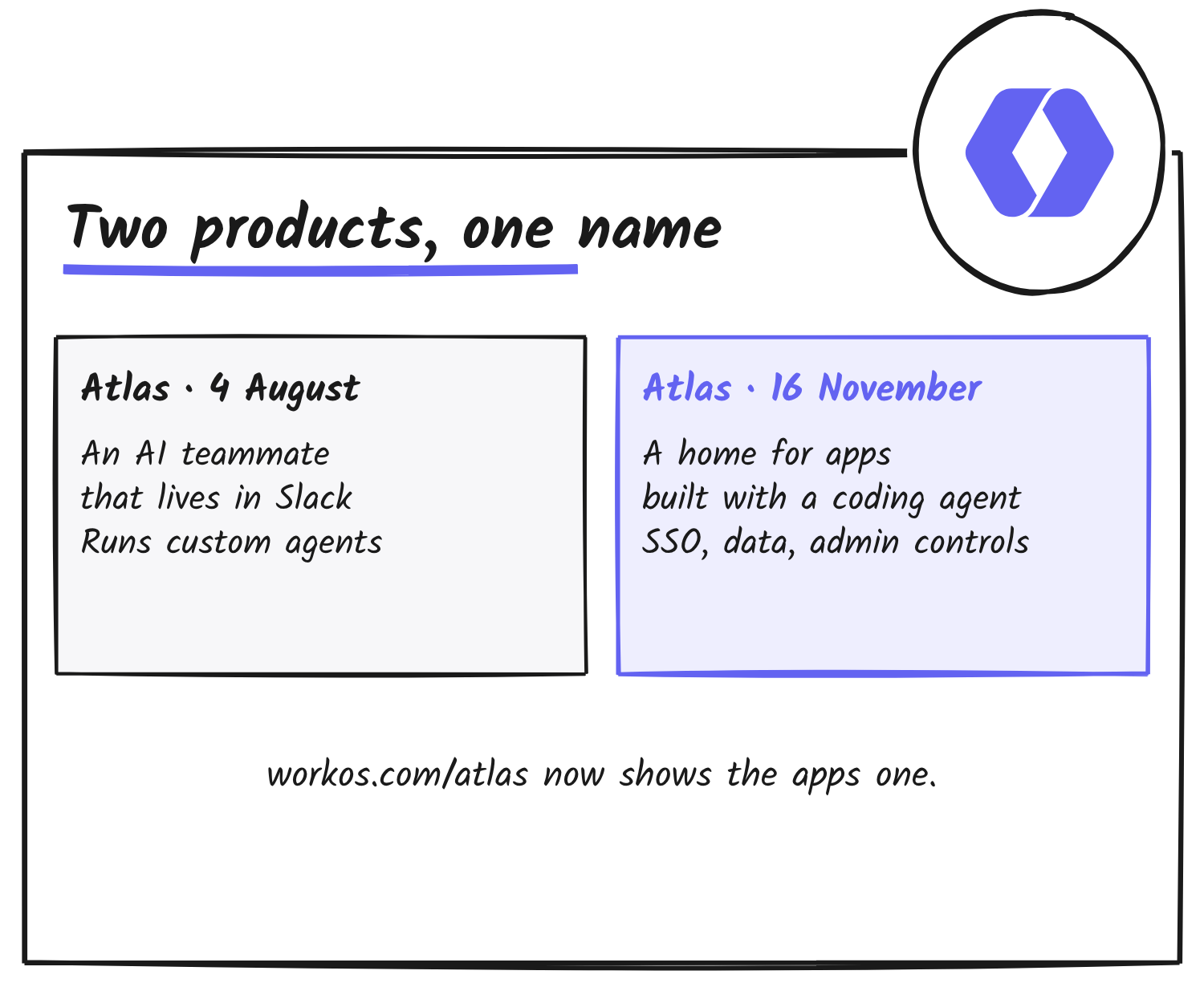
WorkOS already sells something else called Atlas. It launched on 4 August as an AI teammate that lives in Slack: you mention it in a channel, it answers, and you can create custom agents with their own names, instructions and scoped tools. Grinich said at launch that anyone could sign up, and atlas.workos.com/install still hands off to Slack’s authorisation screen. The address workos.com/atlas is what moved. It now describes the apps platform, and the Slack announcement stays at workos.com/blog/atlas.
Inside WorkOS, the apps platform is older than the launch. WorkOS’s Garrett Galow described it in a talk at AI Engineer World’s Fair as the infrastructure under the internal apps staff already build and share.
What Atlas does
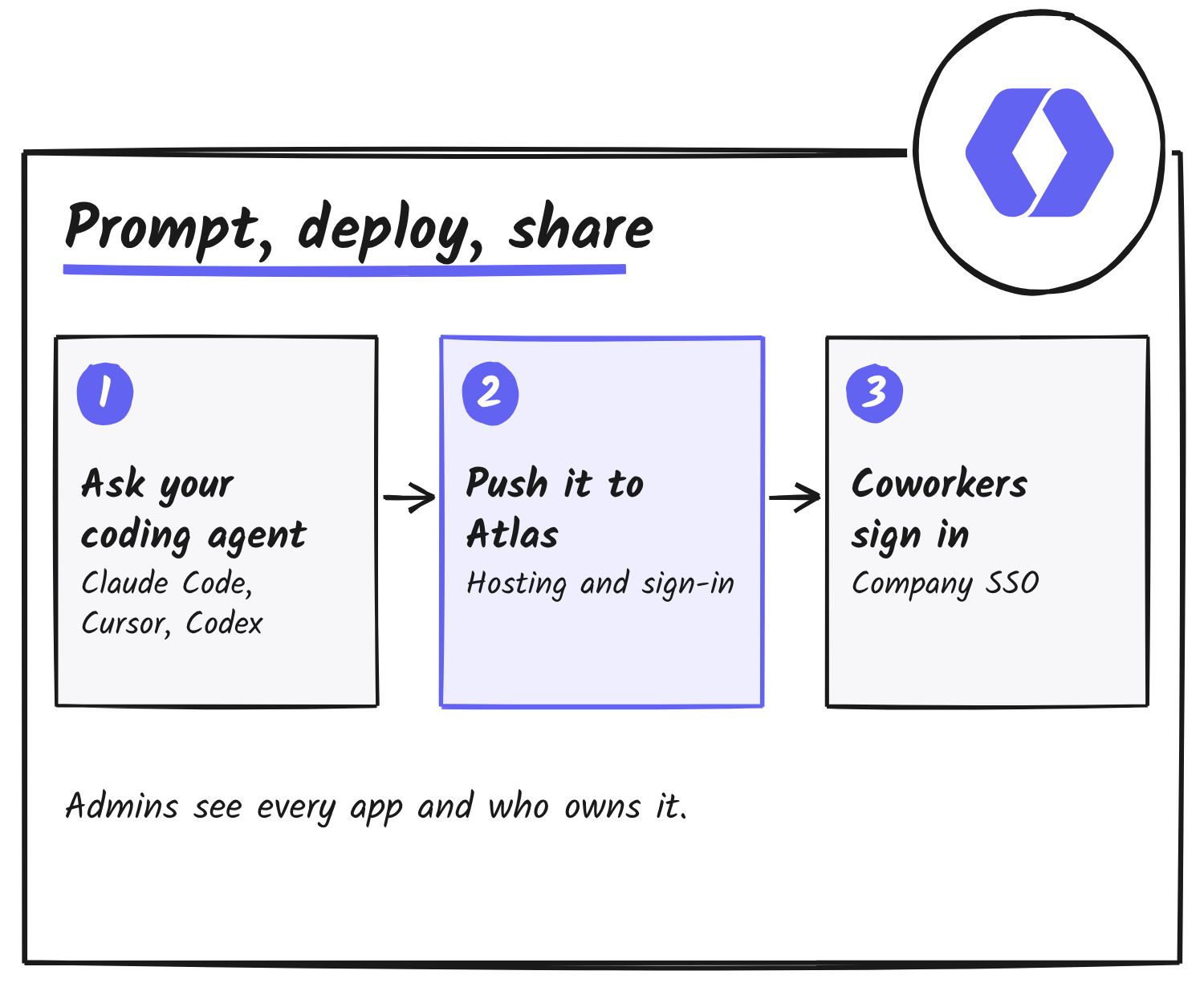
The workflow has three steps. Connect your coding agent to Atlas once, describe the app, and ask the agent to deploy it. WorkOS’s example prompt asks for a weekly status board for executives: project progress from Linear, Friday updates from Slack and figures from Snowflake, grouped by department and refreshed on a schedule. The result gets its own address, and coworkers open it with their company account.
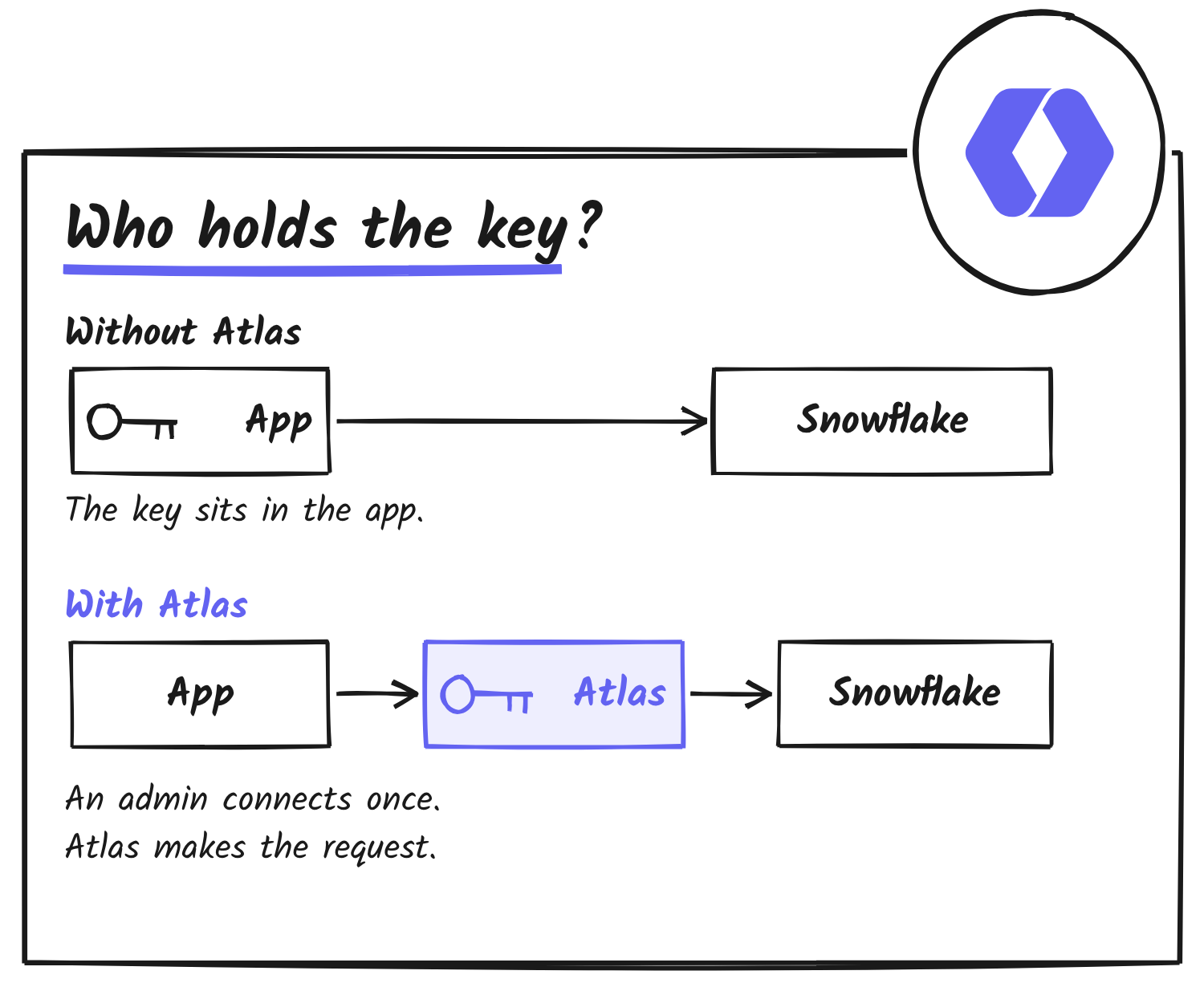
Credentials get the most space in the announcement. An admin switches on the tools the company uses, such as GitHub, Google Workspace, Slack and Snowflake. Builders say which tools an app needs, and Atlas makes each request for the app, so connection credentials never sit in its code. An app that acts as a person, say to read their pull requests or calendar, needs that person to connect their own account and approve that app. If a builder wants a tool nobody has switched on, they ask and an admin decides.
Admins get a list of every running app and its owner. They can limit an app to named people, groups or roles from the company’s identity provider, the system that holds staff accounts, and an activity log records who changed what. Apps can also expose tools over MCP, the protocol agents use to call tools, which means an app’s main user can be an agent.
What WorkOS has shown working
Most of the access controls were demonstrated at WorkOS’s init() conference on 7 October, according to WorkOS’s own recap. The demo’s first app went live on Atlas with Snowflake data, a database for its notes and a shared sign-in. Then an admin restricted a second app to the sales group, a list Atlas pulls from the identity provider. Jacobia Johnson, the WorkOS engineer playing a new hire, refreshed the page and lost access, and the activity tab logged the denial. Cutting the Salesforce connection blocked that app until she repeated the OAuth flow, the standard permission handshake.
The recap says WorkOS staff ran the demos on a fictional company, and that Airlock, Atlas and Passport were all previews at that point.
| Claim | Where WorkOS makes it | Shown at init()? |
|---|---|---|
| SSO and MFA on every new app | Announcement | Yes. Signing out of Atlas also signed the presenter out of the sample app, because the apps share one authentication instance. |
| Restrict apps by group or role | Announcement | Yes. A sales-group restriction locked out the presenter. |
| Credentials kept out of app code | Announcement | An app was blocked when its Salesforce connection was cut. The recap doesn’t cover where the keys are stored. |
| Activity log | Announcement | Yes. The activity tab recorded the denial. |
| Isolated runtimes, allow-listed egress, hashed API keys, cross-site defences, agent guardrails | Product page, by name only | No. |
What WorkOS has built on it
Every example in the announcement is a WorkOS app. Engineer Colin Barber built a live world map that lights up each time someone signs in with WorkOS. Staff use an org chart app; Blurple Pages, which answers “who owns this?” with the team, Slack channel and on-call rotation; Time Off Hub, which pulls everyone’s time off from Rippling into one calendar; and a shared dashboard for publishing and downloading agent skills. The flagship, Flashboards, tracks onboarding funnels, activation, growth and adoption, and one team used it to compare onboarding outcomes for users shown a new wizard. At init(), Grinich said staff already use Atlas for candidate management, a month-end financial dashboard and the office’s lunch orders.
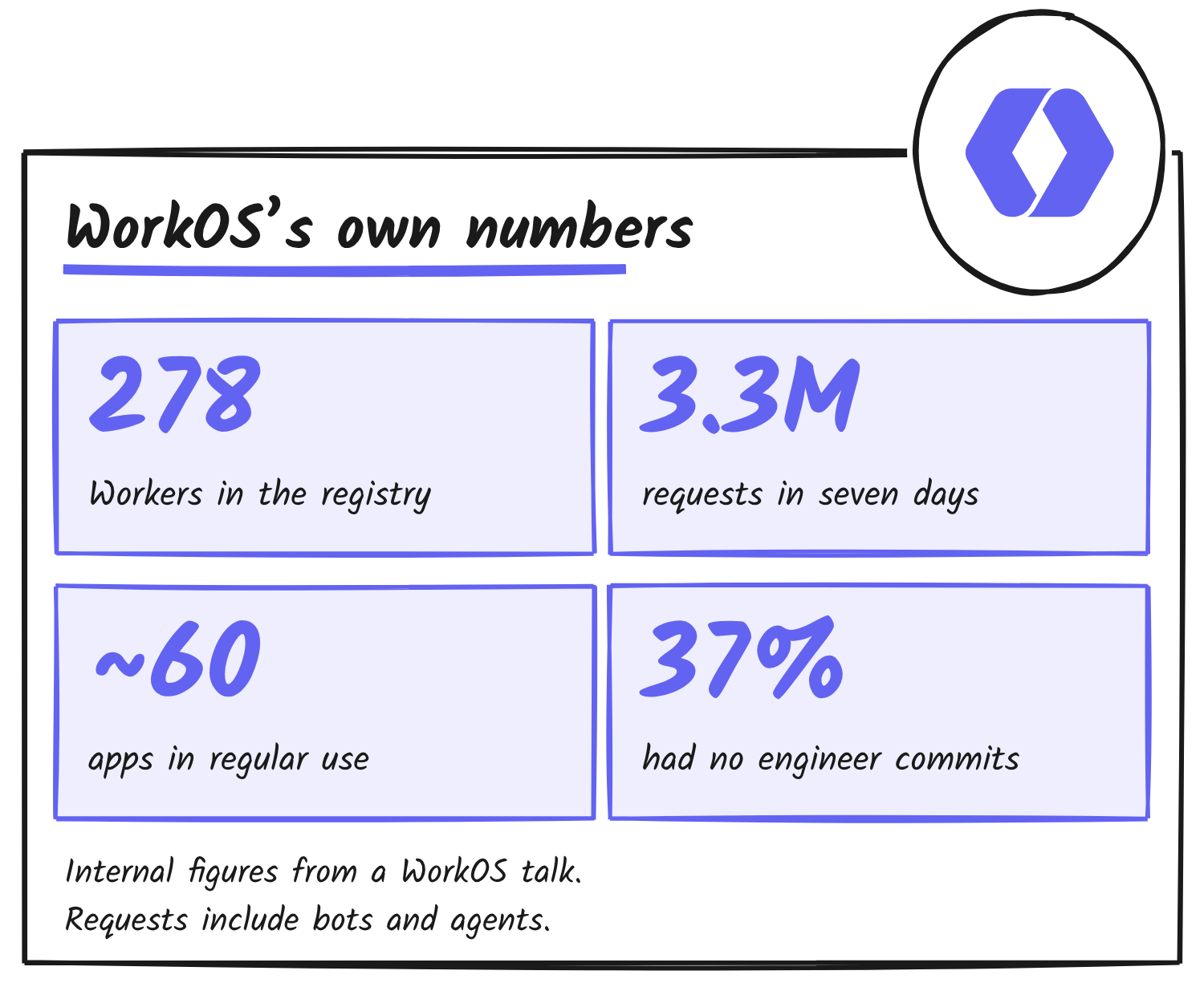
Galow gave the scale in his talk, as ai.engineer’s write-up reports it. WorkOS’s internal registry of Cloudflare Workers, the units of code that run on Cloudflare’s network, listed 278 Workers, 21 deployed that day, 3.3 million requests over seven days and 60 custom domains. Galow narrowed the regularly used population to about 60 apps, and 37% of those had no engineer in any commit. The request count includes people, machines and agents, because some apps are APIs and Slack bots, so it isn’t a count of human visits.
Galow also told the story behind the platform. An account executive built a sales chatbot in Lovable before going on leave, so colleagues could keep using what she knew. When WorkOS’s CEO tried to open it, he got “You don’t have access.”, because he had no Lovable account.
The talk and the launch differ in a few places. Galow said group and role permissions were a planned addition, and that secrets sat in Doppler, a third-party secrets manager. The October demo showed group restrictions, and the product page now lists “Secrets in Vault”, which is the name of one of WorkOS’s own products. Galow also described a wow command line tool that sets up a builder’s machine and starts a project. The announcement doesn’t mention it and describes connecting a coding agent to Atlas instead.
What WorkOS hasn’t said
WorkOS hasn’t published pricing or a general availability date for Atlas. The announcement and changelog describe early access only, and the announcement names no customer outside WorkOS. Its screenshots use sample data.
The announcement doesn’t say where Atlas apps run. Galow said in the talk that Atlas used Cloudflare Workers at the time, and that a later move to Vercel or AWS should be invisible to builders.
Atlas is the first of five launches WorkOS has scheduled for 16 to 20 November. The launch page names only Atlas and lists the other four days as coming soon.
Sources
- WorkOS Atlas: A secure home for the internal apps your team builds with AI, WorkOS
- WorkOS Atlas product page, WorkOS
- Atlas: Build and share internal apps with AI, WorkOS changelog
- init() 2026 recap: Airlock, Atlas, Passport and the builders on stage, WorkOS
- Introducing Atlas, your AI coworker, WorkOS
- Let Anyone at Your Company Ship Internal Apps with AI, Garrett Galow, AI Engineer World’s Fair 2026
- Launch Week Fall 2026, WorkOS
- Michael Grinich on X, 16 November 2026
- Michael Grinich on X, 16 November 2026
Discover more from Sulat AI & Tech News
Subscribe to get the latest posts sent to your email.