Google Threat Intelligence Group (GTIG) says attackers have for the first time run a vulnerability pipeline from patch to working exploit with no person in the loop, according to its Q4 2026 AI Threat Tracker, published on 16 November. GTIG found the pipeline, an agent framework named exploit_agent, on an exposed staging server.
Google summed up the report in a blog post, saying attackers now use autonomous LLM frameworks to “continuously scan software updates, figure out what flaw was patched, and build an attack for it”. An LLM, or large language model, is the kind of AI behind chatbots such as Gemini. The report also covers stolen AI accounts, influence operations and a new way of hiding a backdoor in a coding assistant’s settings.
What exploit_agent does
GTIG says the staging server hosted a multi-agent framework for vulnerability research and weaponisation, wired to several frontier and local LLMs. It runs continuous differential analysis of popular web application software: it compares code before and after a patch is announced, works out the flaw, drafts an exploit and runs it without human involvement.
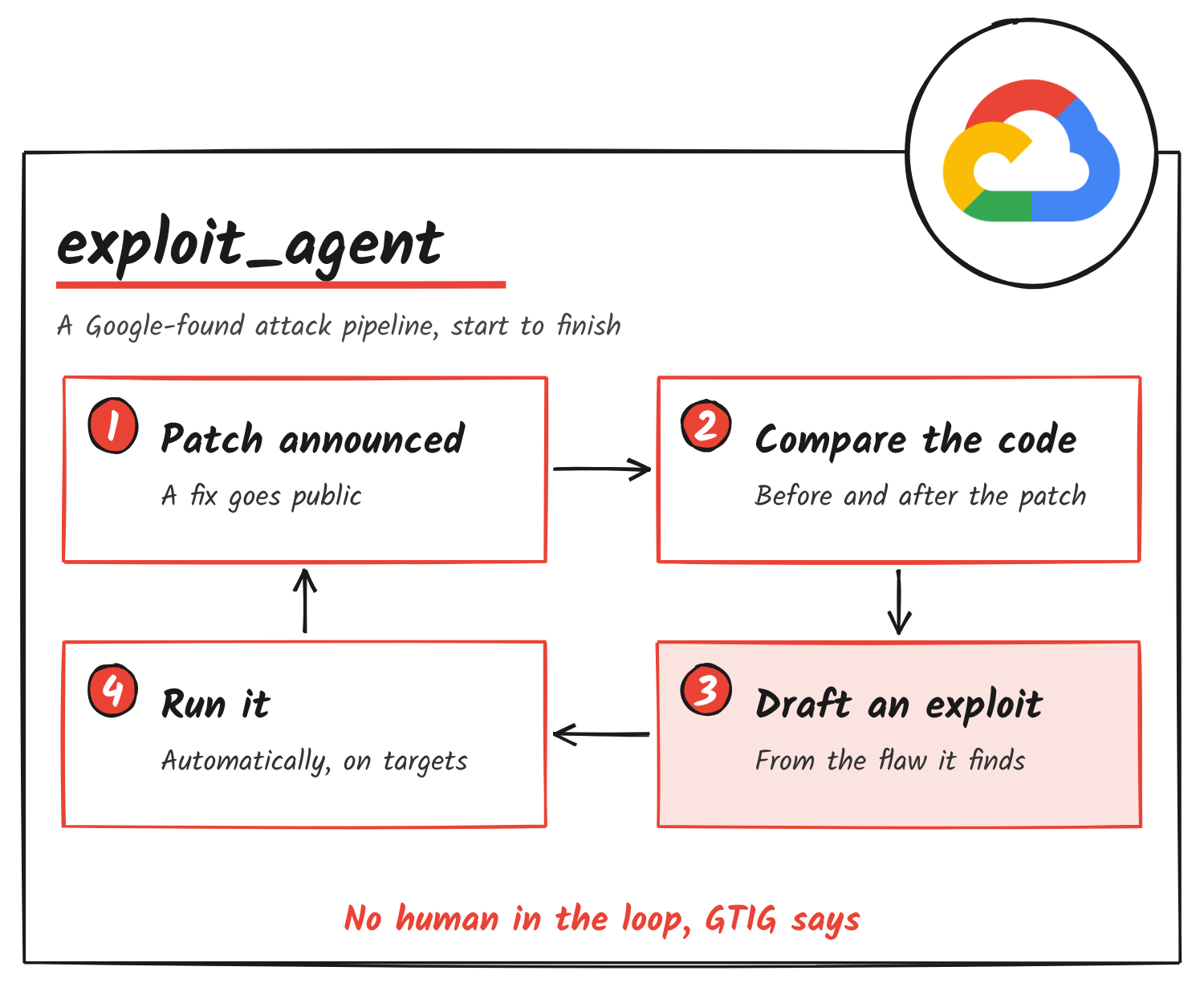
The server also held scripts for later stages of an intrusion: internal reconnaissance, brute-forcing, installing webshells and removing other attackers’ webshells. Victim data on it shows the operator went after French media and entertainment websites and education sites, GTIG says. One of its screenshots shows the framework reading the access-control check in version 2.19.25 of the Spectra (Ultimate Addons for Gutenberg) WordPress plugin, and the environment file that holds the LLM API keys carries comments in Russian.
Patches turn into exploits faster
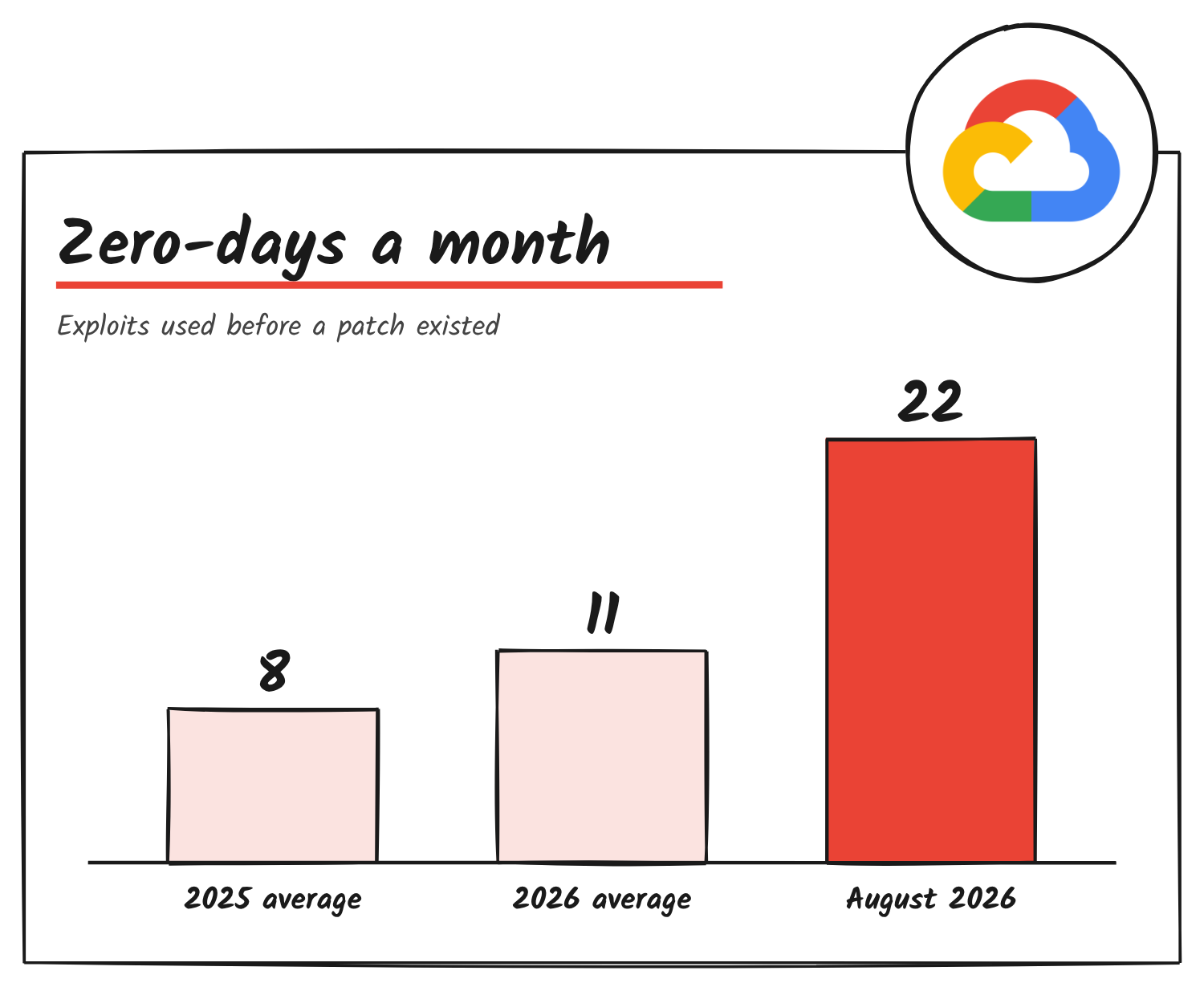
GTIG says LLMs suit n-day work, meaning flaws that already have a patch. An attacker can compare two versions of the same code and read the release notes and proof-of-concept code, while hunting for a zero-day means casting a wider net. In a September analysis, GTIG found that disclosures and exploits nearly doubled between January and August 2026. Zero-day exploitation rose from an average of eight a month in 2025 to 11 a month in 2026, then hit 22 in August.
The report points to two recent cases. In late August, attackers exploited two PaperCut print management flaws as zero-days and chained them for unauthenticated remote code execution: CVE-2026-81578, an authentication bypass, and CVE-2026-82078, an unsafe dynamic class loading bug. Huntress and other researchers used LLMs to produce working exploits within a day of disclosure. GreyNoise reported a campaign four days after disclosure in which the attacker likely used LLMs to build and test exploits, assemble a target list and hit hundreds of organisations, going from a foothold to domain administrator within minutes.
The PHP flaws CVE-2026-109618 and CVE-2026-109619 were found with LLM-assisted analysis. A proof-of-concept video and early patched code were public before the official patches landed on 21 October 2026. In the days after, hundreds of claimed proof-of-concept exploits appeared that didn’t work, likely generated by LLMs, and defenders had to check each one.
Open-source attack frameworks in live intrusions
GTIG says several attackers now use open-source agentic penetration-testing frameworks to automate stages of live intrusions. The frameworks share three abilities: finding and exploiting low-complexity flaws, using an LLM to write single-use payloads on demand, and adjusting tactics from what each attempt returns. GTIG covered ARTEX, the best known of them, in a separate report.
| Framework | What it is | What GTIG saw |
|---|---|---|
| CAIRN | Open-source, multi-agent; specialised agents share a “blackboard” in an observe, orient, decide, act loop | Used in intrusions, including against US aerospace targets |
| PentAGI | Open-source and autonomous, built for entry-level operators | A customised version ran reconnaissance and vulnerability scans against organisations in Asia from late August to early October 2026 |
| CyberStrikeAI | Go-based backend that links commercial and open-weight LLMs to more than 100 security tools | Experimentation |
| HexStrike AI | MCP-integrated harness that gives LLM clients more than 150 offensive tools and over 12 sub-agents | Experimentation |
GTIG also saw a PRC-nexus group building its own automated attack framework, likely for espionage. The frameworks currently trade stealth for velocity, GTIG says: unrestricted autonomous execution produces forensic traffic, recognisable identifiers and code-level traces that defenders can find. GTIG expects less human involvement and more stealth as the underlying models improve. Google SecOps has rulepacks for detecting ARTEX, and Mandiant has published a hardening guide.
Stolen AI access has a price list
LLMJacking means breaking into a victim’s cloud account and running AI workloads on their bill. Mandiant says it responded to several cases in 2026 across financial services, retail, transportation and technology organisations in North America, South America and Asia Pacific. Bills climbed within hours, single-day fraudulent charges passed US$100,000 in some cases, and in the worst cases the abuse reached US$1 million before it was stopped.
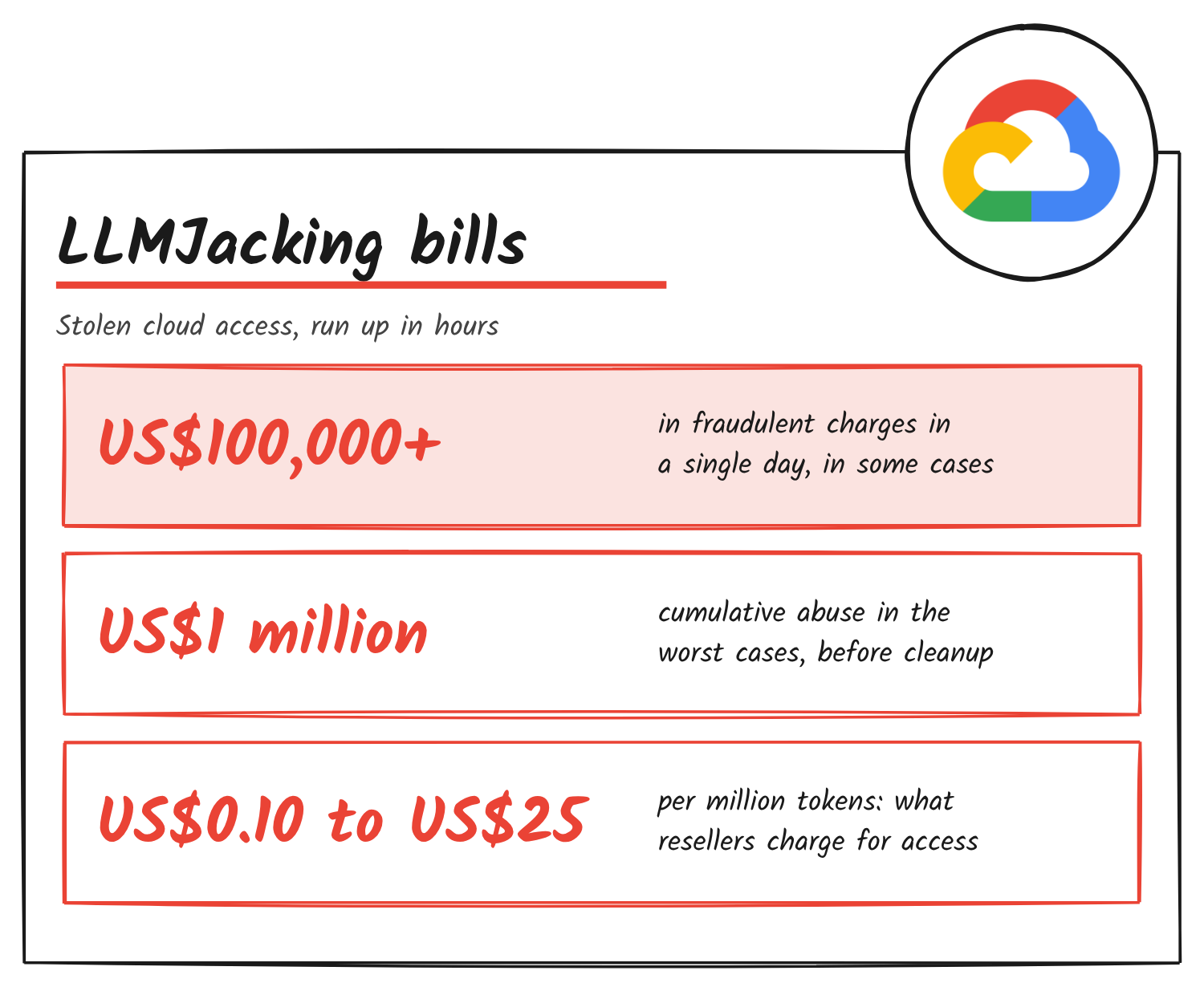
One attacker used CVE-2026-40217, a sandbox escape in LiteLLM that turns limited-access “Virtual Keys” into full administrator credentials. Another used a “burn and rotate” method, creating and deleting short-lived service accounts to get around rate limits. Attackers resell the access through what GTIG calls LLM Mixers, storefronts that route buyers’ traffic through a pool of stolen credentials and compute. Ads on Russian- and Chinese-language marketplaces list prices from US$0.10 to US$25 per million tokens. The vendor APIMart charges five times more once a prompt passes 100,000 tokens, and JetNight sells monthly subscriptions.
A backdoor in a coding assistant’s settings
GTIG ties a series of intrusions at cryptocurrency organisations in North America and Europe to a suspected North Korean cluster it tracks as MIDNIGHT NEPTUNE. The attackers posed as recruiters on professional networking sites, using profile photos that carried SynthID watermarks, which are Google’s markers for AI-generated images. They sent targets to fake meeting pages with “ClickFix” lures, which prompt people to run a supposed fix script. After getting in, the attacker edited .claude/settings.json files in internal code repositories so that starting Claude Code triggered a download of the SOMBERMEME backdoor. It also created GitHub personal access tokens named after Microsoft Copilot.
Elsewhere in the report, GTIG says the PRC contractor LEAKY CASTLE used LLMs to analyse, translate and summarise stolen data, which matches a Wall Street Journal report. It also says PRC-nexus actors now use LLM platforms and their file-hosting backends for staging malware, dead-drop command and control, and exfiltration. A Chinese-language phishing service called Jieyou added an LLM chatbot in a June 2026 update, so affiliates can set up phishing panels by typing instructions.
On influence operations, GTIG assesses with high confidence that state groups, commercial vendors and profit-driven political clickbait networks now build LLMs into their standard work. It describes a contractor using the Gemini API, among other providers, to build a platform designed to run more than 100,000 social media accounts through cloud phone farms and automated account aging. GTIG adds that better content doesn’t necessarily mean greater impact.
What Google is doing about it
Google says the Gemini-related activity in the report triggered Gemini’s safety responses, that it disabled the assets involved, and that Google DeepMind used the findings to strengthen its classifiers and models. Its product answer is Google AI Threat Defense, which combines Gemini and other frontier models, Wiz’s risk prioritisation, CodeMender’s automated patching and Mandiant’s expertise. Google also points to Gemini 4 Carbon, which it says has layered defences against requests for working exploits or malware.
GTIG expects attackers to keep adopting these frameworks and to move closer to fully agentic intrusions. The full report is on the Google Cloud blog.
Sources
- GTIG AI Threat Tracker: Agentic Threat Activity Crosses a Significant Threshold, Google Cloud
- The era of autonomous attacks has arrived, Google
- ARTEX and Friends: Enter Agentic Offensive Frameworks, Google Cloud
- The Rise of LLMJacking, Google Cloud
- GreyNoise on the PaperCut campaign
Discover more from Sulat AI & Tech News
Subscribe to get the latest posts sent to your email.