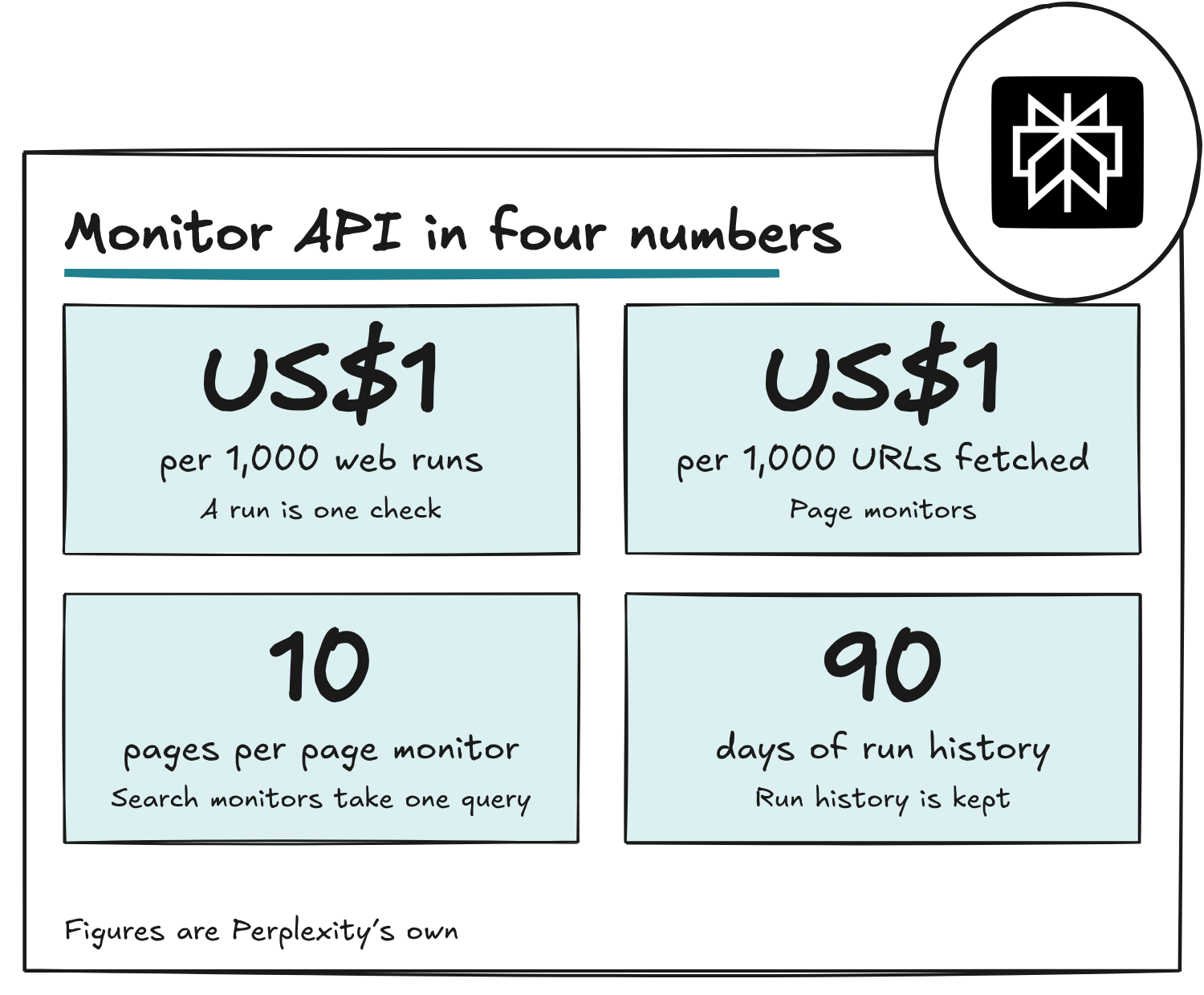
Perplexity has put web monitoring behind an API. Point the new Monitor API at a topic, or at up to 10 pages, give it a schedule, and it posts to a webhook of yours whenever something relevant shows up. Web monitors cost US$1 per 1,000 runs. Page monitors cost US$1 per 1,000 URLs fetched. It’s live now, on the same key you’d use for Search.
The Perplexity Developers account announced it on X on 16 November, with a blog post the same day. The pitch will sound familiar if you’ve built this yourself: a cron job runs some searches, a pile of glue code throws out the repeats, and it all falls over around the time you’re tracking hundreds of things.
Today we’re introducing the Perplexity Monitor API.
November 16, 2026
Monitor API tracks new developments on a topic or changes to specific pages on a schedule, then sends relevant updates to your application through webhooks.
Available now at $1/1k runs or URLs fetched.
Two kinds of monitor
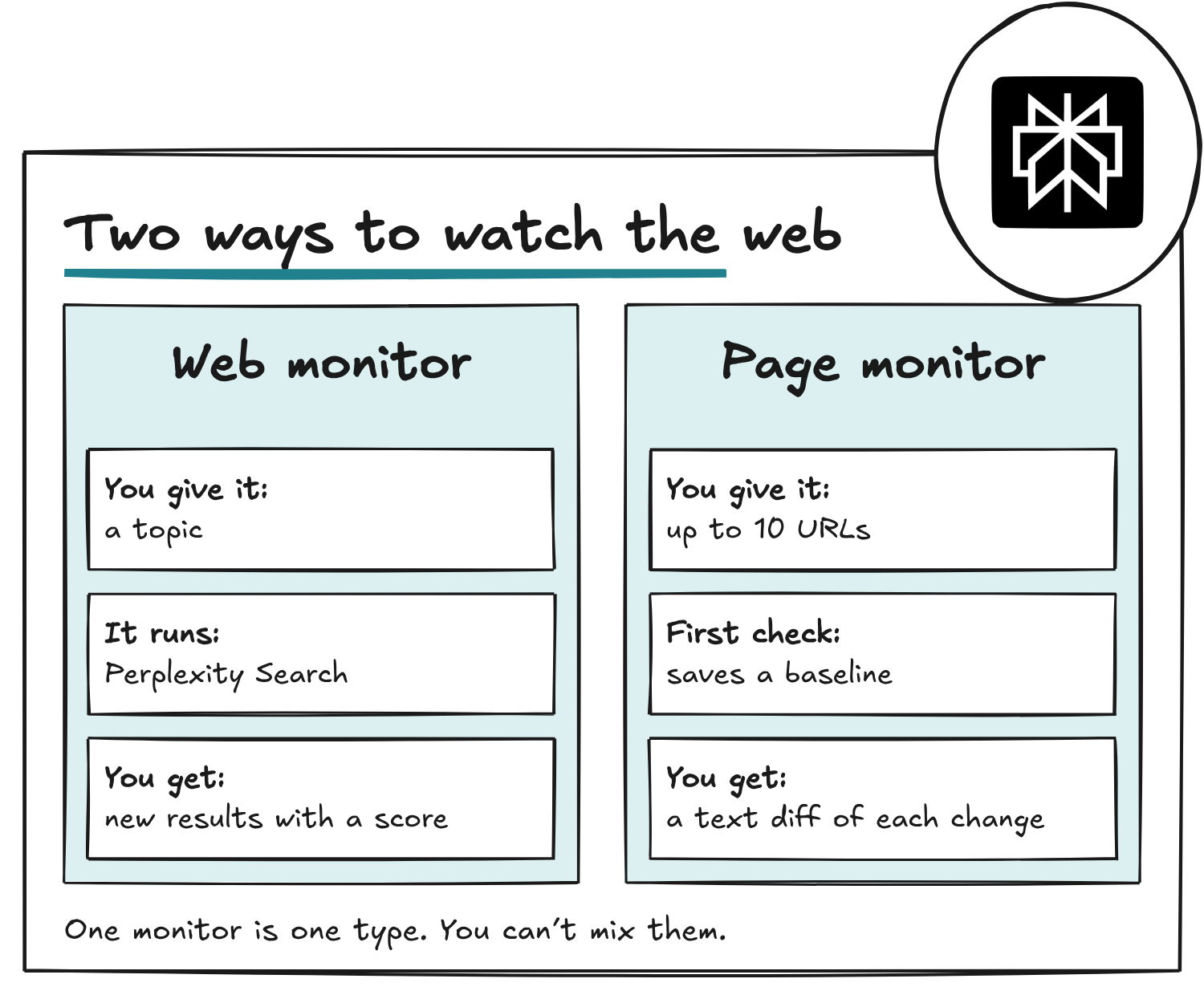
The docs split monitors into two kinds, and a monitor is only ever one of them. A web monitor holds a single query (1,000 characters at most) and runs it through Perplexity Search over web and news results, looking at 1 to 20 results per run. You can include or exclude up to 20 domains each, and you choose whether it hunts for newly published pages, recently updated ones, or both.
A page monitor is the blunter tool. You hand it 1 to 10 public URLs you already care about, such as a pricing page, a changelog or a policy page. Its first fetch of each one gets stored as the baseline and reports nothing. After that, every run compares the new text against the stored copy and sends back a diff. Both kinds take an optional goal, a sentence or two in plain English like “New Series A or B announcements” (the example in Perplexity’s own request), and you can edit the goal later without starting over.
Perplexity’s own example creates a daily web monitor like this:
curl --request POST https://api.perplexity.ai/v1/monitors \
  --header "Authorization: Bearer $PERPLEXITY_API_KEY" \
  --header "Content-Type: application/json" \
  --data '{
    "name": "AI infra funding",
    "targets": [
      {"type": "search", "query": "AI infrastructure funding rounds"}
    ],
    "goal": "New Series A or B announcements",
    "schedule": {"type": "interval", "interval": "1d"},
    "webhook": {"url": "https://agent.example.com/hooks"}
  }'
What cuts the noise
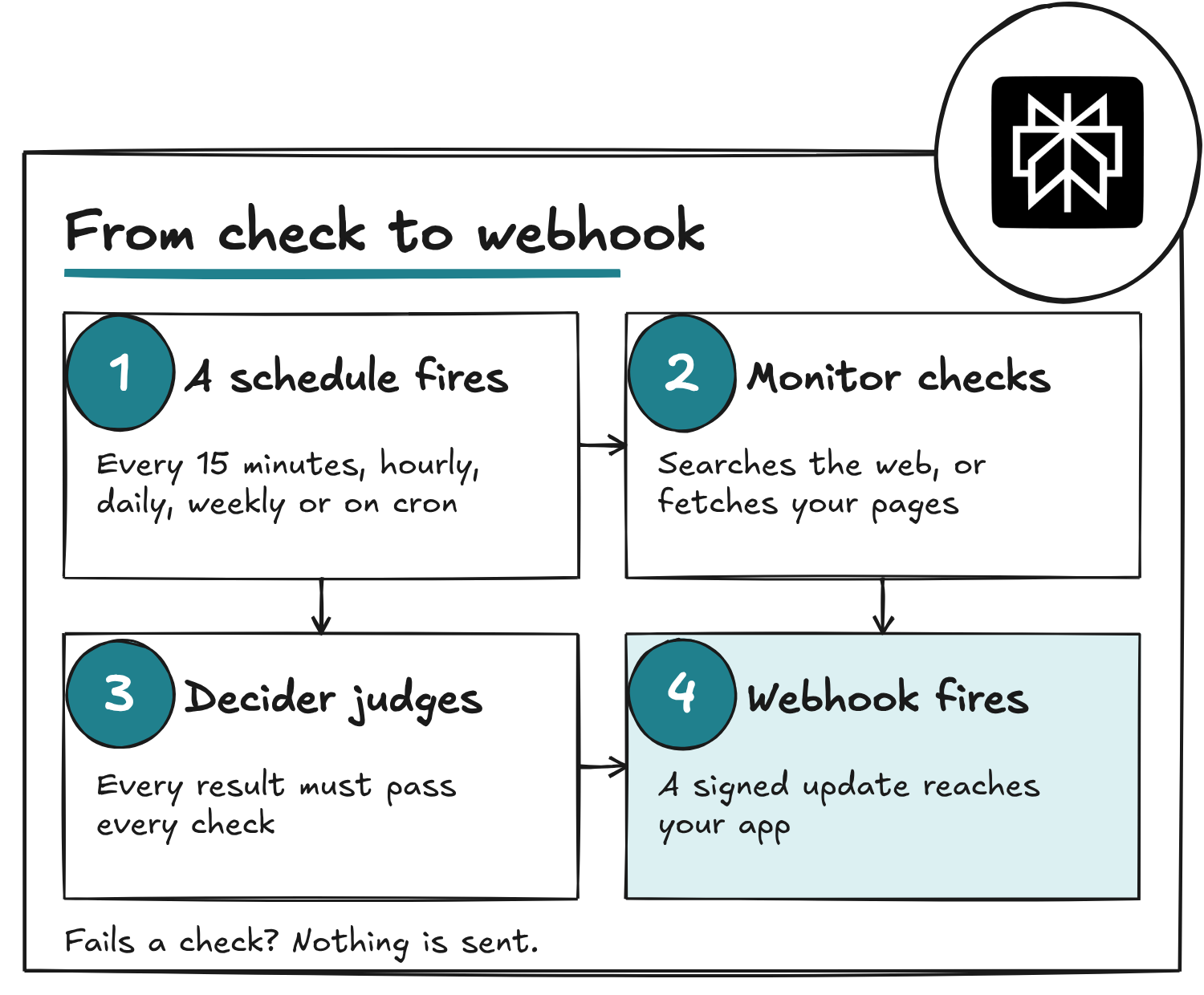
What stops this from drowning you in noise is Decider, the decision model Perplexity released on 12 November. It scores every candidate against the goal. A web result has to pass four tests: relevant, from a legitimate source, new, and fresh. A page change faces one, which is whether the edit matters for what you asked. An update is sent only if every check meets its threshold, and it arrives with a confidence score. Each threshold can be adjusted, and the scoring still happens when you haven’t written a goal.
Perplexity ran its own comparison against other Search API providers: 60 topics taken from real Search API queries, covering company news, technology releases and regulation, each watched for eight hours. A separate model then graded the results for relevance and for when each page went up. Perplexity says it came out with the freshest, most relevant results over the widest range of topics, and that plenty of its results turned up nowhere else. The blog doesn’t name the providers it tested against.
Schedules and webhooks
Schedules run at a fixed interval (every 15 minutes, hourly, daily, weekly) or on a custom cron expression, and a new monitor’s first run is due immediately. Each run picks up where the last stopped, so Monitor filters out results it has already sent. You can pause, resume or fire one by hand from the API or the API Console.
Webhooks follow the Standard Webhooks v1 format. Your receiver recomputes an HMAC-SHA256 signature from the webhook-id header, the webhook-timestamp header and the raw body, and the docs say to refuse anything stamped more than five minutes away from your clock. The default events are monitor.changes.detected and monitor.paused; monitor.run.completed is opt-in. A page change arrives with a unified diff, cut off at 24 KiB.
Expect duplicates, because delivery is at least once. Dedupe on webhook-id and on each change’s ID. Answer within 10 seconds with a 2xx. A timeout, a network error, a 408, a 429 or any 5xx gets retried, up to seven attempts over about 17.6 hours. A redirect, a 410, another 4xx or a bad TLS certificate ends the delivery on the spot.
Monitors also pause themselves. A webhook that keeps failing, unreadable sources, a refused credit check or an organisation policy block will each do it, and the monitor’s pause_reason says which. Fixing the problem doesn’t unpause it; you have to resume it. Organisations that require zero data retention can’t create, resume or run monitors.
What it costs
On price, a web monitor bills US$0.001 for each successful run, once, even when the run searches several times or finds nothing. A page monitor bills US$0.001 for each URL fetched in a successful run, and failed or skipped runs are free. Run the numbers for an hourly schedule over 30 days: a web monitor bills 720 runs, or US$0.72, and a page monitor watching 10 URLs bills 7,200 fetches, or US$7.20. Run history is kept for 90 days. The cost on each run is list price, which the docs say isn’t the invoice amount.
Perplexity’s blog lists four production uses: GTM engineering, equity research, competitive intelligence and regulatory monitoring. The Monitor API docs have a quickstart and separate Search and Page guides, and the API Console can create monitors too.
Discover more from Sulat AI & Tech News
Subscribe to get the latest posts sent to your email.