Baseten has launched the Baseten Voice Agent Stack, infrastructure for running voice agents on its Dedicated Inference service, and Baseten Realtime Voice, a voice agent API built on it that the company says costs about US$0.01 per audio minute. Both are in private preview, and you join a waitlist to get in.
Baseten announced both on X on 16 November, and its blog post, written by Ian Carrasco and Tianshu Cheng, carries the detail.
Introducing the Baseten Voice Agent Stack: optimized infrastructure to run and customize voice agents. Every model and the orchestrator are hosted for low end-to-end latency, each component scales on its own, and you can swap or post-train any model.
— Baseten (@baseten) November 16, 2026
We built Baseten Realtime Voice on it using open-weight models: 73.5% on τ²-Bench Voice, more than double the cascaded baseline, with sub-second turns at ~$0.01/min.
Both are in private preview now: https://www.baseten.co/blog/introducing-the-baseten-voice-agent-stack/
A phone-answering voice agent chains three models: speech-to-text to hear the caller, a language model to decide the reply, and text-to-speech to speak it. An orchestrator, the software that passes audio and text between them, runs each turn. Baseten says that even when all three models are hosted on its platform, an orchestrator running somewhere else adds hundreds of milliseconds of network round trips per turn. The Voice Agent Stack runs the orchestrator alongside the models in one cloud region to remove those hops.
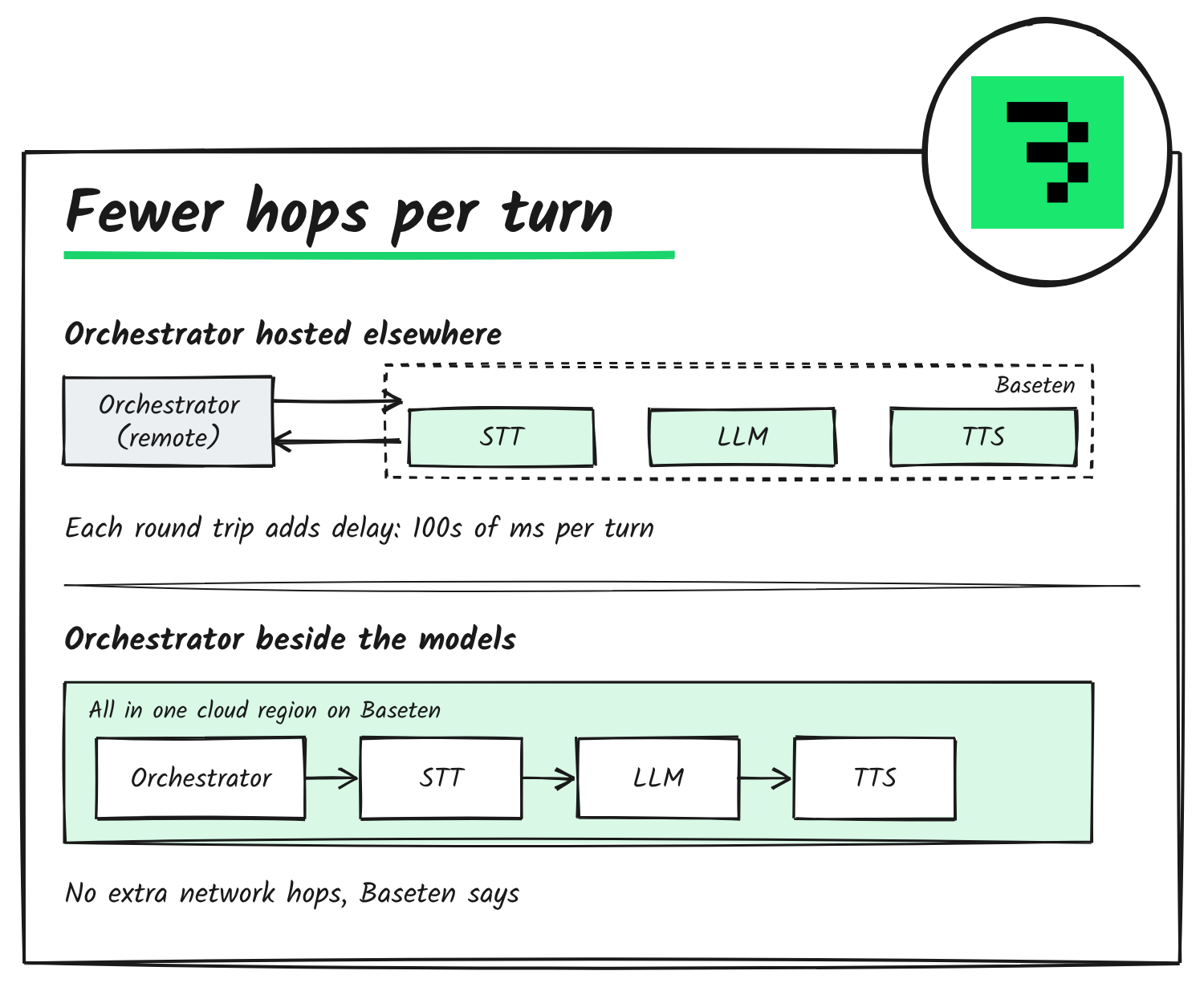
What the stack gives you
Baseten lists autoscaling, cross-cloud failover, inference runtime optimisation and post-training support as part of the stack. Each component scales against its own concurrency target, so a pipeline where the speech-to-text saturates first doesn’t force you to add capacity for the other two, Baseten says.
The stack is model-agnostic. Baseten says you can bring any speech-to-text, language and text-to-speech combination you can host on its platform, mix those with third-party APIs, and swap models during a call. It pitches post-training as the payoff: tuning the speech-to-text model on healthcare or finance jargon, or fine-tuning text-to-speech on your own voice data with its Baseten Training recipes.
Baseten Realtime Voice
Realtime Voice is Baseten’s own reference agent on the stack, built around a Pipecat-based orchestrator. It speaks the core OpenAI Realtime protocol, so tool calling, MCP, delegation and voice control carry over from an existing OpenAI Realtime agent with minimal changes, Baseten says. It adds keyword boosting, configurable acknowledgements and voice cloning, and it runs in audio-in, audio-out and text-in, audio-out modes. Server-side tools execute on the orchestrator, which saves a client round trip on each tool call.
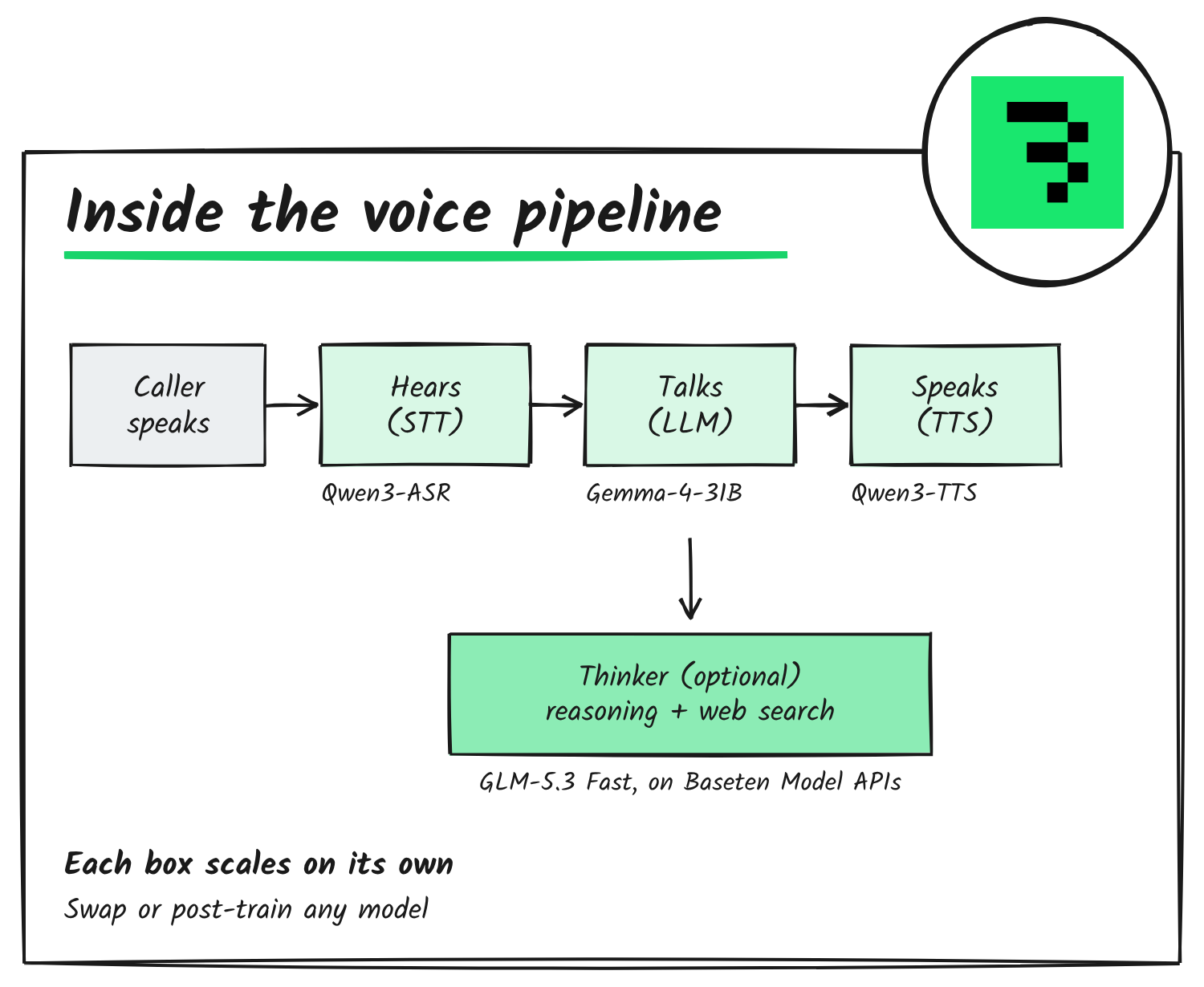
The setup Baseten measured uses Qwen3-ASR for speech-to-text, Gemma-4-31B as the talker language model and Qwen3-TTS for speech, all open-weight. An optional delegation mode hands reasoning and web search to a stronger thinker model, GLM-5.3 Fast on Baseten Model APIs, while the talker keeps the conversation moving.
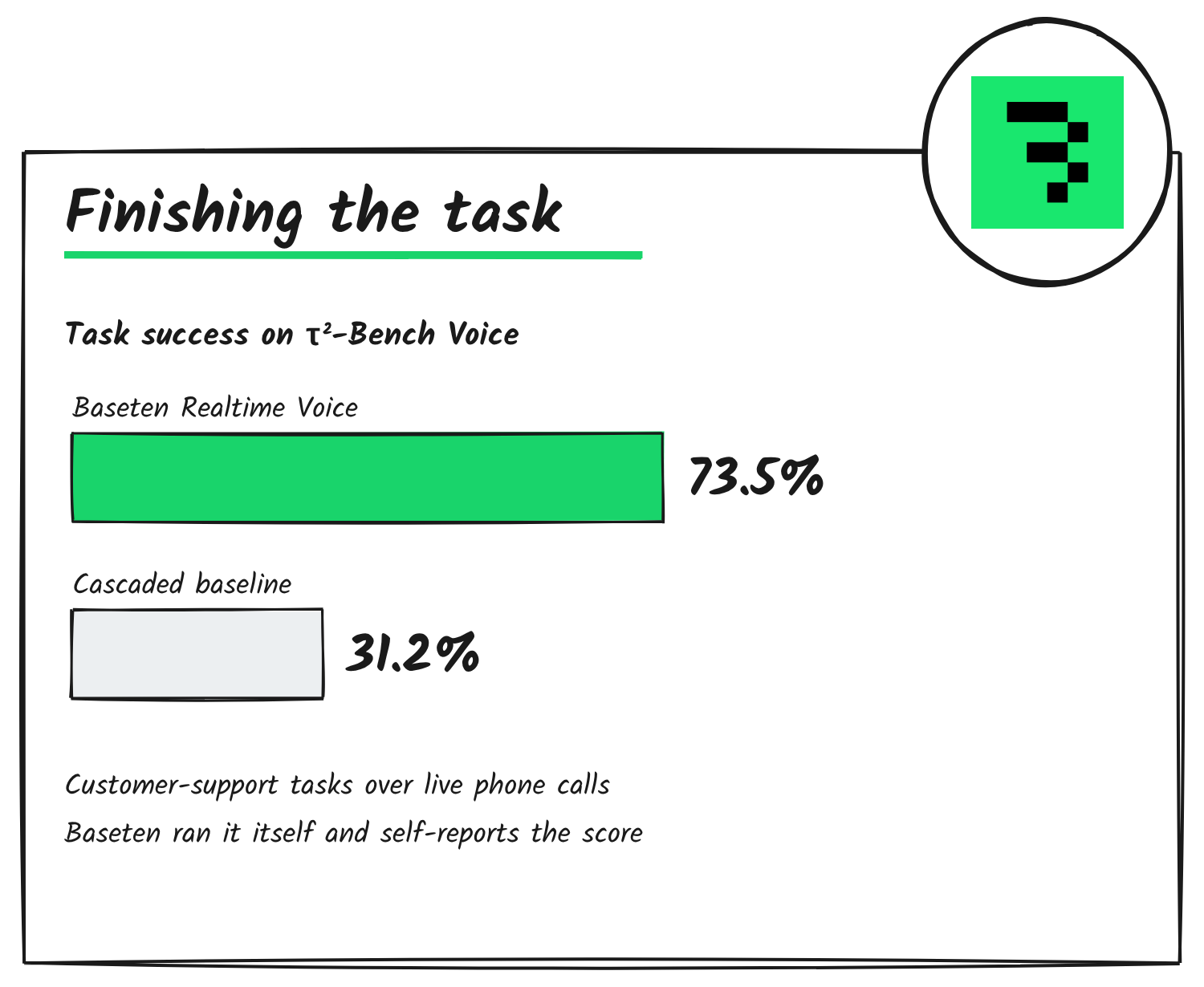
The numbers Baseten reports
Baseten says Realtime Voice scores 73.5% on the English split of τ²-Bench Voice, which tests customer-support tasks over live, full-duplex phone calls, with delegation switched on. That compares with 31.2% for the cascaded baseline. Baseten calls it the highest-scoring cascaded system and the leading open-source stack on the leaderboard, and puts its telecom score at 93.9%. The 73.5% is self-reported on Sierra’s test harness. Artificial Analysis didn’t measure it, and Baseten says it isn’t directly comparable with Artificial Analysis’s results.
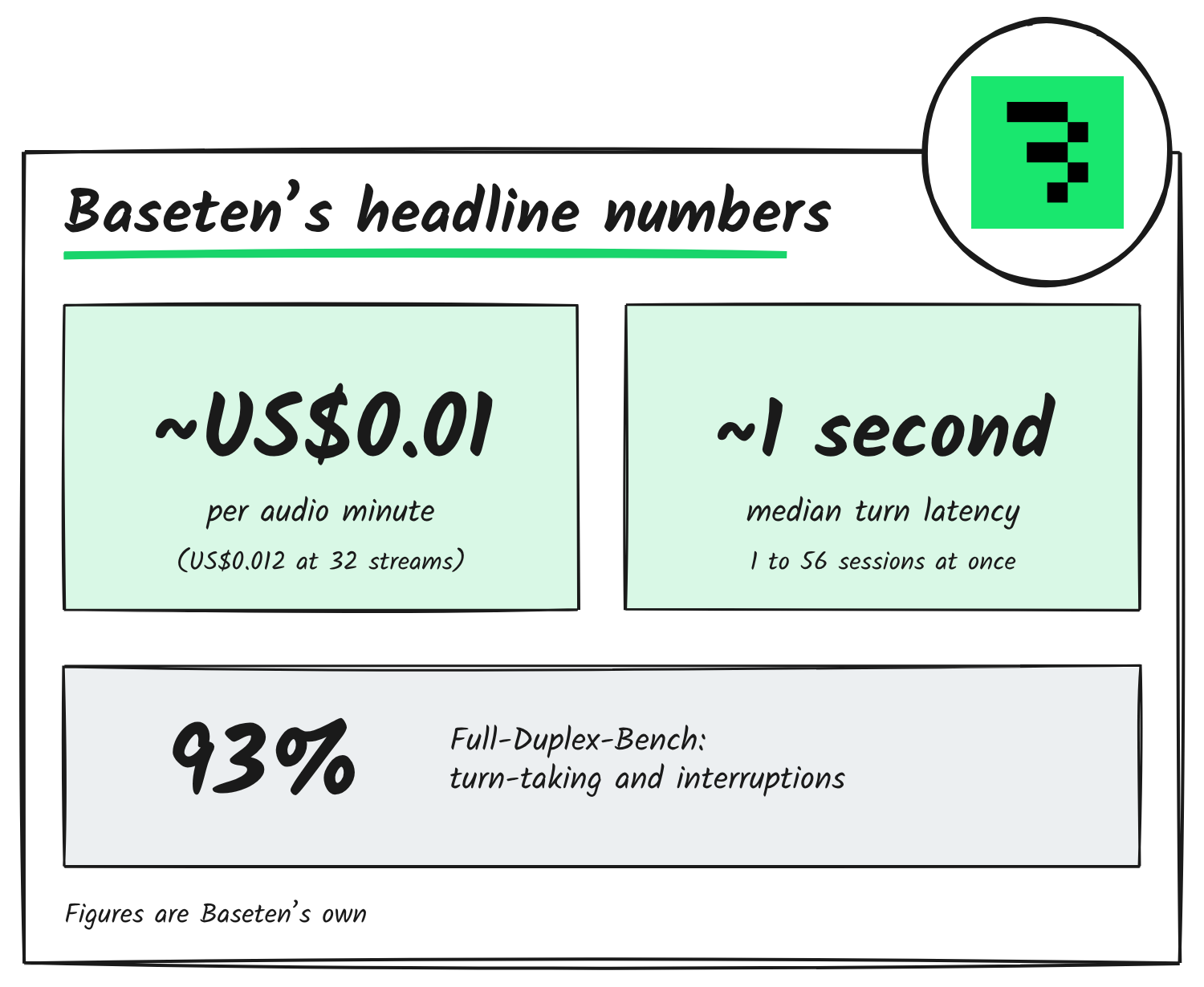
On Full-Duplex-Bench, which tests pauses, turn-taking and interruptions, Baseten says it scores 93%, the highest among open-source full-duplex systems on Artificial Analysis’s split.
In its summary, Baseten reports a median turn latency under one second at 32 concurrent sessions. Its latency chart shows median time to first audio rising from 0.94 to 1.14 seconds as load grew from one to 56 concurrent calls, with context up to 16,000 tokens. Baseten says longer contexts push latency up, so it offers configurable summarisation that caps each session at a target context length.
What it costs
Baseten puts the price at about US$0.01 per audio minute per stream. The figure on its chart is US$0.012, and its footnote derives the cost from a list price of US$18.39 an hour across 32 fully utilised concurrent sessions. That arithmetic comes to about US$0.0096 a minute; the post doesn’t explain the US$0.012. That US$0.012 leaves out the per-token charge for GLM-5.3 Fast delegation, which Baseten bills like any other language model endpoint. From 32 concurrent streams up, Baseten says, its per-minute cost undercuts every hosted speech-to-speech API it evaluated. At 56 sessions it estimates US$0.008 per call-minute including delegation, under its stated utilisation assumptions.
Availability and what’s next
Both products are in private preview. You join the waitlist on Baseten’s site, and the documentation and recipes are published. Baseten’s post gives no date for general availability.
Baseten lists what’s next: more complex orchestration flows and an easier path for bringing existing voice agent pipelines onto its platform with your own orchestration logic; full-duplex conversation with native speech-to-speech models, and omni models paired with dedicated text-to-speech heads; and new scheduling primitives across the components of a cascaded pipeline.
Sources
- Baseten on X, 16 November 2026
- Introducing the Baseten Voice Agent Stack, Baseten, 16 November 2026
- Realtime Voice overview, Baseten documentation
Discover more from Sulat AI & Tech News
Subscribe to get the latest posts sent to your email.