Kirill Skrygan, the CEO of JetBrains, wants software governance for AI agents to stop being a policy document and become part of the engineering workflow. He makes the case in an InfoWorld New Tech Forum column dated 16 November, which says governance “must move from policy to engineering practice”. JetBrains already sells tooling in that space: Air Governance went generally available on 22 October 2026 and covers agent approvals, spend limits and usage analytics. Its audit logs are listed as coming soon.
The column never names Air Governance. InfoWorld says New Tech Forum is open to vendors and other outside contributors, and the byline gives Skrygan’s title as JetBrains CEO.
What the column asks for
Skrygan sets out five controls. An audit trail should show what an agent changed, which instructions it received and which tests it ran. Human approval should be settled in advance; in his example, AI can write code and run tests unaided, but anything touching production infrastructure waits for a person. Least privilege applies too, so an agent that runs tests shouldn’t be able to edit deployment configuration. Usage and cost need measuring against what they produce, since usage rates and token counts show how much AI is used, not whether it pays off. And once several agents work across teams, permissions, traceability and approval need shared standards.
He also links to a Wall Street Journal article on the “software harness”, which he describes as a layer of software around AI models that gives organisations more control over tasks and token costs.
What Air Governance lists today
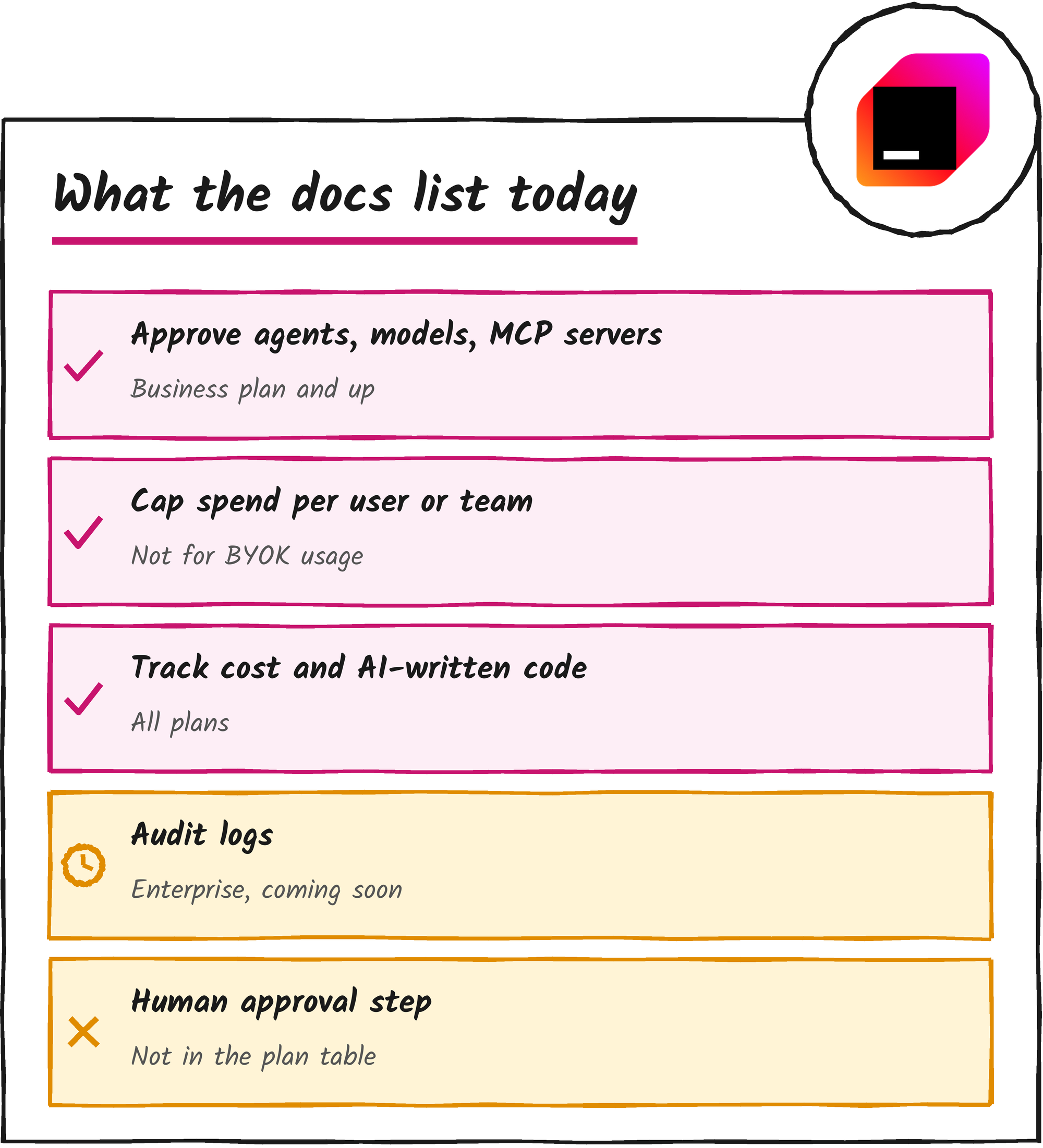
| Control in the column | What JetBrains lists |
|---|---|
| Audit trail | Session explorer shows who ran each session, the agents and models, duration and consumption. AI audit logs are an Enterprise feature marked coming soon. |
| Human approval | The plan table lists no approval step. |
| Limits on access | Admins approve agents, models, providers and MCP servers through policies, on Business and Enterprise. |
| Usage and cost | Credit limits per user, team and service account on every plan, plus costs by user, agent, model and provider, and the split between human-written and AI-generated code. |
| Shared standards | AI policies combine approved providers, models, agents and credit limits for different groups, on Business and Enterprise. |
Viktor Kiselev announced the general release on JetBrains’ blog. The product used to be called JetBrains Central. It works with Claude Agent, Codex, Gemini CLI, Junie and other ACP-compatible agents, in IDEs, the command line, browsers and on mobile. Admins can cap credits per user, team or service account, route usage through their own OpenAI, Anthropic, Amazon Bedrock or Google Vertex AI accounts (bring-your-own-key, or BYOK), pick which agents are approved, and set up MCP servers once for the whole company.
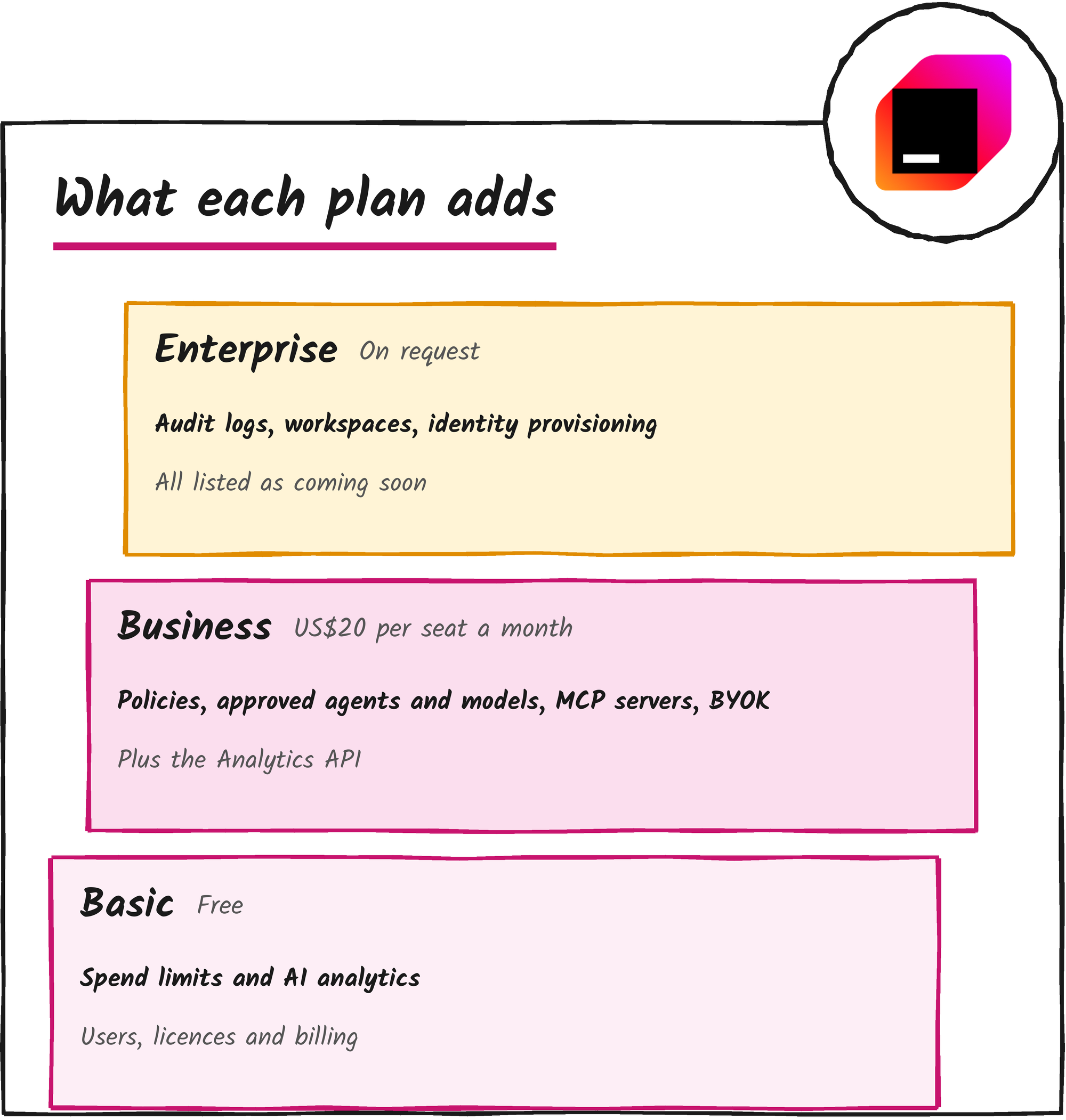
The plans page has three tiers. Basic is free. Business costs US$20 per seat per month, and Enterprise is priced on request. Every plan gets spending limits and analytics. Policies, model and agent management, MCP servers, BYOK management and the Analytics API start at Business.
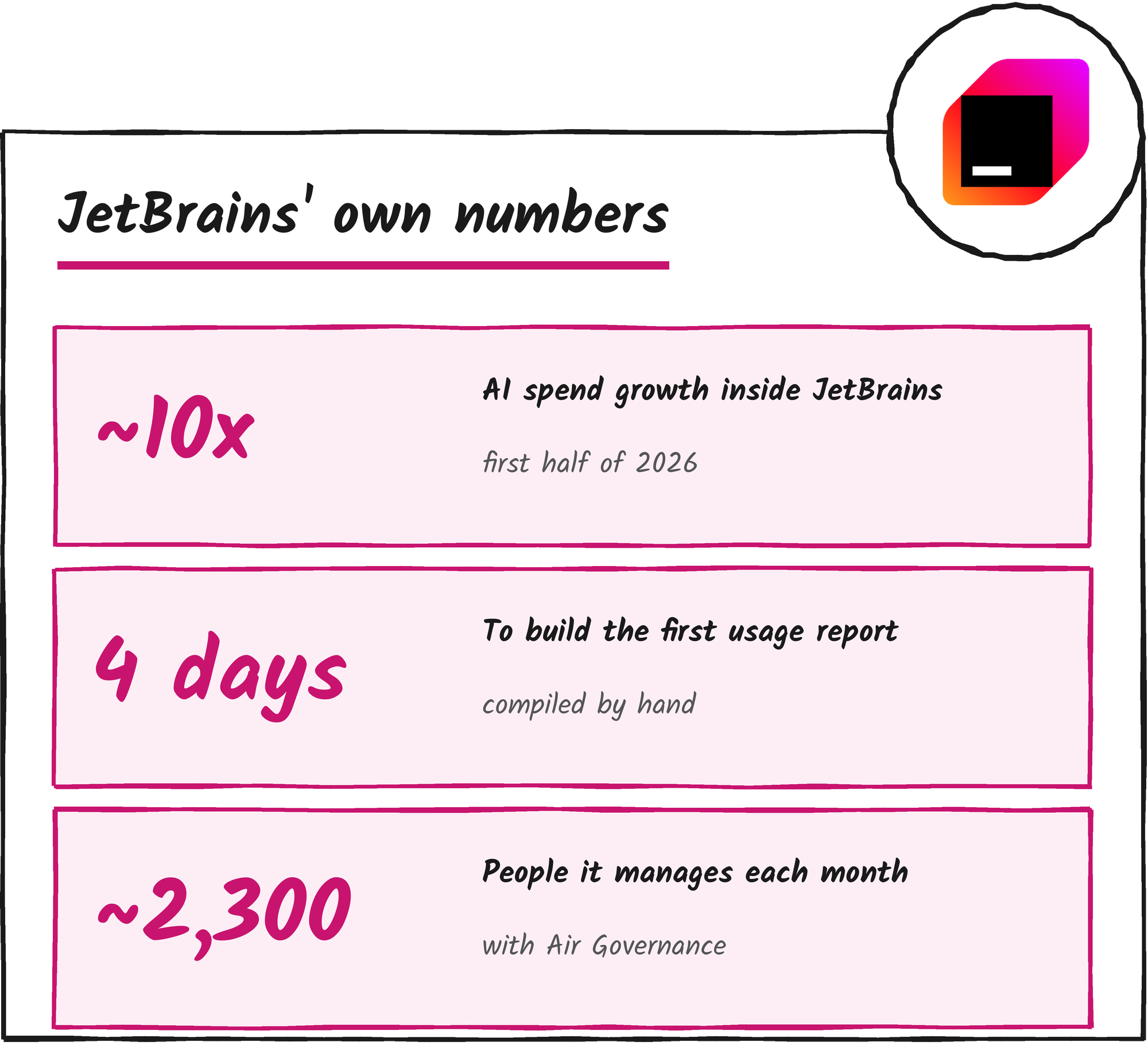
JetBrains says it ran into the same problem itself. Its AI spend rose roughly tenfold in the first half of 2026, and the first cross-vendor usage report took four days to put together by hand. Air Governance now manages agent usage for about 2,300 people at JetBrains each month.
Where the product and the column part ways
Start with the audit trail, the column’s first control. The Enterprise plan lists AI audit logs, but marks them coming soon, along with hybrid deployments, workspaces, identity provisioning and priority support. The plans page doesn’t say what the logs will record. The analytics documentation does describe a session explorer, which shows who ran each session, which agents and models it used, how long it lasted and what it consumed. Changed files, instructions and test runs aren’t on that list.
Spend caps don’t reach every route. Credit limits apply to JetBrains AI usage only, and the plans page says BYOK requests don’t consume AI credits, so the limits skip them and the provider bills the organisation directly. JetBrains lists credit limits and custom pricing for BYOK models as work in progress.
Policy enforcement is tied to the paid plans. If an organisation drops to Basic, its policy, MCP server, agent and provider settings stop taking effect, and every user with AI access can use every agent.
Coverage of outside tools is still being built. JetBrains lists MCP server propagation to third-party command-line tools, “so company-approved tools reach every agent, not just JetBrains ones”, along with GitHub Copilot support and cloud agent connections through its Air Gateway connector. The AI-generated code metrics come from JetBrains IDEs and plugins, and the docs set minimum versions, including IDE 2025.3.0 or later.
JetBrains is holding a livestream on Air Governance from 4pm to 5pm CET on 18 November, which is 4am to 5am on 19 November in New Zealand. Viktor Kiselev, lead product manager for Air Governance, and Guillaume Garnier, product manager for AI analytics, are taking questions.
Discover more from Sulat AI & Tech News
Subscribe to get the latest posts sent to your email.