Reuters reports that China is putting AI into classrooms for almost 200 million primary and secondary students, with a national goal of universal AI literacy by 2030. Its examination found AI facial recognition being added to classrooms in Guizhou, 14,000 classrooms in Yunnan slated to have lessons recorded and analysed by AI, and a rural Anhui school teaching core subjects through AI-generated lessons.
Reporters Laurie Chen and Xiuyuan Ning visited schools, spoke to over a dozen educators, parents and experts, and read more than 100 academic papers and government procurement filings. China’s education ministry didn’t respond to Reuters’ request for comment.
The 2030 target comes from the ministry. Its December 2024 guidance asks schools to make AI courses a regular part of the curriculum, moving from awareness in the early primary grades to project work in high school. In Georgetown CSET’s translation of the ministry’s notice, the aim is to “basically universalize AI education in primary and secondary schools” by 2030. In April 2026 the ministry added an “AI empowering education” action plan that puts AI into teacher qualification exams and certification.
What the provincial plans require
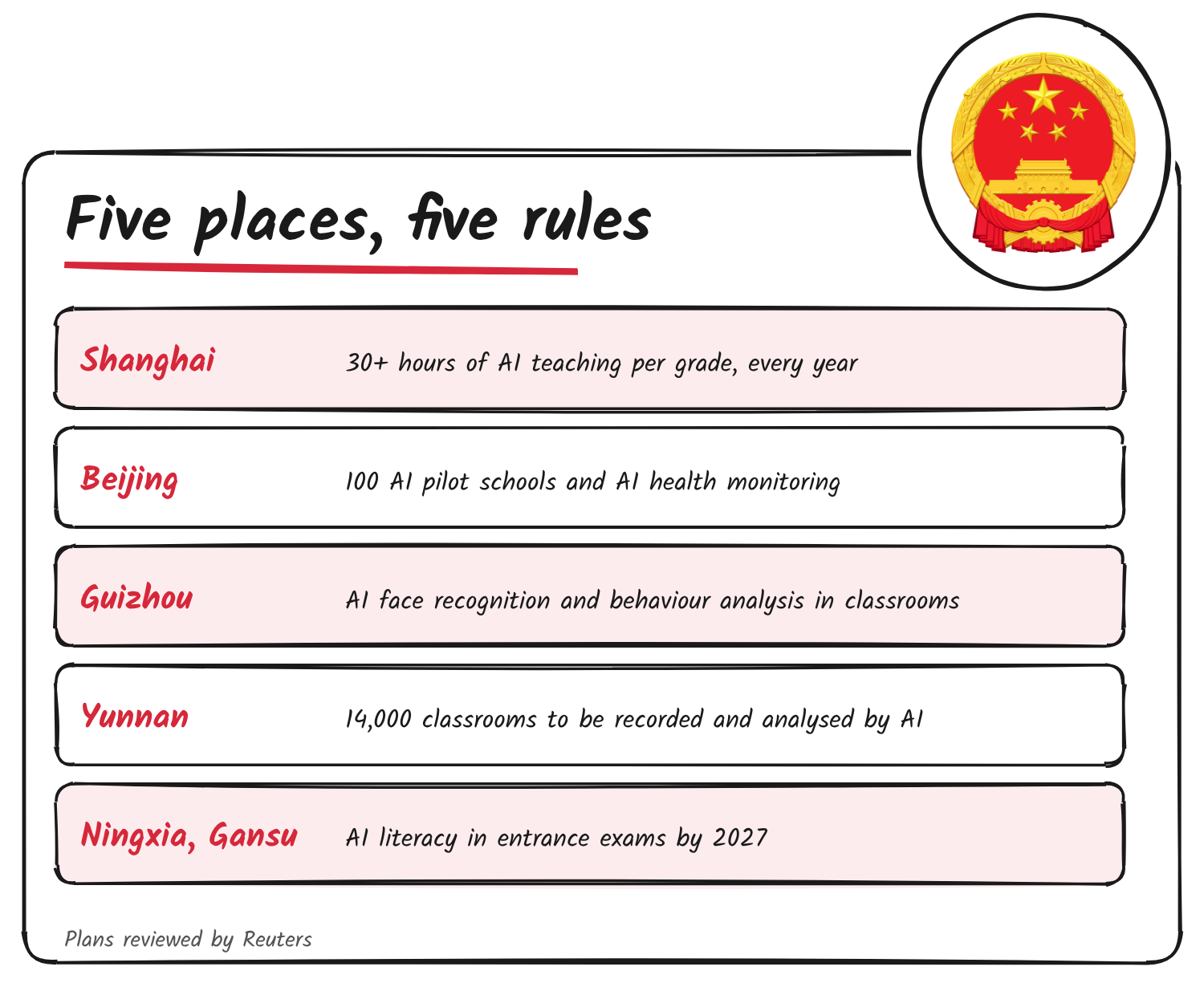
Reuters reviewed provincial “AI+ education” blueprints and says nearly half of China’s provinces and municipalities have binding plans. Shanghai mandates at least 30 hours of AI skills teaching per grade each year. The Beijing city government plans to set up 100 AI pilot demonstration schools and bring AI into student health monitoring. Ningxia and Gansu plan to put AI literacy into high-stakes school entrance exams by 2027.
Some of the documents go further. Guizhou is bringing AI facial recognition and behavioural analysis into classrooms, Shanghai is deploying mental and physical health monitoring, and Yunnan has 14,000 classrooms slated to have lessons recorded and analysed by AI.
Two schools, two reasons
Beijing New Talent Academy charges US$39,000 a year for more than 2,000 students. Reuters was given rare access: the school built its own digital innovation curriculum covering AI, robotics and programming, plus a classroom AI model that uses features from popular Chinese systems. Thirteen-year-old Peng Gaodi has used AI to build more than 200 apps. Headmaster Liu Wei says only a small minority of students will become AI scientists or engineers, and that the aim for the rest is to make AI an everyday tool for learning and creating.
In rural Anhui province, Funan County Qinqing High School uses AI to cover a shortage of qualified teachers. Its 4,000 pupils, most of them children of migrant workers, learn core subjects through AI-generated lessons on tablets, and AI agents ask questions rather than give answers when they struggle, headmaster Yang Tianliang says. The school generates text, images, interactive lessons and videos with models from Alibaba’s Qwen, ByteDance and Z.AI.
Yang says university admission rates rose from below 60% to 90% in recent years. Reuters couldn’t independently verify those figures. He estimates at least 200 other Chinese schools run similar systems. An Alibaba spokesperson told Reuters its open-source models and Cloud for Youth Programme give students direct access to AI tools. ByteDance and Z.AI didn’t respond to requests for comment.
What it costs
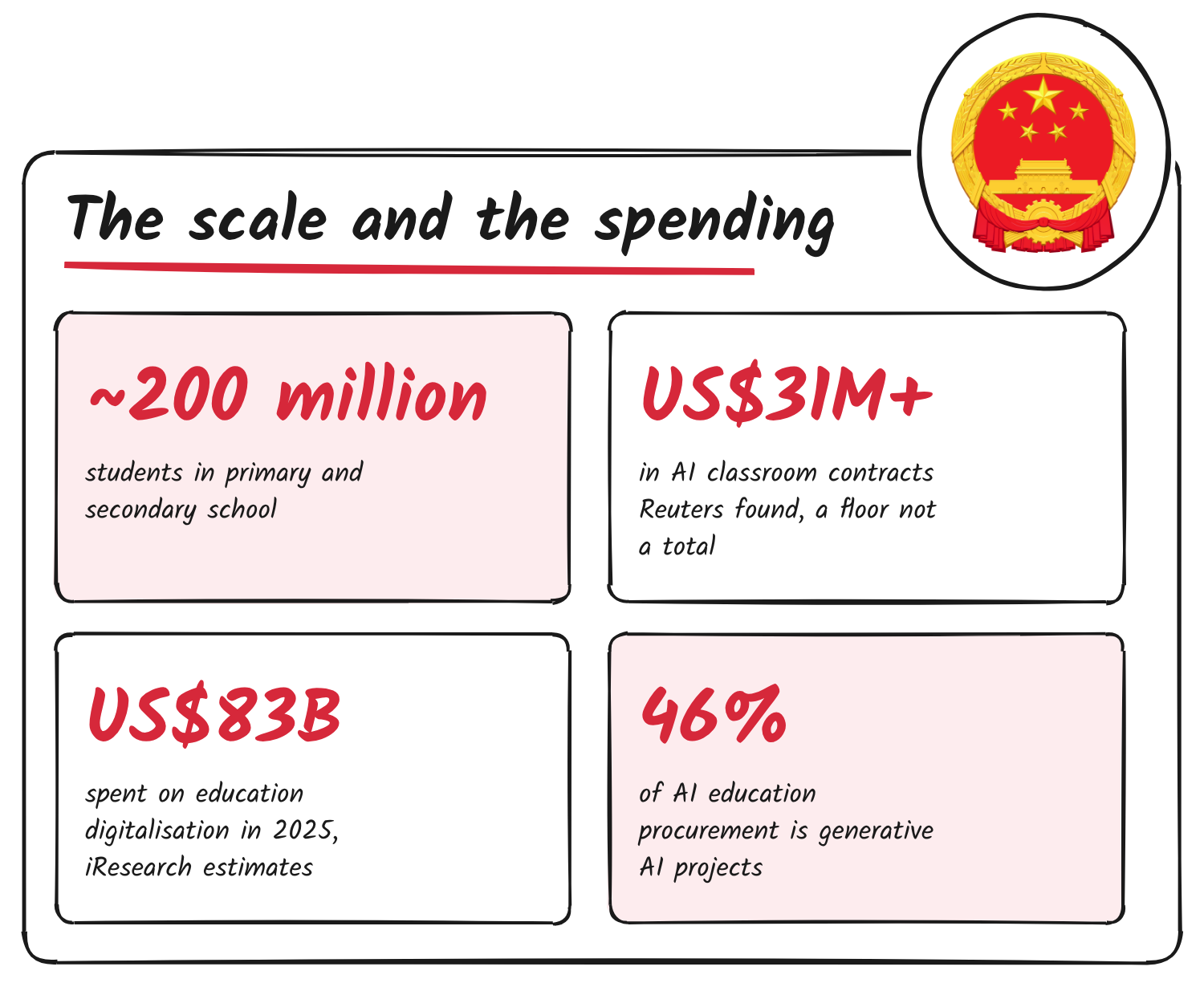
Across more than 100 government procurement documents, Reuters found at least US$31 million committed in the past year to AI classroom equipment, training and teaching platforms. It says the true figure is likely far higher, because the money is spread across thousands of local budgets and isn’t officially tallied. Consultancy iResearch estimates 2025 spending on education digitalisation at just under US$83 billion, with generative AI projects making up 46% of AI education procurement.
No scorecard yet
China hasn’t set a standard framework for measuring AI literacy, Reuters reports. “Mature, widely adopted assessment rubrics for compulsory school-level AI competency are still being built,” said Selena Guo, portfolio lead at research firm China Policy. Ted Mo Chen, chief of staff at education technology startup ClassIn, said “Implementation is all over the place,” and that few schools he had visited had integrated AI into the curriculum effectively.
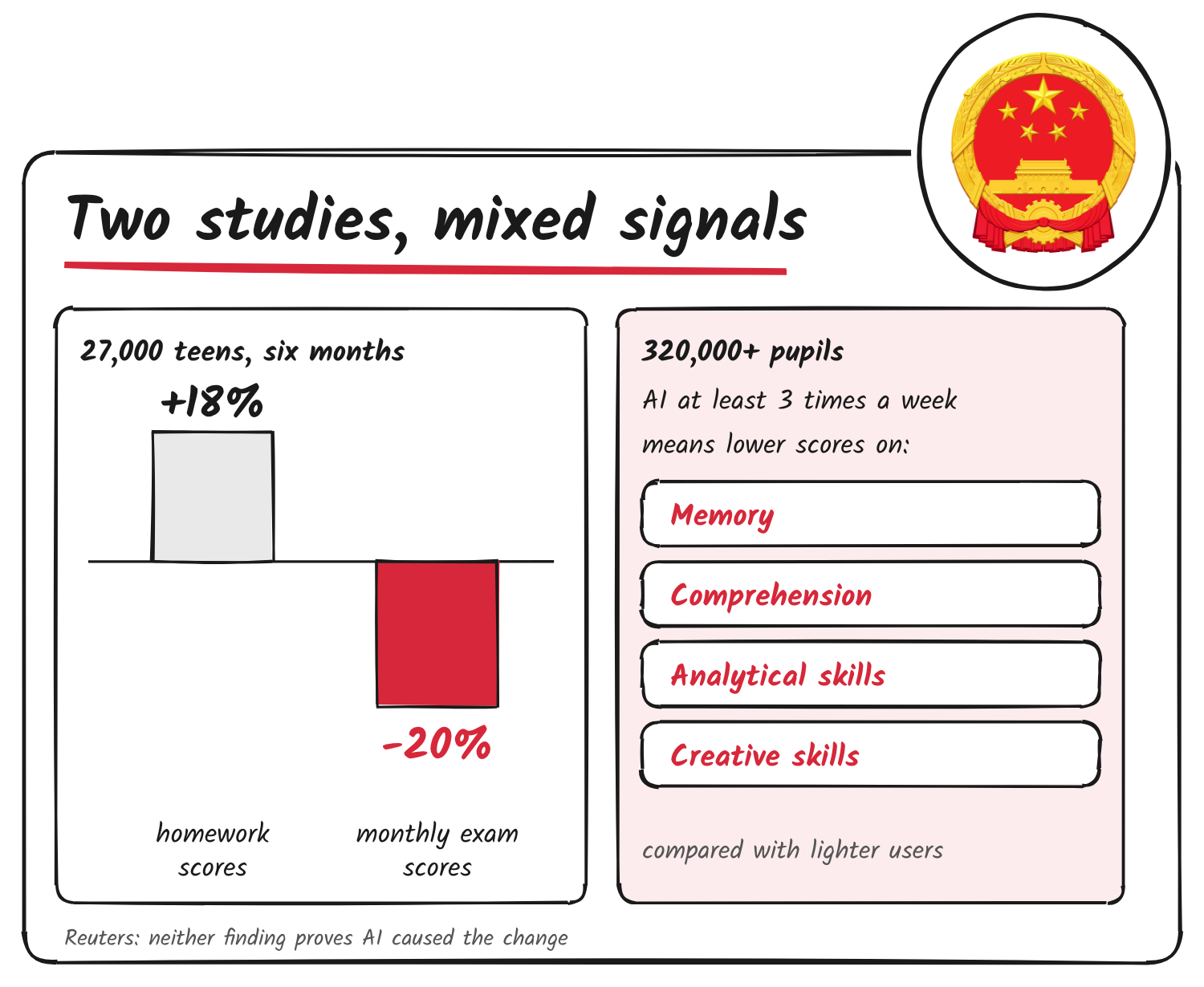
The early research Reuters cites points both ways. A study of nearly 27,000 Chinese teenagers linked AI adoption to an 18% rise in homework scores and a 20% drop in monthly exam scores within six months, with the biggest drops in social science subjects. A nationwide survey this year of more than 320,000 pupils found educational benefits, but students using AI at least three times a week scored lower on memory, comprehension, analytical and creative skills than lighter users. Reuters notes that neither finding establishes causation.
Some parents are setting their own limits. Rita Luan, whose 11-year-old daughter attends a leading public school in Beijing, makes her daughter spend 15 minutes on a hard maths problem before turning to ByteDance’s Doubao chatbot, then asks her to solve the same problem again days later without help.
Discover more from Sulat AI & Tech News
Subscribe to get the latest posts sent to your email.