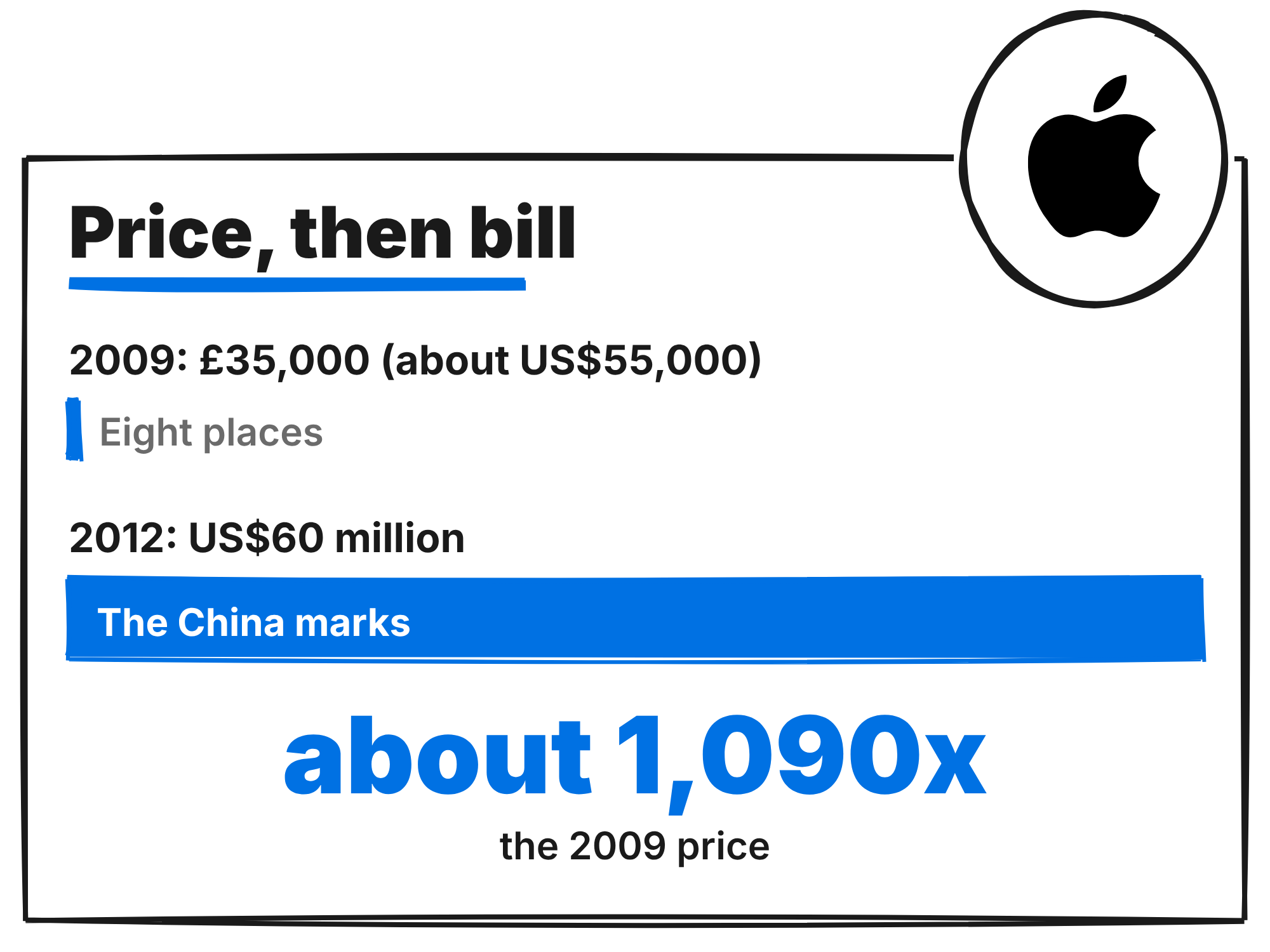
Apple bought the iPad trademarks in eight countries and territories through a shell company for £35,000 in December 2009, then paid US$60 million in 2012 to settle who owned the name in mainland China. The Guangdong Higher People’s Court announced the settlement on 1 July 2012, and the Library of Congress summarised the court’s statement: Apple paid the money into an account the court designated.
A post on X this week, viewed more than 520,000 times, retold the saga as a heist with a villain, a disguise and a showdown. The outline holds up. Three of its details read differently in the court record and the 2012 press coverage, and those are covered further down.
A computer called the I-PAD
Yang Rongshan, also written Yang Long-san, founded Proview, a display maker with operations in Taiwan, Shenzhen, Hong Kong and Europe, according to the Hong Kong High Court’s 2011 judgment. Proview says it built an internet terminal called the I-PAD, short for Internet Personal Access Device, starting in 2000. At a 2012 press conference the company said it had put US$30 million into the project and made between 10,000 and 20,000 units, China Daily reported.
Proview’s Taiwanese arm registered iPad marks in several countries in 2000, and its Shenzhen arm registered two in mainland China in 2001, Courthouse News Service reported from Proview’s California complaint. China Daily’s history of the case adds that the company also registered iPDA, iUVD, iNOCE and iWEB. Only one of those ever got a keynote.
A shell with a punny name
In August 2009 an English company called IP Application Development Ltd was incorporated. The Hong Kong High Court describes it as a special-purpose company set up and used by Apple to acquire iPad trademarks. Proview’s complaint says the name was chosen because its initials spell IPAD.
A man who called himself Jonathan Hargreaves wrote to Proview’s UK arm. On 8 September 2009 he said IPAD was “an abbreviation for the company name IP Application Development Limited” and that the company “will not compete with Proview”, according to the complaint. The complaint adds that Apple’s own affidavit in a Hong Kong court in May 2010 identified Hargreaves as an alias for a man named Graham Robinson. The Hong Kong judgment calls the negotiator “an agent engaged by Apple and IP Application”.
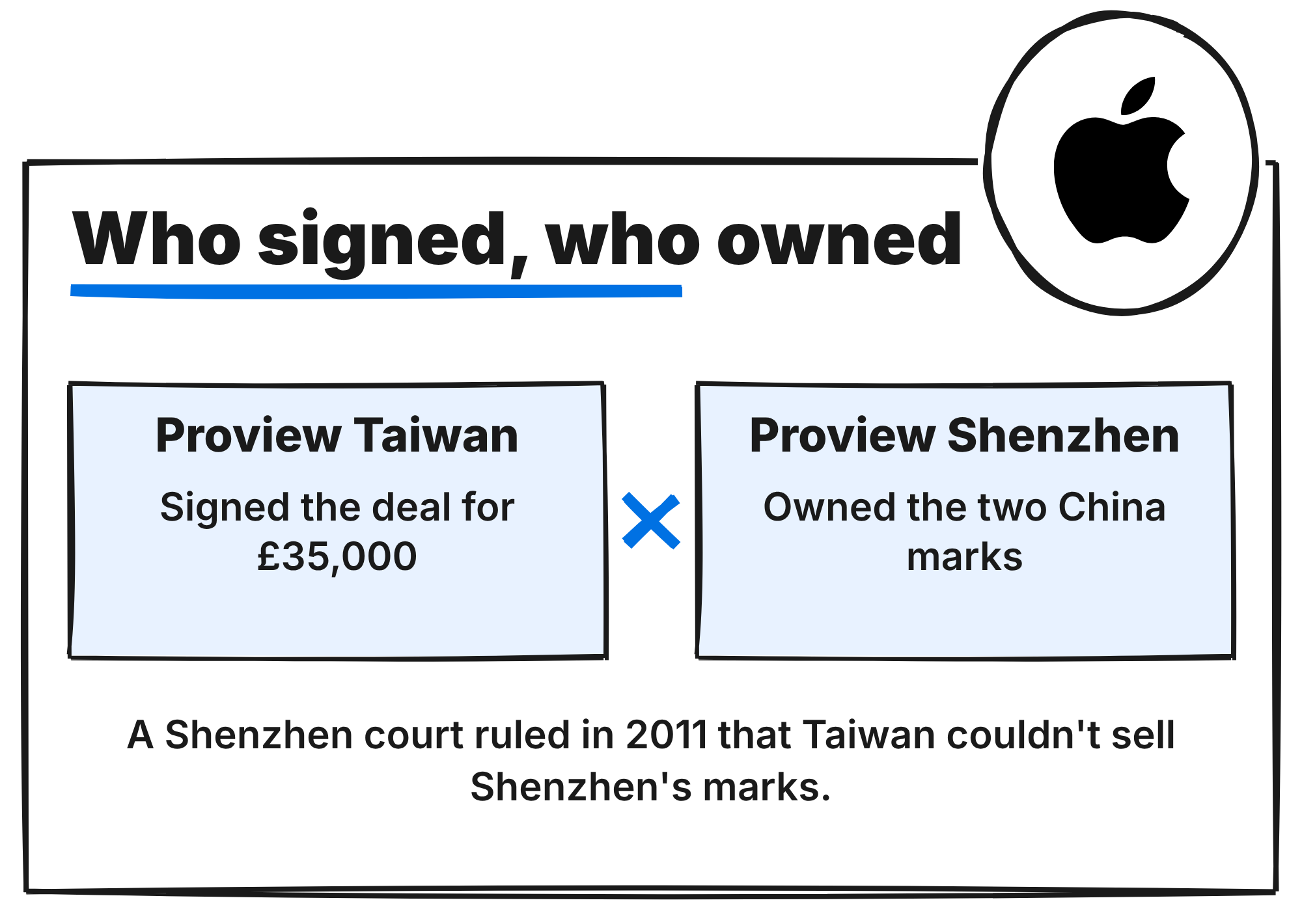
The price was £35,000, about US$55,000. The deal was signed on 23 December 2009 and covered the marks in eight countries and territories, the Hong Kong judgment says. Steve Jobs unveiled the iPad 35 days later, on 27 January 2010. IP Application then handed the marks to Apple for £10, China Daily’s history of the case says.
The signature that didn’t count
The assignment said Proview’s Taiwanese company owned the Chinese marks. The two registrations were in Shenzhen’s name, the Hong Kong judgment says, and the mismatch surfaced after the iPad’s announcement. The judgment adds that Proview’s companies then sought US$10 million from Apple rather than transferring them.
Apple sued in Shenzhen in 2010. In late 2011 the Shenzhen Intermediate People’s Court ruled that Proview Shenzhen hadn’t signed any transfer and rejected Apple’s claim, China Daily reported. Apple argued Shenzhen was part of the deal: Proview’s negotiators came from Shenzhen, and Apple filed a document carrying Yang’s signature. Proview Shenzhen replied that it never signed a transfer agreement with IP Application.
Shops, customs and a court
After that ruling Proview went after retailers. A court in Huizhou ruled in February 2012 that an electronics chain’s iPad sales were illegal, China Daily reported. Stores in Shijiazhuang and Xuzhou stopped selling iPads, and CCTV confirmed officials in Xuzhou were impounding them, according to the New York Times as relayed by Engadget. Proview lawyer Ma Dongxiao told the Times the company had asked authorities in 20 cities to investigate iPad sales. Fellow lawyer Xie Xianghui told China Daily that Proview had spoken to authorities in more than 40 cities.
Proview also asked Chinese customs to block iPad shipments in and out of the country. Yang Long-san told Reuters that customs had said a ban would be “difficult to implement” because Chinese consumers love Apple products, 9to5Mac reported. The same report said Amazon China and Suning removed the iPad at Apple’s request.
Proview’s lawyer told China Daily the group’s debts were about US$400 million. China Daily separately reported net liabilities at Proview International of 2.87 billion yuan (US$456 million), with eight banks holding its assets, the iPad trademark included, as collateral.
US$60 million, paid to a court
The Guangdong Higher People’s Court heard Apple’s appeal on 29 February 2012, according to the English summary from China’s trademark authority. A mediation agreement took effect on 25 June, and Apple transferred US$60 million to an account the court designated.
Proview’s lawyer told China Daily the payment fell short of the US$400 million Proview had demanded, but Proview accepted it as the best way to settle the case, and the money would go toward the group’s debts. China Daily reported that its calls to Apple went unanswered. Set against the roughly US$55,000 paid in 2009, the bill came to about 1,090 times the original price.
Where the record reads differently
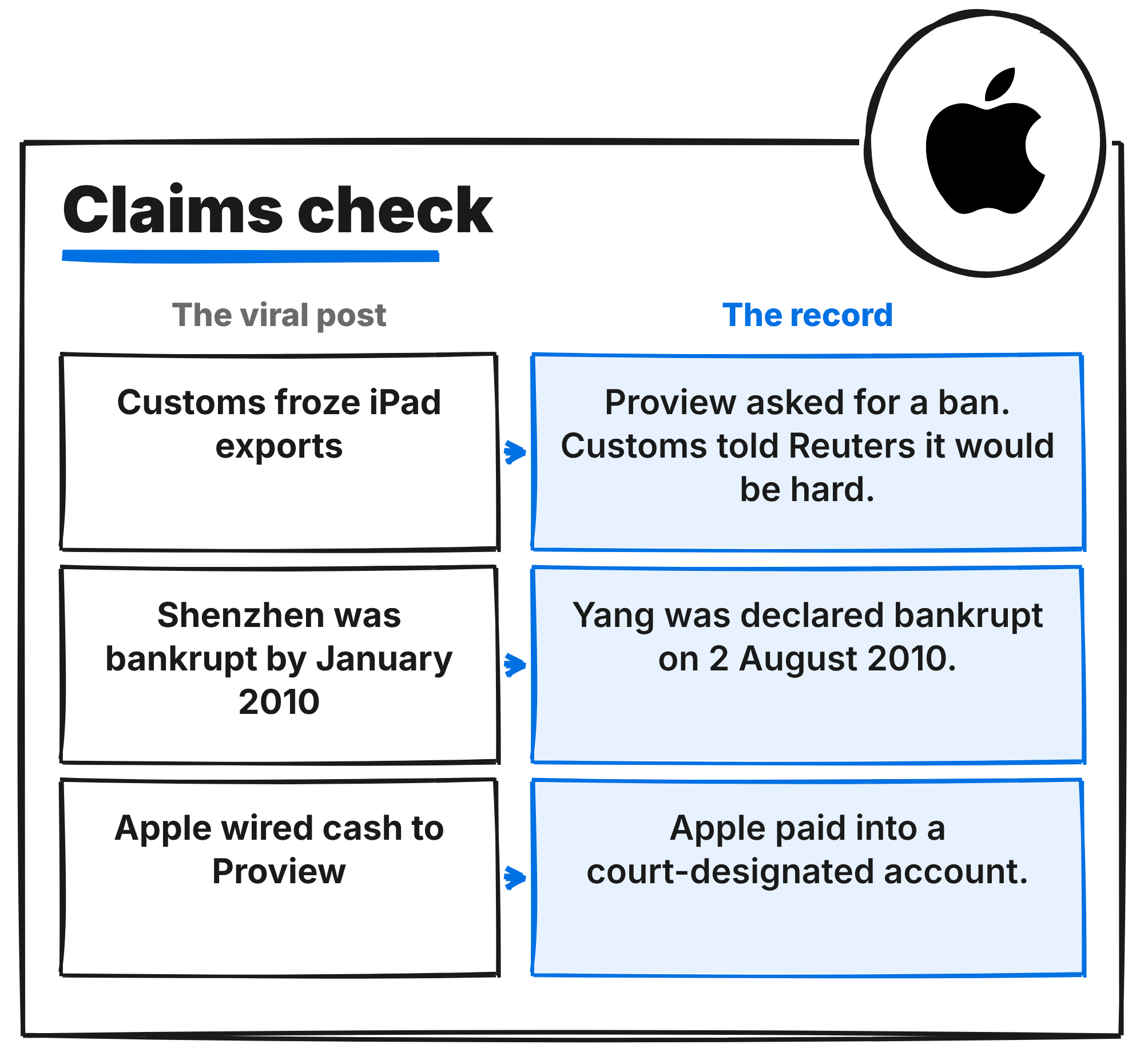
The post has Tim Cook wiring cash to Yang. The court’s announcement, as the Library of Congress summarises it, says Apple paid into a court-designated account after in-court mediation. Reuters reported that the money went to Proview Technology (Shenzhen).
The post says Proview’s customs petition froze Apple’s supply chain. The February 2012 reporting has Proview asking for a ban and Yang saying customs thought one would be difficult to implement. The settlement came four months later.
The post says Proview Shenzhen had just gone bankrupt when the deal closed. The group was already in trouble in late 2009, when eight banks met as creditors to discuss restructuring, China Daily’s history says. Hong Kong suspended trading in Proview Holdings’ shares on 12 May 2010, and the High Court says Yang was adjudicated bankrupt on 2 August 2010.
The post credits Yang with catching Apple’s lawyer. The alias came out in Apple’s own affidavit in May 2010, according to Proview’s complaint. The post also says ten trademarks changed hands, while the Hong Kong judgment counts eight countries and territories and the trademark authority’s English summary counts ten registrations. It lists the Chinese registrations as 1590557 and 1689538, and the judgment lists 1590557 and 1682310.
On 2 July 2012 the Shenzhen court asked the State Administration for Industry and Commerce to move the two registrations from Proview Shenzhen to Apple.
Discover more from Sulat AI & Tech News
Subscribe to get the latest posts sent to your email.