AWS has published a guide to choosing multi-agent AI designs, written from its work with car makers and other factories. Four AWS staff wrote the post for the AWS Machine Learning Blog on 16 November, which was 17 November in New Zealand. It sorts eight coordination patterns into two tiers, names five anti-patterns, offers four questions for picking a design and maps the lot to AWS services. The advice: set the control flow yourself, and hand it to the model only when the work leaves you no choice.
The authors are Malini Sethi, Deepesh Koppunuru, Kamlesh Mariwala and Sandy Hsieh, who support automotive and manufacturing customers at AWS. They say multi-agent coordination is a distributed systems problem and that many teams taking it on haven’t yet built distributed systems instincts. When early builds fall short, they write, the cause is rarely the model.
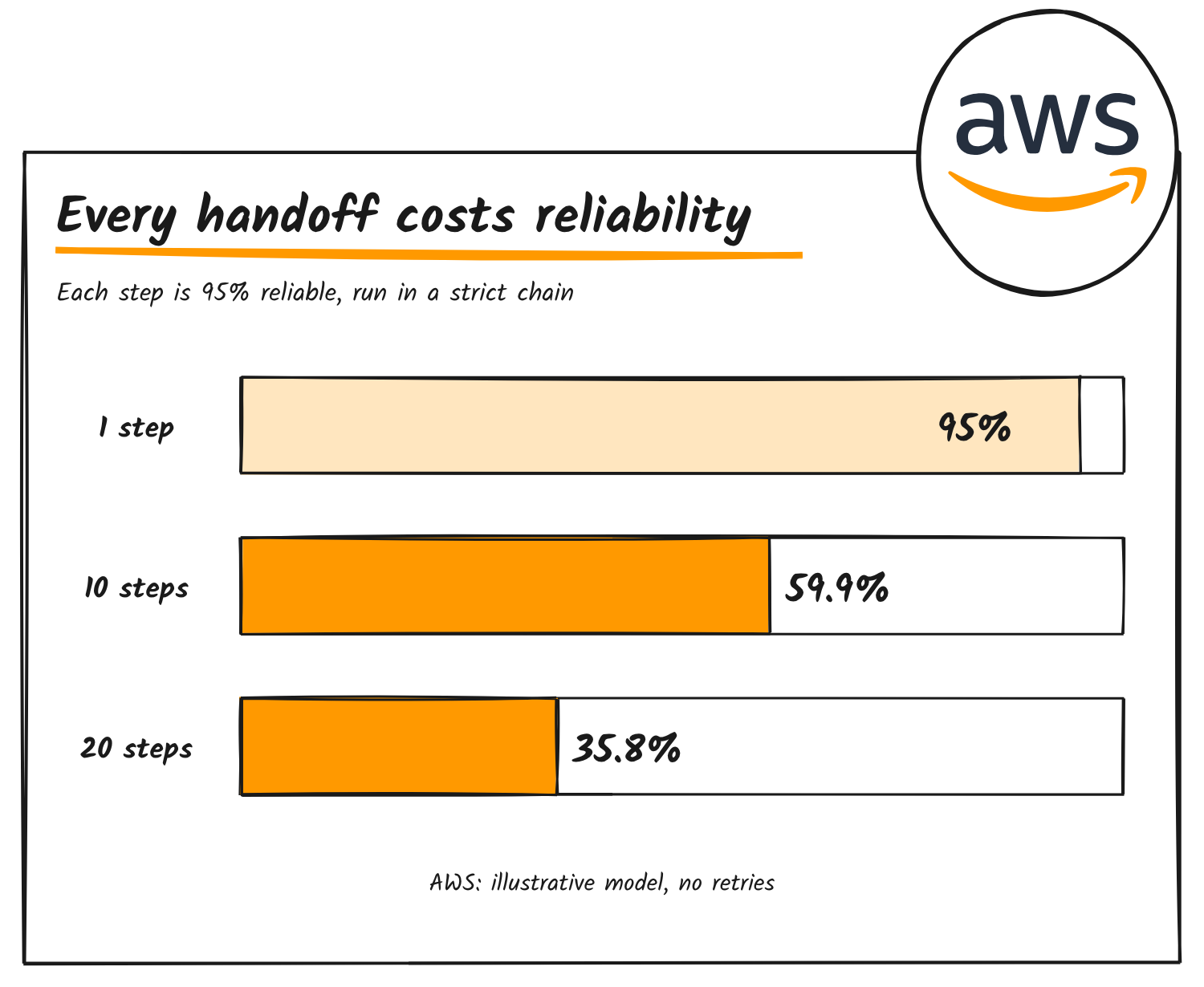
Their evidence starts with a reliability sum. Give every step in a strictly sequential chain a 95 percent success rate and ten steps deliver 59.9 percent end to end, while 20 steps deliver 35.8 percent. AWS flags the model as illustrative and says it assumes no retries. The numbers are right: 0.95 to the tenth power is 0.599, and to the 20th it’s 0.358.
The post also links two outside sources, and each says a little less than AWS’s wording. AWS writes that about 88 percent of AI pilots never reach production. The linked CIO article, from March 2025, reports IDC research done with Lenovo: 88 percent of observed proofs of concept didn’t reach wide deployment, and for every 33 a company launched, four graduated.
The second link goes to a Stanford HAI report on CooperBench, which gave pairs of coding agents more than 650 tasks across Python, TypeScript, Go and Rust, each built to make the two collide. Diyi Yang, the senior author, says “today’s best coding agents lose nearly half their capability when paired up to share work.” Letting the agents message each other had almost no effect on the results.
Tier 1: you draw the path
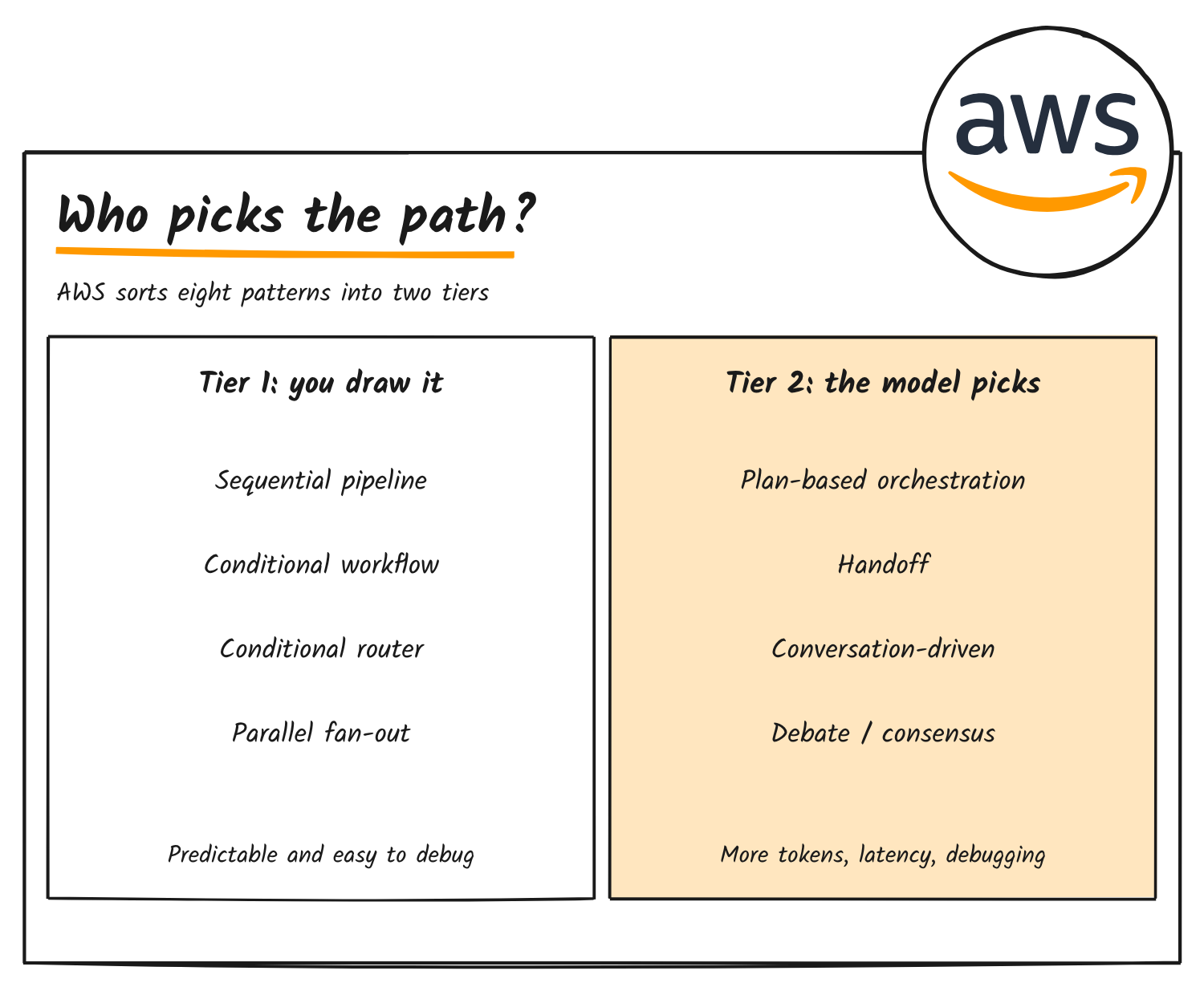
AWS splits its patterns by who controls the flow. In Tier 1 the developer fixes the path at build time. In Tier 2 the model picks it as it goes, which AWS says suits work whose steps can’t be written down in advance, at a higher cost in tokens, latency and debugging. Its default is to start in Tier 1 and move a task to Tier 2 only when its subtasks emerge during the work.
| Pattern | Tier | Where AWS says it fits |
|---|---|---|
| Sequential pipeline | 1 | Document processing, extract-transform-load chains, warranty-claim triage |
| Conditional workflow | 1 | A write, test and deploy loop, with retries capped at N before a human steps in |
| Conditional router | 1 | Intent-driven dispatch, quality gates, customer inquiry routing, anomaly triage |
| Parallel workflow | 1 | Multi-source analysis, batch processing, work that splits into independent pieces |
| Plan-based orchestration | 2 | Subtasks discovered mid-work, such as multi-station root-cause analysis |
| Handoff | 2 | Peer-to-peer delegation, such as customer service passing to technical support or billing |
| Conversation-driven | 2 | A shared group chat where a selection mechanism sets the turn order |
| Debate or consensus | 2 | High-stakes, low-volume decisions |
The conditional workflow is where AWS ties a pattern to an anti-pattern. One agent writes code and another tests it, and a pass or fail check sends passing work to deployment. Failing work loops back for a retry, up to N times, and then goes to a human. AWS says the orchestration layer should enforce that cap, for example with an AWS Step Functions iteration limit, so the loop can’t turn into the unbounded iteration problem covered below.
The parallel workflow is about latency. A research orchestrator gives a financial agent, a geopolitical agent and a logistics agent each their own source, and a fan-in step waits for all three before it synthesises, resolves conflicts and ranks what they found. AWS says total latency equals the slowest single agent rather than the sum of the three, and that a failure retries only its own path.
Tier 2: the model draws the path
Plan-based orchestration works like a project manager. One orchestrator keeps an explicit plan with assignments and dependencies, sees all the context and gives each worker only its slice. The workers are stateless, so one that fails doesn’t contaminate the others and the orchestrator retries just that worker.
The handoff pattern passes control peer to peer. AWS says every transfer has to carry validated task state, the evidence behind it and any unresolved questions, and writes that “a handoff that moves only through the conversation is not a handoff.” In the conversation-driven pattern, also called group chat, every agent reads one shared conversation and a selection mechanism, either round-robin or model-driven, decides who speaks next. State lives implicitly in the history.
Debate or consensus is the pattern AWS tells readers to go easy on. Several agents judge the same input without seeing each other’s reasoning, and the results are settled by majority, a judge agent or escalation. AWS calls it the most expensive pattern in the post and says that on perceptual tasks it buys latency rather than accuracy. Most production systems, it adds, mix patterns: workflows for the predictable parts and autonomous patterns where flexibility counts.
Five anti-patterns
AWS says each of these looks reasonable at design time and later shows up as inflated token cost, a missed takt-time window or a decision that has drifted out of sync with the plant floor. Takt time is the pace a production line sets for each unit.
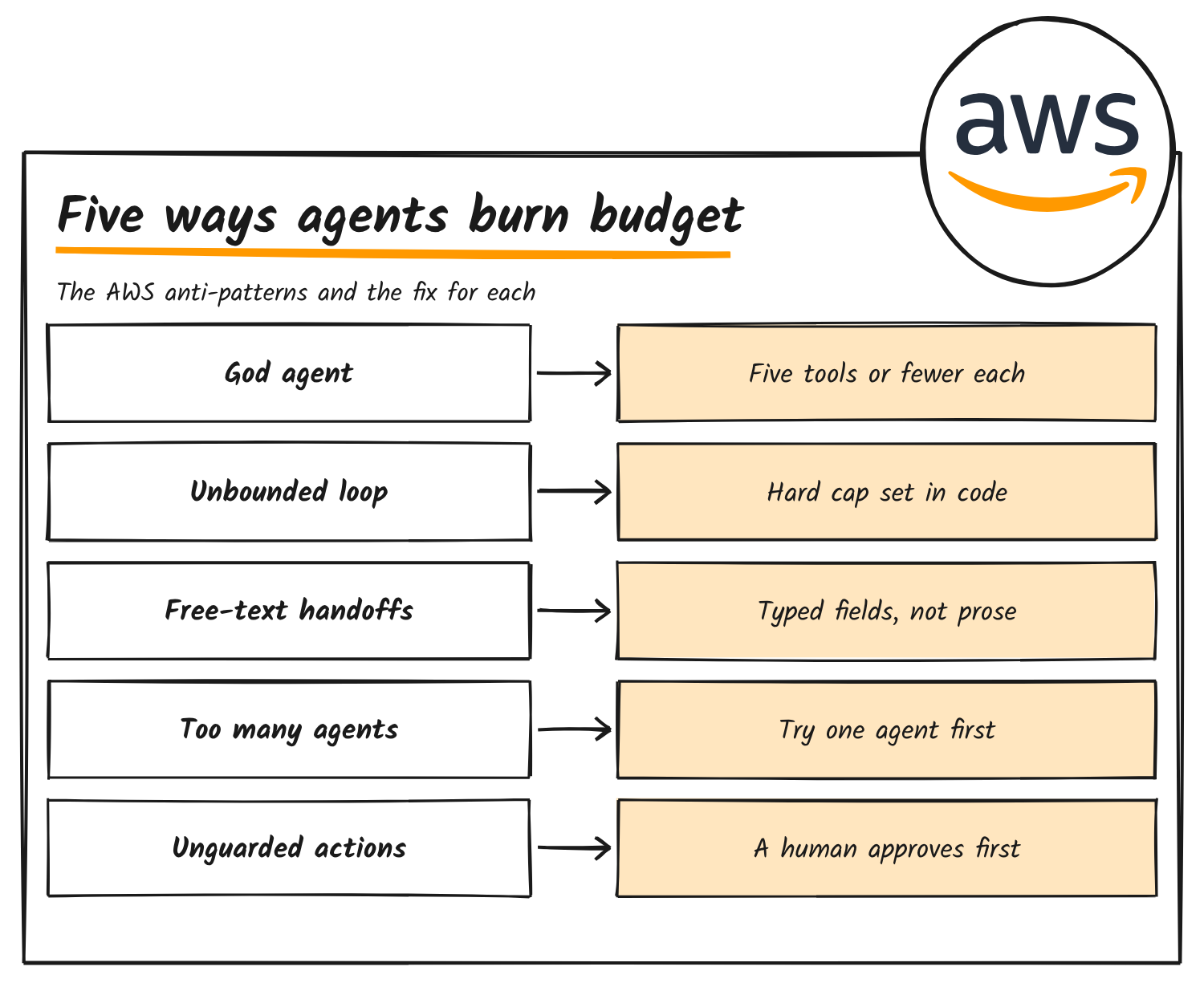
The first is the god agent: one agent behind one prompt with 15 or more tools, covering equipment effectiveness analysis, PLC diagnostics and maintenance. A PLC is the programmable logic controller that runs a machine. AWS says tool selection degrades as tools pile up and failures get hard to attribute, and its fix is bounded agents of five tools or fewer. The second is unbounded iteration, an agent that loops on “try again” with no hard stop. AWS says a four-agent system can burn a significantly higher number of tokens before a single retry, and that “the model will not stop itself.” Its fix is a hard iteration ceiling in code, a per-agent token ceiling and a budget alarm wired to an automatic stop.
The third is natural-language contracts, where agents pass each other free-text prose with no schema. AWS’s example is “could indicate wear” hardening into “confirmed wear” and then into a maintenance order. The post gives no fix under that heading; its services table points to AgentCore Gateway, which turns APIs and Lambda functions into MCP tools with validated schemas so handoffs carry typed fields.
The fourth is premature multi-agent. AWS says the gains flatten around four agents and that most “specialists” are one model in different costumes. Its test is whether one agent could handle the phases by switching tools. A real multi-agent design, it says, needs at least two different models, different tool access, concurrent execution and genuine interdependency. The fifth is unguarded customer contact: an agent that sends emails, books service visits or changes machine parameters with no approval step. AWS’s fix is a chain of recommendation, Amazon Bedrock Guardrails, schema validation, business rules, human approval and then execution.
Choosing a design
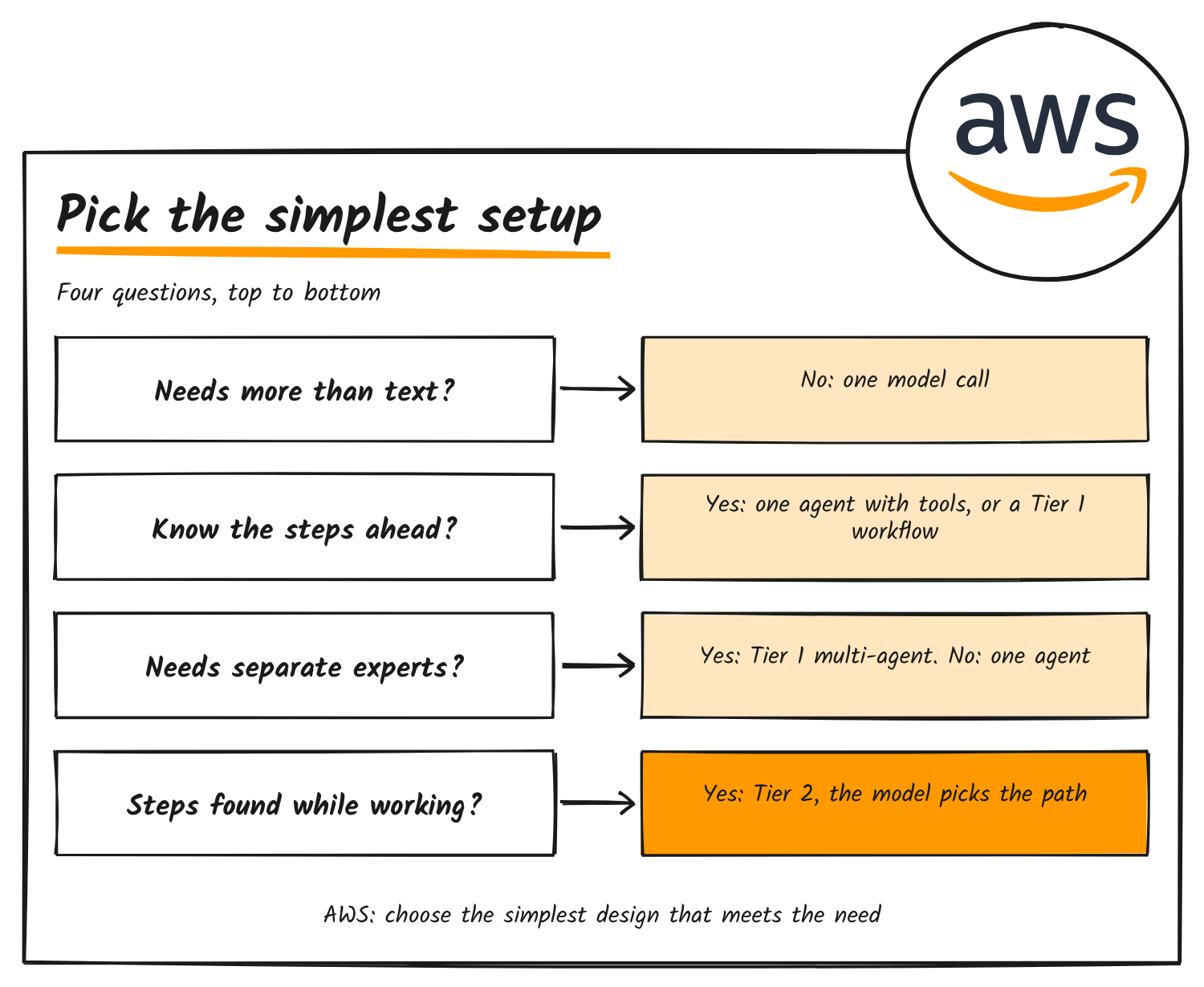
AWS reduces the decision to four questions, asked in order.
- Does the task need action beyond text generation? If not, a direct model call is the baseline.
- Is the solution path known in advance? If it is, the choice is a single agent that calls tools or a Tier 1 workflow.
- Does the work need genuinely distinct expertise? Separate domains with established handoffs justify specialised agents; one domain belongs to one agent, however many tools it needs.
- Does the solution only emerge through exploration? Tier 2 earns its cost only when the subtasks are discovered during the work.
The post then maps seven factory jobs to patterns. Shift handoff summaries get a sequential pipeline and predictive maintenance scheduling gets parallel fan-out and fan-in. Multi-station root-cause analysis gets plan-based orchestration because the subtasks surface during the analysis. Engineering change order impact gets debate, since the stakes justify adversarial review, and supplier communication drafting gets a sequential pipeline with a human gate because it must never send itself.
Why manufacturing changes the sums
AWS names four constraints. The first is latency: an automotive body shop typically runs 60 jobs an hour across more than 40 stations, each with a 60-second takt time, and AWS says even a 2 percent throughput loss can translate into significant annual revenue impact. It tells teams to budget latency at p99, the slowest one percent of calls, rather than the average, and to give every agent a sub-second deterministic fallback. For advisory or quality-flagging agents the fallback passes the part with a flag; for safety-critical ones it’s containment or a stop.
The second is safety, where AWS keeps the PLCs, the SCADA supervisory systems and the manufacturing execution system untouched and wraps an advisory layer around them. Agents observe, analyse and recommend, and they don’t actuate. Safety constraints sit in an external service that agents query, not in prompts, where they can be argued away. A recommendation passes schema validation and a physics simulation, gets checked against the live plant state just before it’s used, and then needs approval at one of four levels, from Level 0, where the agent resolves it alone, to Level 3, where management evaluates a line-stop recommendation.
The third is data. AWS says one stamping press produces more than 50 GB a day of sensor data whose value decays in milliseconds, so it recommends a hybrid: AWS IoT Greengrass runs anomaly detection at the source, and the cloud handles cross-shift analytics, trends across plants and model retraining. The fourth is memory. AWS wants agent memory bound to the shift cycle: the agent starts a shift with the crew roster, production targets and the previous handoff, builds working memory only inside that window and ends by writing a summary of open issues for the next crew.
The AWS services it points to
The post’s services table lists seven needs, and each lands on an AWS product, five of them capabilities of Amazon Bedrock AgentCore.
| Need | Service | What AWS says it does |
|---|---|---|
| Runtime | AgentCore runtime | Runs agents built with Strands, LangGraph or CrewAI, with control flow set by you or the model |
| Shift-bounded memory | AgentCore memory | Managed short-term and long-term context |
| Typed handoffs | AgentCore Gateway | Turns APIs and Lambda functions into MCP tools with validated schemas |
| Agent permissions | AgentCore Identity | A verifiable identity per agent, with fine-grained access control |
| Tracing between agents | AgentCore Observability | Spans and traces across runtime, memory, gateway and tools |
| Human approval | AWS Quick | Approval workflows with one-click approval in Slack |
| Tiered model selection | Amazon Bedrock | One API across model families, so a small model can route and a stronger one can orchestrate |
What the post doesn’t give
The post says its patterns come from real deployments and names none of them. It has no benchmark, token count, cost figure or latency measurement for any pattern. The five-tool limit and the four-agent plateau come without data, the reliability model is labelled illustrative, and the “significantly higher” token burn for a four-agent system has no number attached. Apart from the Strands, LangGraph and CrewAI frameworks that run on the runtime, every service it recommends is AWS’s own.
It closes by telling teams to prove value with Tier 1 patterns and expand from there, and to keep autonomous orchestration for open-ended problems. The full text is on the AWS Machine Learning Blog.
Sources: AWS, “Taxonomy of multi-agent design patterns, anti-patterns, and lessons from manufacturing”, CIO, “88% of AI pilots fail to reach production”, Stanford HAI, “AI Coding Agents Fail at Teamwork”.
Discover more from Sulat AI & Tech News
Subscribe to get the latest posts sent to your email.