Crusoe says a 200 MW data centre uses less water each year than about 20 average US households, and it repeated the claim on X on 16 November with a link to a community video. The figure is Crusoe’s own estimate, and it’s about double the one in the company’s May impact report.
The post went up on the evening of 16 November UTC, which was the morning of 17 November in New Zealand. It says a 200 MW Crusoe data center “uses less water annually than ~20 households”, and adds that Crusoe also pays its own way for the energy and water infrastructure it needs. The video it links, An American story: Protecting what every town depends on, went onto Crusoe’s YouTube channel on 5 November. Its narration carries no figures. The water claim is in the description, where it’s worded as “expected to use less water each year than about 20 average American households”.
Protecting what every town depends on. A 200 MW Crusoe data center uses less water annually than ~20 households. We also pay our way for the energy and water infrastructure we need. 🎥 Watch how we show up for our communities:
November 16, 2026
Where the 20 comes from
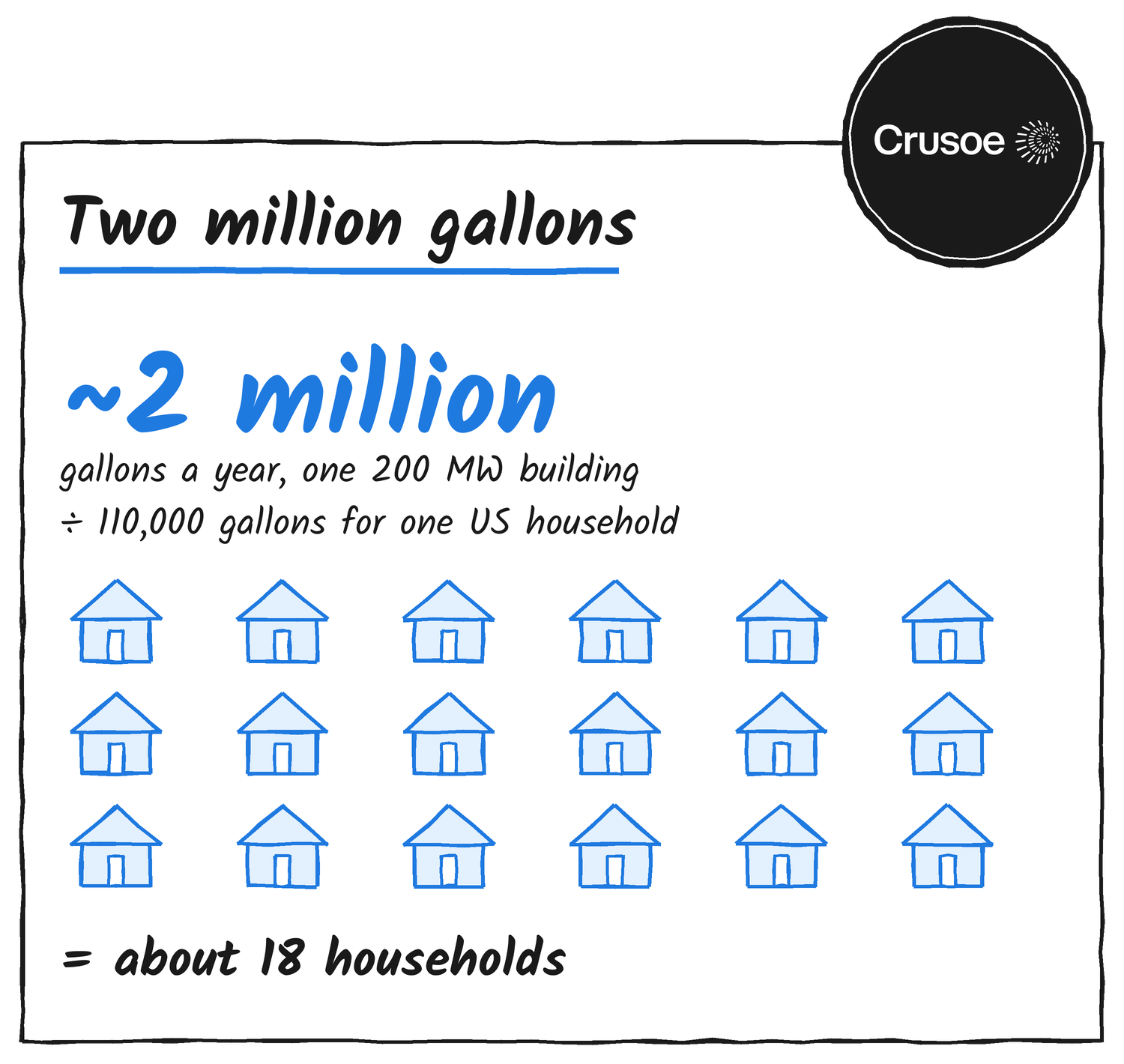
Crusoe’s communities page puts a one-building, 200 MW data centre with closed-loop cooling at “approximately 2 million gallons of water per year”. It says that covers restrooms, kitchens, routine maintenance and equipment washdowns, and equals fewer than 20 average American households and about half the water a typical big box store uses. Crusoe’s 2025 impact report counts a household at about 110,000 gallons a year, citing the US Environmental Protection Agency, so 2 million gallons works out to about 18 households.
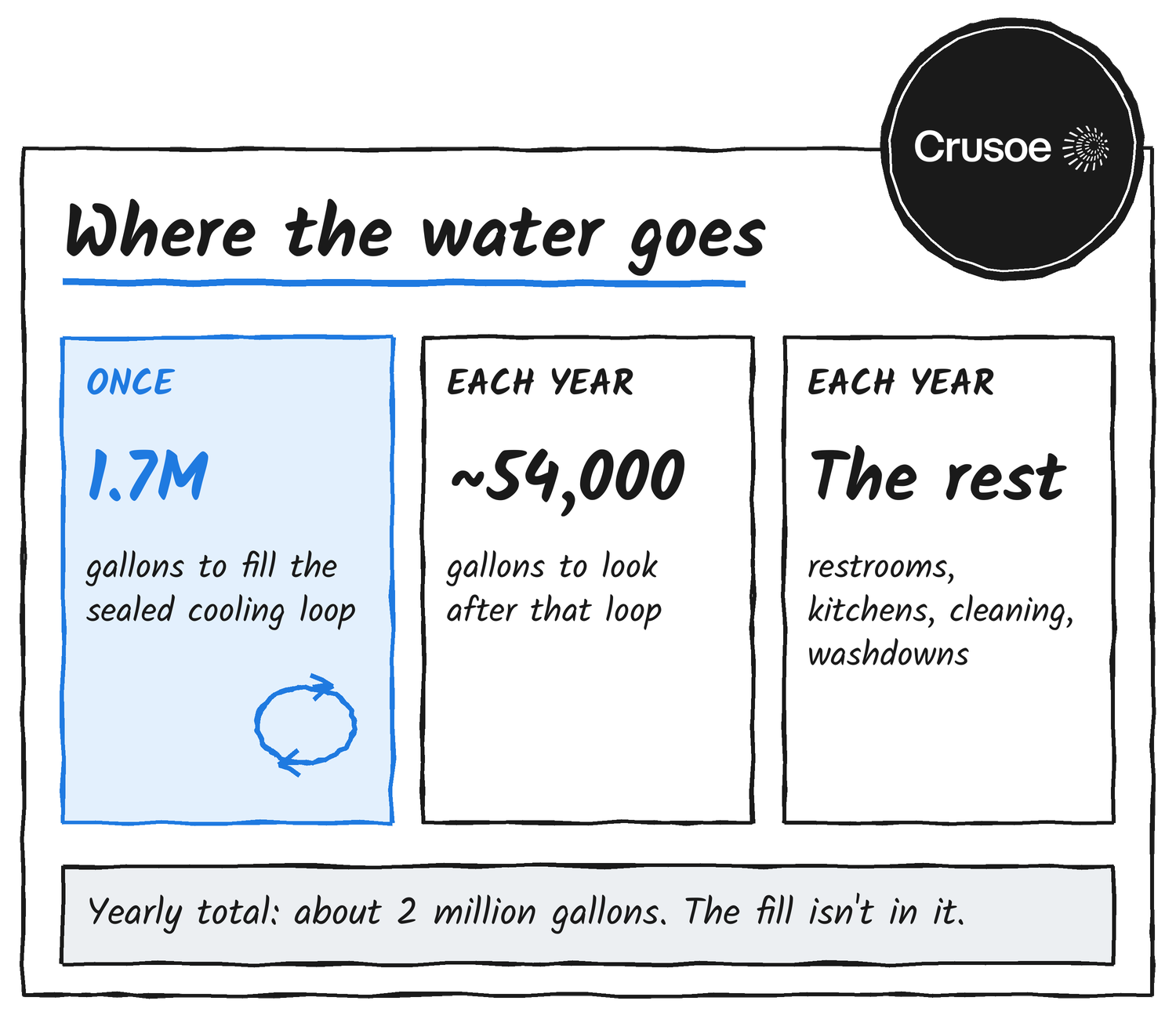
Closed-loop means the cooling water circulates in a sealed system instead of evaporating. Crusoe says the loop needs a one-off fill of about 1.7 million gallons, then about 54,000 gallons a year for maintenance and water treatment, and that no water is used for cooling in normal operation. The fill isn’t in the 2 million gallons. The report counts it separately, at less than 16 households’ annual use. Crusoe’s communities page also says operational water typically comes from the existing public water system, and that during construction it prioritises non-potable sources such as private wells, surface water and harvested rainwater.
The comparison point is evaporative cooling. Crusoe’s report says a traditional large data centre can use more than five million gallons a day that way, comparable to a town of 50,000 people. One day of that is two and a half times Crusoe’s yearly figure. The breakdown covers on-site use only: cooling-loop upkeep and everyday building use. Water used to generate the building’s electricity isn’t part of it.
The figure has changed
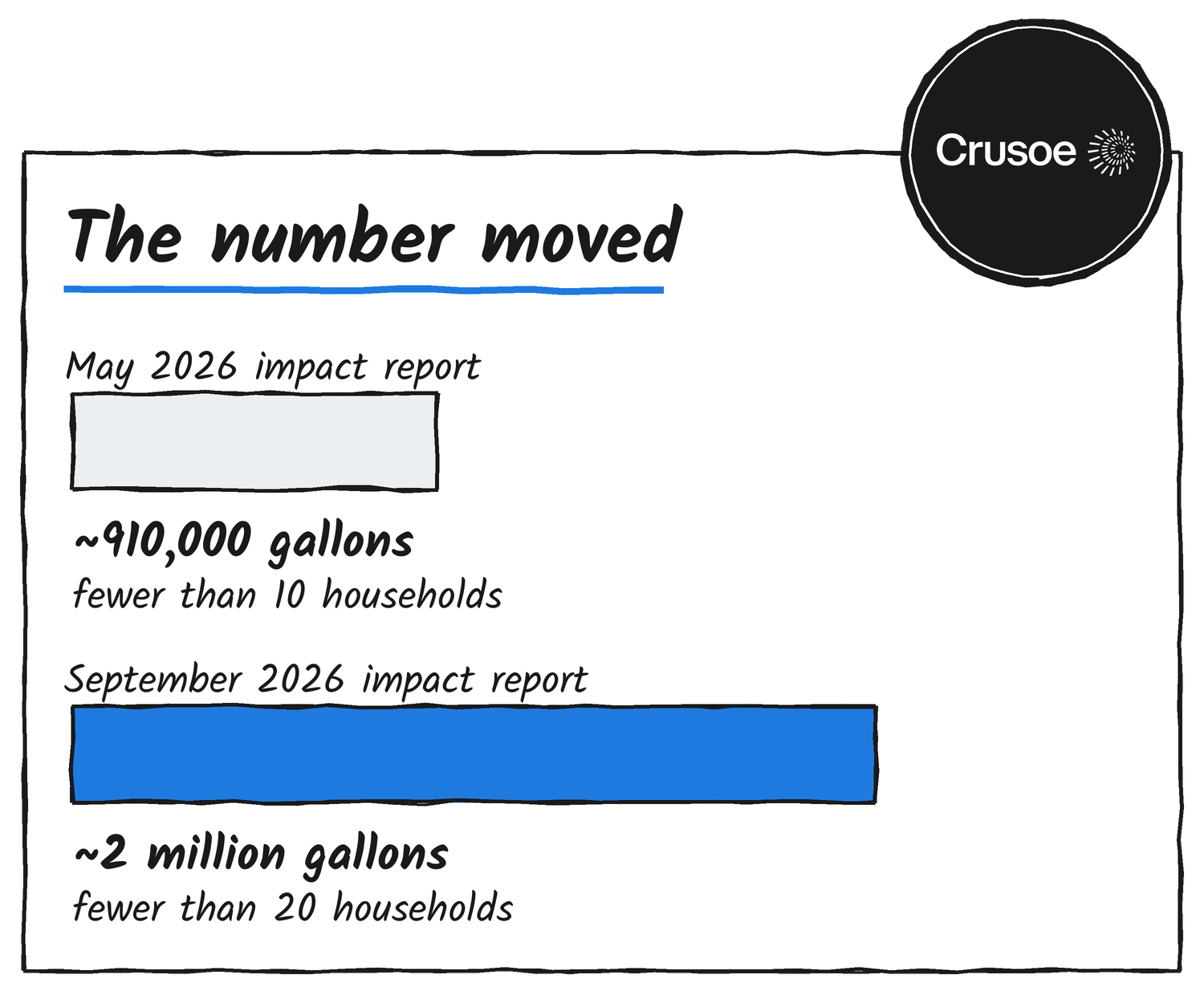
Crusoe’s impact report post, dated 28 May, puts a 200 MW facility at about 910,000 gallons a year, “comparable to fewer than 10 U.S. households”. The report’s PDF now says about 2 million gallons and fewer than 20 households, and its figure for cooling-system maintenance rose from about 50,000 to about 54,000 gallons per building a year. Crusoe’s pages don’t explain the change.
Crusoe’s own pages now disagree. The impact report post still says about 910,000 gallons and fewer than 10 households. So does the Abilene community page, which says a 200 MW data center uses less water “than 10 average US households”. The communities page, a 2 November blog post, the video description and the tweet all say 20.
The same campaign swaps another pair of numbers. The May report says the Abilene campus is expected to supply up to 25% of the city’s and up to 32% of Taylor County’s budgeted property tax revenue once it’s fully built out. The 2 November post and the video description say 32% for the city and 25% for the county.
What else Crusoe commits to
The 2 November post is by Sara Axelrod, Crusoe’s VP of public affairs, government relations and sustainability. It lists commitments the video description repeats: early open houses and town halls, a dedicated liaison on the ground, paying its own way for the energy and water infrastructure it needs, and not planning to sign NDAs (non-disclosure agreements) with local elected officials from here on. Crusoe says it has created more than 15,000 jobs and invested an estimated US$20 billion locally.
Crusoe’s communities page links a water fact sheet, and the full impact report is a PDF linked from its blog.
Discover more from Sulat AI & Tech News
Subscribe to get the latest posts sent to your email.