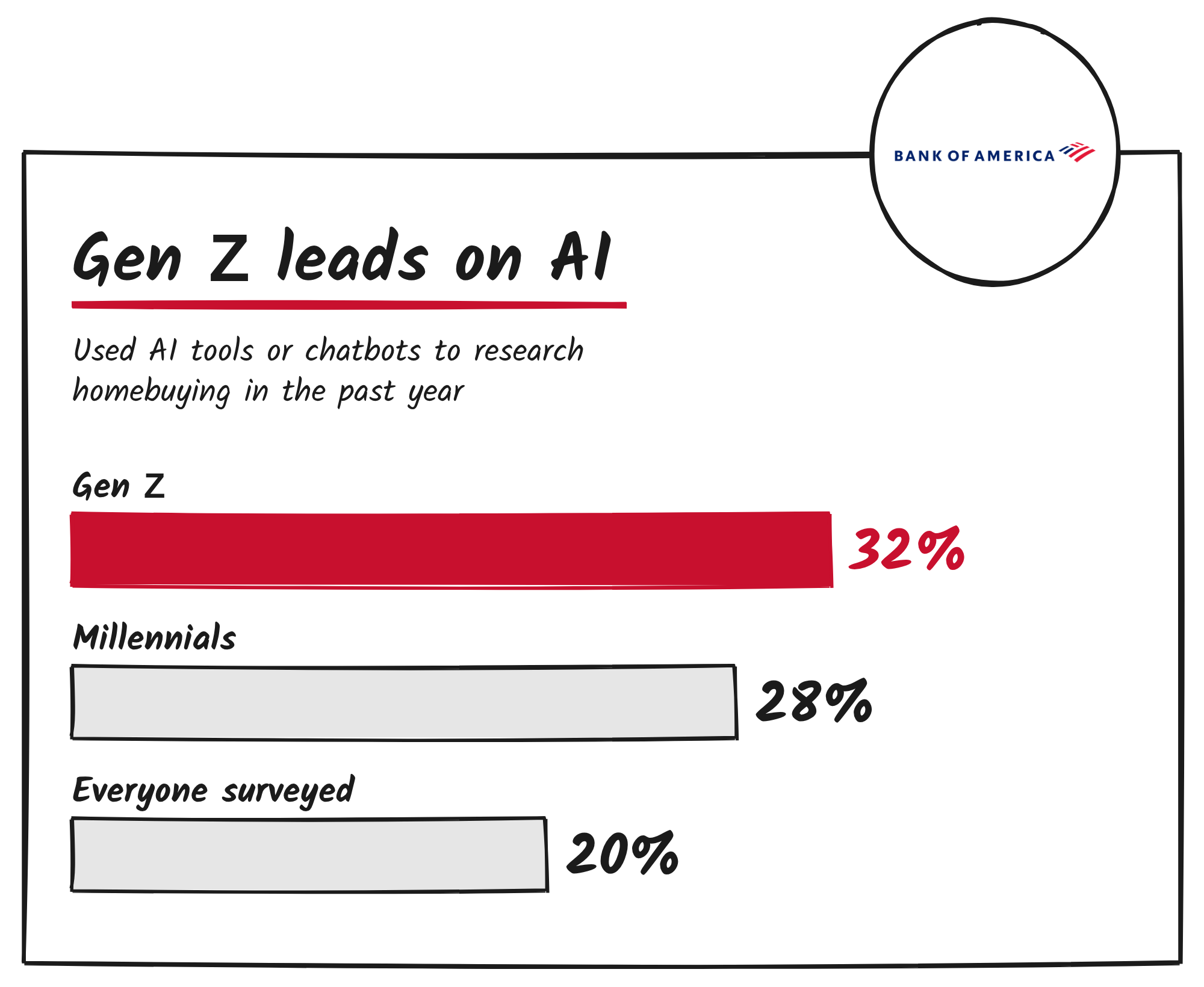
Gen Z is leading on AI in Bank of America’s latest homebuying survey. Of its Gen Z buyers and homeowners, 32% say they used a chatbot or other AI tool for research in the past year. Millennials sit at 28%. Everyone together, 20%. That’s from the bank’s 2026 Homebuyer Insights Report (PDF), which PYMNTS ran on 16 November next to a different story, the AI rules Fannie Mae and Freddie Mac now put on lenders. The two aren’t connected. Those rules cover the AI a lender runs, not the chatbot a buyer opens alone.
How the survey was run
Sparks Research ran the survey online for the bank from 13 April to 10 May 2026, with 1,000 homeowners and 1,000 renters. Respondents were adults who share in household money decisions and who own a home, used to, or plan to. The margin of error is 2.2 points at 95% confidence.
That’s for the whole sample, though. Gen Z gets no sample size and no margin, and the report never says which birth years count. The bank paid for the survey and lends mortgages. Matt Vernon, its head of consumer lending, uses his commentary in the report to point clients to the bank’s Digital Mortgage Experience.
What buyers used AI for
Money came first. Of the prospective buyers who used AI, 57% had it estimate affordability, mortgage payments or closing costs, 55% wanted the process explained, and 52% looked into neighbourhoods, market trends or property values. People could pick more than one.
A chatbot didn’t replace everyone. Touring homes is where 55% still want a human, and legal or contractual advice is where 54% do.
Fannie Mae and Freddie Mac write the rules for lenders
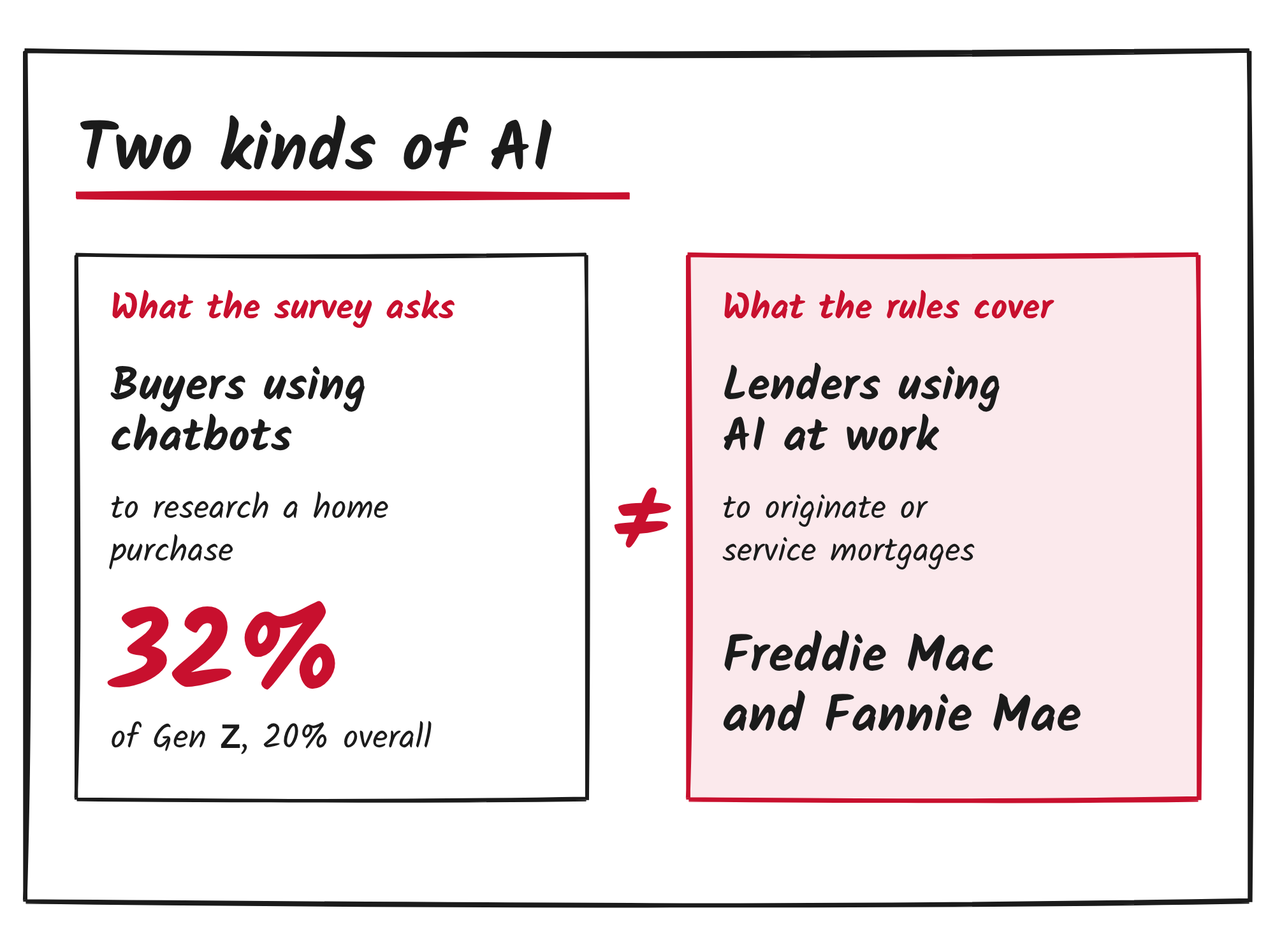
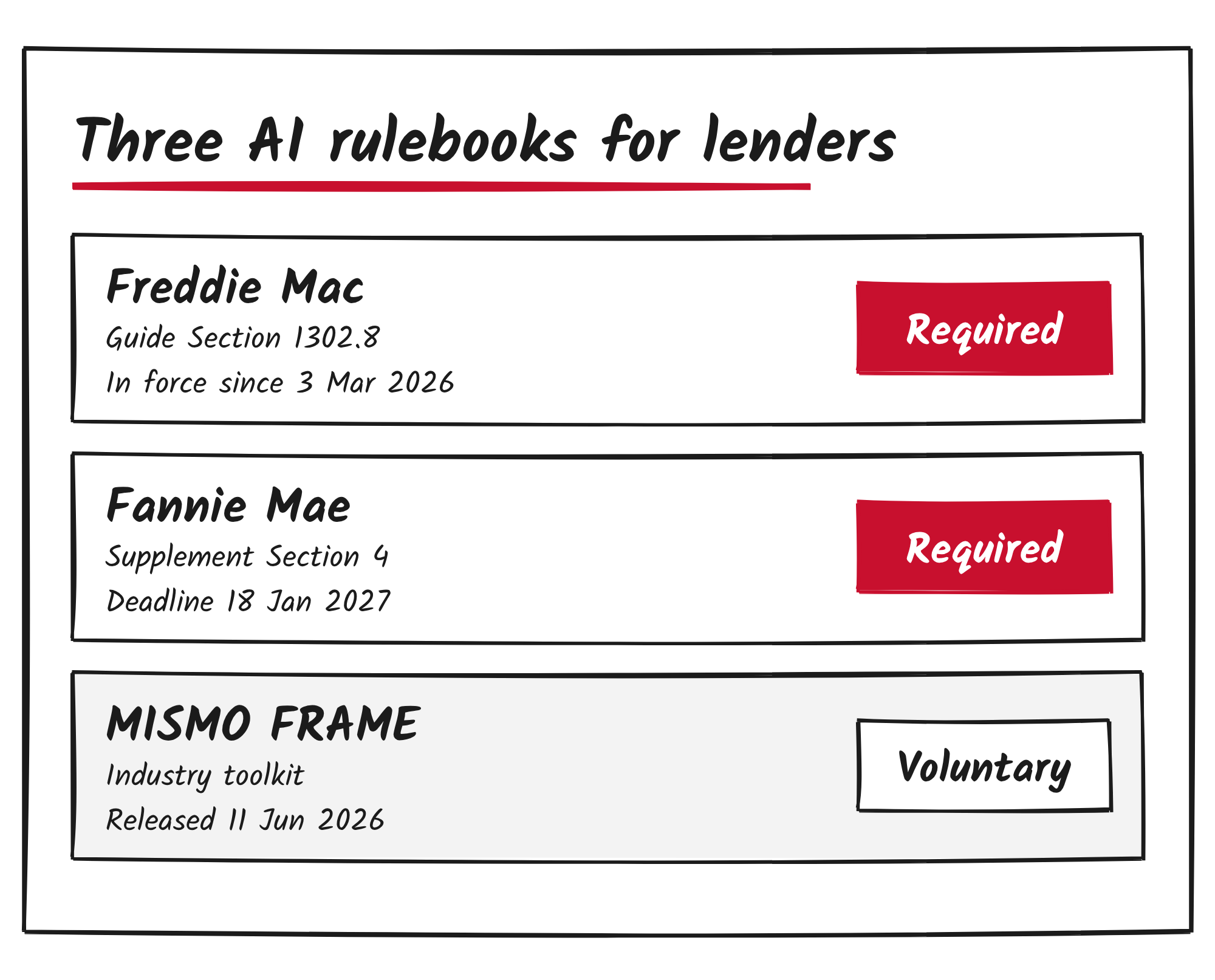
Freddie Mac got there first. Its rule has applied since 3 March 2026. Section 1302.8 of the Seller/Servicer Guide, added by Bulletin 2025-16, covers any lender or servicer that uses AI or machine learning on loans Freddie Mac buys, guarantees or services. They need written AI policies signed off by senior management, at a minimum a chief information, technology, information security or risk officer or the equivalent, and an owner who reviews them every year. Freddie Mac can ask what AI a lender uses, why and with what safeguards, and the lender has to answer promptly. The lender also indemnifies Freddie Mac against losses tied to its AI use. It has to watch its systems for performance, security breaches and bias too.
Freddie Mac’s FAQs draw two lines. Simple automation that doesn’t analyse data or make a decision isn’t AI under the rule. AI inside a vendor’s product is handled through the lender’s third-party risk programme.
Fannie Mae took a longer road. Its Lender Letter LL-2026-04 came out on 8 April and asked for principles-based governance. In October, Bulletin 26-01 announced a new Information Security and Business Resiliency Supplement, and the letter now says the Supplement supersedes it. Section 4 gets specific: an inventory of AI use cases, model testing and validation, monitoring after deployment, change controls, security checks for risks like prompt injection, and disclosure to Fannie Mae on request. Lenders have until 18 January 2027 to finish implementing it.
One oddity: the Supplement calls AI “Super Intelligence” throughout. A footnote says the term is used in place of “Artificial Intelligence” to align with evolving industry terminology and “is not intended to alter the scope, meaning, or applicability of the requirements”.
MISMO, the mortgage industry’s standards body, went voluntary. Its FRAME toolkit, released on 11 June, is open to member companies through MISMO Connect and includes a governance policy template, an AI system inventory and a risk assessment. The Urban Institute says it follows the NIST AI Risk Management Framework, the US standards agency’s guide, and is aimed at small and midsize institutions.
The coverage is a step behind
PYMNTS, citing an Urban Institute article from 28 September, says Freddie Mac and Fannie Mae introduced their AI frameworks in early 2026. That’s right for Freddie Mac. Fannie Mae’s April letter has since been replaced by a Supplement with a January 2027 deadline, a change that came after Urban published.
What the frameworks leave out
Urban’s Linna Zhu, Todd Hill and Matthew Pruitt put the three frameworks next to each other. Freddie Mac’s bulletin is the one that names fairness and bias mitigation. Fannie Mae’s April letter wanted AI to be trustworthy and ethical, but it named neither fairness nor bias. None of the three makes lenders show results, such as faster, more accurate matches between borrowers and homes or wider access to credit. Each keeps a human in the loop, and none says how that human and the software should work together.
States are adding their own rules. Texas’s Responsible AI Governance Act took effect on 1 January 2026. Colorado’s revised Automated Decision-Making Technology Act follows on 1 January 2027, 17 days before Fannie Mae’s deadline.
Discover more from Sulat AI & Tech News
Subscribe to get the latest posts sent to your email.